In theory, Bitcoin (BTC) should serve as a hedge against inflation. It’s easy to access, its supply is predictable, and central banks cannot arbitrarily manipulate it.
However, investors aren’t treating it that way. Instead, the cryptocurrency market is mirroring the stock market. Why is that? Let’s dive into what prevents cryptocurrencies from acting as a hedge against inflation, and what needs to happen to make them a hedge in the future.
Crypto could be a hedge, but it comes with inconveniences
Cryptocurrencies present a unique solution, given their lack of a central governing bank. You can’t lose trust in something that doesn’t exist. Its supply is finite, so it naturally appreciates in value. People using a blockchain with proof-of-stake protocols can access their funds at any time, while continuously earning staking rewards on their current balance. This means that the actual value of annual percentage yield is tied to the economic activity on the chain via its treasury and staking reward distribution mechanics. Those properties seem to address the cause of inflation in the traditional monetary systems — but some roadblocks remain.
For starters, let’s examine the reasons why people invest in and hold cryptocurrencies. The majority of cryptocurrency holders see the future potential of those technologies, meaning some of their value is not currently present. They are speculative investments. Decentralization has been achieved by Bitcoin, but its exuberantly high energy costs remain unaddressed, and the majority of mining forces are still aggregated into a dozen mining pools. Ethereum has similar issues with energy consumption and mining pool centralization. Ethereum also has a security problem — more than $1.2 billion has already been stolen on its blockchain this year.
There’s also the issue of decentralized exchanges, or DEXs, which are currently not as fit for use as centralized exchanges. The DEX with the highest transaction volume, Uniswap, offers inefficient pricing compared with a centralized exchange. A simple trade of $1 million in Tether (USDT) for USD Coin (USDC) would cost over $30,000 more in fees and slippage than when executed on a centralized exchange.
These are technical problems that have solutions
Granted, these issues are being addressed. Several third-generation blockchains are tackling energy consumption and decentralization head-on. Privacy is improving. Crypto holders are beginning to accept that their wallets will always be fully traceable, which will prove enticing to new users who have previously been hesitant over blockchain’s hypertransparency. Projects seeking to merge traditional finance’s mathematical rigor with the native attributes of cryptocurrency are tackling the problem of DEX inefficiency.
Mass adoption and integration need to happen before crypto can act as a bulwark against inflation. Crypto has characteristics of future value in an ecosystem that is currently struggling to establish its fundamentals. The crypto economy is still waiting for applications that will take full advantage of decentralization without sacrificing the quality and experience, which is especially important for widespread adoption. A payment system where each transaction costs $5 and the exchanged value is regularly lost will remain unfeasible.
Until the top cryptocurrencies can be used efficiently for real-world payments and decentralized applications provide a similar level of utility as centralized systems, crypto will continue to be treated as a growth stock.
Inflation is caused by a lack of trust — something crypto still needs
Inflation isn’t caused by just printing more money, which is to say that the presence of an asset doesn’t automatically cause its value to go down. Between September 2008 and November 2008, the number of billions of U.S. dollars in circulation tripled, yet inflation went down.
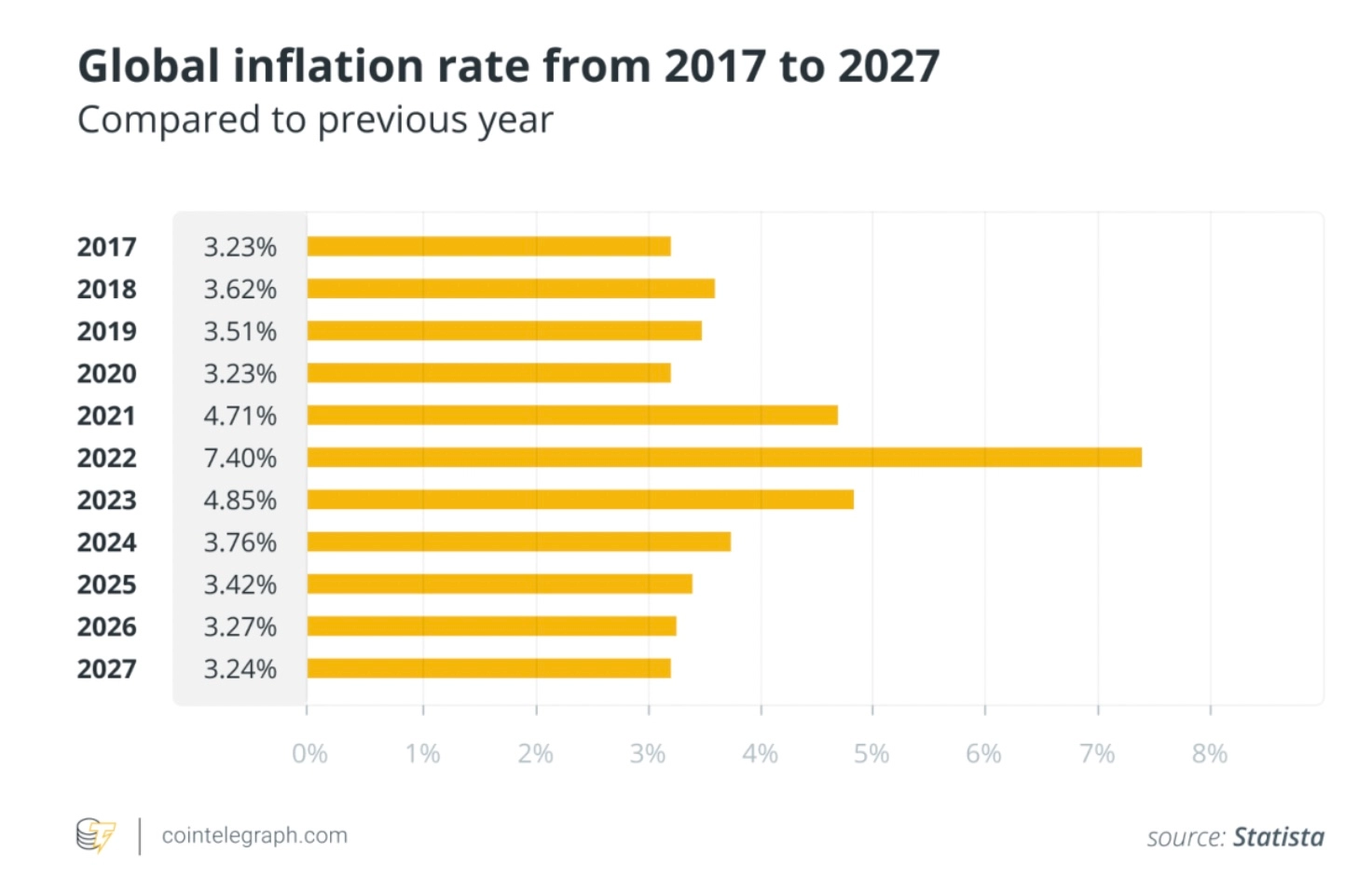
Inflation has much more to do with public distrust of the central monetary system. This lack of confidence — combined with corporate price gouging, the upheaval caused by pandemic relief packages and significant supply chain disruptions (accelerated, in part, by the war in Ukraine) — has landed us in the current crisis. The big money-print of 2021 didn’t cause inflation, but it magnified it.
In terms of presence, the supply of funds alone is not an overly significant issue for a store-of-value currency. What is stored is not necessarily part of the circulating supply. Gold, for example, exists in large volumes in the form of jewelry, bullion and so on, but in much smaller volumes on the commodity market. A market that took into account all the mined gold on earth would have a totally different price. Because this jewelry and bullion are not traded on the market at all, they do not affect the supply-and-demand curve. The same applies to currency.

Inflation is the result of a loss of trust that an asset is able to store its value over a long period of time. Most goods in this world are finite, so every party aware of the raised supply but unsure of the monetary policy will automatically factor it into their prices. Inflation becomes a self-fulfilling prophecy.
Crypto as an inflation hedge is possible, but not in the current climate
Cryptocurrencies fail as an inflation hedge during times of high volatility and market uncertainty. That said, they generally excel in steady growth environments where they easily outperform the market and where the relatively small market capitalization compared with fiat currencies plays in their favor as a growth stock. Current solutions to the problem of usability aren’t sustainable due to their speculation-based nature and low transaction volumes. The fall of financially unsound blockchains affects the entire ecosystem, which means that potential long-term solutions keep being derailed by scammers.
The more responsible and diligent the crypto community becomes, the more every sound protocol will benefit, and crypto will become a genuine hedge against inflation. Because cryptocurrencies currently follow growth stock patterns, they act as a good hedge against inflation during periods of stable growth but fail during times of financial crisis. As cryptocurrencies evolve, they’ll become an effective bulwark during these downturns too.
These days, it’s prudent to err on the side of caution when it comes to crypto investing during periods of market turmoil, and it would be unwise to use crypto as the only tool for shoring up investments against inflation. But this will shift as blockchain protocols continue to mature, and we’ll see an increase in the adoption and stability of cryptocurrencies as inflation hedges. The tools are already in place.