Market Adjusts Following Google's $84.7 Billion Fundraising, AI Valuations Now Focus on Payback Speed

marsbit發佈於 2026-06-12更新於 2026-06-12

文章摘要

After Alphabet's announcement of an $84.75 billion equity financing round, market focus for AI investment is shifting from pure growth narratives to capital efficiency and payback periods. The core argument is that AI is being re-priced from a software-like growth story into a heavy-asset infrastructure cycle, requiring massive capital expenditure (CapEx) on chips, data centers, and power grids. While Alphabet's financing itself is not a distress signal—part of it is for administrative purposes like tax obligations on stock compensation—it highlights the enormous capital demands of AI infrastructure. This demand extends beyond tech giants to pure-play AI model companies (like OpenAI, Anthropic), data center REITs, and utilities. Major tech firms are projected to spend heavily on AI data centers in 2026, signaling a broad-based capital cycle the market must absorb. Consequently, valuation logic is changing. Investors are moving away from questions about who has the strongest AI narrative and are now prioritizing clear visibility into orders, stable cash flows, and the cost of capital. This has led to recent pressure on high-multiple AI software and semiconductor stocks, while "picks-and-shovels" hardware, data center, and power assets with firmer near-term demand may see relative support. The key going forward will be monitoring whether rising CapEx guidance across companies is matched by a timely monetization of AI investments into revenue and cash flow. The market's toler...

TL;DR

Over the past few years, the core question for AI investments has been simple: Will AI change the world? As long as the answer leaned towards "yes," the market was willing to assign higher valuations to chipmakers, cloud providers, software companies, and model developers.

Recently, the market narrative has begun to shift. Some semiconductor and high-valuation AI software stocks have seen pullbacks, with market participants shifting capital preferences towards areas with clearer order pipelines and more stable cash flows. Concurrently, Alphabet announced a large-scale equity fundraising and had previously revised its 2026 capital expenditure guidance upward in its Q1 earnings report.

These two events cannot be simplistically framed as "fundraising caused the decline." A more accurate context is that the market is repricing AI—from a software-style growth story to a capital-intensive infrastructure cycle.

The keyword here is capital expenditure. AI is not a business that can scale by writing a few lines of code; it requires chips, data centers, networks, power, and land. The greater the capex, the more investors ask three questions: Where is the money coming from, how expensive is it, and how long will it take to get a return.

Alphabet's Fundraising Makes the Market Recalculate the Capital Account

Alphabet's fundraising itself is not a crisis signal, but it is a strong reminder: AI build-out is now a mega-capital project.

According to SEC filings and reports from Reuters and Investing, Alphabet announced plans in June 2026 for an approximately $80 billion equity fundraising, later adjusted to $84.75 billion. The funds are intended for uses including AI infrastructure and computing capacity expansion, though not all will be directly allocated to AI capex. SEC documents show that of a $40 billion ATM (At-The-Market) program, about $30 billion is anticipated for administrative arrangements related to tax obligations for employee stock vesting.
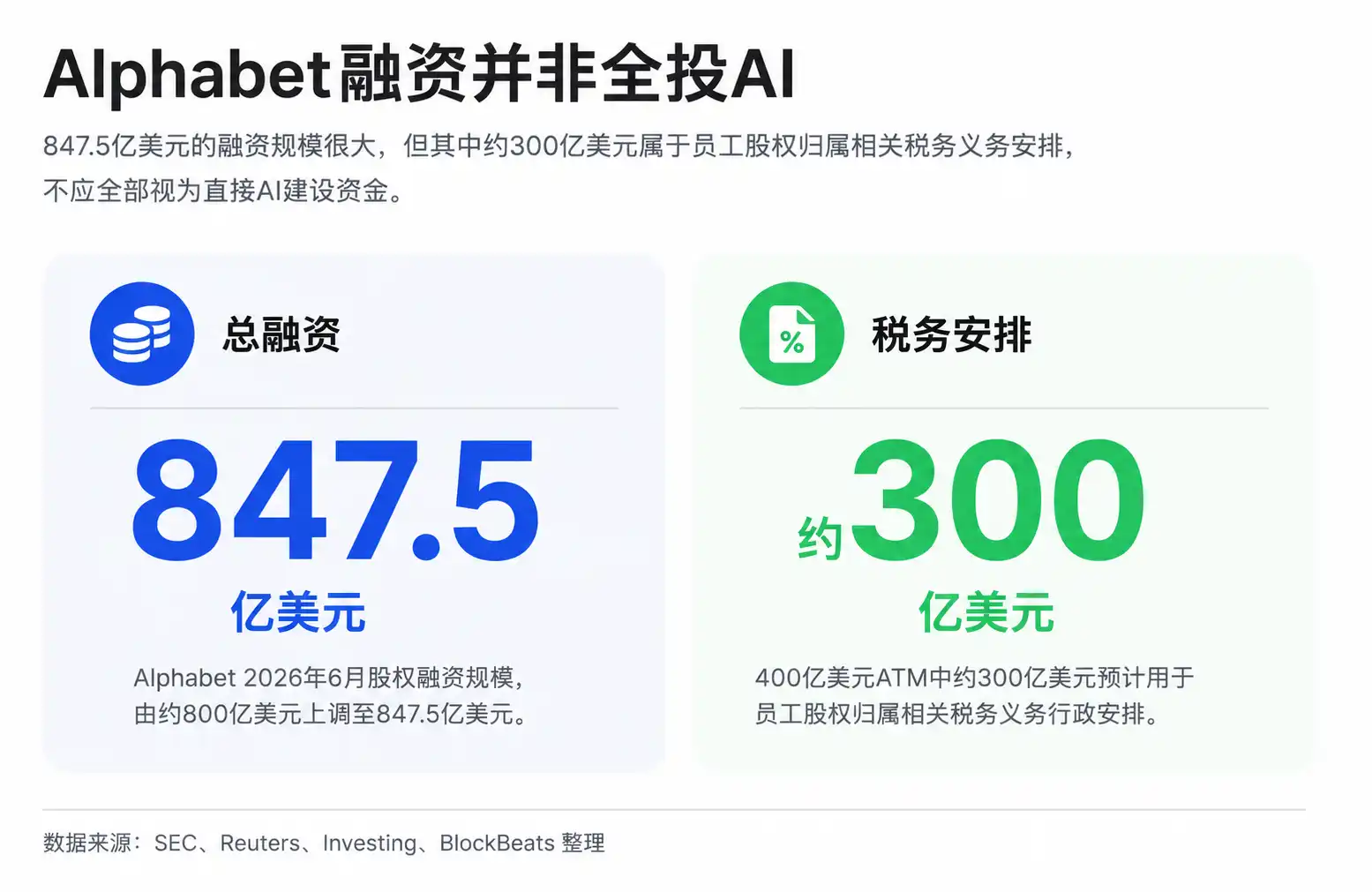
This distinction is important. Labeling the entire $84.75 billion as "AI construction funds" overstates the direct allocation, but it still alters investor sentiment. Because even a cash cow like Alphabet needs to expand fundraising in public markets, the market naturally wonders: If it needs to bolster financial flexibility, who will provide the capital needed next by OpenAI, Anthropic, xAI, data center REITs, and power companies?

Capital expenditure and operating expenses are also not the same. Spending on hiring and marketing is an opex; buying servers, building data centers, and securing power is capex. The latter is more like building a factory—it creates significant upfront cash flow pressure, appears on the books slowly through depreciation, but the market immediately assesses the payback period.

In its Q1 2026 earnings call, Alphabet raised its full-year capital expenditure guidance from $175-185 billion to $180-190 billion. The company cited reasons including investments related to the Intersect acquisition, as well as AI compute demand. Management emphasized maintaining a healthy balance sheet and financial flexibility and did not describe the fundraising as a survival pressure.
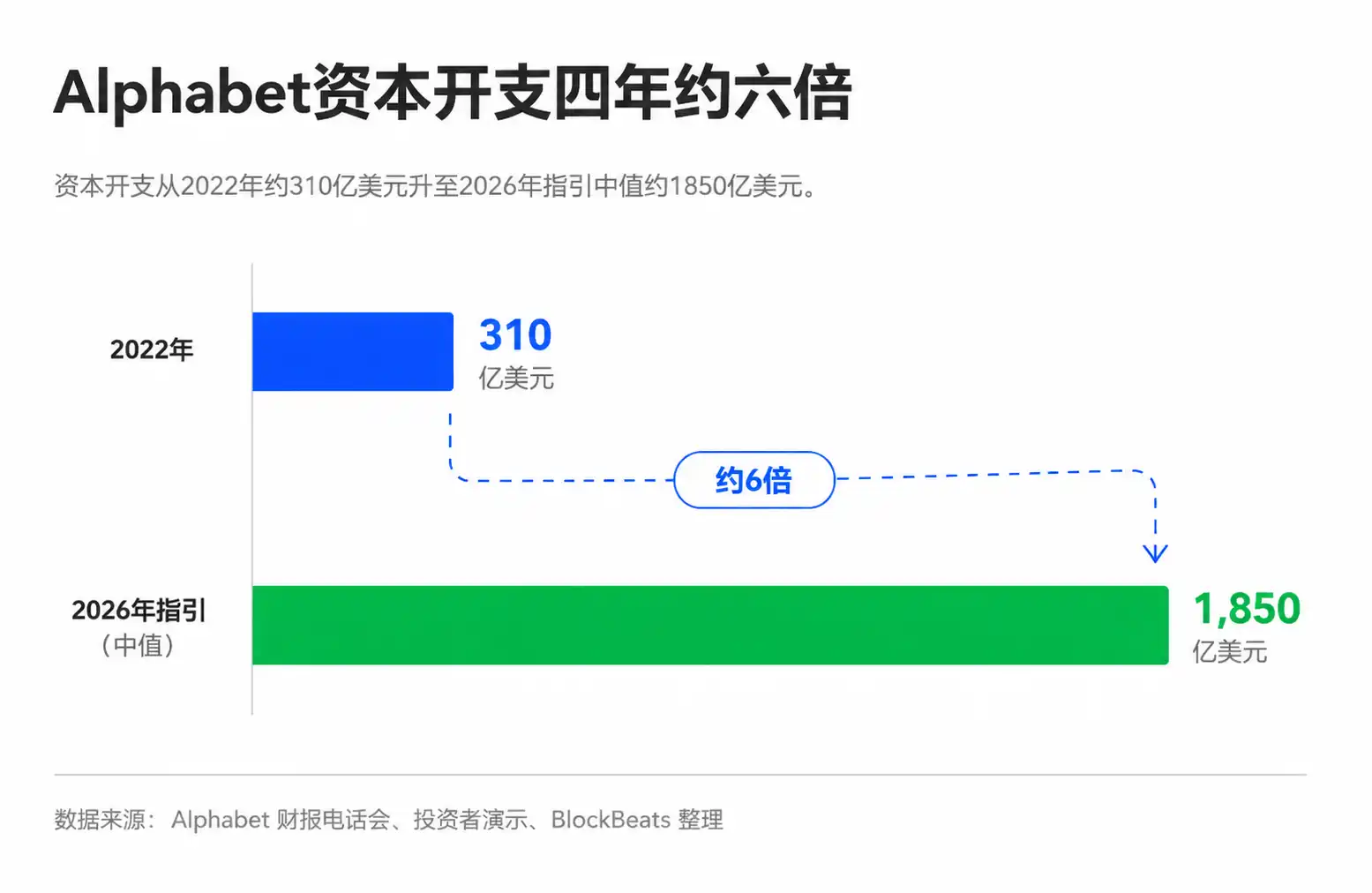
Investors are calculating a different equation. When capex guidance is repeatedly revised upward, the denominators in valuation models change: depreciation increases, free cash flow faces pressure, financing costs and potential equity dilution enter the calculation. The AI trade is entering its next phase. The previous phase rewarded imagination; the next phase rewards capital efficiency.

AI Money Isn't Just Burning on Big Tech's Books

The capital requirements for AI infrastructure don't fall solely on giants like Alphabet, Microsoft, Amazon, and Meta. What truly makes the market nervous is that multiple types of entities may simultaneously compete for the same pool of capital.

The first category is frontier model companies. Companies like OpenAI, Anthropic, and xAI see rapid revenue growth, but training and running models require continuous computing power purchases, leading to significant cash burn. Unlike established cloud providers with the cushion of advertising, cloud, and software cash flows, they rely more on external funding, strategic investments, and may later depend on IPOs or debt markets.

The second category is data center companies. AI doesn't need ordinary office servers but high-density, energy-intensive data centers. Data center REITs raise capital to build facilities and then lease computing infrastructure to cloud providers or AI companies. Assets like Digital Realty and Equinix benefit from demand expansion, but the expansion itself requires continuous financing.

The third category is power and utilities. One of the biggest bottlenecks for large AI data centers isn't chips, but electricity. Large data centers transfer pressure to the power grid, substations, transmission lines, and long-term power purchase agreements. The money burned by AI companies doesn't stop at GPUs; it flows along the supply chain to land, facilities, cooling, the grid, and energy projects.
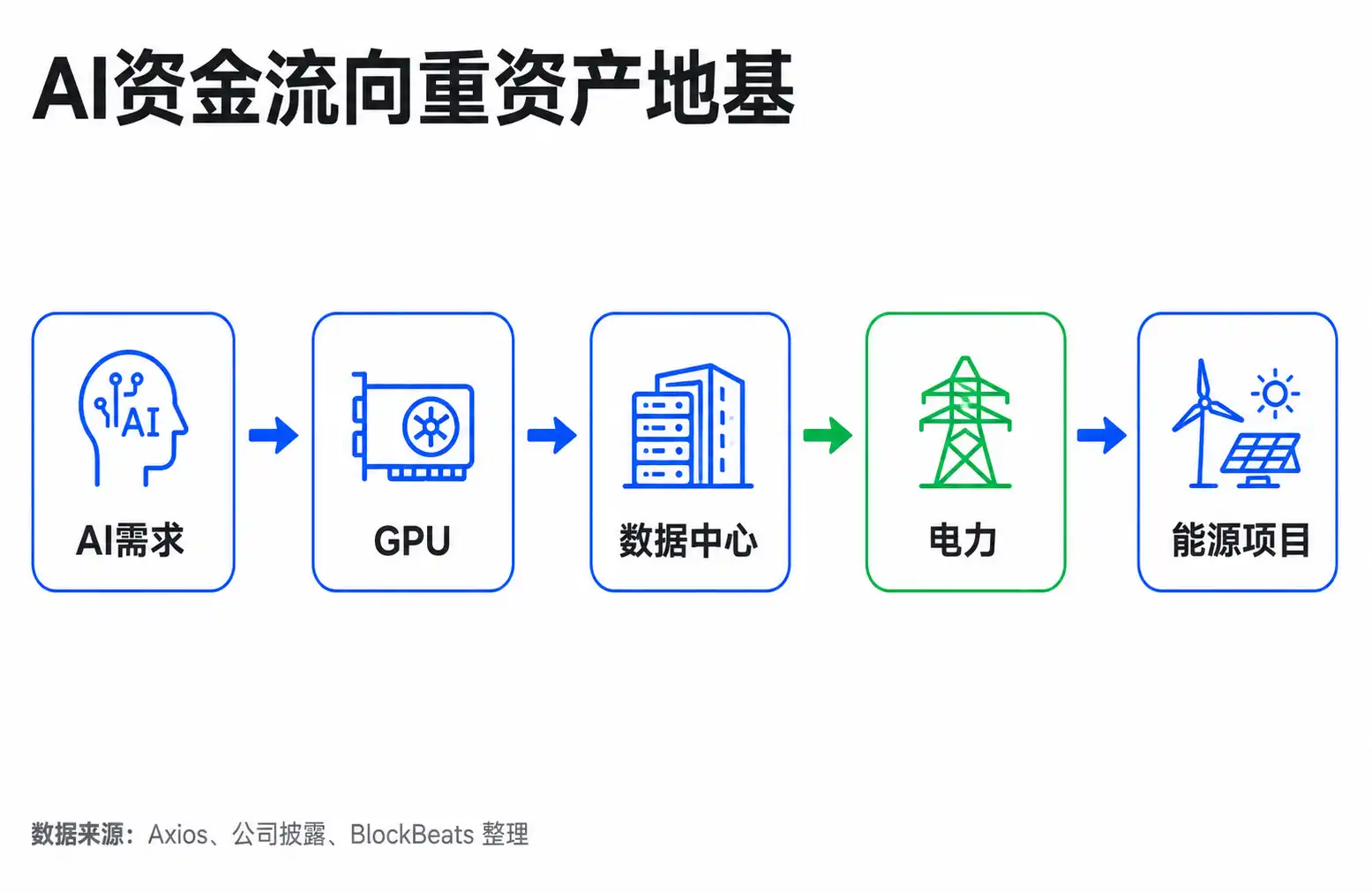
According to an Axios report on June 10, 2026, Alphabet, Amazon, Meta, Microsoft, and Oracle had raised $255.34 billion through equity and debt in 2026, stating that the five companies' AI data center spending for the year would reach approximately $750 billion. This figure shouldn't be taken as precise causal proof, but it gives the market a sense of scale: AI's capital needs are transitioning from a single-company issue to a financing cycle that the entire financial market needs to absorb.
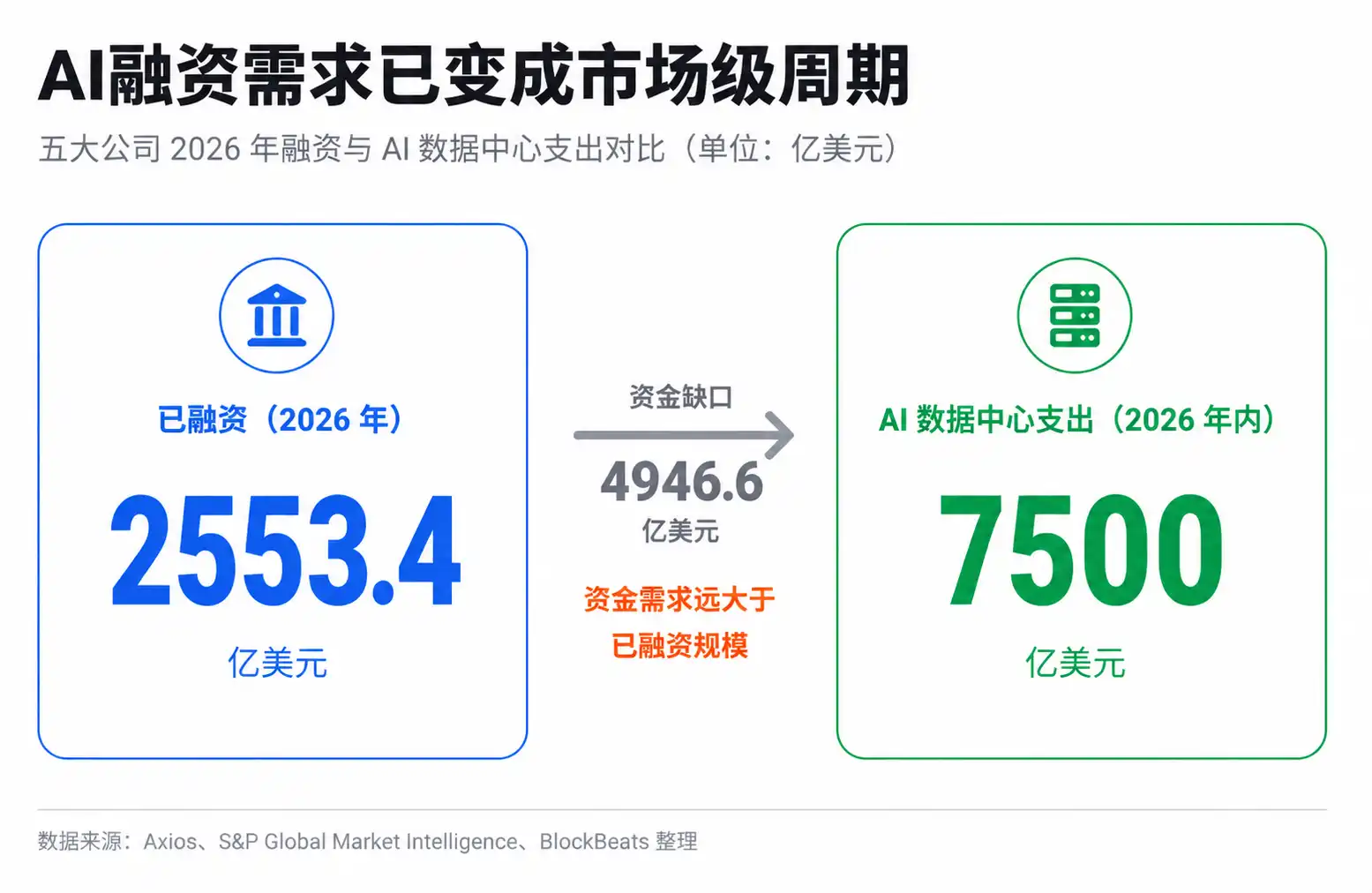
The market used to view AI as a software revolution: low marginal cost, fast growth, high margins. Now, frontier AI resembles infrastructure revolutions like railroads, electricity, and fiber optics: requiring concentrated build-out early on, massive investment, potentially creating immense value eventually, but facing tests of financing capacity, cost of capital, and capacity utilization in between.

Valuation Logic Shifts to Payback Speed

When a market reassessment occurs, prices initially reflect not that fundamentals have deteriorated, but that investors are starting to ask a different set of questions.

Previously, they asked: Whose AI narrative is strongest? Whose revenue growth is fastest? Who is closest to the next platform entrance? Now the questions are: Who can convert invested capital into cash flow? Whose order book is sufficiently certain? Who has access to low-cost financing? Who will see profit dilution or pressure during this high-capex cycle?

This explains the recent divergence within the AI sector. High-valuation AI software companies and those with heavier long-term narratives are more vulnerable because their valuations rely on future growth. Once the market raises its cost of capital estimate, the discounted present value of future cash flows declines. Some semiconductor companies may also be affected, as investors worry whether order growth can continue at super-expected rates.

But this doesn't mean all AI assets are being abandoned. Hardware, storage, networking equipment, data centers, and power assets with clearer order visibility might反而 find relative support during this reassessment. The reason is straightforward: when the market starts focusing on the build-out cycle, the "pick-and-shovel" sellers still have demand; but investors will be more挑剔 in asking whose orders are truly visible and who is just riding the narrative for valuation.

This is also the divergence between Alphabet management and cautious investors. Management emphasizes that AI investment is a strategic necessity, and fundraising is to maintain initiative in long-term competition. The cautious camp worries that AI monetization速度 may lag behind capital expenditure, especially when multiple giants and model companies simultaneously expand fundraising, prompting capital markets to demand higher returns and thus压低 valuations.

Both sides can be true simultaneously. AI can be the correct long-term infrastructure investment while also temporarily depressing free cash flow and valuation multiples in the short term. For investors, being "bullish on AI" and "bearish on a subset of AI valuations" are not contradictory.

Next Steps: Watch Capex and Revenue Realization

It's too early to attribute the recent pullback solely to AI financing pressure driving the market, let alone claim an AI liquidity crisis has emerged. Macro interest rates, profit-taking, cooling of crowded trades, and employment data fluctuations could all be reasons for sector volatility. The fundraising news更像是 incorporated into the market's explanatory framework rather than a button单独 driving prices.

But this explanatory framework itself deserves attention. Once the market starts pricing AI with "capex, cost of capital, payback period," the ranking of many assets will change.

For cash cows like Alphabet, the question isn't whether they can raise money, but whether AI investment will持续挤压 free cash flow and whether new投入 can translate into cloud revenue, advertising efficiency, subscription revenue, or enterprise service revenue. As long as revenue growth can cover depreciation and financing costs, the market can accept higher capex; if capex continues to be revised upward while returns迟迟不出现, valuation pressure will become more pronounced.

For pure-play AI companies, the question is more direct: Can high revenue growth keep pace with computing power consumption? If OpenAI, Anthropic, xAI can prove that enterprise customers are willing to持续付费 and unit economics improve, external capital will still flow in; if revenue growth is largely consumed by higher training and inference costs, the next round of financing or IPO pricing will be more挑剔.

For data center and power assets, the market will watch long-term contracts, utilization rates, financing structures, and power constraints. The more real the AI demand, the more important these "foundation" assets become; but if financing costs rise, or if data center construction超前于 real demand, they could shift from beneficiaries to承压方 of heavy-asset压力.

The most important validation points going forward are not the daily涨跌 of a semiconductor index, but whether the next round of earnings reports shows further upward revisions to capex guidance, whether AI revenue can materialize faster, and whether public markets can still smoothly absorb large-scale equity and debt issuance. As long as these variables remain positive, the AI trade isn't over; but the valuation language the market uses for AI has likely moved past the phase of只看想象空间.


相關問答

QWhat is the main shift in market valuation logic for AI investments discussed in the article?

AThe market is shifting from valuing AI based on its transformative potential and growth narrative to evaluating it as a capital-intensive infrastructure cycle, with a focus on capital efficiency, funding costs, and payback periods.

QWhy did Alphabet's announced capital raise cause market concern, according to the article?

AAlphabet's capital raise, while partly for administrative purposes, served as a strong reminder that AI infrastructure is a massive capital project. It prompted investors to reassess the broader funding needs of the AI ecosystem and question where capital would come from for other players like model companies, data center REITs, and utilities.

QWhat three categories of entities does the article identify as competing for capital in the AI infrastructure build-out?

AThe three categories are: 1) Frontier model companies (e.g., OpenAI, Anthropic), 2) Data center companies and REITs, and 3) Power and utility companies responsible for supplying the massive electricity needs of AI data centers.

QHow has the market's reaction to AI stocks changed with this new valuation focus?

AThe market reaction has become more differentiated. High-valuation AI software and semiconductor stocks with less certain near-term returns have faced pressure, while assets with clearer order visibility—like certain hardware, networking equipment, data centers, and power infrastructure—have found relative support as 'picks and shovels' plays in the build-out phase.

QWhat key metrics will investors now focus on to validate the AI investment thesis, as per the article?

AInvestors will focus on: 1) The trajectory of capital expenditure guidance in upcoming earnings reports, 2) The speed at which AI investments convert into tangible revenue streams (e.g., cloud, advertising, enterprise services), and 3) The public market's capacity to absorb large-scale equity and debt issuances from AI-related companies without significantly raising the cost of capital.

你可能也喜歡

XRP Ledger 发布 3.2.0 版本升级并启用 XRPLd 新品牌名

XRP Ledger发布了3.2.0版本,这是对其底层区块链基础设施的一次重要升级。本次更新的核心是将运行网络的软件名称从“rippled”更名为“xrpld”,以更好地反映整个项目生态。 与此前侧重于前端功能的版本不同,3.2.0版本优先进行了后端升级和效率提升,旨在增强网络性能并为未来的扩展做准备。关键改进包括内存优化措施,预计可节省高达40%的服务器内存使用。 此次升级引入了名为“fixCleanup3_2_0”的修改,为单资产金库、借贷协议、权限系统、去中心化交易所、多用途代币和权限域等多个模块带来了安全性增强。开发团队还新增了不变性检查,以确保已删除账户不会在账本上留下不一致的数据,从而加强整个网络的完整性和可靠性。 对于开发者而言,新版本增加了一项重要功能:应用程序无需连接服务器即可检索XRP Ledger协议和服务器定义信息,这将极大便利钱包、区块链浏览器和API等的开发工作。 在可扩展性和稳定性方面,更新包括可配置的区块大小、通过nuDB实现的高效数据库存储,以及将gRPC服务器的TLS/双向TLS支持改为可选,以提升企业用户的性能和连接性。此外,默认对等端口从51235更改为2459,并修复了涉及自动做市商、支付、代币托管、多用途代币、订单簿和RPC等多个方面的问题。出于性能考虑,3.2.0版本暂时禁用了交易不变性检查,但开发团队表示这不会构成安全威胁。

TheNewsCrypto7 小時前

XRP Ledger 发布 3.2.0 版本升级并启用 XRPLd 新品牌名

TheNewsCrypto7 小時前

交易

現貨
合約

熱門文章

什麼是 GROK AI

Grok AI: 在 Web3 時代革命性改變對話技術 介紹 在快速演變的人工智能領域,Grok AI 作為一個值得注意的項目脫穎而出,橋接了先進技術與用戶互動的領域。Grok AI 由 xAI 開發,該公司由著名企業家 Elon Musk 領導,旨在重新定義我們與人工智能的互動方式。隨著 Web3 運動的持續蓬勃發展,Grok AI 旨在利用對話 AI 的力量回答複雜的查詢,為用戶提供不僅具資訊性而且具娛樂性的體驗。 Grok AI 是什麼? Grok AI 是一個複雜的對話 AI 聊天機器人,旨在與用戶進行動態互動。與許多傳統 AI 系統不同,Grok AI 接納更廣泛的查詢,包括那些通常被視為不恰當或超出標準回應的問題。該項目的核心目標包括: 可靠推理:Grok AI 強調常識推理,根據上下文理解提供邏輯答案。 可擴展監督:整合工具協助確保用戶互動既受到監控又優化質量。 正式驗證:安全性至關重要;Grok AI 採用正式驗證方法來增強其輸出的可靠性。 長上下文理解:該 AI 模型在保留和回憶大量對話歷史方面表現出色,促進有意義且具上下文意識的討論。 對抗魯棒性:通過專注於改善其對操控或惡意輸入的防禦,Grok AI 旨在維護用戶互動的完整性。 總之,Grok AI 不僅僅是一個信息檢索設備;它是一個沉浸式的對話夥伴,鼓勵動態對話。 Grok AI 的創建者 Grok AI 的腦力來源無疑是 Elon Musk,這個名字與各個領域的創新息息相關,包括汽車、太空旅行和技術。在專注於以有益方式推進 AI 技術的 xAI 旗下,Musk 的願景旨在重塑對 AI 互動的理解。其領導力和基礎理念深受 Musk 推動技術邊界的承諾影響。 Grok AI 的投資者 雖然有關支持 Grok AI 的投資者的具體細節仍然有限,但公開承認 xAI 作為該項目的孵化器,主要由 Elon Musk 本人創立和支持。Musk 之前的企業和持股為 Grok AI 提供了強有力的支持,進一步增強了其可信度和增長潛力。然而,目前有關支持 Grok AI 的其他投資基金或組織的信息尚不易獲得,這標誌著未來潛在探索的領域。 Grok AI 如何運作? Grok AI 的運作機制與其概念框架一樣創新。該項目整合了幾種尖端技術,以促進其獨特的功能: 強大的基礎設施:Grok AI 使用 Kubernetes 進行容器編排,Rust 提供性能和安全性,JAX 用於高性能數值計算。這三者確保了聊天機器人的高效運行、有效擴展和及時服務用戶。 實時知識訪問:Grok AI 的一個顯著特點是其通過 X 平台(以前稱為 Twitter)訪問實時數據的能力。這一能力使 AI 能夠獲取最新信息,從而提供及時的答案和建議,而其他 AI 模型可能會錯過這些信息。 兩種互動模式:Grok AI 為用戶提供“趣味模式”和“常規模式”之間的選擇。趣味模式允許更具玩樂性和幽默感的互動風格,而常規模式則專注於提供精確和準確的回應。這種多樣性確保了根據不同用戶偏好量身定制的體驗。 總之,Grok AI 將性能與互動相結合,創造出既豐富又娛樂的體驗。 Grok AI 的時間線 Grok AI 的旅程標誌著反映其發展和部署階段的關鍵里程碑: 初始開發:Grok AI 的基礎階段持續了約兩個月,在此期間進行了模型的初步訓練和微調。 Grok-2 Beta 發布:在一個重要的進展中,Grok-2 beta 被宣布。這一版本推出了兩個版本的聊天機器人——Grok-2 和 Grok-2 mini,均具備聊天、編碼和推理的能力。 公眾訪問:在其 beta 開發之後,Grok AI 向 X 平台用戶開放。那些通過手機號碼驗證並活躍至少七天的帳戶可以訪問有限版本,使這項技術能夠接觸到更廣泛的受眾。 這一時間線概括了 Grok AI 從創建到公眾參與的系統性增長,強調其對持續改進和用戶互動的承諾。 Grok AI 的主要特點 Grok AI 包含幾個關鍵特點,促成其創新身份: 實時知識整合:訪問當前和相關信息使 Grok AI 與許多靜態模型區別開來,從而提供引人入勝和準確的用戶體驗。 多樣化的互動風格:通過提供不同的互動模式,Grok AI 滿足各種用戶偏好,邀請創造力和個性化的對話。 先進的技術基礎:利用 Kubernetes、Rust 和 JAX 為該項目提供了堅實的框架,以確保可靠性和最佳性能。 倫理話語考量:包含圖像生成功能展示了該項目的創新精神。然而,它也引發了有關版權和尊重可識別人物描繪的倫理考量——這是 AI 社區內持續討論的議題。 結論 作為對話 AI 領域的先驅,Grok AI 概括了數字時代轉變用戶體驗的潛力。由 xAI 開發,並受到 Elon Musk 願景的驅動,Grok AI 將實時知識與先進的互動能力相結合。它努力推動人工智能能夠達成的界限,同時保持對倫理考量和用戶安全的關注。 Grok AI 不僅體現了技術的進步,還體現了 Web3 環境中新對話範式的出現,承諾以靈活的知識和玩樂的互動吸引用戶。隨著該項目的持續演變,它成為技術、創造力和類人互動交匯處所能實現的見證。

763 人學過發佈於 2024.12.26更新於 2024.12.26

什麼是 GROK AI

什麼是 ERC AI

Euruka Tech:$erc ai 及其在 Web3 中的雄心概述 介紹 在快速發展的區塊鏈技術和去中心化應用的環境中,新項目頻繁出現,每個項目都有其獨特的目標和方法論。其中一個項目是 Euruka Tech,該項目在加密貨幣和 Web3 的廣闊領域中運作。Euruka Tech 的主要焦點,特別是其代幣 $erc ai,是提供旨在利用去中心化技術日益增長的能力的創新解決方案。本文旨在提供 Euruka Tech 的全面概述,探索其目標、功能、創建者的身份、潛在投資者以及它在更廣泛的 Web3 背景中的重要性。 Euruka Tech, $erc ai 是什麼? Euruka Tech 被描述為一個利用 Web3 環境提供的工具和功能的項目,專注於在其運作中整合人工智能。雖然有關該項目框架的具體細節仍然有些模糊,但它旨在增強用戶參與度並自動化加密空間中的流程。該項目的目標是創建一個去中心化的生態系統,不僅促進交易,還通過人工智能整合預測功能,因此其代幣被命名為 $erc ai。其目的是提供一個直觀的平台,促進更智能的互動和高效的交易處理,並在不斷增長的 Web3 領域中發揮作用。 Euruka Tech, $erc ai 的創建者是誰? 目前,關於 Euruka Tech 背後的創建者或創始團隊的信息仍然不明確且有些模糊。這一數據的缺失引發了擔憂,因為了解團隊背景通常對於在區塊鏈行業建立信譽至關重要。因此,我們將這些信息歸類為 未知,直到具體細節在公共領域中公開。 Euruka Tech, $erc ai 的投資者是誰? 同樣,關於 Euruka Tech 項目的投資者或支持組織的識別在現有研究中並未明確提供。對於考慮參與 Euruka Tech 的潛在利益相關者或用戶來說,來自知名投資公司的財務合作或支持所帶來的保證是至關重要的。沒有關於投資關係的披露,很難對該項目的財務安全性或持久性得出全面的結論。根據所找到的信息,本節也處於 未知 的狀態。 Euruka Tech, $erc ai 如何運作? 儘管缺乏有關 Euruka Tech 的詳細技術規範,但考慮其創新雄心是至關重要的。該項目旨在利用人工智能的計算能力來自動化和增強加密貨幣環境中的用戶體驗。通過將 AI 與區塊鏈技術相結合,Euruka Tech 旨在提供自動交易、風險評估和個性化用戶界面等功能。 Euruka Tech 的創新本質在於其目標是創造用戶與去中心化網絡所提供的廣泛可能性之間的無縫連接。通過利用機器學習算法和 AI,它旨在減少首次用戶的挑戰,並簡化 Web3 框架內的交易體驗。AI 與區塊鏈之間的這種共生關係突顯了 $erc ai 代幣的重要性,成為傳統用戶界面與去中心化技術的先進能力之間的橋樑。 Euruka Tech, $erc ai 的時間線 不幸的是,由於目前有關 Euruka Tech 的信息有限,我們無法提供該項目旅程中主要發展或里程碑的詳細時間線。這條時間線通常對於描繪項目的演變和理解其增長軌跡至關重要,但目前尚不可用。隨著有關顯著事件、合作夥伴關係或功能添加的信息變得明顯,更新將無疑增強 Euruka Tech 在加密領域的可見性。 關於其他 “Eureka” 項目的澄清 值得注意的是,多個項目和公司與 “Eureka” 共享類似的名稱。研究已經識別出一些倡議,例如 NVIDIA Research 的 AI 代理,專注於使用生成方法教導機器人複雜任務,以及 Eureka Labs 和 Eureka AI,分別改善教育和客戶服務分析中的用戶體驗。然而,這些項目與 Euruka Tech 是不同的,不應與其目標或功能混淆。 結論 Euruka Tech 及其 $erc ai 代幣在 Web3 領域中代表了一個有前途但目前仍不明朗的參與者。儘管有關其創建者和投資者的細節仍未披露,但將人工智能與區塊鏈技術相結合的核心雄心仍然是關注的焦點。該項目在通過先進自動化促進用戶參與方面的獨特方法,可能會使其在 Web3 生態系統中脫穎而出。 隨著加密市場的持續演變,利益相關者應密切關注有關 Euruka Tech 的進展,因為文檔創新、合作夥伴關係或明確路線圖的發展可能在未來帶來重大機會。當前,我們期待更多實質性見解的出現,以揭示 Euruka Tech 的潛力及其在競爭激烈的加密市場中的地位。

666 人學過發佈於 2025.01.02更新於 2025.01.02

什麼是 ERC AI

什麼是 DUOLINGO AI

DUOLINGO AI:將語言學習與Web3及AI創新結合 在科技重塑教育的時代,人工智能(AI)和區塊鏈網絡的整合預示著語言學習的新前沿。進入DUOLINGO AI及其相關的加密貨幣$DUOLINGO AI。這個項目旨在將領先語言學習平台的教育優勢與去中心化的Web3技術的好處相結合。本文深入探討DUOLINGO AI的關鍵方面,探索其目標、技術框架、歷史發展和未來潛力,同時保持原始教育資源與這一獨立加密貨幣倡議之間的清晰區分。 DUOLINGO AI概述 DUOLINGO AI的核心目標是建立一個去中心化的環境,讓學習者可以通過實現語言能力的教育里程碑來獲得加密獎勵。通過應用智能合約,該項目旨在自動化技能驗證過程和代幣分配,遵循強調透明度和用戶擁有權的Web3原則。該模型與傳統的語言習得方法有所不同,重點依賴社區驅動的治理結構,讓代幣持有者能夠建議課程內容和獎勵分配的改進。 DUOLINGO AI的一些顯著目標包括: 遊戲化學習:該項目整合區塊鏈成就和非同質化代幣(NFT)來表示語言能力水平,通過引人入勝的數字獎勵來激發學習動機。 去中心化內容創建:它為教育者和語言愛好者提供了貢獻課程的途徑,促進了一個有利於所有貢獻者的收益共享模型。 AI驅動的個性化:通過採用先進的機器學習模型,DUOLINGO AI個性化課程以適應個別學習進度,類似於已建立平台中的自適應功能。 項目創建者與治理 截至2025年4月,$DUOLINGO AI背後的團隊仍然是化名的,這在去中心化的加密貨幣領域中是一種常見做法。這種匿名性旨在促進集體增長和利益相關者的參與,而不是專注於個別開發者。部署在Solana區塊鏈上的智能合約註明了開發者的錢包地址,這表明對於交易的透明度的承諾,儘管創建者的身份未知。 根據其路線圖,DUOLINGO AI旨在演變為去中心化自治組織(DAO)。這種治理結構允許代幣持有者對關鍵問題進行投票,例如功能實施和財庫分配。這一模型與各種去中心化應用中社區賦權的精神相一致,強調集體決策的重要性。 投資者與戰略夥伴關係 目前,沒有與$DUOLINGO AI相關的公開可識別的機構投資者或風險投資家。相反,該項目的流動性主要來自去中心化交易所(DEX),這與傳統教育科技公司的資金策略形成鮮明對比。這種草根模型表明了一種社區驅動的方法,反映了該項目對去中心化的承諾。 在其白皮書中,DUOLINGO AI提到與未具名的「區塊鏈教育平台」建立合作,以豐富其課程提供。雖然具體的合作夥伴尚未披露,但這些合作努力暗示了一種將區塊鏈創新與教育倡議相結合的策略,擴大了對多樣化學習途徑的訪問和用戶參與。 技術架構 AI整合 DUOLINGO AI整合了兩個主要的AI驅動組件,以增強其教育產品: 自適應學習引擎:這個複雜的引擎從用戶互動中學習,類似於主要教育平台的專有模型。它動態調整課程難度,以應對特定學習者的挑戰,通過針對性的練習加強薄弱環節。 對話代理:通過使用基於GPT-4的聊天機器人,DUOLINGO AI為用戶提供了一個參與模擬對話的平台,促進更互動和實用的語言學習體驗。 區塊鏈基礎設施 建立在Solana區塊鏈上的$DUOLINGO AI利用了一個全面的技術框架,包括: 技能驗證智能合約:此功能自動向成功通過能力測試的用戶頒發代幣,加強了對真實學習成果的激勵結構。 NFT徽章:這些數字代幣標誌著學習者達成的各種里程碑,例如完成課程的一部分或掌握特定技能,允許他們以數字方式交易或展示自己的成就。 DAO治理:持有代幣的社區成員可以通過對關鍵提案進行投票來參與治理,促進一種鼓勵課程提供和平台功能創新的參與文化。 歷史時間線 2022–2023:概念化 DUOLINGO AI的基礎工作始於白皮書的創建,強調了語言學習中的AI進步與區塊鏈技術去中心化潛力之間的協同作用。 2024:Beta發佈 限量的Beta版本推出了流行語言的課程,作為項目社區參與策略的一部分,獎勵早期用戶以代幣激勵。 2025:DAO過渡 在4月,進行了完整的主網發佈,並開始流通代幣,促使社區討論可能擴展到亞洲語言和其他課程開發的問題。 挑戰與未來方向 技術障礙 儘管有雄心勃勃的目標,DUOLINGO AI面臨著重大挑戰。可擴展性仍然是一個持續的擔憂,特別是在平衡與AI處理相關的成本和維持響應靈敏的去中心化網絡方面。此外,在去中心化的提供中確保內容創建和審核的質量,對於維持教育標準來說也帶來了複雜性。 戰略機會 展望未來,DUOLINGO AI有潛力利用與學術機構的微證書合作,提供區塊鏈驗證的語言技能認證。此外,跨鏈擴展可能使該項目能夠接觸到更廣泛的用戶基礎和其他區塊鏈生態系統,增強其互操作性和覆蓋範圍。 結論 DUOLINGO AI代表了人工智能和區塊鏈技術的創新融合,為傳統語言學習系統提供了一種以社區為中心的替代方案。儘管其化名開發和新興經濟模型帶來某些風險,但該項目對遊戲化學習、個性化教育和去中心化治理的承諾為Web3領域的教育技術指明了前進的道路。隨著AI的持續進步和區塊鏈生態系統的演變,像DUOLINGO AI這樣的倡議可能會重新定義用戶與語言教育的互動方式,賦能社區並通過創新的學習機制獎勵參與。

683 人學過發佈於 2025.04.11更新於 2025.04.11

什麼是 DUOLINGO AI

相關討論

歡迎來到 HTX 社群。在這裡,您可以了解最新的平台發展動態並獲得專業的市場意見。 以下是用戶對 AI (AI)幣價的意見。

活动图片