Will Ex-Ripple CTO Schwartz Develop Bitcoin Again? His Answer Turns Heads

bitcoinist发布于2026-02-12更新于2026-02-12

文章摘要

David Schwartz, former Ripple CTO and key architect of the XRP Ledger, dismissed the possibility of returning to Bitcoin development, calling Bitcoin “largely a technological dead end.” He argued that Bitcoin's success is driven more by social and monetary inertia than by technological innovation at its base layer. The comments emerged from a debate on X (formerly Twitter) about centralization in crypto, where Schwartz defended XRP's early "genesis reset" by pointing to what he called more centralized incidents in Bitcoin's history, such as a coordinated rollback in 2010. Schwartz stated that blockchain technology matters less to Bitcoin’s success than its established monetary status, comparing it to the U.S. dollar. He confirmed he has no plans to develop for Bitcoin again and will instead focus on his own projects on the XRP Ledger. At the time of writing, XRP was trading at $1.38.

David Schwartz, Ripple’s former CTO and one of the original architects of the XRP Ledger, poured cold water on the idea of returning to Bitcoin development this week, calling Bitcoin “largely a technological dead end” in a reply that quickly ricocheted through crypto’s never-ending decentralization debates.

The exchange started as a fight over history and governance. On Feb. 9, X user Bram Kanstein argued that XRP’s early “genesis reset” — often described as treating the 32,750th XRP block as a kind of starting point — illustrates crypto’s centralized tendencies. Kanstein wrote that the milestone “may be thought of as the genesis,” before adding: “Except it is not. The XRP Genesis reset is a prime example of the centralized nature of ‘CrYpTO’.”

Ex-Ripple CTO Schwartz Calls Bitcoin A ‘Tech Dead End’

Schwartz jumped in with a comparison that redirected the argument toward Bitcoin. “Bitcoin had at least two incidents that showed way more centralization than this incident did,” he wrote, “especially since the decision in this incident was not to make any coordinated changes and just live with it.”

That claim drew a follow-up from X user, who floated SegWit as a candidate for what Schwartz meant, an example of coordinated protocol change. The ex-Ripple CTO pushed back on that framing: “I wasn’t because I don’t really think of adding new features as showing centralization,” he replied. “But I think you could make a good argument that it does. The biggest one I was thinking of was the coordinated 2010 rollback.”

The thread’s tone shifted on Feb. 10 when X user Khaled Elawadi asked the question that put Schwartz’s own priorities in the spotlight: since co-creating the XRPL, had he worked on or even considered developing Bitcoin again?

“Not really,” Schwartz answered. Then he went further, sketching an argument that Bitcoin’s dominance owes less to the evolution of its base-layer tech than to social and monetary inertia. “I think bitcoin is largely a technological dead end for the same reason the dollar is,” he wrote. “The technology just doesn’t seem to matter all that much to its success, at least not at the blockchain layer.”

For XRP supporters, Schwartz’s comments served two purposes at once: a defense against charges that XRPL’s early history implies unique centralization, and a reminder that Bitcoin’s “hands-off” mythology also has had real-world exceptions in its early days.

What’s hard to miss is where the ex-Ripple CTO draws the line. Bitcoin’s success can persist even if base-layer technical progress slows, because the network’s strength increasingly behaves like a monetary standard rather than an engineering project. Schwartz is pursuing a different strategy for the XRP Ledger. After stepping down as Ripple CTO, he announced that he would pursue his own projects on the XRP Ledger.

At press time, XRP traded at $1.38.
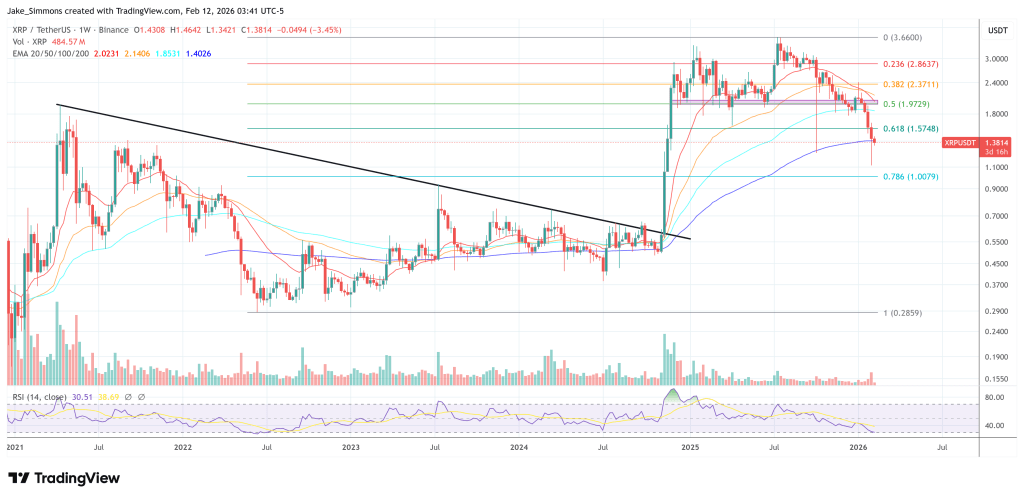
XRP drops below the 200-week EMA, 1-week chart | Source: XRPUSDT on TradingView.com

相关问答

QWhat was David Schwartz's response to the idea of returning to Bitcoin development?

ADavid Schwartz dismissed the idea of returning to Bitcoin development, calling Bitcoin 'largely a technological dead end' and stated that he has 'not really' considered developing Bitcoin again.

QAccording to Schwartz, why does Bitcoin's success persist despite its technological limitations?

ASchwartz argued that Bitcoin's success owes less to its base-layer technology and more to social and monetary inertia, behaving increasingly like a monetary standard rather than an engineering project.

QWhat historical Bitcoin incident did Schwartz cite as showing more centralization than XRP's genesis reset?

ASchwartz cited the 'coordinated 2010 rollback' as a Bitcoin incident that demonstrated more centralization than XRP's genesis reset event.

QHow did Schwartz defend XRP Ledger against charges of centralization?

ASchwartz defended the XRP Ledger by arguing that Bitcoin had at least two incidents showing even greater centralization, and that the decision during XRP's genesis reset was 'not to make any coordinated changes and just live with it'.

QWhat is David Schwartz's current focus after stepping down as Ripple's CTO?

AAfter stepping down as Ripple's CTO, David Schwartz announced that he would pursue his own projects on the XRP Ledger.

你可能也喜欢

TechFlow 情报局:芯片股单日蒸发万亿美元,比特币跌破 6 万美元,美伊冲突升级

科技情报摘要:宏观波动与AI进展交织 市场因强劲非农数据遭遇剧烈震荡。美国5月非农就业新增17.2万,远超预期,重燃加息担忧,导致美股、加密市场和芯片股同步暴跌。费城半导体指数创六年最大单日跌幅,芯片股市值蒸发逾万亿美元;比特币跌破6万美元,技术指标显示超卖程度已达2020年疫情暴跌水平。与此同时,消费品巨头CEO警告美国消费者正在耗尽积蓄,与强劲就业数据形成矛盾信号。地缘政治方面,美伊冲突升级,美军拦截伊朗导弹并打击其雷达站,霍尔木兹海峡持续受阻,引发原油供应与通胀忧虑。 AI领域进展与争议并存。Anthropic发布报告称AI已能参与改进自身研究流程,引发对递归自我改进(RSI)的讨论。另一方面,Claude被指在协助开发rsync代码库时引入了更多bug,引发关于AI编程工具利弊的争论。此外,研究出现新转向,有发现认为思维链(chain-of-thought)在某些场景会降低性能,研究者正尝试训练“内隐推理”模型。DeepSeek V4 Flash在本地部署测试中表现惊艳,GitHub Copilot也开放了自定义端点,支持连接本地模型。 其他要闻包括:Gemma 4量化版在AMD GPU上运行良好;谷歌被曝每月向SpaceX支付9.2亿美元用于AI训练算力;微软内部文件显示其希望AI产品让用户“上瘾”引批评;标普500指数维持规则,拒绝将SpaceX、OpenAI等未盈利的AI独角兽纳入。

marsbit59分钟前

TechFlow 情报局:芯片股单日蒸发万亿美元,比特币跌破 6 万美元,美伊冲突升级

marsbit59分钟前

我用了一年,才看清 Agent 支付扎心的真相

我用了一年时间深入研究Agent支付领域,发现当前市场存在诸多扎心现实。总体来看,真正的、大规模的需求尚未形成,初创公司面临结构性问题。 首先,在Agent对商户的“代购式商业”方面,用户体验存在根本缺陷。对于需要视觉比价的大多数商品(如服装、电子产品),纯文本对话界面远不如传统电商界面直观高效。虽然AI在理解需求和比价指令上表现不错,但无法替代并排浏览、挑选的体验。商户目前接入主要是出于“防御性”的“Agent引擎优化”考虑,担心未来落后,而非当前有实际客流。外卖等高频低决策场景有潜力,但受限于平台未开放API和过高的推理成本。另一个突破口是帮助用户处理复杂、体验差的购物流程(如叠加优惠、非母语操作),但这需要强大的B2C分发渠道,而这是巨头的优势。 其次,在Agent对API(机器间调用服务)方面,虽然存在机器间支付场景,但当前开发者大多已通过预付额度等方式解决小额支付问题。更深层矛盾在于,主流SaaS供应商的商业模式依赖大额企业合同,不愿支持极小额、临时性的API访问。新兴协议更适合服务长尾、小众的需求,但这个市场的付费意愿和规模有限。 第三,Agent对Agent的商业模式目前几乎完全停留在理论层面,尚未产生有意义的交易量。虽然这是一个需要专用结算基础设施的长期愿景,但与当前市场脱节。 相比之下,Agent对金融是目前唯一存在既有需求和付费意愿的类别。将AI嵌入基金经理、财务团队等现有工作流是自然演进,并能创造全新能力(如实时监控、自动调仓)。但该领域竞争激烈,受严格监管,老牌机构拥有显著优势。 文章最后指出,行业巨头因资金充足和防御心态仍在投入建设,但对初创公司而言,时间线至关重要。真正的机遇不在于单纯的支付层,而在于解决“协同”这一更宏大的问题——即如何协调Agent与人类的工作、验证成果并进行结算。大规模协同将自然催生结算机制,解决协同问题的公司终将吞并支付业务。经过一年探索,作者团队已将方向转向一个市场需求真实存在、增长迅速且尚未被充分服务的新领域。

链捕手2小时前

我用了一年,才看清 Agent 支付扎心的真相

链捕手2小时前

Claude Opus 4.8 找到一个 45 亿美元的 Bug,AI时代正在批量生产黑客

一名安全研究员使用AI模型Claude Opus 4.8在Zcash加密货币的隐私协议Orchard中发现了一个严重的“无限增发”漏洞,导致其市值短时间内蒸发约45亿美元。这一事件并非由Anthropic公司最尖端但受限的Claude Mythos模型完成,而是由已公开发布、进入日常工具的普通模型实现的,凸显了AI正在将发现高危漏洞的能力“民主化”和“廉价化”。 AI降低了漏洞挖掘的门槛,带来了双重影响:一方面,它催生了大量由AI生成的虚假或低质量安全报告,如同“注意力DDoS”攻击,消耗着本就人力匮乏的开源维护者精力;另一方面,它也能更快地找出那些隐藏多年、以往需要专家耗费巨大成本才能发现的真实漏洞。我们的数字世界一直建立在存在诸多潜在缺陷的代码之上,过去的“安全”在相当程度上源于发现成本高昂。 然而,能力的扩散并未带来责任的均摊。网络安全行业本就面临巨大的人才缺口,尤其是在复杂分析和应急响应层面。当AI让攻击和漏洞报告变得泛滥时,修复漏洞、守护系统的人力链条却变得更加紧张。破坏可以被自动化脚本轻易复制,但重建信任与安全仍需依赖稀缺的专业人力进行艰苦、细致的修复工作。 AI时代揭示了一个现实:我们习以为常的平稳数字生活,并非理所当然,而是依赖于一条脆弱的人力协作防线在持续对抗风险。未来真正的挑战或许不是找到漏洞,而是是否有足够的人愿意并能够修复它们。

marsbit2小时前

Claude Opus 4.8 找到一个 45 亿美元的 Bug,AI时代正在批量生产黑客

marsbit2小时前

交易

现货
合约

热门文章

加密市场宏观研报:《GENIUS Act》法案取得重大进展,BTC突破历史新高,后市全新展望

2025年5月22日,比特币价格正式突破11万美元大关,创下历史新高。在政策面、宏观经济、资金面与投资者结构共同作用下,一场结构性牛市浪潮正在展开。而此轮上涨背后的核心驱动,是美国《GENIUS稳定币法案》的实质性进展以及多项利好的叠加。本文将从政策端突破、宏观环境转向、链上与ETF资金结构、交易行为演化,以及重点受益赛道五大维度,全面解析此轮BTC再创新高的深层逻辑,并前瞻下半年市场的潜在趋势。

1.6k人学过发布于 2025.05.22更新于 2025.05.22

加密市场宏观研报:《GENIUS Act》法案取得重大进展,BTC突破历史新高,后市全新展望

相关讨论

欢迎来到HTX社区。在这里,您可以了解最新的平台发展动态并获得专业的市场意见。以下是用户对BTC(BTC)币价的意见。

活动图片