Author: Chloe, ChainCatcher
According to a Bloomberg report, Erebor, a digital bank launched by Anduril founder Palmer Luckey and supported by billionaire investor Peter Thiel, is negotiating a new round of funding, targeting a valuation of at least $8 billion. This is roughly double its valuation from last December's round ($350 million raised, $4.35 billion valuation). The funding is still in early stages, and the valuation is not yet finalized. An Erebor spokesperson declined to comment on the negotiations.
A bank that has only been operational for a few months has seen its valuation double. This represents one of the highest valuation increases among newly licensed U.S. banks in recent years. What likely prompted investors to revise their price upwards is perhaps the expansion speed revealed in its financial reports.
What Potential Do Investors See in the Financial Reports?
According to informed sources, Erebor's deposit base surged from $1.1 billion reported to regulators at the end of March to approximately $4.05 billion within three months, nearly quadrupling in a single quarter. It also added nearly 400 new clients, and the bank anticipates profitability before the end of 2026.
This growth rate has also sparked external skepticism about whether Erebor's connections with Silicon Valley's tech circles and government defense circles are too close, raising suspicions of an "insider" game.
Luckey directly addressed this, emphasizing that none of the quarterly growth came from his own companies and that new clients independently chose Erebor. He added that a significant portion of the recent expansion focuses on companies rebuilding U.S. manufacturing capacity. The bank has correspondingly expanded equipment financing, venture debt, and credit business supporting industrial and defense enterprises.
Pulling back to its Q1 financial report reveals Erebor's total assets of $1.703 billion, deposits of $1.098 billion, and bank equity of $600.6 million. The bank had no loan or lease business on its books and no borrowings other than deposits (items like federal funds purchased, repurchase agreements, other borrowed money, and subordinated debt were zero). The asset structure is heavily skewed towards liquidity: approximately $1.411 billion is cash and deposits with other banks, and about $275 million consists of available-for-sale debt and equity securities (including $116 million in bonds and $159 million in equity securities).
Furthermore, quarterly net interest income was only $3.36 million, with non-interest expenses of $10.56 million, resulting in a net loss of $6.01 million. However, for a new bank that has just launched and is still amortizing technology, compliance, and operational costs, such losses are considered necessary expenses.
In other words, investors are willing to pay an $8 billion valuation not for Erebor's current profitability potential but for the growth rate of its deposits surging from $1.1 billion to $4.05 billion, and the anticipation of its future ability to lend these deposits and develop stablecoin-related businesses.
A Founder Unfamiliar with Wall Street, Yet with Notable Pedigree
To understand Erebor, one must first grasp the recurring product-building pattern behind it.
Founder Palmer Luckey's career spans Oculus VR and Anduril, consistently focusing on hardware, regulatory barriers, and the intersection of high-capital-intensive industries adjacent to government ecosystems. In 2012, he entered the nascent VR market, solving long-standing industry problems like latency and spatial tracking, and sold Oculus to Facebook for $2 billion in 2014. His second venture, Anduril, applied the same playbook to the defense industry: using private venture capital to build defense systems first, then selling them to the government as "products" rather than via traditional "cost-plus" contracts, thereby building deep ties with the Department of Defense and intelligence agencies. Luckey explicitly stated that Erebor will collaborate with the intelligence community "from day one" to prevent fraud, adopting a proactive compliance posture.
However, Luckey himself is an outsider to banking. Erebor's brand relies partly on his and Thiel's reputations, but prestige cannot replace regulatory and operational track records. Once it steps onto Wall Street, the bank will ultimately be scrutinized by the standards of a regulated institution.
Therefore, the actual operational team has a solid financial foundation: President Michael Hagedorn comes from Wells Fargo's regional banking; CEO Owen Rapaport's background is in crypto compliance through Aer Compliance; Chief Strategy Officer Jacob Hirshman was involved in Circle's stablecoin business and practiced at Sullivan & Cromwell; Growth VP Noah Pompan has experience from MoonPay. The investor lineup includes Joe Lonsdale's 8VC, Thiel's Founders Fund, Lux Capital, and a fund affiliated with a16z.
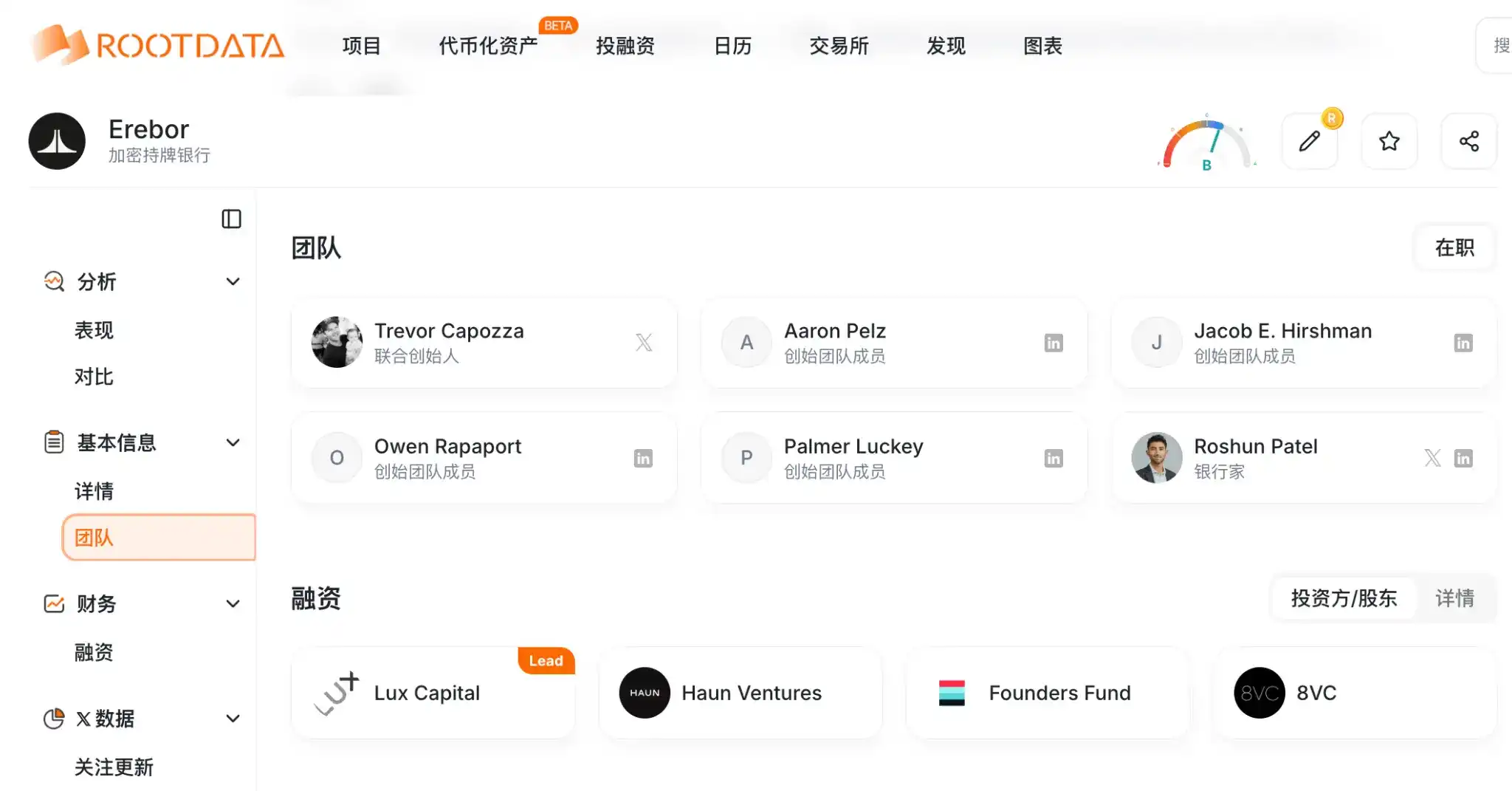
Image Source:RootData
Additionally, a key strategic choice for Erebor is: insisting on obtaining its own banking charter and being responsible for its financial statements, unlike Mercury or Brex, which rely on partner banks. Luckey's argument is that relying on third-party infrastructure exposes one to risks of "de-platforming," policy pressure, and product limitations. Only by holding the charter and ledger can it potentially fulfill its promises regarding on-chain settlement, stablecoin issuance, and redemption.
Looking back at Erebor's origins, they are almost entirely tied to the collapse of Silicon Valley Bank (SVB) in 2023. That failure left a large number of startups and venture capitalists suddenly without a banking partner and their deposits uninsured. Luckey and investors believed this created a "structural vacuum"—a bank specifically serving startups disappeared, while traditional banks were too conservative or slow for startups holding non-standard assets (defense contracts, AI hardware, digital tokens).
Erebor claims to address roughly four pain points: First, providing credit for physical assets; traditional banks are good at lending against real estate or receivables but not at valuing "GPUs" or "aerospace research." Second, bridging the on-chain/off-chain divide, bringing fiat banking and stablecoin settlement onto the same regulated balance sheet. Third, meeting 24/7 settlement needs, replacing the decades-old schedules of SWIFT and ACH. Fourth, providing dollar access for high-growth international businesses, combating the "de-banking" friction they often face.
Of course, how much of this operational potential is real versus marketing remains debatable. Venture-backed companies now have alternatives like non-bank lenders and DeFi loans, and some incumbent banks had already begun targeting tech niches before SVB's collapse. Erebor's founders clearly believe existing institutions are insufficient, and the fact that it obtained a full banking charter suggests regulators might also see some merit in this judgment.
Furthermore, digital assets are core to Erebor's long-term strategy. It plans to handle deposits and payments for dollar stablecoins, provide instant conversion between fiat and stablecoins, offer 24/7 settlement rails, and gradually support stablecoin issuance and redemption within a regulated framework. Its OCC charter even explicitly allows it to hold small amounts of crypto assets on its own balance sheet to pay for on-chain transaction fees. The regulatory letter defined such holdings as "incidental" to banking activities, setting a noteworthy compliance precedent.
On April 2nd, the Sui Foundation announced that Erebor now supports the Sui network, allowing clients to deposit and withdraw stablecoins. This is one of the first public pieces of evidence of its effort to connect regulated banking infrastructure to on-chain payments.
However, reality also presents gaps. According to informed sources, demand for crypto-collateralized loans has been lower than the bank initially anticipated. This aligns with the aforementioned financial report: what is currently driving growth are companies rebuilding U.S. manufacturing capacity and the equipment financing and venture debt provided to them. In other words, Erebor currently resembles more of a "defense + advanced manufacturing + crypto" hybrid rather than a purely native crypto bank.
Perfect Timing, Even for Applying for a Charter?
Regarding the charter, Erebor received preliminary conditional approval from the OCC on October 15, 2025, FDIC deposit insurance approval on December 16, 2025, and its final charter in early February 2026. It officially launched on February 8, 2026, with approximately $625 million in initial capital (a significant increase from the roughly $275 million during the preliminary approval stage). It is the first newly issued (de novo) national bank charter under the current U.S. administration.
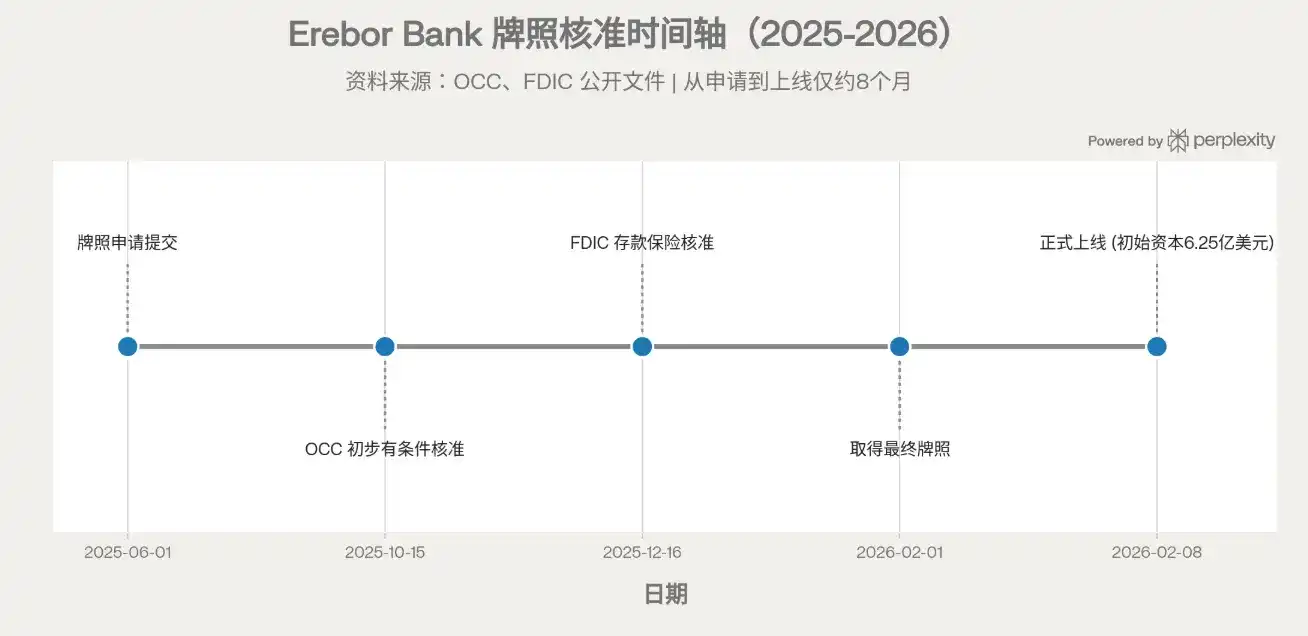
All of this occurred against the backdrop of a noticeable shift in U.S. banking policy: under the leadership of Comptroller Jonathan Gould, the OCC has adopted a regulatory stance explicitly open to digital asset banks. Gould himself praised this charter as an example of a "dynamic and diverse financial system." Combined with the advancement of the federal-level stablecoin framework (the GENIUS Act), previously ambiguous legal territory has been clarified to a significant extent.
Notably, regulators did not give a carte blanche. In exchange for approval, the OCC and FDIC imposed strict conditions: maintaining a Tier 1 leverage ratio of at least 12% for the first three years (approximately double the "well-capitalized" threshold) along with capital maintenance commitments. It can be said that Erebor's feasibility is partly tied to the current political cycle. If the regulatory stance shifts in the future, or if stablecoin and anti-money laundering rules tighten, its entire narrative built on "token-friendly rules" could face headwinds.
Finally, synthesizing external media assessments, Erebor's model almost precisely replicates the lessons from SVB's failure in every single risk factor.
It serves early-stage, tech-heavy companies with non-traditional collateral. It caters to a small number of large accounts (startups, founders, investment funds) rather than thousands of retail customers. The failure or withdrawal of any single client (due to crypto market volatility, significant venture capital pullback) could significantly impact liquidity. Regulators have long pointed out that SVB's "monocrop" customer concentration was a key driver of the bank run.
The crypto correlation exacerbates the issue. If a supported stablecoin de-pegs or crypto prices crash, the deposit base and loan collateral could shrink simultaneously. Beyond this, there are policy reversal risks (its entire narrative bets on relaxed token rules), execution risks in building core systems and on-chain settlement from scratch, and the yet-unverified premise of whether "stablecoins will be widely adopted by clients." Finally, there are reputational and political risks. Luckey's highly controversial political associations, combined with the novelty of a "crypto bank" itself, could amplify market confidence loss if the bank encounters trouble.
It can be said that Erebor is a high-profile experiment at the intersection of banking, crypto, and industrial policy.
It advocates for the market needs arising from the financing gap left by SVB's collapse and the friction in crypto payments. Now, regulators have given their written endorsement, and the team combines tech prestige with Wall Street backgrounds. The execution of this new model, the continuity of the regulatory stance, and the genuine market demand for its integrated services are precisely the points for rigorous market scrutiny.