Sui's Hashi Bridge Bitcoin Deposits Surpass 1.1 Million in 3 Weeks

cryptonews.ru发布于2026-08-18更新于2026-08-18

文章摘要

Sui's Hashi bridge, launched on July 22, has seen over 1.1 million BTC deposited in its first three weeks of testnet activity, with 165,000 BTC withdrawn. This rapid growth suggests early interest from retail and institutional investors in moving native Bitcoin to the Sui network without wrapping it into a synthetic token—a direct response to security concerns following major bridge hacks in recent years. Announced in March 2026, Hashi is a decentralized primitive designed to let native Bitcoin ($BTC) serve as collateral for on-chain lending and borrowing. Unlike traditional wrapped-asset bridges, Hashi does not move Bitcoin off its native chain. Instead, users deposit BTC, Sui validators confirm the transaction, and the protocol mints a representative hBTC token for use in DeFi, while the original Bitcoin remains secured on the Bitcoin blockchain. Security is multi-layered, featuring a 2-of-2 multisig safeguarded by validators using Multi-Party Computation (MPC) and a customizable "Guardian Layer" that acts as a circuit breaker for large withdrawal requests. Over 25 institutions, including BitGo, Cumberland, and Ledger, are currently stress-testing the system, indicating demand for compliant, non-custodial ways to use idle Bitcoin in DeFi. The protocol's revenue model relies on interest rate spreads between lenders and borrowers, rather than inflationary token emissions. If successful, Hashi could become a major link between Bitcoin's $1.4 trillion market and non-Bitcoin ...

Onchain analysts report that activity in the Hashi testnet by Sui has remained high since its launch on July 22: in just three weeks, total deposit volume has exceeded 1.1 million, while withdrawals have reached 165,000.
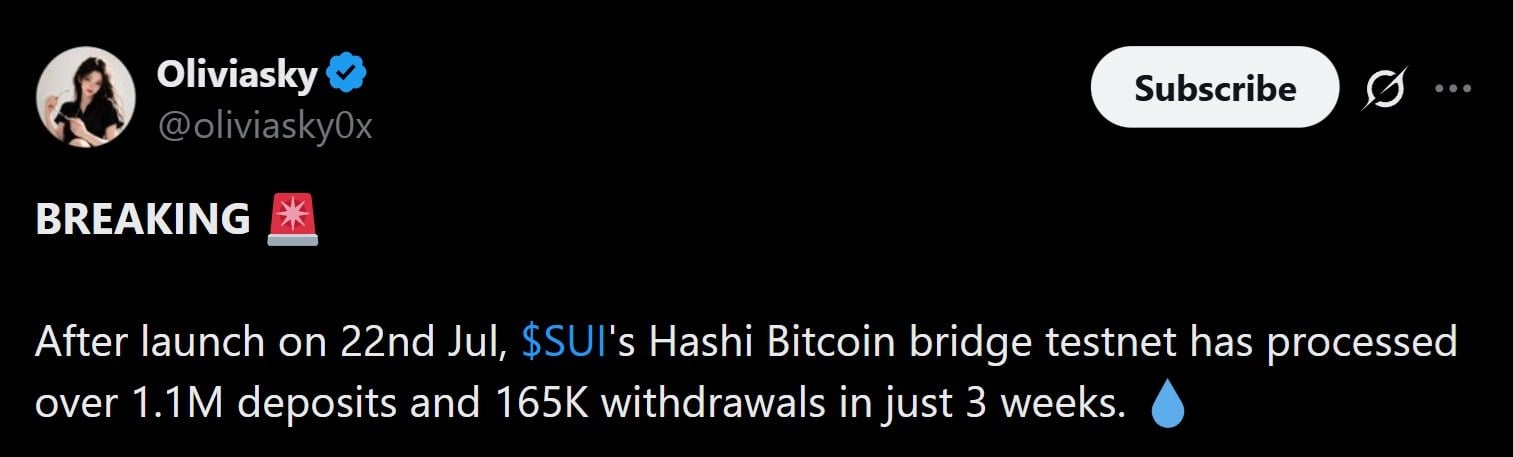
These speeds appear to indicate early interest from retail and institutional investors in transferring native bitcoins to the Sui network without converting the asset into a synthetic token — a model that has come under close scrutiny on other chains after hundreds of millions of dollars were stolen in repeated attacks on storage-based bridges in recent years.

Hashi was first introduced by the Sui Foundation in March 2026 as a decentralized primitive designed to allow Bitcoin ($BTC) to serve as collateral in on-chain lending and borrowing markets. The project went through a closed testnet (devnet) phase before launching the current public testnet, providing developers with access to software development kits (SDKs) and integration guides ahead of the eventual mainnet launch.

Regarding the numbers, it's worth noting that 2026 has been tough for Bitcoin-related decentralized finance (DeFi): the total value locked (TVL) in second-layer BTCFi has fallen by roughly 74% compared to 2025 highs and stood at about 91,000 $BTC by mid-year. Hashi's proposal to keep $BTC in its own chain, rather than "wrapping" it, is a direct response to this skepticism, and the early deposit and withdrawal data gives Sui an argument that this approach is finding its audience despite the overall market downturn.

How Hashi Keeps Bitcoin in Its Original Form

Unlike traditional wrapped asset bridges, Hashi does not withdraw Bitcoin from the Bitcoin network. Instead, users deposit native $BTC, Sui validators confirm the transaction, and the protocol mints hBTC — a representative token that can be used as programmable collateral for institutional lending and borrowing of stablecoins, while the underlying Bitcoin remains in its own chain.

Security is based on a multi-layered architecture where deposits are protected by a "2 of 2" multi-signature, requiring signatures from protocol validators using multi-party computation (MPC) — a cryptographic scheme where no single party ever possesses the full private key.

Finally, withdrawals pass through a "Guardian Layer" — a customizable risk management system functioning as a "circuit breaker" that verifies large withdrawal requests against pre-set thresholds before confirming them. Overall, this architecture aims to avoid the single points of failure that made older cross-chain bridges vulnerable to attacks.

Institutional Investors Back the Protocol

Currently, more than 25 organizations are stress-testing the system, including storage and trading giants such as Bitgo and Cumberland, as well as Swissborg, Fluid, and Ledger. Their involvement spans trading desks, custody infrastructure, and asset management platforms, indicating demand for compliant, non-custodial ways to deploy idle bitcoins into DeFi without taking on the counterparty risk that plagued earlier "wrapped" Bitcoin-based bridges.

The protocol's revenue model relies on interest rate spreads between depositor yields and the amount paid by borrowers for Bitcoin-backed loans, rather than on inflationary token issuance to incentivize activity.

This structure mirrors the pricing approach of traditional credit desks and, in the view of Sui investors, will prove more sustainable after testnet incentives fade and real capital is deployed.

If Hashi can ultimately capture even a small share of the $1.4 trillion Bitcoin market in on-chain lending, it would become one of the most significant examples to date of interaction between the Bitcoin balance sheet and non-Bitcoin DeFi ecosystems.

end-content

热门币种推荐

相关问答

QWhat significant achievement did Hashi from Sui accomplish in its testnet within three weeks of launch?

AWithin three weeks of its testnet launch on July 22, the Hashi bridge from Sui recorded a total deposit volume exceeding 1.1 million BTC, with withdrawals surpassing 165,000 BTC.

QHow does Hashi fundamentally differ from traditional wrapped-asset bridges?

AUnlike traditional wrapped-asset bridges, Hashi does not remove bitcoin from the Bitcoin network. Instead, users deposit native BTC, Sui validators confirm the transaction, and the protocol mints representative hBTC tokens for programmable collateral. The underlying bitcoin remains secure in its original chain.

QWhat is the core security mechanism used by Hashi to protect user deposits?

AHashi's security is based on a multi-layered architecture. Deposits are protected by a 2-of-2 multi-signature scheme that requires signatures from protocol validators using Multi-Party Computation (MPC), ensuring no single party ever holds the complete private key.

QWhat role does the 'Guardian Layer' play in Hashi's withdrawal process?

AThe Guardian Layer is a customizable risk management system that acts as a 'circuit breaker.' It verifies large withdrawal requests against pre-set thresholds before confirming them, designed to prevent the single points of failure that made older cross-chain bridges vulnerable.

QHow does the Hashi protocol's revenue model function?

AHashi's revenue model relies on the interest rate spreads between the income earned by depositors and the amount paid by borrowers for bitcoin-backed loans. It does not rely on inflationary token emissions to incentivize activity, reflecting a traditional credit pricing approach.

你可能也喜欢

交易

现货

热门文章

如何购买S

欢迎来到HTX.com!我们已经让购买Sonic(S)变得简单而便捷。跟随我们的逐步指南,放心开始您的加密货币之旅。第一步:创建您的HTX账户使用您的电子邮件、手机号码注册一个免费账户在HTX上。体验无忧的注册过程并解锁所有平台功能。立即注册第二步:前往买币页面,选择您的支付方式信用卡/借记卡购买:使用您的Visa或Mastercard即时购买Sonic(S)。余额购买:使用您HTX账户余额中的资金进行无缝交易。第三方购买:探索诸如Google Pay或Apple Pay等流行支付方法以增加便利性。C2C购买:在HTX平台上直接与其他用户交易。HTX场外交易台(OTC)购买:为大量交易者提供个性化服务和竞争性汇率。第三步:存储您的Sonic(S)购买完您的Sonic(S)后,将其存储在您的HTX账户钱包中。您也可以通过区块链转账将其发送到其他地方或者用于交易其他加密货币。第四步:交易Sonic(S)在HTX的现货市场轻松交易Sonic(S)。访问您的账户,选择您的交易对,执行您的交易,并实时监控。HTX为初学者和经验丰富的交易者提供了友好的用户体验。

3.6k人学过发布于 2025.01.15更新于 2026.08.06

如何购买S

相关讨论

欢迎来到HTX社区。在这里,您可以了解最新的平台发展动态并获得专业的市场意见。以下是用户对S(S)币价的意见。

活动图片