In 2026, Hong Kong's artificial intelligence sector is experiencing a "high-density explosion." If last month's budget plan, which included a HK$3 billion computing power subsidy, was a shot in the arm for the industry, then the recent series of major academic breakthroughs and high-level industry dialogues indicate that Hong Kong's AI is rapidly transitioning from the "infrastructure development" phase to the deep waters of "application deployment."
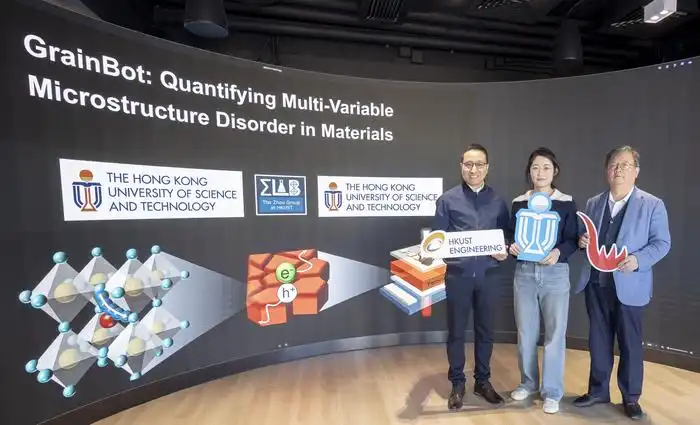
Just yesterday (March 3), while most market observers were still focused on the computing power inflation of NVIDIA's latest GPU or which parameter-heavy general-purpose large model OpenAI had released, a team led by Professor Guo Yike, the Provost of the Hong Kong University of Science and Technology (HKUST), dropped a bombshell in both academic and industrial circles—GrainBot.
This is not just another AI toolbox; it is a quintessential example of "AI for Science" (AI4S) moving from concept to industrial application. As a long-time observer of the quantitative technology and deep tech sectors, I believe the emergence of GrainBot signifies that the focus of Hong Kong's AI development is shifting from "general-purpose chatbots" to "vertical discoveries." For financial professionals, understanding the logic behind GrainBot is key to identifying the alpha in hard tech investments over the next five years.
(Image source: analyticalscience.wiley.com)
To understand the value of GrainBot, we must first understand the "pain points" of materials science.
In the upstream of high-end manufacturing, such as semiconductors, new energy batteries, and photovoltaic panels, material performance often determines the success or failure of a product. And material performance—whether it's conductivity, strength, or corrosion resistance—largely depends on its microstructure, i.e., the size, shape, and distribution of "grains." For a long time, materials scientists have been like artisans with magnifying glasses. They use scanning electron microscopes (SEM) or atomic force microscopes (AFM) to capture thousands of images, then rely on PhD students or researchers to spend hundreds of hours manually identifying, tracing, and annotating the boundaries of each grain. This is not only highly inefficient but also fraught with human subjectivity and error.
The emergence of GrainBot is essentially equipping the microscope with an "L4-level autonomous driving brain."
According to the latest research published in Cell Press's flagship journal "Matter," GrainBot uses advanced computer vision (CV) and deep learning algorithms to automatically perform image segmentation, feature extraction, and quantitative analysis. It no longer requires human intervention to accurately identify grain boundaries and calculate complex geometric parameters such as surface area, groove geometry, and convex-concave volume.
More importantly, GrainBot is not just a "counter." It has the capability for correlation analysis, directly linking these microstructural data to the macro-performance of materials. In validation tests on metal halide perovskite films—a key material for next-generation high-efficiency solar cells—GrainBot successfully built a database containing thousands of annotated grains, revealing previously unquantifiable structure-performance relationships. A statement by Professor Guo Yike at the launch event was particularly forward-looking: "As scientific workflows become more automated and data-intensive, such toolkits will become the key engine for future 'autonomous laboratories.'"
For financial capital, the emergence of achievements like GrainBot means that we need to readjust the valuation models for AI projects. Over the past two years (2024-2025), market enthusiasm for AI has been primarily focused on "general-purpose large models" and "application-layer SaaS." The valuation logic mainly revolved around MAU (monthly active users), ARR (annual recurring revenue), and Token consumption. However, as the marginal effects of general models diminish, capital is beginning to look for new growth points. AI for Science (AI4S) offers a completely different logic: its value lies not in "how many people it serves" but in "how much it shortens R&D cycles" and "how many new materials it discovers."
Taking GrainBot as an example, if it can reduce the R&D cycle for perovskite solar cells from 3 years to 6 months, or help a company like CATL (Contemporary Amperex Technology Co. Limited) discover a new cathode material that increases energy density by 10%, the economic value generated would be exponential.
This is an "industrial IP" logic. The future AI unicorns may no longer be companies developing chatbots, but rather "digital laboratories" that master the core data and algorithms of specific vertical fields (such as materials, biomedicine, and chemical engineering) and can mass-produce patented technologies.
Under this logic, the advantages of Hong Kong's universities are greatly amplified. Unlike Silicon Valley's software engineer-dominated ecosystem, Hong Kong boasts an extremely high density of experts in materials science, chemistry, and biomedicine. This breakthrough by HKUST is the result of deep collaboration between computer science (Professor Guo Yike's team) and chemical engineering (Professor Zhou Yuanyuan's team). This combination of "AI + Domain Knowledge" forms a moat that is difficult for pure internet companies to replicate.
GrainBot is not an isolated case. If we zoom out, we can see that Hong Kong is building a new paradigm for scientific research based on "autonomous laboratories." Autonomous laboratories refer to the use of robotics and AI to achieve full automation of experimental design, execution, data analysis, and iterative optimization. In this closed loop, AI (like GrainBot) is responsible for "seeing" and "thinking," while robots are responsible for "doing." This trend has profound implications for the transformation of Hong Kong's economic structure. For a long time, Hong Kong has been seen as a financial center and trading port, but often considered "lacking" in hard tech R&D. However, with the advent of the AI4S era, the form of R&D is changing—it is becoming more digital and intelligent. Hong Kong does not need vast land for factories like the mainland; it only needs to leverage its computing power infrastructure and top-tier research minds to become a global exporter of "various new material formulations."
Imagine the future Hong Kong Science Park, which might not only have office buildings but also hundreds of "unmanned laboratories" running 7x24. They continuously consume data, analyze results through tools like GrainBot, automatically adjust experimental parameters, and ultimately output high-value patentable formulations. These formulations can then be licensed to manufacturing bases in the Greater Bay Area for mass production. This is version 2.0 of "Hong Kong R&D + Bay Area Manufacturing."
Of course, as rational observers, we cannot ignore the problems and hidden concerns.
The biggest bottleneck for AI for Science remains data. Unlike the massive amounts of internet text used to train ChatGPT, high-quality scientific data (such as perfectly annotated microscope images) is extremely scarce. The success of GrainBot was possible because the team invested significant effort in building an initial high-quality dataset. Furthermore, the "silo effect" of scientific data is more severe than on the internet. The data of every materials company and every laboratory is a core secret. Establishing a secure data sharing mechanism (perhaps incorporating Web3 or privacy computing technologies) to allow AI models to "learn from diverse sources" is key to the next step of commercial deployment.
In the spring of 2026, standing on the HKUST campus overlooking Clear Water Bay, we see not just the scenery but also the generational shift in scientific research paradigms.
The release of GrainBot symbolizes the perfect handshake between the "hacker spirit" (rapid iteration, algorithm-driven) and the "artisan spirit" (meticulous observation, material refinement). For investors, the focus should no longer be solely on who owns the most NVIDIA GPUs, but rather on who can use AI to solve the most specific real-world physical problems.
On this new track, Hong Kong has made a strong start. GrainBot may be just the beginning. Beyond the field of view of the microscope, a trillion-dollar market for AI-driven material discovery is slowly unfolding.