Author:CM
The EF is proposing a new structure, using this opportunity to reinterpret the worldview of Ethereum. Crypto is in a massive wave—where is Ethereum headed?
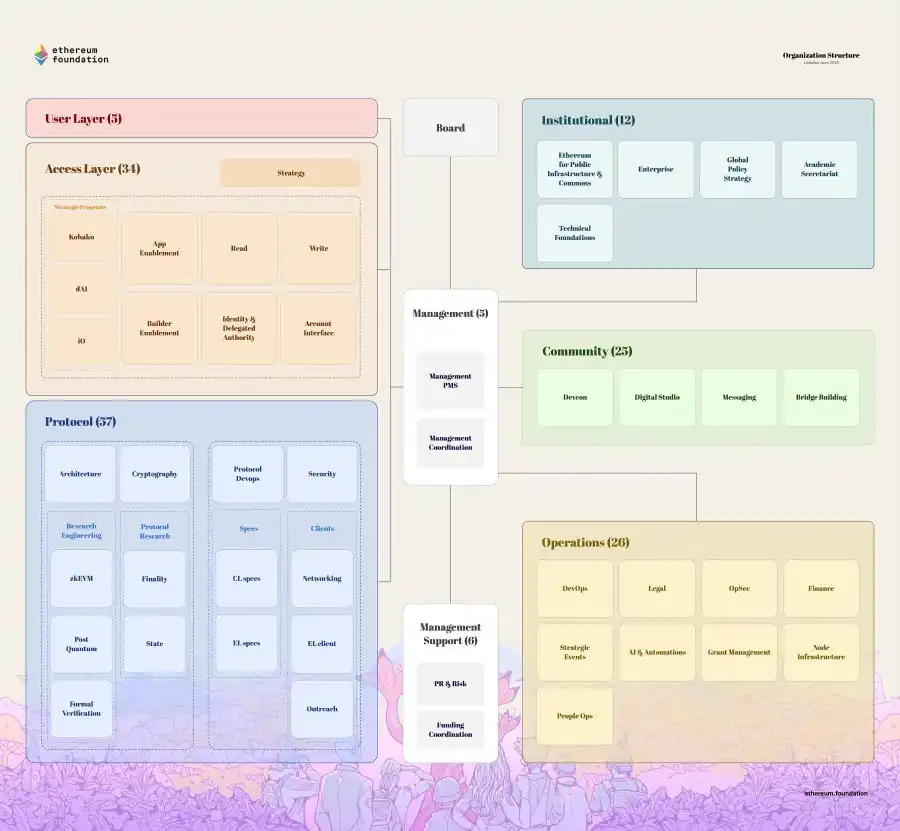
The EF has laid off 20% of its staff and announced a brand-new structure—5 Working Layers. Compared to the previously loose foundation structure, the EF will now clearly define what it should focus on in the coming years. These 5 working layers are:
-
Protocol Layer
-
Access Layer
-
User Layer
-
Community Layer
-
Institutional Layer
We can think of this as the division of work responsibilities within the EF.
1/5 · Protocol Layer
Maintains Ethereum's core properties, which is what Vitalik has been emphasizing: CROPS:
-
Censorship-resistant
-
Robust
-
Open
-
Private
-
Secure
The specific work is more focused on underlying technology, such as safely advancing hard forks, reducing trust dependencies, resisting quantum threats, combating toxic MEV, etc. This part is the EF's foundational task and represents Ethereum's core value. It has always advocated not sacrificing Ethereum's self-sovereign properties for short-term financialization, institutionalization, or market narratives.
Of course, this is difficult in the current environment because, from a user's perspective, embracing institutions and the market is always a safe choice. In reality, I believe decentralization is not an excuse for laziness or evasion in marketing. If we consider Ethereum as a brand-new world, with CROPS as the bottom line of the world order, then actively meeting the needs of various roles in this new world without crossing that line is the only way to give this world its value and quickly escape the utopia of the geek world. This is absolutely the right thing to do. It doesn't necessarily have to be done by the EF, and the EF has repeatedly expressed its position and role. I hope more organizations will do this in the future.
2/5 · Access Layer
The Access Layer focuses on whether users can practically use Ethereum's self-sovereign capabilities. The EF mentions several key actions: reading the chain, transacting, proving, authorizing, exiting. Users, and the agents that will act on their behalf in the future, should be able to perform these operations without relying on unverifiable intermediaries.
There is an important principle here called zero option, which means that for every intermediary path, there must exist a credible, intermediary-free alternative path, and this path must remain consistently available.
I think this is crucial. The most direct example is if one day a frontend goes down or a server fails, you should still be able to operate your funds by directly interacting with the contract. If you've ever been trapped once, you'll deeply understand its significance.
3/5 · User Layer
The task of the User Layer is to ground the EF's work in the real needs of real users and organizations. It will focus on user segmentation and user profiles. Its purpose is to connect the Protocol Layer and the Access Layer, ensuring that development truly reaches users and that these decisions are effective rather than existing in a vacuum.
This is something the EF has been lacking in the past, as many discussions tended to be overly research-oriented or infrastructure-focused. We can clearly see that Ethereum's past prosperity, DeFi summer, NFT summer, basically came from community innovation. There was no intersection between the application end and the technical end, nor was there feedback of needs from the application end to the technical end. Ethereum thus entered an unexpected boom period in a fragmented way.
Some attribute it to luck, others say it was the inevitable result of Ethereum's technical accumulation. In fact, the Ethereum ecosystem did guide the explosion of on-chain applications, and crypto entered a new era, but back then developers and users didn't have many choices, so the smart people and smart money gathered on Ethereum.
Today's situation is quite different. L1s and L2s are everywhere, the cost of launching a chain has dropped rapidly. Although Ethereum still takes security and stability as its biggest moat, when other competitors haven't exposed problems, this value is not easily recognized by users and developers. (I personally agree that security is the biggest moat for a public chain.)
Therefore, the User Layer is the work the EF should pay the most attention to. A new world needs to understand what its inhabitants want.
4/5 · Community Layer
Its purpose is to maintain and disseminate the value consensus of Ethereum.
-
Within the ecosystem: Help the community understand why Ethereum exists, what should be upheld, and what narratives should not lead it astray.
-
Outside the ecosystem: Help the EF connect with adjacent fields such as open source, privacy, civil liberties, and public interest technology.
So what consensus does it aim to establish? Based on the EF's article and my understanding of Ethereum, it can be summarized into the following points:
-
Not to be hijacked by centralized interests.
-
Maintain technological neutrality, not be swayed or influenced by any cultural, political, or other factors.
-
Adhere to the CROPS-based values and not sacrifice any of them for short-term commercial interests.
The loosening of consensus in this cycle is, I think, the most severe in history. In the past, crypto had not entered the mainstream view, the user base was small, there were no applications, and prices were sluggish. None of these problems caused users to lose confidence that decentralization was the future. However, in this cycle, with the launch of spot ETFs for BTC and ETH, the emergence of DAT companies, the U.S. stablecoin bill, and institutions starting to develop L1s, more people have come into contact with crypto, which is a huge success from this perspective. But the impact it brings is slowly becoming apparent. These influences are subtle but are gradually changing the underlying logic of this market.
For example, the massive on-chain issuance of stablecoins has brought TVL but simultaneously replaced the monetary properties of BTC and ETH. How long has it been since we heard the term 'coin-based'? Before USDT was born, exchanges mostly used coin-to-coin trading, often with BTC as the trading pair. During DeFi summer, on-chain LPs mostly used ETH as the trading pair, and NFT summer was priced in ETH. Today, these things are gradually disappearing. The long arm of dollar hegemony has reached the blockchain. DAT companies have even packaged crypto into something they themselves once most despised.
Regarding decentralization, the angle of thinking has shifted from combating the opacity, corruption, and inefficiency of traditional finance to questioning whether institutions need decentralization. Actually, this question doesn't require much thought; institutions' need for decentralization is definitely limited or applicable only in certain special scenarios. The term 'decentralization' is being discussed less and less and is even somewhat mocked.
Of course, I believe crypto has no reason to reject the needs of institutions; it is permissionless, and both institutions and individual users should be accepted. However, if we change the underlying consensus of public chains and the consensus based on decentralization just to welcome the entry of institutions, we cannot define it as wrong. But the final outcome of this move is actually no different from a second internet—a few authoritative institutions control the network nodes. If this situation continues to develop, these chains will quickly become some 'national chain' or 'institutional chain.' Wouldn't it be easy to cut off business with Iran on a U.S. chain? Here, many people compare neutral and decentralized public chains to the high seas, which seems somewhat reasonable.
5/5 · Institutional Layer
Responsible for the EF's interactions with institutions but premised on self-sovereignty. The EF's expression toward institutions is not 'making it easier for institutions to control users' but emphasizes using Ethereum and cryptographic technology to create better integration cases.
This statement is very clear, similar to what we discussed above. Those truly universal, globally serving businesses are still most suitable to be placed on the Ethereum public chain because it will never be interfered with by certain coercive means or factors. Ecosystems with centralized control power find it increasingly difficult to achieve this over time.
A final note: we are in a massive wave and cannot change it. But Bitcoin and Ethereum have experienced countless market changes. Whether the outside world is dawn or darkness, the next block is always produced.