Anxiety of quantum risk to Bitcoin is weighing on its price: Execs

cointelegraph发布于2025-12-19更新于2025-12-19

文章摘要

Quantum computing risks are creating anxiety among Bitcoin investors and affecting its price, according to industry executives. While Blockstream co-founder Adam Down argues the threat is decades away and that the network’s core security doesn’t solely rely on encryption, others like Nic Carter of Castle Island Ventures warn that developer denial is “extremely bearish.” Craig Warmke of the Bitcoin Policy Institute adds that perceived quantum risk is slowing capital inflow and driving diversification. Both emphasize the need for contingency plans to reassure holders, even if the actual threat remains distant. Critics also note that traditional targets would likely be compromised long before Bitcoin.

The response from Bitcoin developers on the risk of quantum computing to the cryptocurrency is weighing down its price and affecting capital flow, crypto industry executives have argued.

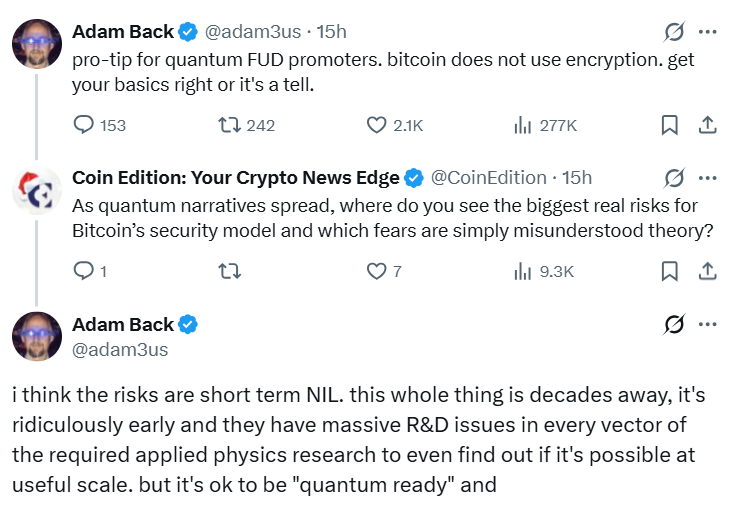
Adam Back, a cypherpunk the and co-founder of Bitcoin infrastructure company Blockstream argued in a series of X posts on Thursday that it is good for Bitcoin (BTC) to be “quantum ready,” but it won’t be a threat for the next few decades, as the technology is still “ridiculously early,” and has research and development issues.

He predicts there will be no risks in the next ten years and even if some parts of Bitcoin’s encryption were broken, it does not rely on encryption for its core security model and “it’s not going to result in Bitcoin being stolen on the network.”
Source: Adam Back

Quantum computing continues to be debated as a potential threat to the crypto industry, as more advanced computers that could break encryption have been theorized as having the capability to reveal user keys and expose sensitive data.

Investors concerned about quantum risk

Nic Carter, a partner at venture capital firm Castle Island Ventures, said in response to Back, that it’s “extremely bearish” that many influential developers “flatly deny that there’s any quantum risk.”

“The discrepancy between capital and developers on this issue is massive. Capital is concerned and looking for a solution. Devs are mainly in complete denial. Inability to even acknowledge quantum risk is already weighing on the price.”

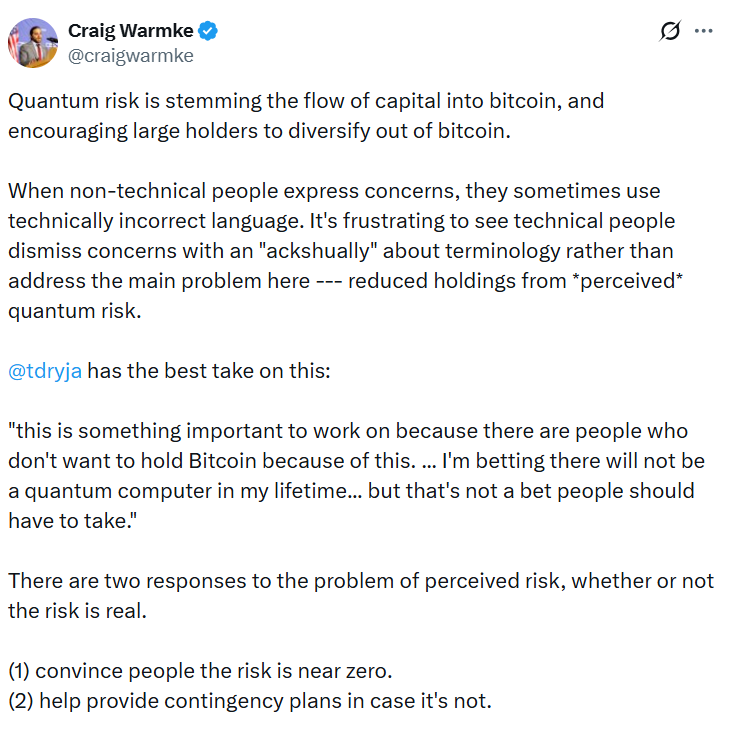
Craig Warmke, a fellow at the think tank, the Bitcoin Policy Institute, agreed, adding that quantum risk is slowing the flow of capital into Bitcoin and pushing larger holders to diversify.

“When non-technical people express concerns, they sometimes use technically incorrect language,” he said, adding it was “frustrating to see technical people dismiss concerns” rather than address the topic of “reduced holdings from perceived quantum risk.”
Source: Craig Warmke

Contingency plans should be in place

Along with the technology being years away from being a threat, critics also argue that banking giants and other traditional targets will be cracked long before Bitcoin.

Related: Bitcoiners push for quantum-resistant BIP-360 upgrade as debate heats up

Carter maintains that companies and even countries are raising significant funds to build quantum computers, and artificial intelligence is helping accelerate the development.

Meanwhile, Warmke said the best way forward, whether or not the risk is real, is to convince people the risk is near zero and help provide contingency plans in case it’s not.

“The only way forward is to develop and converge on contingency plans, just in case, so that people feel more comfortable holding Bitcoin,” he added.

Magazine: Big questions: Would Bitcoin survive a 10-year power outage?

热门币种推荐

相关问答

QWhat is the main concern that crypto executives say is weighing on Bitcoin's price?

ACrypto executives argue that anxiety over the potential risk of quantum computing to Bitcoin is weighing down its price and affecting capital flow.

QAccording to Adam Back, when does he predict quantum computing will become a threat to Bitcoin?

AAdam Back predicts there will be no quantum computing risks to Bitcoin for the next ten years, and it won't be a threat for the next few decades due to the technology being 'ridiculously early'.

QWhat is Nic Carter's view on how developers are handling the quantum risk discussion?

ANic Carter finds it 'extremely bearish' that many influential developers 'flatly deny that there's any quantum risk,' creating a massive discrepancy between capital concerns and developer attitudes.

QHow does Craig Warmke say quantum risk is affecting investor behavior?

ACraig Warmke states that quantum risk is slowing the flow of capital into Bitcoin and pushing larger holders to diversify their holdings due to perceived risks.

QWhat solution does Craig Warmke propose to address quantum computing concerns?

ACraig Warmke proposes that the best way forward is to develop and converge on contingency plans for quantum risk to make people feel more comfortable holding Bitcoin, whether the threat is real or not.

你可能也喜欢

高盛报告拆解中国AI大模型竞争格局:谁将成为长期赢家?

高盛发布报告深入分析中国AI大模型竞争格局,认为行业正处历史拐点。中国开源/开放权重大模型的智能性能已逼近全球顶尖专有模型,凭借架构创新和参数效率,能以远低于美国模型的成本实现接近性能。 报告将竞争演进概括为“从DeepSeek的成本效率时刻到智谱GLM的模型智能时刻”。市场呈现“双层结构”:高端模型(如智谱GLM5.2、阿里Qwen3.7 Max)定价约为每百万token 1美元,推理毛利率约10%-20%;低端模型定价低至每百万token 0.06-0.2美元,主攻价格敏感的中小企业及个人用户。高盛预测,中国AI模型的API及订阅收入将从2026年估算的350亿元人民币增至2030年的8790亿元。 开源是中国模型主流策略,利于部署和生态,但现有纯开源模式导致公司披露的ARR严重低估实际部署规模。行业正逐步转向“开放权重+社区许可证”模式以改善变现。 企业AI使用范式正从“token最大化”转向“ROI优先”。中国模型凭借性价比优势,正加速拓展国际市场,并已入驻AWS Bedrock等全球主流平台。 高盛通过定价能力、成本优势与财务实力三维框架评估长期赢家。在基础文本模型领域,智谱与DeepSeek定位最强;在多模态领域,字节跳动领跑。报告维持对MiniMax和快手的买入评级,看好其发展前景。

marsbit1小时前

高盛报告拆解中国AI大模型竞争格局:谁将成为长期赢家?

marsbit1小时前

交易

现货

热门文章

加密市场宏观研报:《GENIUS Act》法案取得重大进展,BTC突破历史新高,后市全新展望

2025年5月22日,比特币价格正式突破11万美元大关,创下历史新高。在政策面、宏观经济、资金面与投资者结构共同作用下,一场结构性牛市浪潮正在展开。而此轮上涨背后的核心驱动,是美国《GENIUS稳定币法案》的实质性进展以及多项利好的叠加。本文将从政策端突破、宏观环境转向、链上与ETF资金结构、交易行为演化,以及重点受益赛道五大维度,全面解析此轮BTC再创新高的深层逻辑,并前瞻下半年市场的潜在趋势。

1.7k人学过发布于 2025.05.22更新于 2025.05.22

加密市场宏观研报:《GENIUS Act》法案取得重大进展,BTC突破历史新高,后市全新展望

相关讨论

欢迎来到HTX社区。在这里,您可以了解最新的平台发展动态并获得专业的市场意见。以下是用户对BTC(BTC)币价的意见。

活动图片