The new CEO and chief restructuring officer for the bankrupt FTX cryptocurrency exchange, John Ray, has icily responded to the erratic series of tweets from former CEO and founder Sam Bankman-Fried.
⠀
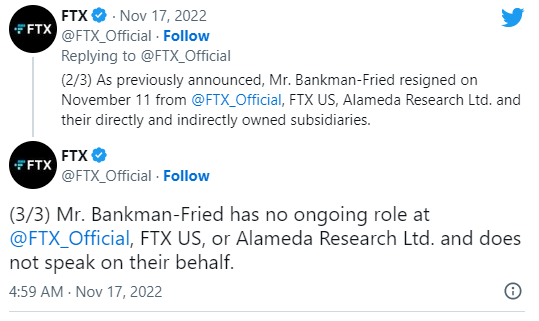
The official Twitter account of FTX on Nov. 16 tweeted a statement from Ray addressing Bankman-Fried’s recent public statements, reiterating he “has no ongoing role at [FTX], FTX US, or Alameda Research Ltd. and does not speak on their behalf.”
⠀
⠀
On Nov. 14 Bankman-Fried began a strange Twitter thread that — over the course of 40 or so hours — eventually spelled out “What HAPPENED” across nine tweets, he then went on to claim he was meeting with regulators, wanting to “do right by customers.”
⠀
Afterward, he began to lay out the finances and leverage of FTX and its sister trading firm Alameda Research on Nov. 16 claiming FTX’s leverage was around $13 billion, not $5 billion as he originally thought.
⠀
FTX’s downward spiral kicked off in early November with a series of events eventually leading to the exchange and its roughly 130 global subsidiaries filing for Chapter 11 bankruptcy in the United States on Nov. 11.
⠀
John J. Ray III took over as CEO on Nov.11 with FTX’s bankruptcy filings. He has gained notoriety for previously overseeing the bankruptcy of former fraudulent energy giant Enron which had around $63.4 billion in assets and was the largest corporate bankruptcy in U.S. history at the time.