Glassnode: Consumer Confidence Falls as AI-Related Stocks Rise, Bitcoin Lags Behind

cryptonews.ru发布于2026-08-17更新于2026-08-17

文章摘要

According to Glassnode, consumer confidence remains at one of its lowest levels in a decade, despite two consecutive months of improvement. This has not stopped households from moving money out of cash, as they expect further cost-of-living increases and a broader economic slowdown. The key question is where this capital is flowing. US stocks hit a new all-time high in early August, primarily driven by trading in AI-related stocks rather than a broad market rally. Bitcoin, historically seen as a hedge against declining trust in traditional finance, has not participated in this movement. Spot Bitcoin ETFs saw outflows of $389.7 million in one week, coinciding with rising equity markets—a divergence that aligns with Glassnode's data on capital flows. Bitcoin is currently trading at roughly half its October 2025 peak, stuck in a narrow range. Meanwhile, AI-related trading continues to attract fresh capital from retail traders, hedge funds, and even crypto-native institutional investors, who are redirecting funds into AI stocks and tokens. The macroeconomic backdrop has not been hostile to Bitcoin, with core inflation at a moderate 2.5% in July. However, Bitcoin's muted response to favorable inflation data is seen as a concerning signal, given its supposed role as a hedge against currency debasement. Spot Bitcoin exchange trading volume has fallen to its lowest since 2019, and recent ETF inflows are only a "fraction of any prior accumulation wave," suggesting institutional buy...

According to Glassnode's assessment, the level of consumer confidence remains "among the lowest levels in the past decade," even after two consecutive months of improvement. This weakness has not stopped households from moving funds from cash into assets, as consumers still expect the cost of living to rise further and overall economic growth to slow. However, the intrigue still lies in where exactly this capital is flowing.
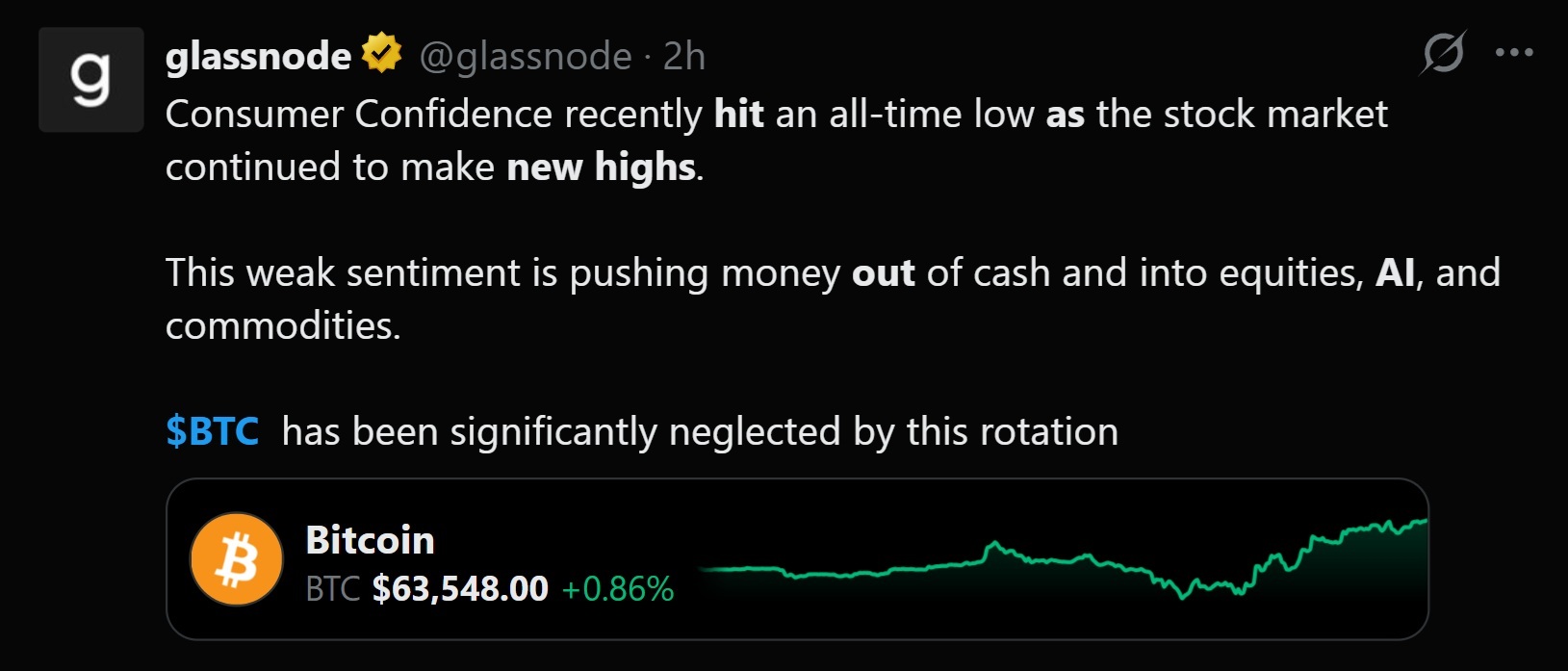
Image source: X

US stocks set a new all-time high on August 7th and have since held just below that level, with the gains almost entirely driven by trading in artificial intelligence (AI)-related company stocks, rather than a broad market rally.

Bitcoin, historically positioned as an asset that wins in situations where consumers lose confidence in the traditional financial system, has not been part of this move. As Bitcoin.com News reported last week, assets under management in spot Bitcoin ETFs shrank by $389.7 million in a single week, even as stock markets continued to rise—this divergence aligns with Glassnode's data on where capital is actually flowing this summer.

Where the Money is Actually Going

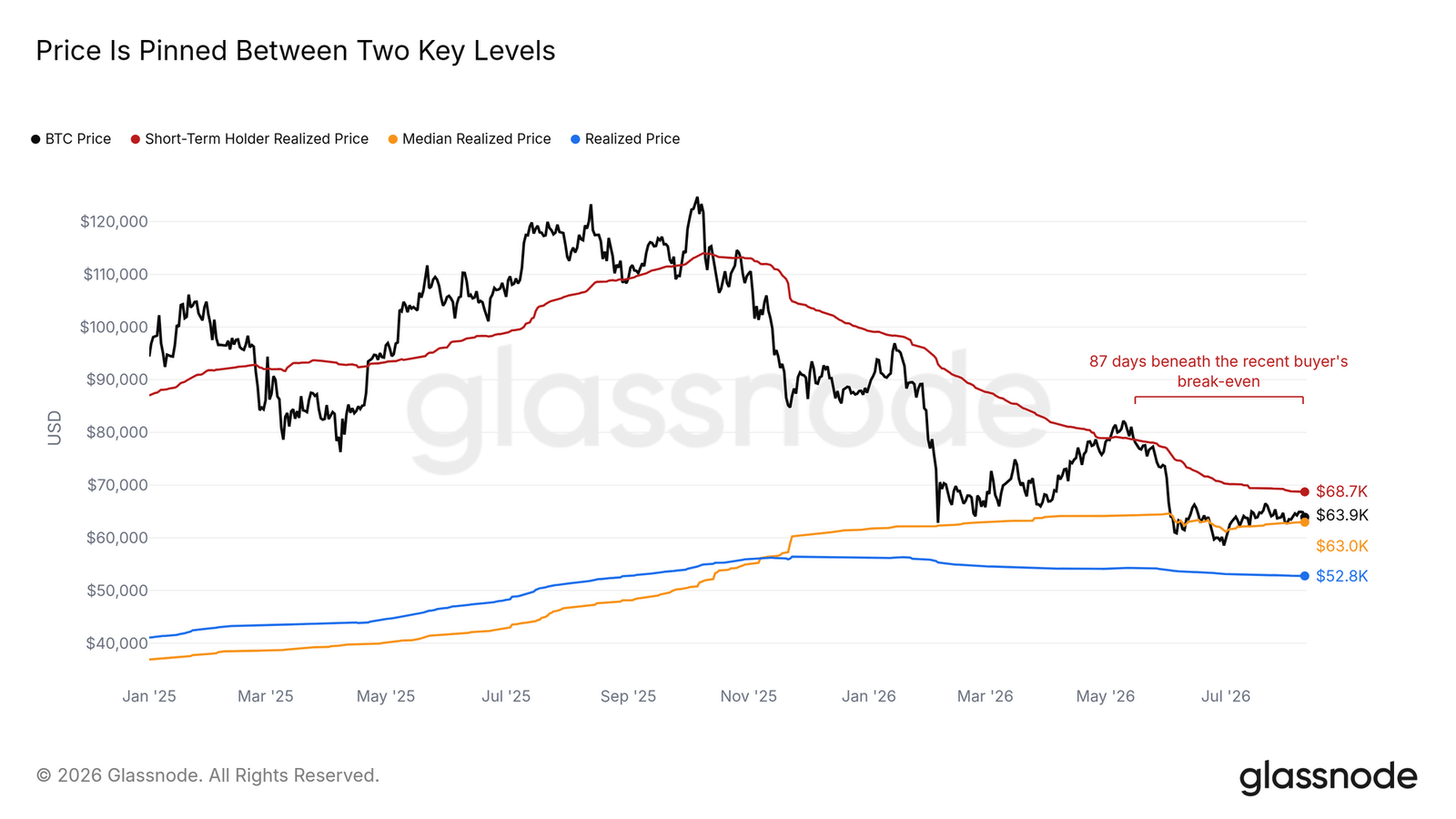
Bitcoin is currently trading at roughly half its October 2025 peak—a sharp drop that has left the asset stuck in a narrow range between its median realized price of around $63,000 and the cost basis for short-term holders of around $68,700.
Meanwhile, AI-related trading continues to attract fresh capital, as retail traders, hedge funds, and even crypto-oriented institutional investors (who once championed Bitcoin as the preferred hedging tool) are instead redirecting their investments into AI-specializing company stocks and AI-related crypto tokens.

The macroeconomic backdrop has not been hostile to Bitcoin, at least on paper: core inflation was 2.5% in July—a relatively moderate level—and the stock market took it as good news, continuing its record run. Bitcoin's muted reaction to favorable inflation data is itself a red flag noted by researchers, given that this asset is supposed to thrive amidst currency devaluation fears and loose monetary policy.

Finally, Bitcoin spot exchange trading volume has fallen to its lowest level since 2019, with recent ETF inflows constituting only a "tiny fraction of any of the past accumulation waves." This may indicate that institutional buying (which was the driver of Bitcoin's rally in 2024 and 2025) has paused.

What This Means for Bitcoin

The trend described by Glassnode—namely, the reorientation of mining and tech companies towards AI instead of digital assets—is manifesting not only in trading flows. Some Bitcoin miners have already begun pivoting their power contracts and data center capacity towards AI workloads, following the same capital rotation that Glassnode is tracking in the stock markets.

From the outside, this movement looks like a structural shift that may continue to put pressure on the narrative of Bitcoin as the "default place" for capital leaving cash.

Nevertheless, none of this actually means the arguments for Bitcoin's devaluation hedging or scarcity have been disproven—it's simply not happening on the timeline crypto optimists expected this summer. Bitcoin.com News recently analyzed a parallel argument that the growing US national debt should structurally have a positive impact on Bitcoin—a thesis that, like the AI capital rotation story, has not yet been clearly reflected in the price.

end-content

热门币种推荐

相关问答

QAccording to the Glassnode analysis, where is capital flowing despite low consumer confidence levels?

AThe capital is flowing primarily into assets, specifically towards stocks of companies related to Artificial Intelligence (AI) and AI-related crypto tokens, rather than into Bitcoin or broad market equities.

QWhy is Bitcoin's recent price action considered concerning by researchers mentioned in the article?

ABitcoin's muted reaction to favorable July inflation data (2.5% core inflation) is a concerning signal because the asset is supposed to thrive in environments with currency devaluation concerns and loose monetary policy, yet it failed to rally.

QWhat does the record low spot Bitcoin exchange trading volume, coupled with weak ETF inflows, potentially indicate?

AIt potentially indicates that institutional buying, which was a driving force behind Bitcoin's rallies in 2024 and 2025, may have paused or stalled.

QHow are some Bitcoin miners adapting to the capital rotation trend described by Glassnode?

ASome Bitcoin miners are starting to repurpose their power contracts and data center capacity towards Artificial Intelligence (AI) workloads, following the same capital rotation from digital assets to AI seen in the stock markets.

QWhat does the article suggest about the structural narrative of Bitcoin as a default destination for capital leaving cash?

AThe article suggests that the current capital rotation into AI represents a structural shift that may continue to pressure the narrative of Bitcoin being the default destination for capital exiting cash, even though the long-term arguments for Bitcoin (scarcity, hedge against devaluation) are not disproven.

你可能也喜欢

交易

现货

热门文章

加密市场宏观研报:《GENIUS Act》法案取得重大进展,BTC突破历史新高,后市全新展望

2025年5月22日,比特币价格正式突破11万美元大关,创下历史新高。在政策面、宏观经济、资金面与投资者结构共同作用下,一场结构性牛市浪潮正在展开。而此轮上涨背后的核心驱动,是美国《GENIUS稳定币法案》的实质性进展以及多项利好的叠加。本文将从政策端突破、宏观环境转向、链上与ETF资金结构、交易行为演化,以及重点受益赛道五大维度,全面解析此轮BTC再创新高的深层逻辑,并前瞻下半年市场的潜在趋势。

2.0k人学过发布于 2025.05.22更新于 2025.05.22

加密市场宏观研报:《GENIUS Act》法案取得重大进展,BTC突破历史新高,后市全新展望

相关讨论

欢迎来到HTX社区。在这里,您可以了解最新的平台发展动态并获得专业的市场意见。以下是用户对BTC(BTC)币价的意见。

活动图片