Author: Prathik Desai, Token Dispatch
Compiled by: Saoirse, Foresight News
"When the capital development of a country becomes a by-product of the activities of a casino, the job is likely to be ill-done." – John Maynard Keynes, 1936
The crypto industry is often criticized, with the common perception that it is entirely driven by speculation, and many label it as a casino with no fundamental support. But many fail to realize that speculation is often a leading signal of market evolution. A group of speculators, scorned by the mainstream, gather together to form liquidity, and the mature, compliant businesses of the future are built upon this very liquidity.
In this article, I will analyze this evolutionary path in light of recent phenomena in the crypto market: a public chain originally intended for stock trading launches a Meme coin issuance platform; a perpetual futures trading platform transforms into infrastructure for bulk commodity trading; and a brokerage firm, relying on funds from frog-themed tokens, supports the construction of its on-chain stock trading system.
The story unfolds......
In the crypto space, speculation has many names: market noise, bubbles, casinos. But one point is almost never acknowledged: in the industry's march towards maturity, speculation can become the foundation upon which upper-layer business models grow.
However, it must be clarified: not all bubbles can transform into foundations. Bubbles that remain purely speculative for too long will eventually burst quickly. But if a bubble can combine with a sustainable trading scenario and continuously generate trading activity, it can become the foundation, supporting the landing of more businesses.
This is not a new phenomenon; it has been repeated throughout the long history of finance.
Consider the Chicago grain market in the 1840s. The Chicago Board of Trade introduced futures markets with the original intention of helping farmers, whose harvests were highly uncertain, lock in selling prices in advance to minimize losses. But for every farmer wanting to sell grain forward, there needed to be a counterparty willing to take on the long side of the forward contract and bear the price risk. Speculators filled this gap. The essence of a functional risk transfer market is speculative capital voluntarily taking on the price risk that farmers wanted to shed.
The key to the birth of the futures market was the decoupling of "physical grain" and "grain as a traded commodity." American historian William Cronon termed this process the abstraction of grain. Once grain trading was simplified into warehouse receipt notes, ownership could be freely transferred, allowing speculators to participate in trading on a large scale. Massive speculative trading created sufficient liquidity, enabling farmers to always find counterparties. This ample liquidity ultimately allowed Chicago to grow into the global pricing center for wheat.
Interestingly, at the time, a large number of people resisted and despised this type of trading. The Grange Movement openly criticized exchange speculators, accusing them of profiting from farmers' labor. Yet this mechanism eventually evolved into indispensable price discovery infrastructure for the global agricultural economy. If there had been no speculators acting as counterparties in the 1870s, the global wheat market today would not have a mature pricing system.
Economist John Maynard Keynes's remarks on speculation are well-known, but his complete view more clearly reveals the dual role of speculation. Keynes divided market activities into two categories: enterprise investment, which forecasts the earnings an asset will produce over its full lifetime; and speculation, which forecasts the psychology of the market. He feared that in markets with ample liquidity, speculation would cannibalize enterprise investment.
A closer reading of his discourse shows speculation's dual nature.
"Speculators may do no harm as bubbles on a steady stream of enterprise. But the position is serious when enterprise becomes the bubble on a whirlpool of speculation. When the capital development of a country becomes a by-product of the activities of a casino, the job is likely to be ill-done."
Speculation that exists independently of underlying assets is highly risky; but if speculation is anchored to valuable underlying assets, it can play a positive role.
As early as the first known book on securities markets – Joseph de la Vega's "Confusion of Confusions" written in 1688 – the author noted that the Amsterdam Exchange attracted both investors and gamblers. Most existing exchanges started this way. But over time, this history faded, and a stereotype formed: that serious investment needs were the original purpose of exchanges. This is not the case.
Looking at the Present
On August 5th, the crypto industry's largest decentralized exchange, Uniswap, launched the Pools issuance platform, allowing users to issue and trade Meme coins on Robinhood Chain. This blockchain was built by the eponymous brokerage firm, initially aiming to serve its 30 million funded accounts for tokenized stock trading.
The story goes much further. Before the Pools platform officially launched, traders unearthed the yet-to-be-public smart contract, conducting over $150 million in trades through it. This forced Uniswap to simultaneously support both the test and official contract versions and delay the launch plan. The platform's top token, FRONG, named after the frog video filename used in Uniswap's pre-launch promotional material, was minted six days early via the same contract; on the day the platform officially opened, the token had 12,141 holders.
Interpret this as you will: approximately $150 million in capital traded a frog-themed token on infrastructure not yet officially operational, built on a public chain originally designed for securities trading. FRONG has now become the unofficial mascot of the Pools platform. It's hard not to suspect this was a deliberately orchestrated move to drive traffic to Uniswap's latest V4 version chain. Even if not planned, on-chain Uniswap V4 daily trading volume surged from $86.2 million to $228.3 million, nearly tripling.
But as stated at the article's outset, not all bubbles and speculation can foster sustainable business models. Whether a speculative activity can last long-term depends fundamentally on *what* it is speculating on. We can look at shturl.c.
For years, shturl.c has made speculation its core product and is now one of the largest Meme coin issuance platforms. Seventy percent of Meme coins on the platform have a lifespan of less than a day, with only a tiny fraction surviving over a month.
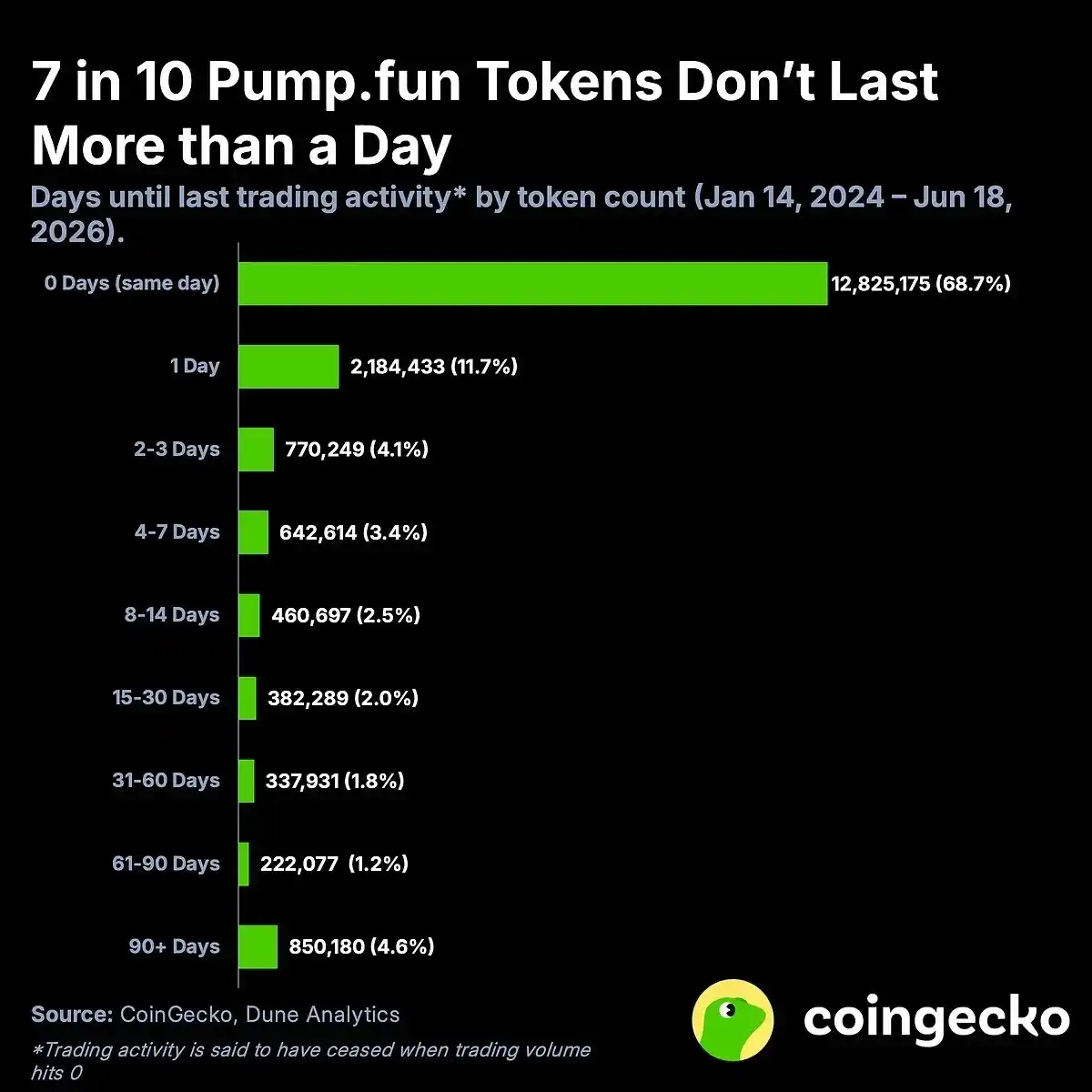
@Coingecko
From January–July 2026, the protocol's fee revenue nearly halved compared to the same period last year, reaching only $420 million. Despite this, it remains one of the crypto industry's most revenue-generating protocols, with annual revenue of $620 million and a net profit of $584 million last year.
Hyperliquid is another platform of this type. It initially focused on high-leverage cryptocurrency trading, catering to traders' directional bets. Later, it extended the leveraged trading model to various assets for round-the-clock trading, unrelated to crypto. Under the HIP-3 governance framework, the platform has now launched perpetual contracts for Nvidia, Tesla, Nasdaq tracking products, gold, crude oil, silver, stock indices, and more. When oil-related news breaks on a Sunday, traders can immediately take positions, while traditional markets wait until Monday to open.
In early July, the platform's real-world asset perpetual contract volume historically surpassed cryptocurrency trading for the first time, accounting for 52% of total volume.
Although Hyperliquid's overall trading volume has shrunk by nearly half from its 2025 peak, growth in real-world asset trading has offset the decline in crypto trading pairs. This is precisely the value speculation can create: Hyperliquid migrated the leverage trading model that attracts native crypto users to assets like gold, pre-IPO company equity, and stock indices, building a new round-the-clock pricing layer. Many traditional trading platforms are now emulating this model.
Robinhood Chain is replicating this development path in real-time.
Although the team positions this public chain as underlying infrastructure for on-chain stock trading, CEO Vlad Tenev is happy with the traffic brought by Meme coin traders.
"We built Robinhood Chain with the goal of being the best public chain for real-world asset trading... but it's also excellent for trading Meme coins."
Riding the wave of Meme coin trading, the chain surpassed Base chain in daily active users within three weeks of launch. The traffic and capital from Meme coin trading serve as the seed capital for the future development of the on-chain stock trading system.
Of course, this doesn't guarantee that speculation will inevitably upgrade into a mature business. Whether this transformation can be completed depends on the platform's own choices.
Robinhood, with 30 million funded users and multiple business lines, has strong distribution capabilities that could potentially convert the traffic from Meme coin trading into a user base for on-chain securities trading. We can see that its Q2 prediction market revenue skyrocketed over tenfold year-over-year to $156 million, accounting for 20% of the platform's total trading revenue.
The Nature of Speculation
Many still fail to understand speculation. Speculation itself is neither absolutely good nor bad. Stripped of all labels, speculation is simply one of humanity's oldest instincts.
When people convert their views into financial bets, speculation is naturally born.
In its most primitive form, speculation is the search for liquidity to price an asset; wherever liquidity flows, it prices that asset. The asset can be a sack of wheat, Nvidia stock, a frog video named frong.mp4, the outcome of a football match, or the probability of a presidential candidate winning.
The attributes of the underlying asset itself determine the direction and boundaries of speculation. Once speculation loses the support of a valuable underlying asset, the hype generated by the same capital ultimately struggles to precipitate long-term, valuable outcomes. This rule runs through the history of finance, and the crypto industry is treading the same path.
Hyperliquid tied leverage trading to assets like gold, building a new pricing system in just two years; Robinhood leverages the unexpected traffic from Meme coin speculation to simultaneously build the underlying channels for on-chain securities trading.
What kind of system speculation ultimately constructs depends on how much value the underlying asset can bear.