Author: Long Yue, Wall Street News
When AI, reindustrialization, defense modernization, and sovereign debt vie for capital simultaneously, Goldman Sachs believes this battle for capital will rewrite the investment paradigm—with the Fed merely an observer in this grand drama.
For decades, the backdrop of the global economy was "savings glut"—abundant capital, low interest rates, with money struggling to find a home.
This era is coming to an end.
Mark Wilson, head of Goldman Sachs' European hedge fund business, states bluntly in his latest weekly note: "We are in the most capital-hungry investment cycle ever."
The driving forces are not singular. AI infrastructure construction itself is extremely capital-intensive, but that's just one strand. Concurrently, reindustrialization, reinvestment in defense, rebuilding power systems, supply chain realignment under deglobalization pressures, coupled with sovereign nations' financing needs to cover rapidly rising interest payments and ballooning welfare expenditures—multiple demand curves are rising simultaneously, naturally pushing up the price of capital.
Wilson's conclusion: this capital competition "is likely to be a persistent medium-term feature, driving capital pricing and costs structurally higher, thereby changing the investment paradigm relative to recent history."
The Fed Is a Passenger, Not the Driver
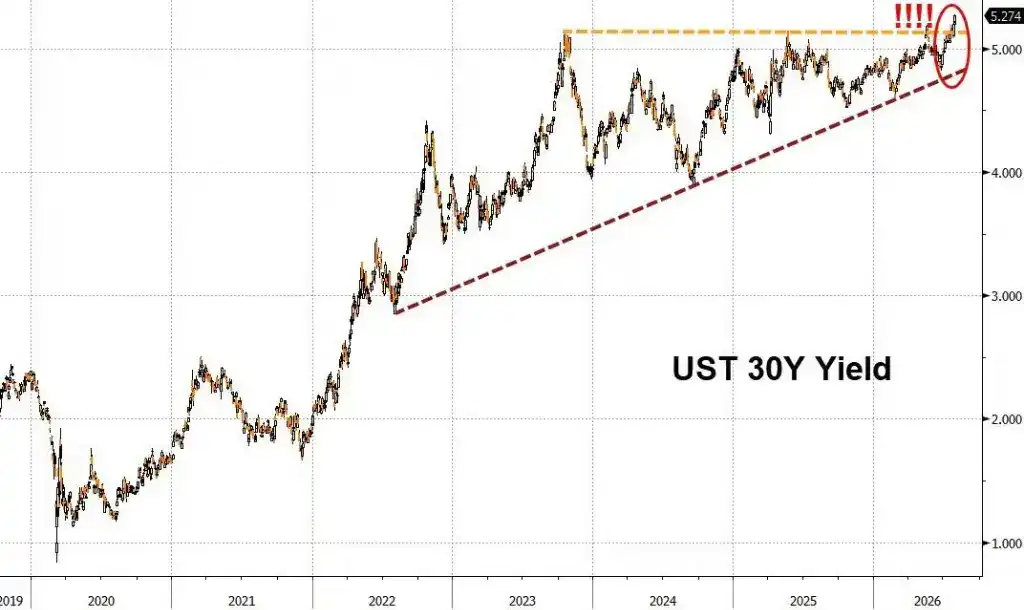
This week, the yield on the 30-year U.S. Treasury decisively broke higher, reaching levels unseen before the Global Financial Crisis (pre-GFC).
The backdrop for this breakout is newly appointed Fed Chair Wash deliberately reducing forward guidance, significantly increasing market uncertainty about the policy path. Wilson cites historical data: "Looking back at the six Fed chairs since 1970, Bernanke and Yellen each experienced a 10% pullback in their first year, while the other four saw pullbacks ranging from 20% to 36% in their first year." Markets have historically not fared well early in a new chair's tenure.
But Wilson states clearly: "I agree the Fed is more of a passenger than a driver in this conversation."
In other words, the fundamental driver of rising yields is not monetary policy, but the aforementioned structural capital demand. "Given the capital competition described at the opening, do not expect this breakout to reverse quickly."
Index Calm, Turbulence Beneath the Surface
For investors solely focused on index moves, July seemed calm. But Wilson points out, "underneath the indices, the moves have been historic."
Two themes played out simultaneously:
First, extreme stock dispersion. Just looking at last Friday: Amazon surged 15% in a single day, Apple plunged 10%—this level of divergence on the same day between the world's two largest companies by market cap is itself highly unusual.
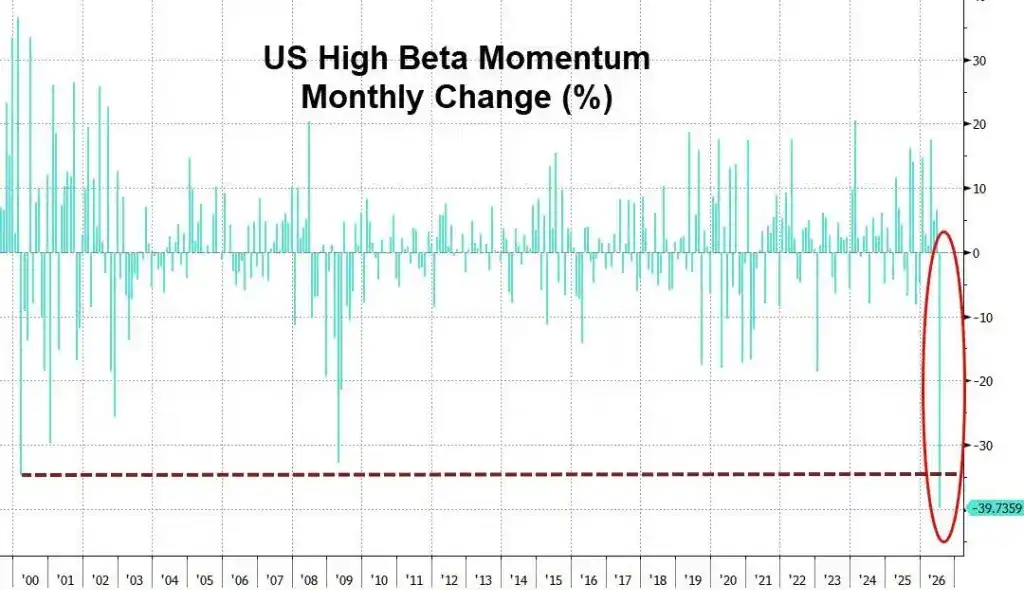
Second, momentum factor collapse. This market-neutral portfolio experienced a 40% drawdown, surpassing the extreme factor rotation records set during the tech bubble burst in March 2000, "creating significant difficulties for many in effective risk management."
The result was massive de-risking. Goldman Sachs Prime data shows fundamental managers' gross exposure falling to a one-year low, net long positioning retreating to the bottom quartile. Wilson believes the market structure is now "much cleaner" after this washout.
August: Why It's Not Time to Rush In
With de-risking complete, does that mean it's time to go long? Wilson offers several reasons why July's price action may not reverse:
-
The impact of the rate breakout hasn't been fully digested, with related recalibrations still underway;
-
Extreme volatility in July (e.g., KOSPI up 18% in a day, SK Hynix up 26% in a day) has altered risk model input parameters, making it impossible for many institutions to quickly re-leverage;
-
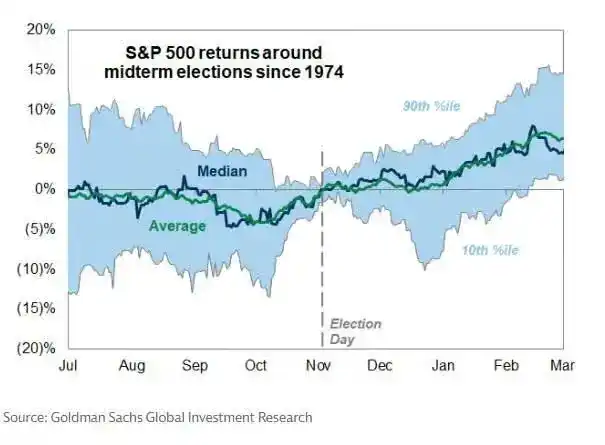
Looking ahead 3 to 6 months, the outlook is not straightforward—focus after summer will shift to the US midterm elections. Wilson cites data: in the 13 midterm election years since 1974, the median return for the S&P 500 from early August to Election Day is 0%.
August is likely to be a digestion period.
Fundamentals: Strong Earnings, but Internal Divergence
Despite sharp market volatility, the fundamental picture remains surprisingly robust.
Wilson notes that, unlike typical years, EPS expectations for 2026 and 2027 have been consistently revised upward throughout the year. Q2 results were generally strong, but the second derivative is starting to diverge: US quarterly EPS growth is expected to peak this quarter at around 26%; while Europe's H1 EPS growth was 13%, H2 is expected to accelerate to 19%, forming a rare pattern of H2 strength.
Memory chips are an exception. Despite being one of the best-performing sectors year-to-date, marginal sentiment signals are deteriorating: spot DRAM prices are stabilizing, progress in low-memory-consumption model technology is accelerating, and more critically—after Chinese memory chipmaker CXMT's IPO, its stock price has surged 6x from the offering price, with a market cap exceeding $550 billion, signaling a significant future supply expansion.
Hyperscalers: "Staggering" Capex, but Returns Are Equally Impressive
The most important validation question this earnings season was whether hyperscale cloud companies could signal strong enough revenue growth and ROI while raising capital expenditure.
The answer is yes—at least for Amazon and Microsoft.
Goldman Sachs' current capex forecasts for Alphabet, Amazon, and Microsoft are as follows:
-
Alphabet: $350 billion in 2027, $415 billion in 2028
-
Amazon: $325 billion in 2027, $366 billion in 2028
-
Microsoft: $262 billion in 2027, $284 billion in 2028
Wilson bluntly says this scale is "staggering."
But simultaneously, business performance is equally impressive: Google Cloud growth accelerated to 82% YoY; Microsoft confidently described enterprise customers moving from "frontier models" to "frontier ecosystems" (infrastructure that routes requests between the most suitable model capabilities); AWS revenue growth accelerated to its highest level since the pandemic.
Most impactful was the direct statement from Amazon's management on the earnings call:
"AI revenue annualized run rate increased materially sequentially and is now over $25 billion, growing triple digits year-over-year."
"We see the margin and return profile of the AI business running slightly ahead of the trajectory we saw when we built the cloud business."
"Even with 2026 capex at $220 billion, we will not have enough capacity to meet all demand in 2026, likely the same in 2027, and the scale of demand for 2028 is already staggering... We have long believed AWS could be a hundreds of billions of dollars revenue business, now we believe it will be at least double that, and will likely become a $1 trillion annual revenue business, accompanied by highly attractive free cash flow and returns on invested capital."
Private Sector vs. State Sector: A Contradictory Transition Period
Wilson concludes with a macro framework: the present is a transition period.
Private-sector hyperscalers are racing to invest, accelerating toward an AI-enabled future; while the state sector is increasingly capital-constrained, with the contradiction between the two set to become more pronounced.
"Global economic reality will, at some point, force people to confront the political choices inevitably required by the repricing of capital—but that is a discussion for another day."
For now, the AI super-cycle remains ahead, and August is likely a relatively calm window for digestion.