Bitcoin demand stays weak despite $1B USDT injection – Here is why!

ambcrypto发布于2026-07-10更新于2026-07-10

文章摘要

Bitcoin is exhibiting a clear divergence between spot and derivatives markets. While futures demand has rebounded sharply, spot demand remains weak, indicating the current recovery is primarily driven by leverage. This makes the rally fragile and vulnerable to a sharp correction, especially amid renewed macro uncertainty from events like U.S.-Iran tensions. Recent data supports this cautious view: spot Bitcoin ETFs saw net outflows, and the Coinbase Premium Index turned negative, signaling weaker U.S. institutional demand. Despite Tether injecting $1 billion in new USDT, much of this liquidity appears to be sitting on the sidelines rather than flowing into Bitcoin spot purchases. This fresh capital could further fuel speculative derivatives activity instead of attracting real buyers. Historically, the current bear market of 248 days is shorter than previous major cycles (381 days in 2022, 385 days in 2018), suggesting the broader downtrend may have further room to run. In summary, Bitcoin's bear cycle remains intact, with the recovery being led by fragile derivatives speculation rather than strong spot demand.

Bitcoin is showing a textbook spot-versus-derivatives divergence.

However, how this setup plays out depends on the broader macro environment.

In a risk-on market, higher derivatives activity can support more upside. In a risk-off market, rising leverage increases the risk of a sharp correction. Recent U.S.-Iran uncertainty brought macro FUD back into the market.

However, the Crypto Fear & Greed Index held above extreme fear. That resilience has revived the debate over whether BTC’s bear market could be nearing its end.

History, however, tells a different story.

As the chart shows, Bitcoin’s current bear market has lasted 248 days. By comparison, the 2022 bear market lasted 381 days, while the 2018 one lasted 385 days, suggesting the current cycle may still have further room to run.
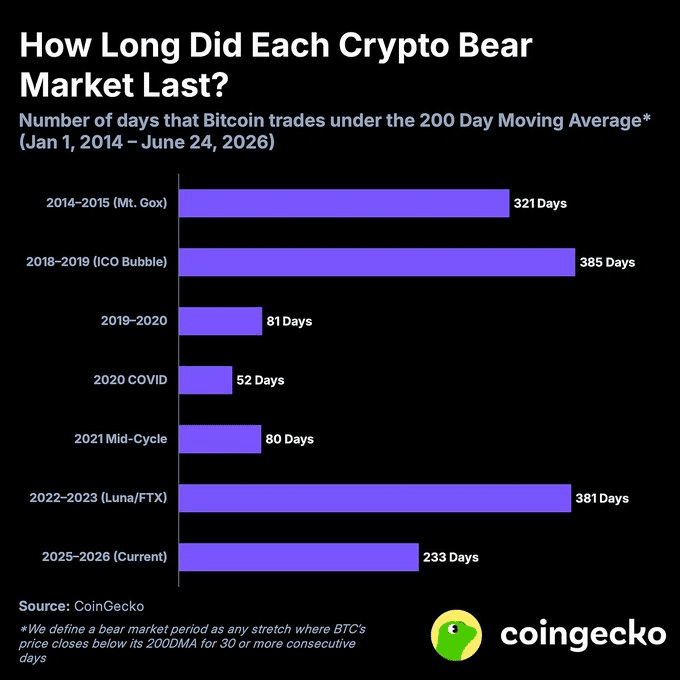
Source: CoinGecko

Institutional positioning also supports that view.

As the market flipped risk-off, spot Bitcoin ETFs saw more than $85 million in net outflows after three straight days of inflows, showing how quickly institutions pulled back as macro uncertainty returned.

Bitcoin’s Coinbase Premium Index tells a similar story.

The index has flipped negative, signaling weaker U.S. spot demand and suggesting institutional buyers have become more cautious as risk sentiment deteriorates.

Taken together, the data suggest Bitcoin is still far from a sustained risk-on environment, with the broader bear cycle remaining intact. Against this backdrop, the growing spot-versus-derivatives divergence becomes even more important.

So, what is it telling us about Bitcoin’s next move?

Bitcoin derivatives surge as spot demand lags

In a volatile market, liquidity injections can send mixed signals.

This time, the timing looks more bearish than bullish.

Tether recently minted $1 billion in fresh USDT even as the overall stablecoin market continues to shrink. Rather than flowing into risk assets, much of that liquidity appears to be sitting on the sidelines, suggesting investors are holding dry powder instead of buying Bitcoin.

The chart below shows why that matters.

Bitcoin’s 30-day cumulative demand has rebounded sharply from nearly -500,000 BTC to around -75,000 BTC, but the recovery has been driven almost entirely by derivatives. Futures demand has surged from roughly -295,000 BTC to slightly positive, while spot demand remains weak at around -78,000 BTC.
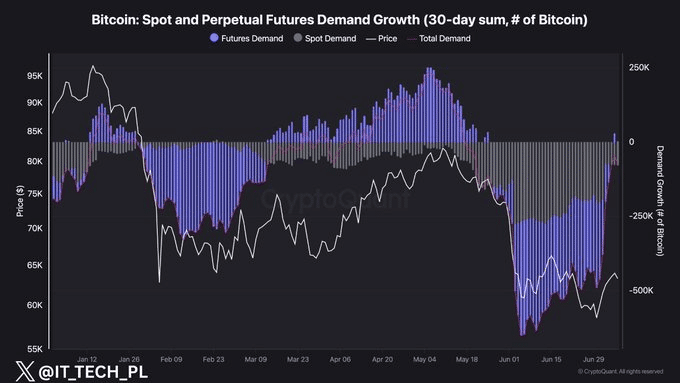
Source: CryptoQuant

Naturally, that leaves Bitcoin in a clear spot-versus-derivatives divergence.

Against this backdrop, the recent $1 billion USDT injection could add more fuel to Bitcoin’s derivatives market than its spot market.

With speculative positioning already leading the recovery, the fresh liquidity could drive leverage even higher instead of attracting real spot buyers. That would leave Bitcoin’s recovery more vulnerable to a sharp flush if sentiment flips risk-off.

In that context, Bitcoin’s bear cycle still looks far from over. If history is any indication, the current cycle has yet to reach the length of previous bear markets.


Final Summary

  • Bitcoin’s recovery is being driven by leverage, while spot demand remains weak, making the rally more fragile.
  • With macro uncertainty still high and fresh USDT liquidity entering the market, Bitcoin’s bear cycle may still have further to run.


热门币种推荐

相关问答

QAccording to the article, what does the divergence between spot and derivatives markets indicate about Bitcoin's current situation?

AThe divergence indicates that Bitcoin's recent price recovery is being driven primarily by increased leverage and speculative activity in the derivatives market, while underlying spot demand from institutions and investors remains weak. This makes the rally more fragile and vulnerable to a sharp correction if market sentiment turns negative.

QWhat is the significance of the recent $1 billion USDT injection mentioned in the article?

AThe $1 billion USDT injection is significant because it occurred while the overall stablecoin market is shrinking. The article suggests this new liquidity is not flowing into buying Bitcoin in the spot market but is instead sitting on the sidelines as 'dry powder' or potentially fueling more leverage in the derivatives market, which does not support a sustainable price recovery.

QHow does the article use historical bear market data to assess the current Bitcoin cycle?

AThe article compares the length of the current bear market (248 days as of the writing) to previous major bear markets in 2022 (381 days) and 2018 (385 days). It argues that because the current bear market is shorter than these previous cycles, it suggests the downturn may still have further room to run and is not necessarily near its end.

QWhat evidence does the article provide to show that institutional demand for Bitcoin is weak?

AThe article points to two key pieces of evidence: 1) U.S. spot Bitcoin ETFs saw over $85 million in net outflows after a brief period of inflows, showing institutions quickly pulled back amid macro uncertainty. 2) The Bitcoin Coinbase Premium Index turned negative, signaling weaker spot buying demand from U.S. institutional investors on the Coinbase exchange.

QWhat is the overall conclusion of the article regarding Bitcoin's near-term outlook?

AThe overall conclusion is that Bitcoin's bear cycle remains intact and is far from over. The recovery is seen as fragile due to being fueled by derivatives leverage rather than strong spot demand. Combined with ongoing macroeconomic uncertainty and historical cycle analysis, the article suggests the bear market may still have further to run.

你可能也喜欢

华尔街交易员将加密货币市场的活跃时段转移至工作日

华尔街交易员正在将加密货币市场的主要活跃时段转移到工作日。几十年来,华尔街遵循着严格的作息,周末市场休市。然而,加密货币市场全天候运作的特性,正迫使机构投资者改变等周一开盘的习惯。 这种不间断的交易环境改变了市场参与者的风险管理方式和价格反应模式。机构资本的涌入本应带来稳定并降低波动性,但实际上却导致了结构性转变和流动性错配。早期,加密货币市场约25%的交易量发生在周末。如今,据Kaiko Research数据,周末交易份额已降至16%,价格发现过程几乎完全转移到了美国市场时段(美东时间9:30-16:00)。纽约交易台关闭后,机构的“安全网”随之消失,市场不确定性增加。 BridgePort公司的分析显示,周末市场更为脆弱:平均交易成本因价差扩大而增加11%;执行一笔10万美元交易的市深度恶化近9%;整体显示流动性较工作日下降超5%。这意味着周末只需更少交易量就能引发剧烈价格波动,小规模下跌可能演变成连锁反应。 美国比特币现货ETF的巨大成功是改变市场根本结构、加剧这种差异的关键因素。ETF在工作日提供了稳定需求,但其在周末的完全缺席造成了流动性真空。自2025年10月以来,投资者从美国现货ETF撤资超50亿美元,这在工作日能被深度市场吸收,但在周末可能引发严重动荡。 因此,周末交易如今需要格外谨慎。市场深度变浅且缺乏大型做市商,大幅增加了价格突然跳空和滑点的风险。理解这些流动性运作的隐含机制,已成为在新金融现实中取得成功的关键。

cryptonews.ru31分钟前

华尔街交易员将加密货币市场的活跃时段转移至工作日

cryptonews.ru31分钟前

每一次对CLARITY法案的投票都将被评估:300万加密货币支持者希望参议员投“赞成”票

美国加密货币倡导组织Stand With Crypto于7月27日宣布,将把参议员对《CLARITY法案》的投票记录纳入其公开立法者评分系统,以代表其300万美国支持者。该组织的评分可供加密货币持有者在11月中期选举前比较候选人立场,并呼吁立法者投票支持该法案。 该组织强调,《CLARITY法案》已动员了数百万期待市场架构立法的加密货币持有者,选民正关注立法者在此关键时期的立场。此次投票记录将作为其评分系统中的突出项,影响中期选举。其选前情绪报告显示,近八成加密货币持有者极可能投票,约70%认为候选人的加密货币立场影响其选择,73%密切关注相关数字资产政策,59%自称无固定党派倾向,这可能使加密货币政策在激烈选战中更具影响力。 目前法案推进面临挑战,需争取60张参议员赞成票,而一些民主党议员推动更严格的道德和消费者保护条款增加了投票难度。Galaxy Research已将法案在2026年通过的概率下调至30%。 该法案已于5月14日获参议院银行委员会两党投票通过,正等待参议院全体表决。法案框架旨在明确联邦监管机构对各类数字资产的权限,并要求交易所及中介机构遵守注册、披露和客户保护规定。对参议员而言,此次投票不仅决定法案是否推进,其结果也将通过Stand With Crypto呈现给数百万支持者。

cryptonews.ru41分钟前

每一次对CLARITY法案的投票都将被评估:300万加密货币支持者希望参议员投“赞成”票

cryptonews.ru41分钟前

交易

现货

热门文章

加密市场宏观研报:《GENIUS Act》法案取得重大进展,BTC突破历史新高,后市全新展望

2025年5月22日,比特币价格正式突破11万美元大关,创下历史新高。在政策面、宏观经济、资金面与投资者结构共同作用下,一场结构性牛市浪潮正在展开。而此轮上涨背后的核心驱动,是美国《GENIUS稳定币法案》的实质性进展以及多项利好的叠加。本文将从政策端突破、宏观环境转向、链上与ETF资金结构、交易行为演化,以及重点受益赛道五大维度,全面解析此轮BTC再创新高的深层逻辑,并前瞻下半年市场的潜在趋势。

1.8k人学过发布于 2025.05.22更新于 2025.05.22

加密市场宏观研报:《GENIUS Act》法案取得重大进展,BTC突破历史新高,后市全新展望

相关讨论

欢迎来到HTX社区。在这里,您可以了解最新的平台发展动态并获得专业的市场意见。以下是用户对BTC(BTC)币价的意见。

活动图片