Chip Rally Cooling Down? Morgan Stanley's Wilson: Funds Are Shifting to AI Hyperscalers Like Microsoft, Amazon

marsbit发布于2026-07-06更新于2026-07-06

文章摘要

Market strategist Michael Wilson of Morgan Stanley notes a shift in investment flows from high-flying semiconductor stocks toward AI hyperscale cloud computing giants like Microsoft, Amazon, and Meta. He observes waning momentum in the chip sector, with the Philadelphia Semiconductor Index down nearly 14% from its recent peak amid valuation concerns, despite a 123% rally since last September. Wilson argues this rotation is occurring against a backdrop of overall market weakness, keeping pressure on major indices, though he maintains a year-end S&P 500 target of 8000, implying roughly 7% upside. The report highlights AI hyperscalers as relatively undervalued within the AI ecosystem, with a basket of such stocks compiled by UBS having fallen 2% since last September. Wilson believes their strong core businesses provide solid footing, though he cautions they may soon temper capital expenditure forecasts in response to market worries over excessive AI spending. The rotation is also expected to benefit sectors beyond tech, such as consumer discretionary, transportation, and biotech. This view aligns with JPMorgan's Mislav Matejka, who anticipates a broadening of market gains beyond the technology sector in the second half of the year.

Author: Bu Shuqing, Wall Street News Agency

U.S. stock markets may struggle to hit new highs in the short term, as funds flow out from this year's best-performing semiconductor stocks towards AI hyperscale cloud providers.

Morgan Stanley's chief equity strategist, Michael Wilson, pointed out in a latest report that momentum in the semiconductor sector is fading, and investors are starting to shift towards this year's underperforming AI hyperscale giants, including Microsoft, Amazon, and Meta.

He believes this rotation is occurring against a backdrop of overall choppy and weak market performance, with major indices continuing to face pressure. Wilson simultaneously maintained his year-end S&P 500 target at 8000 points, implying approximately 7% upside from current levels.

The direct market impact of this assessment is that chip stocks, which previously led the AI rally, face valuation pressure, while hyperscalers, with their strong core businesses, are poised to become the new landing spot for funds. Meanwhile, JPMorgan strategist Mislav Matejka holds a similar view, expecting the market's gains to broaden beyond the tech sector in the second half of the year.

Chip Momentum Fading, Valuation Pressure Emerges

The Philadelphia Semiconductor Index has fallen nearly 14% since hitting a record high last month, with concerns about a valuation bubble persisting. Nonetheless, the index has still surged 123% cumulatively since September last year, highlighting the magnitude of its previous gains.
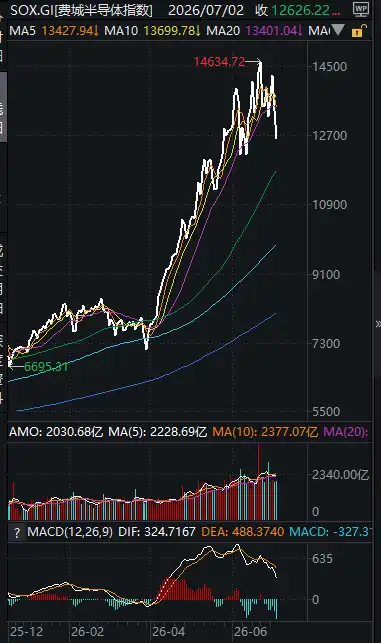
Micron Technology's better-than-expected sales forecast last month failed to sustain the chip stock rally, further confirming the sector's fading momentum. Currently, investors are awaiting comments from companies like Nvidia for more clues on AI chip demand.

Wilson points out that the breakdown in momentum is happening among large, index-weighting companies, which will keep major U.S. benchmark indices under pressure in the near term. The S&P 500 index has been gradually retreating since peaking in early June.

Hyperscalers: Value Opportunity Within the AI Ecosystem

Wilson stated he has recently favored hyperscalers over semiconductor-related stocks. He believes companies like Microsoft, Amazon, and Meta are attractive within the AI ecosystem, primarily because their robust underlying businesses provide solid support.

In contrast, according to Bloomberg data, a basket of hyperscaler stocks compiled by UBS Group has fallen 2% cumulatively since last September, forming a stark contrast with the gains in the semiconductor sector and implying relative catch-up potential for this group.

However, Wilson also anticipates that hyperscalers may begin to moderate expectations for their capital expenditure plans in response to recent market concerns about excessive AI investment. The outlook for capital spending will become a core focus for investors in the next phase.

Rotation Broadening, Opportunities Outside Tech Emerge

Wilson's rotation thesis is not confined to the hyperscale sector. He is also optimistic about the consumer discretionary, transportation, and biotechnology sectors benefiting from the fund outflow from chip stocks.

JPMorgan strategist Mislav Matejka aligns with Wilson's view, expecting market gains to extend beyond the tech sector in the second half of the year. "AI is unlikely to be the only game in town," Matejka wrote in a research note.

It is worth noting that Wilson previously correctly predicted that U.S. stock markets would remain resilient amid geopolitical risks due to strong corporate earnings, lending some credibility to his current assessment. His year-end S&P 500 target of 8000 points implies about 7% potential upside from current levels, but short-term volatility risks cannot be ignored.


热门币种推荐

相关问答

QAccording to Morgan Stanley's Michael Wilson, what are the two main areas where a shift in investor capital is occurring in the U.S. stock market?

AAccording to Michael Wilson, investor capital is flowing out of semiconductor stocks, which have seen significant gains, and is rotating towards AI hyperscalers like Microsoft, Amazon, and Meta.

QWhat specific evidence from the semiconductor market does the article cite to show that its momentum is fading?

AThe article cites that the Philadelphia Semiconductor Index has fallen nearly 14% from its all-time high last month and that strong sales forecasts from companies like Micron Technology failed to sustain a rally, indicating fading momentum.

QWhy does Michael Wilson find AI hyperscalers like Microsoft and Amazon attractive for investment compared to semiconductor stocks?

AWilson finds them attractive because their strong core businesses provide a solid foundation within the AI ecosystem, and their stocks have significantly underperformed the semiconductor sector, suggesting potential for relative catch-up.

QBeyond technology stocks, which other sectors does Michael Wilson believe could benefit from the rotation of funds away from semiconductors?

AMichael Wilson believes the consumer discretionary, transportation, and biotech sectors could benefit from the rotation of funds away from semiconductor stocks.

QWhat is Michael Wilson's year-end target for the S&P 500 index, and what does it imply for potential market movement?

AMichael Wilson maintains a year-end target of 8000 for the S&P 500, which implies approximately 7% potential upside from current levels, though he also warns of near-term volatility and pressure on major indexes.

你可能也喜欢

PeaqOS与World ID将ZK证明引入自主机器人

PeaqOS与World ID的整合将零知识证明技术引入自主机器人领域,使机器能在不收集姓名、照片等个人数据的前提下,验证交互对象是否为真实且唯一的人类用户。该系统通过robotic.sh平台提供,允许联网机器直接请求并验证World ID证明。 传统方式中,配送机器人、共享设备等自主系统依赖密码、证件或个人信息来确认用户身份,存在泄露或冒用风险。World ID提供了替代方案:设备不获取用户身份数据,而是获得加密证明,确认对方是真人。PeaqOS作为协调层,借助去中心化标识符和设备市场,使机器人能请求验证、接收零知识证明,并记录可审计的交互日志,同时不暴露任何底层身份信息。 该系统还支持唯一性验证,例如执行“一人一件物品”规则,无需建立用户身份数据库。演示案例包括自主药品配送:患者通过World App验证后下单,药房配药前再次验证,机器人送达时需确认收货人与订单匹配才解锁货舱。广告派发机器人或共享设备也可类似地确保每人仅限领取一次,且无需用户注册或提供个人数据。 目前,基于PeaqOS的机器人及设备已可通过robotic.sh使用World ID功能。该集成使自主系统能在最小化身份信息收集与存储的同时,可靠验证其交互对象为真实人类。

cryptonews.ru4小时前

PeaqOS与World ID将ZK证明引入自主机器人

cryptonews.ru4小时前

交易

现货

热门文章

如何购买S

欢迎来到HTX.com!我们已经让购买Sonic(S)变得简单而便捷。跟随我们的逐步指南,放心开始您的加密货币之旅。第一步:创建您的HTX账户使用您的电子邮件、手机号码注册一个免费账户在HTX上。体验无忧的注册过程并解锁所有平台功能。立即注册第二步:前往买币页面,选择您的支付方式信用卡/借记卡购买:使用您的Visa或Mastercard即时购买Sonic(S)。余额购买:使用您HTX账户余额中的资金进行无缝交易。第三方购买:探索诸如Google Pay或Apple Pay等流行支付方法以增加便利性。C2C购买:在HTX平台上直接与其他用户交易。HTX场外交易台(OTC)购买:为大量交易者提供个性化服务和竞争性汇率。第三步:存储您的Sonic(S)购买完您的Sonic(S)后,将其存储在您的HTX账户钱包中。您也可以通过区块链转账将其发送到其他地方或者用于交易其他加密货币。第四步:交易Sonic(S)在HTX的现货市场轻松交易Sonic(S)。访问您的账户,选择您的交易对,执行您的交易,并实时监控。HTX为初学者和经验丰富的交易者提供了友好的用户体验。

3.7k人学过发布于 2025.01.15更新于 2026.08.06

如何购买S

相关讨论

欢迎来到HTX社区。在这里,您可以了解最新的平台发展动态并获得专业的市场意见。以下是用户对S(S)币价的意见。

活动图片