As the market is still abuzz with Blackstone Group's $3.5 billion sale of three data centers in Virginia, this alternative asset management giant overseeing over $1.3 trillion in assets has made another, even more surprising move — its data center operator QTS has officially halted the construction of the local Digital Gateway data center project.
This mega-project, once touted as the "world's largest data center campus" with a total area larger than two New York Central Parks, has now come to a complete standstill.
Within just a few days, Blackstone's dual actions — cashing out mature assets at a high point while proactively scrapping a massive reserve project — lay bare the real-world challenges hidden beneath the AI computing infrastructure boom through this abrupt strategic shift.
01
End of a Five-Year Battle: The Untold Story of a Mega-Project's Demise
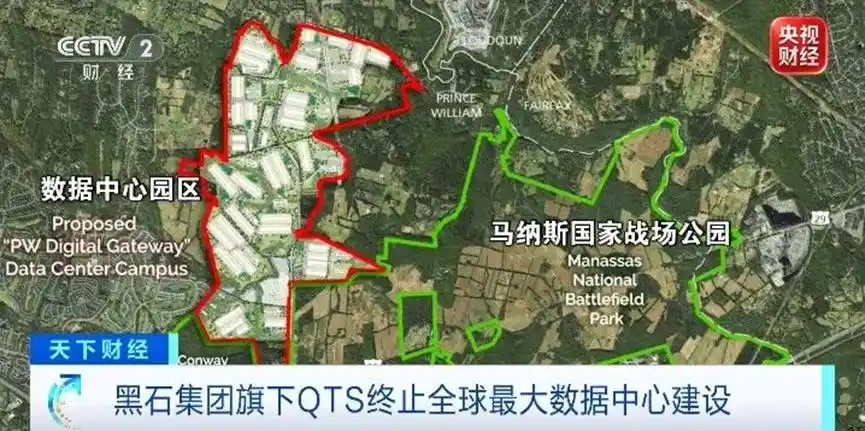
The stalled project is located in Prince William County, Virginia, spanning 2,100 acres. Originally planned with an investment exceeding $100 billion, it aimed to construct 37 data center buildings with a total area of 22 million square feet, which would have made it the undisputed world's largest data center campus.
Yet, from the very first day of public disclosure, the project plunged into a quagmire of controversy.
The site is adjacent to a historic Civil War battlefield and was originally protected land with development restrictions. The idea of clearing it to build densely packed data centers prompted immediate opposition from local residents.
Source: Internet
This resistance lasted a full five years.
Residents pressured local legislators and filed lawsuits targeting the planning process, gradually dragging the project into stagnation.
The fatal blow to the project's approval came from a seemingly minor procedural oversight.
In 2023, the relevant county government in Virginia held a zoning hearing lasting 27 hours regarding the conversion of agricultural and semi-rural land for data center use. Hundreds of supporters and opponents attended to voice their positions.
After the hearing, the regional government approved the rezoning application by a slim majority, but the two newspaper publication notices did not meet the legally required minimum six-day interval.
Opponents seized upon this flaw, eventually taking the case to state court.
In March of this year, a Virginia state court ruled the zoning approval invalid, effectively stripping the project of its legal development status.
Two months later, the other major developer — Compass Datacenters, owned by Canadian asset management giant Brookfield — decided to withdraw first.
The company's president later admitted that the continuous legal disputes and escalating regulatory barriers had completely blocked any feasible path for the project's advancement.
With the partner gone, the massive costs for infrastructure upgrades like water and power grids, originally shared by both parties, fell entirely on QTS.
Coupled with the fact that the court ruling could set an unfavorable legal precedent, leading to even more trouble ahead, Blackstone ultimately decided that continuing was not worth the cost and chose to cut its losses and exit.
This opposition is not an isolated case.
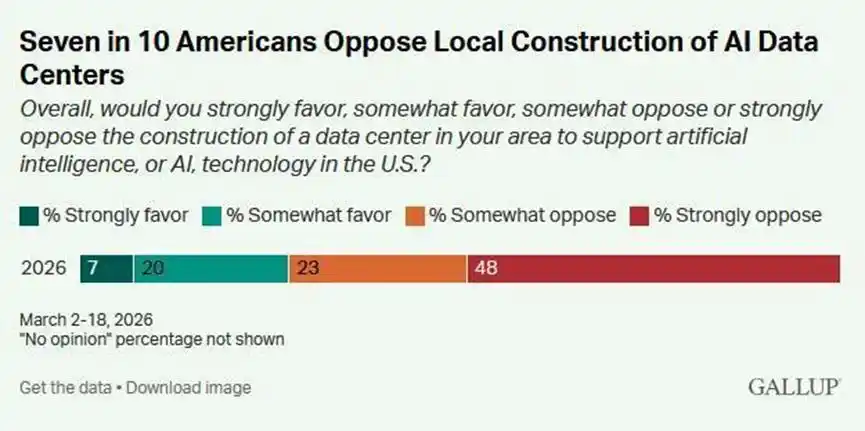
A recent Gallup poll shows that 70% of Americans oppose building AI data centers near their homes, with nearly half strongly opposing it.
Source: Internet
Public concerns are very practical. Data centers consume vast amounts of water and electricity, generate noise, air, and water pollution, increase local living costs, and exacerbate traffic congestion.
In the face of ordinary people's lives, even the grandest AI narratives seem somewhat distant.
02
Capital Begins High-Level Retreat as AI Infrastructure Hits Reality Ceiling
The reason Blackstone's move has sent shockwaves through Wall Street and the tech sector is that it has been a benchmark player in this wave of data center investment.
After acquiring QTS in 2021, buying Australian computing service provider AirTrunk in 2024, and pushing its data center acquisition platform, Blackstone Digital Infrastructure Trust, to an IPO in May this year, Blackstone has aggressively expanded, even calling itself the world's largest data center service provider.
Yet now, this industry leader is selling off mature assets while axing reserve projects, mirroring its "exit at the peak" strategy in the office market years ago.
When the work-from-home trend emerged earlier, causing office rents and values to plummet, Blackstone heavily discounted and sold off several landmark office buildings, accurately timing the cycle's inflection point.
Now, replicating this approach in the data center sector is seen by the industry as a signal of "selling high." When capital most attuned to cycles begins to retreat, it often means the sector's risks are starting to outweigh its rewards.
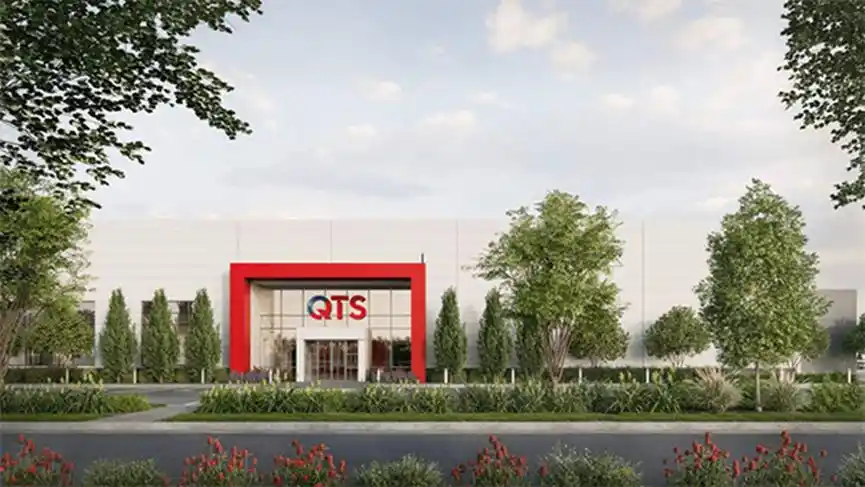
QTS, a data center operator under U.S. Blackstone Group. Source: Internet
In fact, looking beyond the hotly discussed AI computing boom, the real bottlenecks in the data center industry have long been apparent.
A research report from U.S. AI intelligence firm Data Center Watch indicates that in the first quarter of this year alone, delayed data center projects across the U.S. were worth approximately $130 billion.
A J.P. Morgan report, based on satellite image analysis, noted that over 60% of data center projects scheduled for completion in 2027 have not yet broken ground, with another 7% already delayed. The main reasons involve power supply bottlenecks and public opposition.
An unavoidable fact is that data centers are pushing U.S. electricity consumption toward historic highs.
Data from the Electric Power Research Institute (EPRI) shows data centers currently account for 5% of U.S. electricity demand, potentially tripling by 2035; in Virginia, this proportion already exceeds 25%.
EPRI explicitly stated that the existing grid and related policies were simply not designed for the speed and scale of demand brought by AI infrastructure. Data center construction has first hit the physical ceiling of power supply.
Even though in March this year, giants like Microsoft, Google, Amazon, Oracle, Meta, and OpenAI collectively pledged to bear the costs of infrastructure upgrades and build or procure the new power needed for their projects, even ample funds cannot instantly solve problems like delayed power equipment delivery and massive permit approval backlogs.
Beyond power supply constraints, strong public resistance is becoming another core factor hindering data center deployment.
The Data Center Watch report shows Q1 2026 was the period with the most recorded instances of data center projects being blocked or delayed, with opponents obstructing or delaying at least 75 projects across the U.S. in three months.
The number of active grassroots opposition groups targeting data centers nationwide surged from 396 at the end of 2025 to 833 by March, spanning 49 states, with Maryland, Ohio, and Texas being hotspots with the most opposition groups.
In many cases, mobilization against projects begins even before formal applications are submitted.
In May this year, hundreds gathered outside the Utah State Capitol to protest the proposed massive 40,000-acre Stratos project in Box Elder County.
More crucially, policy winds are tightening at the local level.
Virginia has passed a budget bill adding an energy consumption tax for data centers, and several states are also considering temporary moratoriums on new data center construction.
As speculative capital collides with public opposition, policy tightening, and infrastructure shortcomings, whether AI computing infrastructure can maintain its previous breakneck expansion pace is becoming increasingly uncertain.
Blackstone's exit this time might just be the beginning. As the frenzy subsides, the industry must eventually return to a path of acknowledging costs and respecting reality.
References:
"U.S. Data Center Construction Hits Roadblocks, $130 Billion in Projects Stalled in Q1" - 21st Century Business Herald
"World's Largest Data Center Construction Terminated" - Cailian Press
This article is from the WeChat public account "Phoenix.com Finance," author: Storm Eye