As Agent Coding goes viral and reshapes the software industry, it seems the field has gradually accepted the undeniable fact that the role of the "engineer" is changing. In reality, however, the change likely extends beyond just the "engineer" position; a more profound transformation is quietly occurring at the foundation of team organizational structures......
Recently, Boris Cherny, head of the Anthropic Claude Code team, shared a very interesting observation on X.
He pointed out that as functions like engineering, product, design, and data science increasingly merge, he has been pondering what these roles will evolve into in the future. Taking the Claude Code team as an example, the traditional "job labels" internally are being completely discarded, replaced by five new types of "unbundled" roles based on behavioral patterns: The Prototyper, The Builder, The Sweeper, The Growth, and The Maintainer.
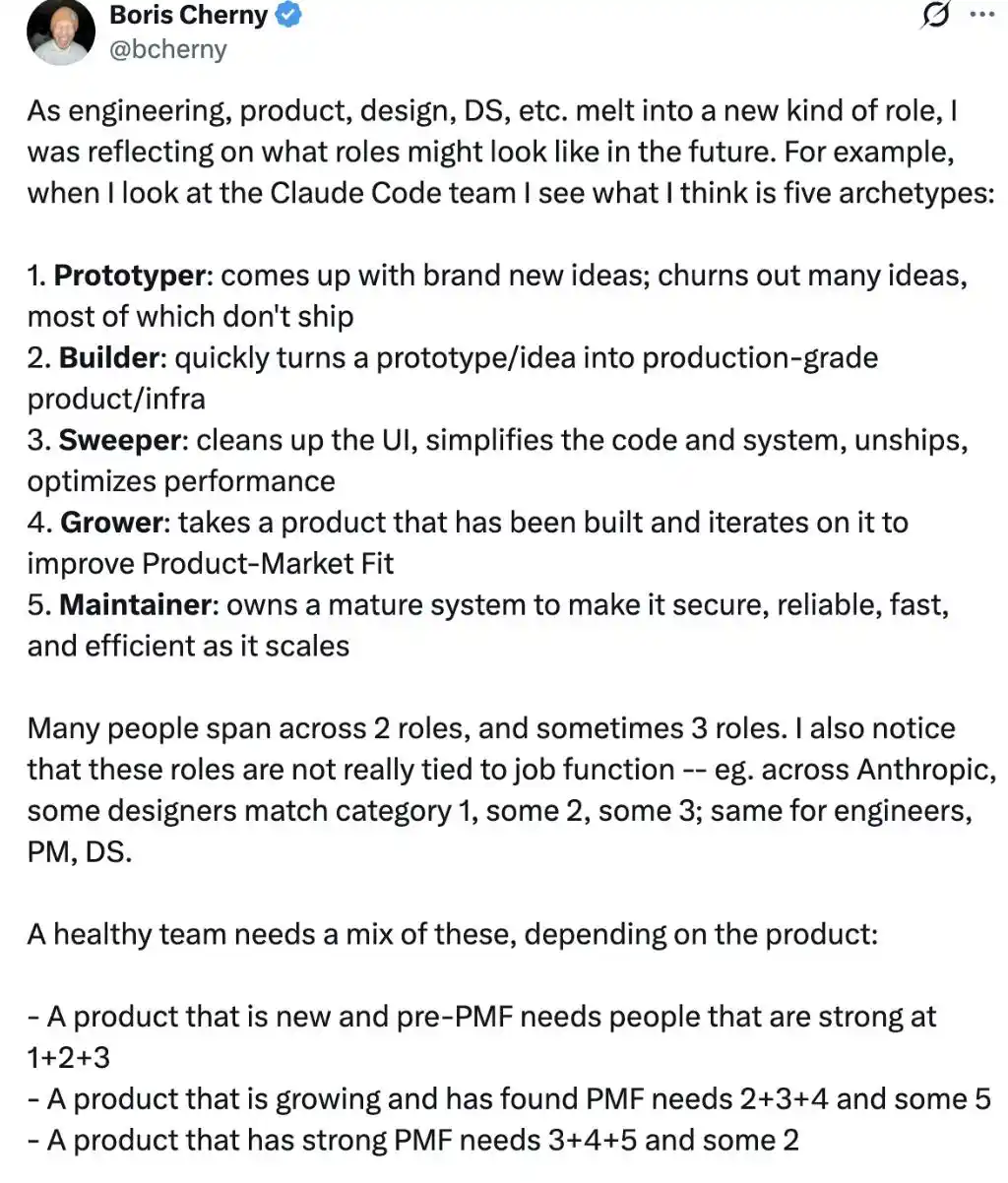
The Prototyper: Primarily responsible for proposing entirely new ideas, continuously generating a large volume of creativity, with most ideas ultimately not being launched. In other words, they pursue the quantity and disruptiveness of ideas, not fixating on whether each one must be implemented.
The Builder: Primarily responsible for quickly turning scattered ideas or rough prototypes into products or highly available infrastructure that can truly be deployed in production environments for massive user bases. In other words, they are responsible for solving the hardcore leap from 0.1 to 1.
The Sweeper: Primarily responsible for "subtraction." The most terrifying side effect of the AI era is the over-expansion of code and features. The Sweeper's duty is to clean up and streamline user interfaces, simplify and refactor messy code and system architectures, and remove unnecessary redundant functionalities to achieve high system performance and maintainability.
The Growth: Takes over a finished, built product. When a product enters the market, The Growth is responsible for continuous, rapid iteration. They must care about: how to bring the product closer to the market? How to make users more willing to stay? How to make a product evolve from "usable" to "needed." However, this role is not equivalent to traditional growth operations; it is more of a combination of product, data, user understanding, and experimentation capabilities.
The Maintainer: Responsible for the long-term operation of a mature system. They may not chase flashy new features but obsess over security, reliability, extreme operational efficiency, and system resilience, ensuring services remain rock-solid under any extreme traffic conditions.
It's important to note, however, that these five roles do not correspond to traditional positions. That is to say, unlike traditional organizational management where a person's role is fixed in a job title.
Boris Cherny believes that many people might span two roles, and sometimes even three.
"I've also noticed these roles aren't truly tied to specific jobs. For example, internally at Anthropic, some designers align more with type 1, some with type 2, and some with type 3; the same goes for engineers, product managers, and data scientists."
This implies that in efficient, AI-empowered teams, many members are no longer 'single-purpose cogs.' A designer can be a Prototyper or a Sweeper; an engineer can be a Builder or a Maintainer; a product manager can take on Growth or become a Prototyper; a data scientist might not only perform analysis but also directly participate in product growth and system optimization......
In other words, the way future teams look at people might change. The past question might have been mainly "What is your job title?" while the future—or the present—is becoming "Which stage of the product lifecycle can you advance?"
Boris Cherny analyzed that the specific combination of these roles needed for a healthy team depends on the product's current stage:
A brand new product that hasn't yet found product-market fit needs people skilled in roles 1, 2, and 3.
A product that is growing and has found product-market fit needs roles 2, 3, and 4, supplemented by some role 5.
A product with strong product-market fit needs roles 3, 4, and 5, while retaining some role 2.
"Perhaps future product roles will look more like this, rather than today's division by specialized fields."
Once this post was published, it immediately sparked lively discussion among netizens, with most expressing agreement.
"This perfectly matches how people actually work. In some projects, I am indeed a 1+3 combo, while in others, I'm almost pure 4. Job titles have never truly captured these."

A data scientist also "stepped forward," saying that as a data scientist, they often find themselves doing Sweeper-type work while also building products with a data science sensibility. "So does that make me a 2+3 type?"

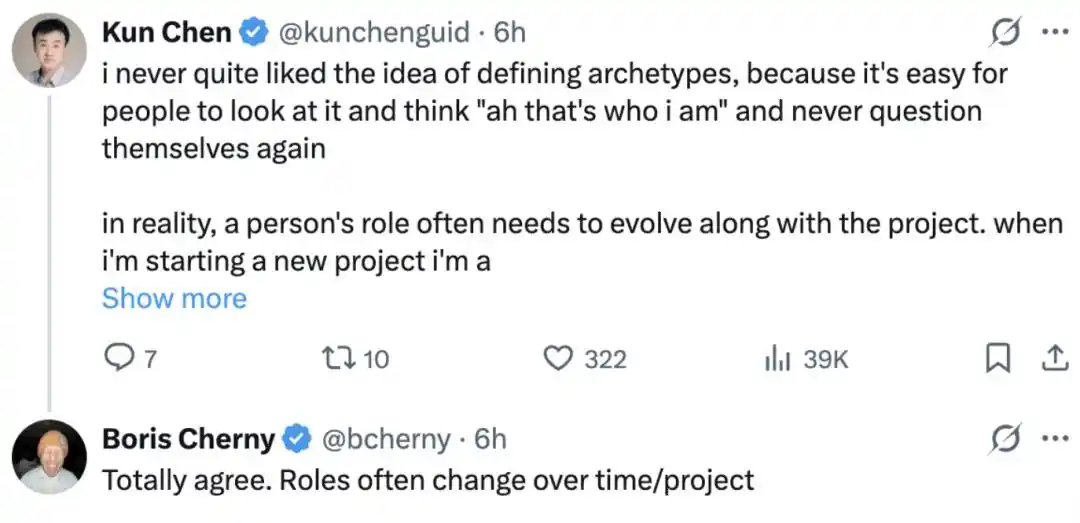
Netizen Kun Chen@kunchenguid expressed strong resonance. He said he never liked defining "role archetypes" because people easily see them and think, "Ah, so this is me," and then stop reflecting. In reality, "a person's role often needs to change along with the project."
He gave an example: when starting a new project, he typically acts as a Prototyper and Builder; but soon, as rough, unfinished parts become bottlenecks, he turns into a Sweeper. As the project matures, he shifts towards Growth and Maintainer... "If I box myself into one specific role, then when the project reaches a certain stage, I'd have to let go."
Another reality is that people now often work on multiple projects simultaneously, requiring them to play different roles in different projects. "Categorizing oneself into a fixed archetype often limits a person's ability to expand their ambitions."
Therefore, his advice is: Stay flexible, focus attention on the most important things needed to achieve the goal, and worry less about role boundaries. Because these boundaries will only continue to blur over time.
Boris Cherny responded, saying this completely captured his own thoughts: "Completely agree. Roles often change over time and project phases."
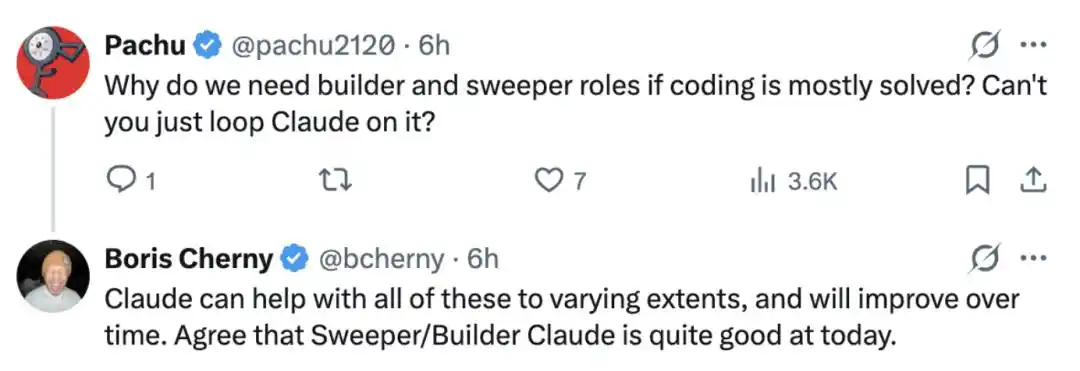
Some netizens expressed skepticism: "Since AI writing code is basically solved, why are roles like Builder and Sweeper still needed? Can't we just let Claude run in a continuous loop?"
In response, Boris Cherny explained that Claude can help with all these things to varying degrees and will continue to become stronger over time. Currently, today's Claude is already quite good at taking on Sweeper and Builder-type work.
What about you? How do you view this change in job roles? Feel free to leave a comment and discuss!
Reference Links:
https://x.com/bcherny/status/2071379474277613732
https://x.com/kunchenguid/status/2071382977628795289
This article is from the WeChat public account "Almost Human" (ID: almosthuman2014), author: Focus on AI