Peter Todd Warns Zcash Tech Is Too Risky For Bitcoin Privacy Push

bitcoinist发布于2026-06-05更新于2026-06-05

文章摘要

Bitcoin developer Peter Todd opposes integrating Zcash-style privacy features into Bitcoin's consensus layer, arguing the cryptographic risk is too high. His comments followed a disclosed issue in Zcash's Orchard shielded pool, sparking a debate on privacy, auditability, and Bitcoin's resistance to change (ossification). Todd distinguishes Bitcoin's transparent ledger, where bugs like the 2010 overflow were visible and reversible, from shielded systems where privacy could hide counterfeit coins or supply destruction, making detection and rollbacks difficult. While critics noted Bitcoin's own history of bugs, Todd countered that these didn't pose the same existential risk. He emphasized that with a significant portion of ZEC already shielded, a hidden bug could devastate user holdings without easy recovery. The discussion highlights the trade-off between advanced privacy and systemic risk in a base protocol.

Bitcoin developer Peter Todd has pushed back against calls to bring Zcash-style privacy into Bitcoin’s consensus layer, arguing that the cryptographic risk profile is too high for the network’s base protocol. The debate erupted after ZODL developers disclosed an issue affecting the Orchard shielded pool, briefly turning a technical incident into a broader argument over privacy, auditability, and Bitcoin ossification.

Todd’s initial post was direct: “Why adding Zcash style privacy to Bitcoin at the consensus layer is a bad idea.” He was responding to a post from Zcash Open Development Lab, which said a “coordinated Zcash network upgrade” was underway after an issue affecting the Zcash Orchard pool was identified during routine auditing and security review processes.

Why Peter Todd Sounds Alarm On Zcash-Style Privacy

The exchange quickly widened beyond ZEC itself. One user argued that Bitcoin has its own history of critical bugs, pointing to the 2010 value overflow incident and the 2013 chain split as evidence that “no protocol is exempt from tech issues.” The same post accused Bitcoin maximalists of pushing for “total ossification” while facing future threats such as quantum computing.

Todd answered by drawing a distinction between visible and hidden failures. “Exactly my point. With Bitcoin, rolling back the chain is feasible, as only a small subset of coins were affected, and the exploit was trivial to notice,” he wrote. His argument was not that Bitcoin is bug-free, but that its accounting model makes certain classes of catastrophic bugs easier to detect and unwind.

That point became the core of the disagreement. When another user argued that rejecting consensus-layer privacy on bug-risk grounds would “stop any innovation/development,” Todd responded that not all cryptography carries the same operational risk. “Different types of cryptography have different levels of risk to them. Zcash-style cryptography has a very high level of risk, much more so than Bitcoin’s cryptography. Which is reflected in how Zcash has had much more serious issues than Bitcoin.”

The counterargument was that Bitcoin itself has suffered serious early failures. One participant cited the 2010 value overflow incident and the 2018 bug, CVE-2018-17144, as examples that challenged Todd’s framing. Todd rejected the comparison, saying neither case put the currency at the same kind of existential risk.

“Neither of those exploits had any chance of destroying the currency,” Todd wrote. “Exactly what coins were counterfeit was trivially visible, allowing easy rollbacks. Not so with Zcash.”

The disagreement turns on a specific property of shielded systems: privacy can reduce the visibility that makes supply audits straightforward. In Todd’s view, this changes the risk calculation for Bitcoin. A bug in transparent accounting can be noticed because invalid outputs or counterfeit coins are visible on-chain. In a deeply shielded system, he argued, the damage may be harder to observe, harder to attribute, and harder to reverse.

Zcash defenders pushed back on that framing as well. One user told Todd that he did not understand the “turnstile construct,” arguing that “no such bug can affect the total ZEC supply.” Todd shifted the focus from total supply to shielded user balances, noting that a large share of ZEC already sits inside the shielded pool. “30% of the Zcash supply is shielded. That supply being destroyed would be a disaster, and would completely wipe out the holdings of a high % of all Zcash users. I personally have a little bit of Zcash, all of which is shielded.”

At press time, ZEC traded at $532.
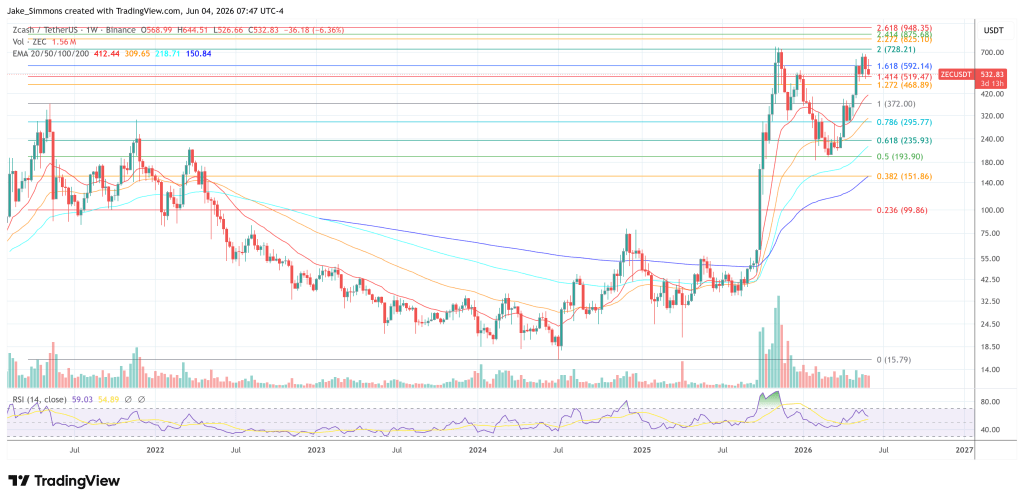
ZEC trades below the 1.618 Fib again, 1-week chart | Source: ZECUSDT on TradingView.com

相关问答

QWhat is Peter Todd's main argument against integrating Zcash-style privacy into Bitcoin at the consensus layer?

APeter Todd argues that the cryptographic risk profile of Zcash-style privacy technology is too high for Bitcoin's base protocol. He believes such shielded systems make catastrophic bugs harder to detect, attribute, and reverse compared to Bitcoin's transparent accounting model.

QAccording to Peter Todd, what key difference exists between handling bugs in Bitcoin's transparent system versus a shielded system like Zcash?

ATodd states that in Bitcoin's transparent system, bugs like counterfeit coin creation are trivially visible on-chain, making coordinated chain rollbacks feasible. In a deeply shielded system, the damage from a bug can be much harder to observe, attribute, and reverse, posing a greater existential risk.

QWhat example did critics use to challenge Todd's view that Bitcoin has a lower risk profile than Zcash?

ACritics pointed to historical Bitcoin incidents like the 2010 value overflow bug and the 2018 CVE-2018-17144 bug as evidence that 'no protocol is exempt from tech issues,' arguing these were also serious failures.

QHow did Peter Todd respond to the claim that a bug cannot affect the total ZEC supply due to its 'turnstile construct'?

ATodd shifted the focus from total supply to user balances, noting that 30% of ZEC supply is shielded. He argued that a bug destroying or compromising that shielded supply would be a disaster, wiping out the holdings of a high percentage of Zcash users.

QWhat event initially sparked the broader debate about privacy and auditability in Bitcoin, as mentioned in the article?

AThe debate was sparked after ZODL (Zcash Open Development Lab) developers disclosed an issue affecting the Zcash Orchard shielded pool during routine auditing, which led to a coordinated network upgrade and broader discussions on privacy technology risks.

你可能也喜欢

历史底部信号再现?估值3亿的Messari以1000万贱卖

加密数据平台Messari曾估值3亿美元,近期以约1000万美元被竞争对手Blockworks收购,标志其八年创业历程结束。该公司衰落部分源于AI技术冲击——传统需耗时数周的研究报告如今可借AI工具快速生成,导致其核心业务价值锐减。 Messari的处境并非个例。2025年至2026年间,加密行业众多不发币、依赖产品服务营收的公司陷入困境:数据平台DappRadar、Parsec相继关停,CoinGecko寻求出售;媒体CoinDesk、Bankless大幅裁员或低价被购;链上数据公司Dune也进行了裁员。行业收缩浪潮明显。 风险投资(VC)领域同样遇冷。加密基金数量减半,新基金募资额骤降至峰值期的12%,投资额在半年内暴跌超80%。资本与人才大量流向AI领域,连Multicoin Capital等知名加密基金创始人也转向AI。有投资人形容当前环境为“大灭绝”。 然而,极端悲观信号集聚或暗示底部临近。比特币自高点跌近50%,恐慌贪婪指数长期处于“极度恐惧”区间;比特币长期持有者占比逼近80%,历史上类似情况常对应市场底部。VC交易活跃度回落至2020年水平,而当时正是新一轮牛市前夜。部分机构如Dragonfly Capital已逆势募资,Blockworks也正低价整合行业资产。历史显示,当多个底部信号共振后,往往孕育着下一轮周期起点。

marsbit23分钟前

历史底部信号再现?估值3亿的Messari以1000万贱卖

marsbit23分钟前

谷歌TPU出货量,上修50%

近期,多家海外机构上调了谷歌TPU的出货预期,将2027年需求预测从1000万颗上修至1500万颗,增幅达50%。这一变化扭转了市场对算力硬件的保守看法,并带动整条配套产业链需求同步提升。 谷歌TPU采用标准化全光互联架构,硬件配套关系固定。其中,NPO光引擎与TPU芯片按1:1匹配,光模块、OCS光交换、服务器电源、光纤及液冷等环节的需求均随芯片规模增长而确定增加。 液冷成为核心受益方向。因新一代TPU功耗大幅提升,风冷已达物理极限,谷歌集群已全面转向液冷方案。预计2026年为放量元年,下半年开始大规模交付。同时,海外厂商面临技术迭代慢、产能不足的瓶颈,为国产液冷厂商让出替代窗口。凭借快速迭代和稳定交付能力,国内企业正切入谷歌供应链,行业迎来“业绩提速+格局洗牌”的双击行情。预计伴随TPU出货量从2027年的1500万颗增长至2028年的3000-3500万颗,专属液冷市场规模将从千亿级突破至3000亿级。 光纤赛道逻辑亦被重塑。AI算力中心建设催生海量光纤需求,但光纤预制棒扩产周期长,导致供需缺口持续扩大。全球云厂商为锁定货源纷纷签订长期协议,使光纤价格与出货趋稳,摆脱周期性波动。国产光纤凭借产能与成本优势,预计2026年出口量将达2-3亿芯公里,占据全球AIDC需求的半壁江山。 此外,1.6T光模块、OCS光交换、服务器电源等配套环节均将受益于TPU放量,需求持续扩容。投资重心正从芯片算力博弈转向基础设施配套的确定性增量,产业链未来两年业绩确定性进一步增强。

marsbit1小时前

谷歌TPU出货量,上修50%

marsbit1小时前

币圈故事退潮后,华尔街真正想要的是什么

币圈故事退潮后,华尔街正将传统金融的核心资产与业务系统性地迁移至区块链上,其目标并非投机或去中心化叙事,而是构建一套可控、生息且合规的链上金融基础设施。 核心动向包括: 1. **资产代币化**:以贝莱德的BUIDL基金为例,它将短期美国国债等低风险资产代币化,提供链上即时结算与每日复投,成为链上金融的基石资产。过户代理机构Securitize即将上市,并与纽交所合作,旨在建立全天候的链上股票清算系统。 2. **波动率变现**:针对比特币等波动资产,贝莱德、高盛等机构推出备兑看涨期权ETF(如BITA),通过系统性卖出期权将波动转化为稳定的月度现金收益,将其包装为标准化的生息产品,以吸引传统大型资金。 3. **稳定币支付与清算**:稳定币正被定位为高效的支付与结算工具。Stripe支持商户用稳定币收款,万事达卡升级系统支持稳定币进行跨时区清算,连SWIFT也计划推出基于分布式账本的跨境清算方案,旨在释放被冻结的巨额结算准备金,提升效率。 4. **监管与合规驱动**:美国《GENIUS法案》等监管框架将合规稳定币明确定义为“支付工具”(禁止派息)并纳入强监管,使其成为美元金融体系的可编程延伸。 总之,华尔街正利用区块链技术的可编程性与效率,在链上复制并优化国债、期权、清算网络等传统金融产品与服务,每一步都紧密依托美元信用与现有监管体系,旨在打造一个更高效且由其主导的新金融管道。

marsbit1小时前

币圈故事退潮后,华尔街真正想要的是什么

marsbit1小时前

交易

现货
合约

热门文章

如何购买PUSH

欢迎来到HTX.com!我们已经让购买Push Protocol(PUSH)变得简单而便捷。跟随我们的逐步指南,放心开始您的加密货币之旅。第一步:创建您的HTX账户使用您的电子邮件、手机号码注册一个免费账户在HTX上。体验无忧的注册过程并解锁所有平台功能。立即注册第二步:前往买币页面,选择您的支付方式信用卡/借记卡购买:使用您的Visa或Mastercard即时购买Push Protocol(PUSH)。余额购买:使用您HTX账户余额中的资金进行无缝交易。第三方购买:探索诸如Google Pay或Apple Pay等流行支付方法以增加便利性。C2C购买:在HTX平台上直接与其他用户交易。HTX场外交易台(OTC)购买:为大量交易者提供个性化服务和竞争性汇率。第三步:存储您的Push Protocol(PUSH)购买完您的Push Protocol(PUSH)后,将其存储在您的HTX账户钱包中。您也可以通过区块链转账将其发送到其他地方或者用于交易其他加密货币。第四步:交易Push Protocol(PUSH)在HTX的现货市场轻松交易Push Protocol(PUSH)。访问您的账户,选择您的交易对,执行您的交易,并实时监控。HTX为初学者和经验丰富的交易者提供了友好的用户体验。

1.1k人学过发布于 2024.03.29更新于 2026.06.02

如何购买PUSH

相关讨论

欢迎来到HTX社区。在这里,您可以了解最新的平台发展动态并获得专业的市场意见。以下是用户对PUSH(PUSH)币价的意见。

活动图片