Trump Executed 3,600 Stock Trades in Q1, Bought Nvidia, Dell, Then Made a 'Stock Tip,' Sparking Conflict-of-Interest Controversy

marsbit发布于2026-05-15更新于2026-05-15

文章摘要

Former President Donald Trump executed 3,642 individual stock trades in Q1 2026, averaging about 60 trades per day, according to a recent OGE 278-T disclosure. This breaks from the modern presidential tradition of using blind trusts. The filings reveal Trump sold large positions in Amazon, Meta, and Microsoft while making significant new purchases in AI and semiconductor firms like NVIDIA, Broadcom, and Intel. Notably, he bought $1-5 million worth of Dell stock on February 10. Three months later, on May 8, he publicly urged Americans to "buy Dell" at a White House event; the stock has since risen 96%. His Intel purchases began in early March, after which the stock surged 150%. The U.S. government had taken a 9.9% stake in Intel in August 2025. These transactions, occurring close to related policy actions or public endorsements, have ignited significant controversy over potential conflicts of interest. While the White House maintains full compliance with the STOCK Act, critics highlight the unprecedented scale of trading and the timing coinciding with his official duties and donors' interests.

Author: Claude, Deep Chao TechFlow

Deep Chao Introduction: Trump's newly disclosed OGE 278-T form shows he executed 3,642 stock trades in Q1 2026, averaging about 60 trades per day, breaking the precedent of using a "blind trust" set by presidents since Lyndon Johnson.

The disclosure reveals that after buying $1 million to $5 million worth of Dell stock on February 10th, Trump publicly urged people on May 8th at the White House to "go buy Dell," following which the stock surged 96%. Multiple trades, including those in Nvidia and Intel, occurred ahead of related policy moves, rapidly fueling a conflict-of-interest controversy.

Trump's personal stock trading record is becoming one of the most contentious documents in Washington.

According to Benzinga, documents released this week by the Office of Government Ethics (OGE) show Trump executed 3,642 securities transactions in Q1 2026, averaging about 58 per day. The 113-page OGE 278-T form was signed by Trump on May 8th, delivered to the OGE on May 12th, and had "Filer paid late fee" handwritten on the cover page, indicating it exceeded the 30- to 45-day filing window stipulated by federal regulations.

This trading frequency breaks the nearly continuous blind trust arrangement precedent since Lyndon Johnson. Most former U.S. presidents placed personal assets in qualified blind trusts to limit conflicts of interest; Carter even liquidated his peanut farm, Obama held Treasury bonds and index funds, and Biden also employed a blind trust arrangement during his term.

Massively Sold Tech Giants, Heavily Bet on AI Chip Supply Chain

Disclosure documents show Trump significantly reduced holdings in Amazon, Meta, and Microsoft in Q1, all falling within the highest valuation bracket of $5 million to $25 million. However, while selling heavily, Trump maintained exposure to these three companies through smaller purchases.

More notably are the new positions. Trump established new positions in the $1 million to $5 million range in Nvidia (NVDA), Broadcom (AVGO), Synopsys (SNPS), Cadence Design Systems (CDNS), and Texas Instruments (TXN), covering almost every core segment of the U.S. AI chip supply chain. Large buys also appeared in Apple, Oracle, ServiceNow, Adobe, and Workday within the same range.
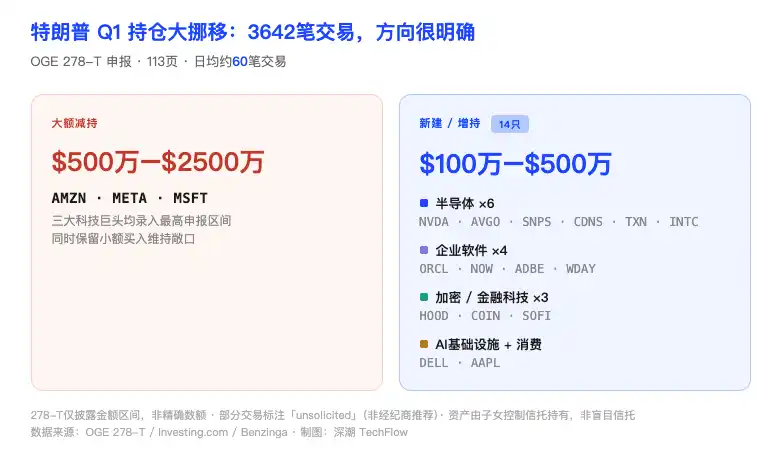
The semiconductor holdings closely align with the White House's policy direction of boosting domestic chip production capacity. According to Quiver Quantitative analysis, the purchase of Nvidia occurred before CEO Jensen Huang accompanied Trump on a visit to China, a trip expected to involve discussions on AI chip exports and semiconductor policy.

White House "Stock Tip" Three Months After Buying Dell, Stock Up 96%

The focus of the conflict-of-interest controversy centers on Dell.

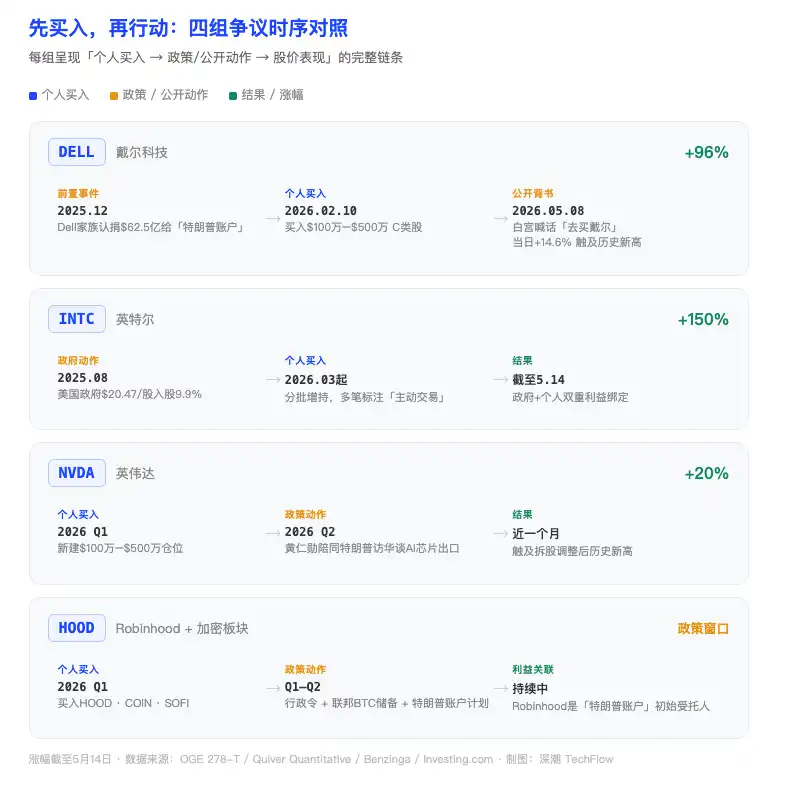
Documents show Trump bought $1 million to $5 million worth of Dell Technologies Class C stock on February 10, 2026. Three months later, at a Mother's Day event on May 8th, Trump thanked Michael Dell and Susan Dell by name at the White House and made the remark that sparked an uproar to those present—telling Americans to "go buy Dell."

That day, Dell's stock price surged as much as 14.6%, hitting a record high of $263.99. From Trump's purchase to the present, Dell's stock price has risen 96% cumulatively.

Another detail in the timeline intensified the controversy. On December 2, 2025, Michael Dell and Susan Dell pledged $6.25 billion to the "Trump Accounts," one of the largest private donations in recent years to a signature project of a sitting president. The White House has not responded to whether there was coordination between the President's public endorsement and the Dell family's donation.

Intel Shares Soar 150% After Purchase, Government Holds 9.9% Stake

Intel's trades are also worth examining.

Trump began buying Intel in batches starting in early March 2026, with several trades marked as "unsolicited," meaning not broker-recommended. Since the initial purchase on March 2nd, Intel's stock price has risen 150%.

Prior to this, the U.S. government purchased 433.3 million shares of Intel in August 2025 at $20.47 per share, giving it a 9.9% stake. In other words, Trump was buying Intel stock in the open market in his personal capacity while, in his presidential role, promoting government investment in Intel.

Additionally, purchases of Coinbase, Robinhood, and SoFi occurred during a period of active government promotion of crypto-friendly policies, including executive orders, a federal bitcoin reserve, and the "Trump Accounts" retirement plan. Robinhood is the initial trustee for that plan.
Non-Blind Trust Sparks Constitutional Debate, White House Claims Compliance

Critics view the alignment of these trading timelines as posing a conflict-of-interest risk. The White House argues that the filings fully comply with the STOCK Act's requirements.

Trump's assets are held in trusts controlled by his children, but the latest documents show numerous trades were executed by brokers acting as agents. The documents do not specify exactly which accounts hold the trading positions nor who gave the trading instructions.

An OGE spokesperson declined to comment on whether the trades reflect Trump's direct trading activity or operations through managed accounts, stating only that "the OGE is committed to transparency and citizen oversight of government."

According to Quiver Quantitative analysis, to their knowledge, this is the first time Trump has actively traded individual stocks while in office. The conservative, bond-heavy portfolio seen in previous 278-T filings has been completely overturned.


相关问答

QWhat is the primary controversy surrounding Donald Trump's stock trades in Q1 2026 as detailed in the article?

AThe primary controversy is the potential conflict of interest, as Trump conducted numerous personal stock trades (3642 in total) while in office, a break from the tradition of modern presidents using blind trusts. Specific concerns include his purchase of Dell stock followed by a public endorsement to "buy Dell" from the White House, and trades in companies like Nvidia and Intel that coincided with or preceded related government policy actions.

QHow did Donald Trump's investment activity in Dell become a focal point of the conflict-of-interest allegations?

ATrump purchased between $1 million and $5 million worth of Dell stock on February 10, 2026. Three months later, on May 8, he publicly told attendees at a White House event to "go buy Dell." Following this endorsement, Dell's stock price surged, having already risen 96% from his purchase date. This sequence created the appearance of using his presidential platform to influence a stock in which he held a significant personal financial stake.

QWhat significant change does the article note in Trump's investment strategy during his presidency compared to his previous disclosures?

AThe article notes a dramatic shift from a conservative, bond-heavy portfolio in his previous financial disclosures to an active trading strategy focused on individual stocks, particularly within the AI chip and technology sectors. This represents his first known period of active individual stock trading while in office.

QAccording to the article, what action did the US government take regarding Intel before Trump's personal stock purchases?

AIn August 2025, the US government purchased 433.3 million shares of Intel at $20.47 per share, acquiring a 9.9% stake in the company. Trump subsequently began personally buying Intel stock in March 2026.

QHow has the White House responded to criticism about the timing of Trump's stock trades?

AThe White House has defended the transactions, stating that the financial disclosures are fully compliant with the requirements of the STOCK Act. However, it has not commented on whether there was any coordination between the president's public endorsements and related stock trades or political donations.

你可能也喜欢

链上 Pre-IPO 全解析:为什么 SpaceX、OpenAI 的定价权正在上链?

链上Pre-IPO交易市场近期热度显著上升,特别是Hyperliquid平台上线了SpaceX的Pre-IPO永续合约。这一趋势类似于加密领域的Pre-Market(上市前交易),合约通常在IPO临近时推出,吸引了大量寻求对冲或增加敞口的交易者。 OpenAI和Anthropic等AI巨头近期公开否认部分二级市场交易的有效性,主要原因有二:一是这些高资本消耗的公司希望资金流向其自身的Primary轮融资,而非与公司无关的二级交易;二是为了避免因复杂的交易结构(如多层SPV)在IPO清算时产生的法律纠纷和责任。 链上衍生品市场(如永续合约)相比代币化现货更具优势。它主要帮助投资者对冲风险,且更符合监管要求(如美国私募股6个月持有期)。衍生品的风险更多是市场风险,而非代币化产品可能涉及的底层资产法律结构风险。 Pre-IPO投资虽有高回报潜力,但通过多层SPV等复杂结构参与存在显著风险,包括交易被公司认定无效导致无法交割、银行合规阻碍以及潜在的欺诈和法律诉讼。 市场参与者多样:链下有如Setter、Forge等大型二级经纪商;链上衍生品侧有围绕Hyperliquid的Trade.xyz、Ventuals等协议;Solana生态则出现了一些面向散户的代币化产品。 Patagon等传统私募交易服务商对涉足链上Pre-IPO市场持谨慎态度,主要担心激怒其投资组合公司并损害合作关系。 展望未来,随着SpaceX、Anthropic、OpenAI等巨无霸公司即将IPO,能够7x24小时交易的链上Pre-IPO永续合约可能获得更多关注,并成为交易所在相关资产上市后捕获主流交易量的重要入口。

marsbit32分钟前

链上 Pre-IPO 全解析:为什么 SpaceX、OpenAI 的定价权正在上链?

marsbit32分钟前

token套餐来了,电信运营商着急了?

近期,电信运营商纷纷推出“token套餐”,引起广泛关注。5月15日,上海电信率先推出token算力服务套餐,随后中国电信、移动、联通全国跟进。套餐按量或包月计价,例如1元对应25万token。然而,其价格被用户吐槽偏贵,与市场主流模型API相比缺乏优势。 运营商此举背后是传统通信业务增长乏力。财报显示,2025年三大运营商营收增长微弱,移动用户数接近饱和,ARPU值下滑。向AI和算力服务转型,成为寻求新增长点的尝试。运营商试图将token包装为易用的AI服务,激发C端需求,例如在APP内提供智能抠图、AI生成宠物等功能。 但目前来看,运营商自身AI产品竞争力不强,更多扮演“模型超市”或集成渠道的角色,核心功能由第三方提供,用户感知不强,并非刚需。同时,在AI云服务市场,运营商还需面对阿里云、腾讯云等已有强大生态和价格体系的云厂商竞争。 更深层的意义在于算力基础设施的重构。政策层面正推动“全国一体化算力网”建设。运营商拥有广泛的网络、基站资源,能提供稳定、低延时的算力调度与覆盖,有望成为像“电网”一样的算力基础网络,支撑AI向物理世界和更广泛场景渗透。因此,运营商入局卖算力,不仅是商业策略调整,更是参与未来算力基建布局的关键一步。

marsbit36分钟前

token套餐来了,电信运营商着急了?

marsbit36分钟前

企业抛售比特币的五大价值逻辑

近期,Strategy公司宣布可能出售部分比特币以达成经营目标,引发了市场关注。企业抛售比特币并非简单的利空行为,在特定场景下,此举能为企业和股东创造实际价值。文章阐述了企业可能选择抛售比特币的五大价值逻辑: **一、提升每股比特币持仓量:** 当公司股价低于其比特币资产价值时,出售比特币并回购股票可以提升每股的比特币持有量。同样,出售比特币来偿付债务也能最大限度减少此指标的下滑。 **二、优化资本结构,降低融资成本:** 出售比特币可以补充现金储备,满足评级机构要求,从而提升信用评级,获得更低的融资利率。长远来看,低成本负债能为企业增厚收益。 **三、合法税务筹划:** 利用美国暂无比特币洗售规则的政策,企业可以通过卖出并重新买入比特币来产生账面亏损,用以抵扣税款,实现税务优化。 **四、破除市场负面舆论:** 通过实际出售一定数量的比特币而不引发市场剧烈波动,可以有力回击关于企业抛售会摧毁市场的谣言,增强市场对其持有比特币模式的信心。 **五、折价回购优先股:** 当企业发行的优先股价格大幅低于面值时,出售比特币并用所得资金低价回购这些股份,可以直接赚取差价并结清高息负债,且收益可能免税。 总结而言,比特币的货币属性为企业提供了灵活的资金调配工具。合理运用出售策略,能够服务于优化资本结构、税务筹划、提升股东价值等核心经营目标。

marsbit36分钟前

企业抛售比特币的五大价值逻辑

marsbit36分钟前

交易

现货
合约
活动图片