‘Ownership must be tracked at creation’ – Can Camp Network solve it?

ambcrypto发布于2026-03-23更新于2026-03-23

文章摘要

Camp Network, a blockchain startup, proposes using crypto to address challenges in entertainment finance and digital ownership, particularly as AI accelerates content creation. It replaces traditional intermediaries with "on-chain vaults" for programmable ownership and automated revenue distribution, allowing communities to fund projects and share in IP success. The system emphasizes "proof of provenance" to track ownership at creation, ensuring proper attribution and royalties. While the model has attracted investment and industry interest, adoption remains cautious, with executives seeking solutions to real inefficiencies like rights tracking and payment delays rather than added complexity.

Camp Network, a blockchain startup focused on artificial intelligence [AI] and intellectual property [IP], is pitching crypto as a fix for growing problems in entertainment finance and digital ownership.

The pitch comes as AI speeds up content creation, while funding and rights systems lag.

Creators often face unclear ownership and complex financing. Camp Network’s approach, using blockchain-based “on-chain vaults”, tries to replace intermediaries with programmable ownership and automated revenue flows.

Funding without middlemen

In an interview with AltcoinDesk, Co-Founder Nirav Murthy said entertainment financing remains slow and controlled by a few players. Creators often give up equity and pay high legal costs to secure funding.

Camp’s model allows communities to fund projects directly. Fans can share in the upside of the IP they support. A recent example included a $200,000 vault used for film post-production and marketing.

Murthy said this model builds stronger audiences. Supporters become more engaged when they have economic exposure.

Tokenizing entertainment flows collapses the distance between creators, capital, and audiences.

The company said 53 global music festivals have joined the network, including Clockenflap and S2O Festival.

Industry response remains cautious. In an interview with IBM, a New York City-based record label said,

Royalty payments are often three to six months delayed. What happens if a song blows up and when the stats come in, not everyone was credited? At that point, changing the metadata is a pain and often swept under the rug.

Executives are open to blockchain only if it solves real inefficiencies such as cross-border payments, rights tracking and revenue distribution, rather than adding complexity.

AI exposes cracks in ownership

The pressure comes from AI’s rapid growth. Content is being created faster than ownership systems can track.

IP still gets priced after the fact... that model collapses once creation happens at AI speed.

Murthy said ownership must be tracked at the moment of creation. Delays can leave creators without payment or control.
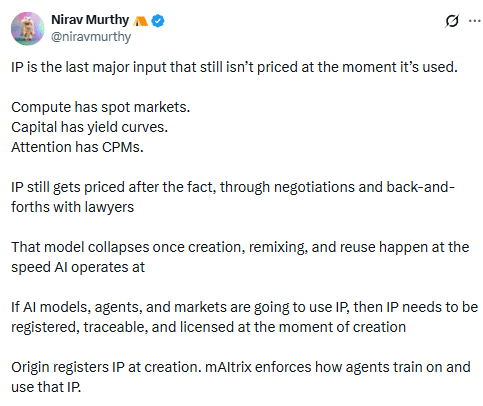
Source: Nirav Murthy/X

Camp Network’s system focuses on “proof of provenance,” which records who created content and how it is used. The goal is to allow creators to license work and receive royalties automatically.

The company describes this as building an “Autonomous IP Layer” for AI systems, where data used to train models is traceable and permissioned.

That approach aligns with broader industry concerns. According to a16z Crypto’s State of Crypto 2025 report, AI and blockchain are increasingly converging, with crypto infrastructure evolving into a core layer of the digital economy.

Capital flows into IP blockchains

Investors have backed this approach.

Camp Network has raised about $30 million across funding rounds. That includes a $25 million Series A led by 1kx and Blockchain Capital.

Murthy has also pointed to broader changes in the market, including how creators and platforms are reacting to AI.

If you’re a startup trying to train a voice model or a video model... you can’t do it anymore

At the same time, legal pressure is rising. Creators and publishers have filed lawsuits over AI training on copyrighted material.

Anyways, adoption remains uneven. Institutional investors still dominate early participation in tokenized assets. As AI creates more content, ownership may become harder to define.


Final Summary

  • Creators still face slow financing, high legal costs, and loss of equity under traditional systems.
  • Camp’s “on-chain vaults” enable direct funding from communities, allowing fans to share in IP revenue.


热门币种推荐

相关问答

QWhat problem does Camp Network aim to solve in the entertainment and AI industries?

ACamp Network aims to solve problems related to unclear ownership, complex financing, and delayed royalty payments in entertainment and AI-driven content creation by using blockchain technology to provide programmable ownership and automated revenue flows.

QHow does Camp Network's 'on-chain vaults' model work for funding creative projects?

ACamp Network's 'on-chain vaults' allow communities to fund projects directly, enabling fans to share in the financial upside of the intellectual property they support. This model replaces intermediaries and reduces legal costs while building stronger audience engagement through economic exposure.

QWhy is tracking ownership at the moment of creation particularly important in the age of AI?

ATracking ownership at creation is crucial because AI accelerates content generation beyond the capacity of traditional ownership systems. Delays in establishing ownership can leave creators without payment or control, especially when content goes viral or is used in training AI models without proper attribution.

QWhat is Camp Network's approach to ensuring proof of provenance for digital content?

ACamp Network focuses on 'proof of provenance,' which records who created content and how it is used. This system allows creators to license their work and receive royalties automatically, ensuring traceable and permissioned use of data, particularly in AI training.

QHow much funding has Camp Network raised, and which firms led their Series A round?

ACamp Network has raised about $30 million across funding rounds, including a $25 million Series A led by 1kx and Blockchain Capital.

你可能也喜欢

AI竞赛新规则:英伟达从芯片战转向能源与基建战场

英伟达宣布为OpenAI在俄亥俄州的数据中心建设提供1050亿美元财务担保,标志着人工智能行业的竞争重心正从芯片转向实体基础设施和能源资源。这家电子制造商通过承担设备租赁和残值风险,确保其系统独家部署于这座4.25吉瓦的园区。此举表明,科技公司为了推动AI进一步发展,已不能止步于制造强大处理器,而必须成为巨型建筑项目的金融担保方和实际共同投资者。 英伟达在提交给美国证券交易委员会的报告中澄清,该担保并非直接建设融资,而是针对租户违约的保险。支付仅在OpenAI无力偿付且设施确认可运营后触发。与此同时,英伟达将向SB Energy投资15亿美元以支持项目的能源部分。项目能源基础由SB Energy和软银提供,计划建设至少10吉瓦新发电能力,其中约9.2吉瓦来自天然气,电网基础设施投资至少42亿美元,首批产能计划于2028年上线。 主要AI开发商正积极通过多元供应商策略降低风险。OpenAI与AMD达成战略合作,部署高达6吉瓦的Instinct GPU;Anthropic也与AMD协议部署最多2吉瓦GPU。英伟达则通过与阿波罗、黑石等多家金融机构合作,动员超过5000亿美元外部资本,并愿意承担交易额25%以内的残值支持。 俄亥俄州项目事件揭示了一个根本性转变:AI领域的领导力不再仅由芯片性能决定,确保物理空间、电力供应和多年项目的财务可持续性已成为关键成功因素。科技公司被迫融入实体经济,承担起开发商和金融机构的职能。行业未来将取决于创新与实际基础设施能力之间的平衡,金融担保和能源合同变得与处理器架构专利同等重要。 从宏观经济视角看,英伟达的交易让人联想到1990年代末电信设备制造商为促进销售而向客户提供信贷的模式。尽管此次担保被结构化为违约保险而非直接贷款,但其经济逻辑相似:设备销售商承担买方部分风险以保障自身产品需求。一个悬而未决的问题是:到2028年,依赖天然气的能源基础设施在AI市场增速可能变化的情况下是否仍能满足需求?如果AI应用普及未达预期,此类融资模式能否持续?

cryptonews.ru7分钟前

AI竞赛新规则:英伟达从芯片战转向能源与基建战场

cryptonews.ru7分钟前

交易

现货

热门文章

如何购买CAMP

欢迎来到HTX.com!我们已经让购买Camp Network(CAMP)变得简单而便捷。跟随我们的逐步指南,放心开始您的加密货币之旅。第一步:创建您的HTX账户使用您的电子邮件、手机号码注册一个免费账户在HTX上。体验无忧的注册过程并解锁所有平台功能。立即注册第二步:前往买币页面,选择您的支付方式信用卡/借记卡购买:使用您的Visa或Mastercard即时购买Camp Network(CAMP)。余额购买:使用您HTX账户余额中的资金进行无缝交易。第三方购买:探索诸如Google Pay或Apple Pay等流行支付方法以增加便利性。C2C购买:在HTX平台上直接与其他用户交易。HTX场外交易台(OTC)购买:为大量交易者提供个性化服务和竞争性汇率。第三步:存储您的Camp Network(CAMP)购买完您的Camp Network(CAMP)后,将其存储在您的HTX账户钱包中。您也可以通过区块链转账将其发送到其他地方或者用于交易其他加密货币。第四步:交易Camp Network(CAMP)在HTX的现货市场轻松交易Camp Network(CAMP)。访问您的账户,选择您的交易对,执行您的交易,并实时监控。HTX为初学者和经验丰富的交易者提供了友好的用户体验。

1.2k人学过发布于 2025.08.27更新于 2026.06.02

如何购买CAMP

相关讨论

欢迎来到HTX社区。在这里,您可以了解最新的平台发展动态并获得专业的市场意见。以下是用户对CAMP(CAMP)币价的意见。

活动图片