Cardano founder Charles Hoskinson has confirmed a new collaboration between Midnight—Cardano’s privacy-focused partner chain—and Google Cloud, framing it as a strategic step to harden the network’s infrastructure and accelerate developer adoption. “Proud to be working with Google on Midnight. They are a wonderful company and add a ton of value to our ecosystem,” the Cardano founder wrote on X, amplifying Midnight’s announcement and a same-day blog post from the project.
Google Is Now Part Of Cardano’s Midnight
In a September 30, 2025 post, Midnight said the Midnight Foundation has launched a “strategic collaboration” with Google Cloud “for enterprise-grade security and infrastructure and to expand community tools and resources,” positioning zero-knowledge technology as “essential infrastructure for next-generation digital systems.” The announcement situates Midnight’s core thesis—selective disclosure and privacy-preserving computation—inside a compliance-aware architecture aimed at institutions handling sensitive data.
The scope of work is unusually concrete for a cloud–blockchain tie-up. According to Midnight, Google Cloud will “operate critical network infrastructure, including running a validator for Midnight,” and will bring its Mandiant division’s threat monitoring and incident-response capabilities to the network.
Midnight also says it will leverage Google Cloud’s Confidential Computing to remove operators from the trust boundary and harden against provider-level access, signaling an attempt to bind zero-knowledge proofs with hardware-enforced isolation. “The future of enterprise applications requires both transparency and privacy,” said Richard Widmann, Head of Web3 Strategy and Operations at Google Cloud. “By providing scalable infrastructure, we’re enabling developers to experiment with innovative zero knowledge frameworks to verify transactions without exposing sensitive data.”
Midnight framed the collaboration as an accelerant for real-world use cases that have historically struggled on transparent public chains. Fahmi Syed, President of the Midnight Foundation, argued that “Midnight transforms privacy from a technical barrier into a competitive advantage, enabling confidential financial systems, verifiable digital identity, and secure applications that can operate at scale with regulatory compliance built in.”
The blog post points to selective-disclosure patterns for financial institutions (private trading and compliant cross-border payments), credential issuance for governments, and privacy-preserving data-sharing in healthcare as early targets.
On the developer front, Midnight said projects building on the network can apply to the Google for Startups Web3 Program, with “up to $200,000 in Google Cloud Platform Credits over two years,” plus training and mentorship—an increasingly standard incentive package in cloud-supported web3 ecosystems but notable for a privacy-centric L1. Midnight’s own post and social messages also emphasize that the Google Cloud collaboration includes support for community tooling and expanded resources, indicating a bid to spur third-party app growth around Midnight’s zero-knowledge stack.
Hoskinson’s endorsement underscores the partner-chain strategy that Cardano entities have advanced this year, with Midnight frequently described as the lead privacy chain in that model. While the announcement stops short of financial terms or service-level guarantees, it commits Google Cloud to an operational role on the network—validator operations and security services—beyond marketing or co-branding, and provides direct quotes from both organizations that anchor the collaboration in concrete infrastructure and security deliverables.
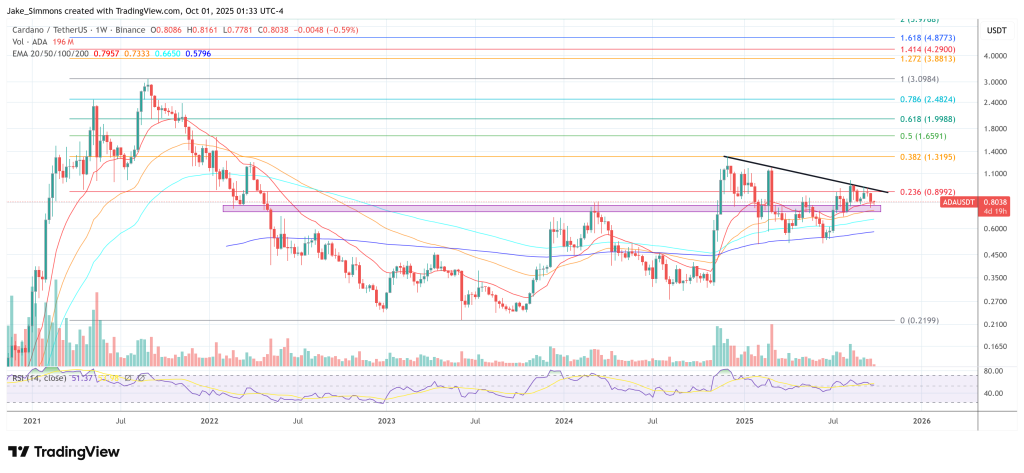
At press time, Cardano (ADA) traded at $0.80.

Related Posts