Is quantum computing threatening Bitcoin sooner than expected? On Wednesday, Microsoft unveiled its first quantum computing chip, dubbed “Majorana 1.” While the tech community has long speculated about Google’s next-generation quantum effort—often referred to as “Willow”—Microsoft’s announcement places renewed focus on the looming question: Can Bitcoin survive the accelerated push toward million-qubit machines?
Microsoft claims that Majorana 1 leverages a new topological core architecture designed to bring quantum computing out of the lab and into meaningful, real-world applications “in years, rather than in decades.” The chip’s unique design reportedly allows quantum systems to operate for longer periods and at more stable states than previous generations.
According to Microsoft CEO Satya Nadella, the company’s roadmap points to a one-million-qubit device by around 2027–2029—an ambition many in the field consider necessary for tackling “industrial-scale” computational tasks.
Is Bitcoin At Risk?
While most financial institutions rely on layered security systems, Bitcoin’s reliance on public-key cryptography has many wondering if it could be an easier target for quantum attacks. A Bitcoin-focused financial platform, River, sounded the alarm in a recent X thread, noting that “1 million qubits can potentially crack a BTC address.” They cautioned that “the Majorana 1 chip is far from that scale now, but could reach the 1 million mark by 2027-2029.”
River’s analysis also suggested that a device with 13 to 300 million qubits—once stabilized—could theoretically break a Bitcoin address within hours, potentially placing up to 5.9 million BTC at risk. Though today’s quantum computers are nowhere near that capacity, River stressed that Microsoft’s achievements shorten the overall timeline, meaning Bitcoin developers cannot afford complacency.
“When run for several days to weeks, a 1-million qubit QC could potentially crack Bitcoin addresses via a long-range attack. […] More realistically, we’d need a QC with 13-300 million qubits to carry out a long-range attack in 1-8 hours. If achieved, this would put 5.9 million BTC at immediate risk. Remember that the best QCs today have only 1,000 qubits. Still, this breakthrough shortens the timeline to make Bitcoin quantum-resistant,” River writes.
Alexander Leishman, CEO of River, emphasizes in a post on X that BTC’s unique setup could expose it more directly to quantum threats compared to banks and other centralized entities. “Access to a public key equals access to the money,” he said, pointing out that traditional banking systems rely on a host of protective layers. Even if quantum hardware were to render HTTPS encryption obsolete, Leishman noted that hackers would still have to surmount additional firewalls, authentication protocols, and in-person security checks to breach a bank.
In contrast, once a Bitcoin public key has been revealed (as happens when BTC is sent from an address), a sufficiently powerful quantum computer might bypass the corresponding private key if it can run the right algorithm for enough time. Leishman admitted he is “skeptical it’s a near-term problem,” but emphasized that ignoring the quantum threat could be shortsighted.
“A quantum computer will not magically give you access to all of the money at Goldman Sachs. It WILL magically give you access to many billions of dollars worth of Bitcoin. Again, I don’t think this threat is viable any time soon but it’s important that we discuss the issue honestly”, he argues.
Prominent Bitcoin commentator Preston Pysh joined the discussion via X, asking if the community should “prioritize engineering quantum-resistant addresses” and pointing to BIP-360 (the proposed P2QRH framework). Pysh suggested that this proposal could potentially be enacted through a soft fork, a method that typically allows for backward compatibility while adding new features to the Bitcoin protocol.
Leishman agreed that securing Bitcoin against quantum attacks should be a priority, though he urged against rushing any modifications. “We shouldn’t rush anything,” he remarked, signaling a preference for careful research and consensus-building among Bitcoin Core developers and the broader community.
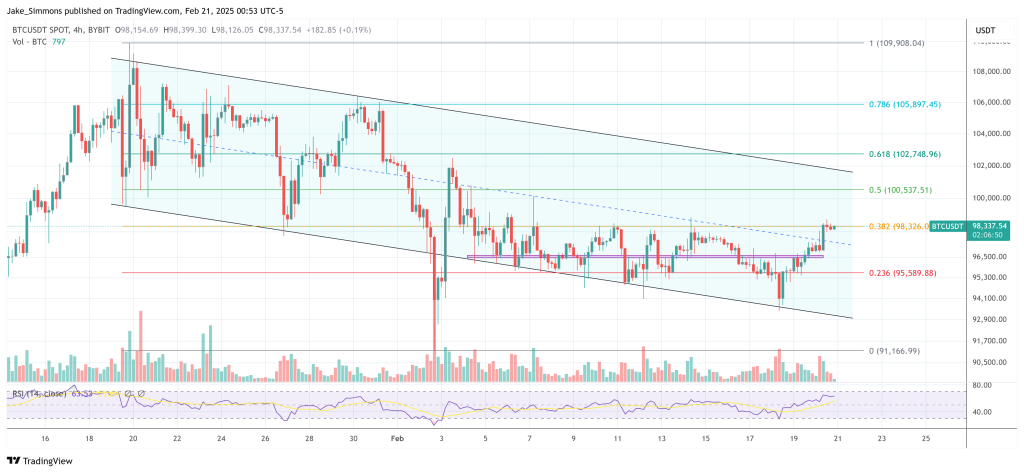
At press time, BTC traded at $98,337.

Related Posts