Why Are Spot Ethereum ETFs Underperforming? Bitwise CEO Reveals

bitcoinist发布于2024-10-21更新于2024-10-21

文章摘要

The launch of spot Ethereum exchange-traded funds (ETFs) has not met the high expectations set by their Bitcoin counterparts, leading...

The launch of spot Ethereum exchange-traded funds (ETFs) has not met the high expectations set by their Bitcoin counterparts, leading industry experts to analyze the underlying reasons. Since their inception on July 23, all spot ETH ETFs have seen outflows of $463 million, according to Farside Investors data. The main culprit is Grayscale’s ETHE with $2.996 billion in outflows, while BlackRock has $1.258 billion and Bitwise $321 million in inflows.

Why Are Spot Ethereum ETFs Not Doing Better?

Hunter Horsley, CEO of Bitwise Asset Management, took to X to shed light on the factors affecting the performance of the US spot Ether ETFs. “Why didn’t the Ethereum ETFs do better? A question I got at an event last week,” Horsley began. “First, how do you judge success? The ETPs from iShares, Fidelity, and Bitwise are all in the top 25 fastest growing new ETPs this year,” he added.

Despite their position among the fastest-growing exchange-traded products (ETPs), Horsley identified several factors that worked against the successful launch of spot Ethereum ETFs. He noted that the timing of the launch during summer, a typically slow period for investors who “monitor but don’t take on a lot of new projects,” may have dampened immediate interest.

Additionally, the market conditions played a role: “Bull markets always draw focus. Bitcoin ETPs launched amid a rising Bitcoin. Ether ETPs launched in a sideways market.” The lack of bullish momentum in Ethereum’s price may have contributed to the tepid response.

Furthermore, the sequential launch of Ethereum ETFs following Bitcoin ETFs may have overwhelmed investors still acclimating to cryptocurrency assets. “For many traditional investors, some time has been and continues to be needed to figure out how to incorporate Bitcoin after the launch of the ETPs. Ethereum arriving before that was solved made it hard to turn attention to it,” Horsley explained.

Nate Geraci, President of The ETF Store and co-founder of the ETF Institute, highlighted the broader success of crypto-related ETFs in 2024. “Update… Out of 525 ETFs launched in 2024, 13 of top 25 are either bitcoin or ether-related. 14 if you include MSTR Option Strategy ETF. Top 4 ETFs all spot btc. 5 of top 7 crypto-related. I call this masterpiece ‘no demand’.”

Related Reading: Ethereum Founder Buterin Lays Out Possible Futures For ETH Protocol

In response, Christopher Perkins, President of CoinFund, suggested that yield-generating products could enhance appeal. “Yield would help. Total return ETH is the killer product,” he stated. Horsley acknowledged the value of staking but downplayed its immediate impact on ETF performance. “Agree, ET32 has been growing rapidly in our Europe franchise,” he replied.

However, Horsley also added, “I don’t think lack of staking yield is a huge issue. Most of ETH today is owned directly so could be staked, yet ~2/3 don’t. But agree it’s valuable. We have an ETH ETP with staking in Europe that’s growing nicely.”

Industry veteran Dan Tapiero, founder and CEO of 10T Holdings, remained optimistic about the future of spot Ethereum ETFs. “Just wait. They’re gonna do just fine,” he asserted. Horsley concurred, simply stating, “Agree.”

At press time, ETH traded at $2,705.
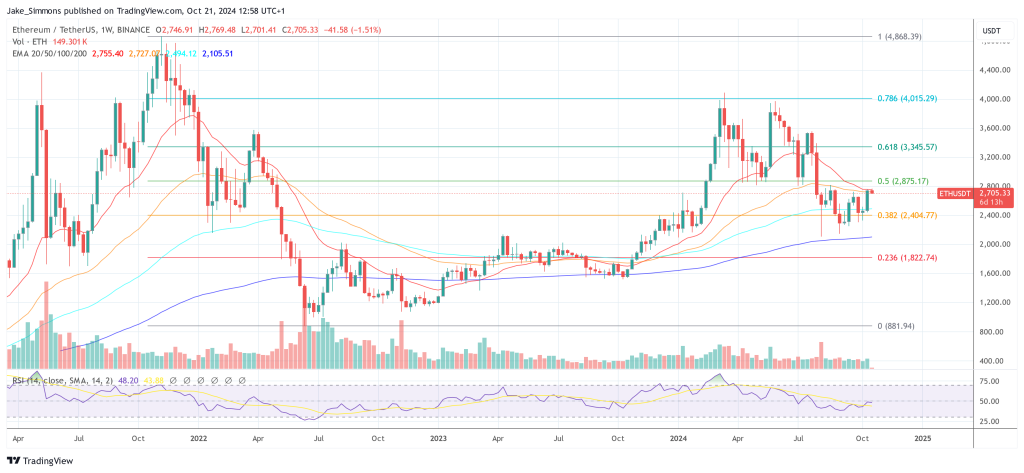
Ethereum price
ETH price trades below the 20-week EMA , 1-week chart | Source: ETHUSDT on TradingView.com
Featured image created with DALL.E, chart from TradingView.com
Jake Simmons

Jake Simmons

Jake Simmons has been a Bitcoin enthusiast since 2016. Ever since he heard about Bitcoin, he has been studying the topic every day and trying to share his knowledge with others. His goal is to contribute to Bitcoin's financial revolution, which will replace the fiat money system. Besides BTC and crypto, Jake studied Business Informatics at a university. After graduation in 2017, he has been working in the blockchain and crypto sector. You can follow Jake on Twitter at @realJakeSimmons.

热门币种推荐

你可能也喜欢

邢波再出手:上次「骂」完世界模型,这次轮到智能体了

邢波教授继去年批评世界模型后,近日与合作者发表新论文《智能体模型批评》,对当前被滥用的“智能体”概念提出系统性质疑与重构方案。 论文尖锐指出,目前众多被称为“智能体”的系统(如编程助手、客服机器人)大多只具备“智能体外观”(agentic),而非真正的“能动性”(agentive)。前者能力依赖于外部预设的工具链和提示词,模型仅是嵌入流程的零件;后者的决策和目标则内生于系统自身。论文以“工卡员工”和“感应灯”为例,说明任务复杂度不同并非自主性的本质区别。 基于此,论文从五个维度拆解主流智能体设计的不足,并提出了对应的“重建”思路: 1. **目标**:应从人类逐步喂指令,转变为一次性给予长期目标,由系统自主进行可调整的分层目标分解。 2. **身份**:自我认知不应固化于提示词,而应成为能根据经验持续演化的“活的自我评估”。 3. **决策方式**:驳斥仅靠延长思维链文字就能规划的观点,主张采用“模拟式推理”,即借助世界模型预测行动后果,再选择最优方案。 4. **节奏判断**:批评固定规划深度的做法,提出需引入独立的“元认知模块”(称为System III),让智能体自行判断何时该深思或速断。 5. **学习**:主张“持续自主学习”,让智能体自主决定何时在真实世界行动、何时退回模拟器训练、何时更新认知。 为整合这些原则,团队提出了具体架构GIC(Goal-Identity-Configurator),包含信念编码器、目标分解器、身份演化器、配置器(System III)、模拟规划器(System II)和执行器(System I)六个组件,并以飞行员训练过程类比其成长路径。 论文最后讨论了安全性,认为GIC架构通过将目标、身份、决策等模块显式化、可审查化,使安全问题变得可诊断、可修正,而非承诺绝对不出错。其核心论点是:真正的自主性不在于任务复杂度,而在于目标、身份与判断力是否内化于模型自身。当前大多数“智能体”可能仍停留在精准执行外部指令的阶段,而非真正理解与自主决策。

marsbit6分钟前

邢波再出手:上次「骂」完世界模型,这次轮到智能体了

marsbit6分钟前

Collector Crypt 如何用「循环买回」制造增长幻觉

《Collector Crypt 如何用「循环买回」制造增长幻觉》摘要 文章分析指出,Collector Crypt(CC)表面上是通过链上卡包抽卡推动增长,但其核心模式依赖“循环买回”——用户购买卡包后立即以约93%的价格卖回给平台,资金得以循环,从而快速推高GMV(商品交易总额)。然而,这种增长存在幻觉。 数据显示,CC的净利率已从2025年第三季度的11.2%腰斩至2026年第二季度的5.6%。GMV的增长主要来自高价位卡包(如250美元、1000美元和2500美元档位),但这些卡包为平台带来的每美元留存率反而更低。增长主要由少数高频、大额消费的钱包驱动,而非广泛用户基础扩大。 同时,实体卡牌赎回消耗了大量利润。2026年5月,赎回成本消耗了该月平台预烧净收入的41.6%。而且赎回活动高度集中,6月仅75个钱包执行了赎回,其中前四大用户就占了近一半。赎回使卡牌永久离开平台库存,迫使CC以可能更高的市场成本重新采购,增加了运营压力。 面对GameStop等强大竞争对手进入同一市场、评级成本上升等压力,CC的经济模型显得脆弱。其B2B合作伙伴策略目前也未能带来可持续的订阅式收入,大部分整合仍将库存和履约负担留在CC身上。 结论认为,CC需要证明其能吸引更广泛的收藏者、建立更深的二级市场,并使链上所有权真正创造价值,而非仅仅依赖“循环买回”来制造GMV增长的表面繁荣。

Foresight News28分钟前

Collector Crypt 如何用「循环买回」制造增长幻觉

Foresight News28分钟前

为了赚这笔钱,他们等了7年

多家支付和科技巨头(Visa、Stripe、万事达、Coinbase、BlackRock等)宣布组建联盟,计划推出名为“Open USD”的美元稳定币,并将储备收益分给采用该币的公司。此举直接冲击了稳定币公司Circle的商业模式,因其主要收入依赖USDC储备资产的利息,导致其股价单日大跌近20%。 这让人想起2019年Facebook主导的Libra项目。当时,类似的巨头联盟试图创建全球数字货币,但因监管压力、Facebook形象问题及联盟内部分歧而失败。然而,Libra的愿景并未消失。 七年间,监管框架(如美国GENIUS法案)逐渐明晰,公链等基础设施成熟,支付公司也已积累相关经验。Open USD的叙事更为收敛,聚焦于合规的美元稳定币和企业结算管道,不再像Libra那样充满宏大但敏感的全球金融变革野心。 不过,联盟模式固有的行动缓慢、利益协调困难等挑战依然存在。稳定币的成功关键在于建立流动性、信任和用户习惯,而非一纸华丽的成员名单。Open USD短期内更可能在企业间支付和特定链上场景中取得进展,而非迅速取代USDC。 对Circle而言,市场正在重新评估其价值:它从“稳定币时代的稀缺门票”被拉回至“众多发行方之一”的竞争现实,其依赖单一收入模型(储备利息)和外部合作伙伴分发的脆弱性因此暴露。Open USD的出现,标志着稳定币领域从早期探索进入巨头合规入场、竞争加剧的新阶段。

marsbit50分钟前

为了赚这笔钱,他们等了7年

marsbit50分钟前

交易

现货

热门文章

加密市场宏观研报:美国“加密货币周”来袭,ETH开启机构军备赛高潮

本周,加密市场迎来两股重磅催化——华盛顿“加密货币周”的立法攻势与以太坊机构布局的密集爆发,共同构成加密行业2025年下半年的“政策拐点”与“资金拐点”。这一轮加密周期的深层逻辑,正从比特币转向以太坊、稳定币及链上金融基础设施。我们认为:美国的政策明朗化+以太坊的机构化扩展,标志着加密行业正进入结构性转正阶段,市场配置的重心亦应逐步从“价格博弈”过渡至“规则+基础设施的制度红利捕捉”。

1.8k人学过发布于 2025.07.17更新于 2025.07.17

加密市场宏观研报:美国“加密货币周”来袭,ETH开启机构军备赛高潮

相关讨论

欢迎来到HTX社区。在这里,您可以了解最新的平台发展动态并获得专业的市场意见。以下是用户对ETH(ETH)币价的意见。

活动图片