The quest to uncover the true identity of Satoshi Nakamoto, the pseudonymous architect of Bitcoin, continues with new revelations from the Federal Bureau of Investigation (FBI). Dave Troy, a well-known investigative journalist, has shared insights from a Freedom of Information Act (FOIA) request he filed, which sought any records pertaining to Satoshi Nakamoto held by the FBI across its headquarters, field offices, legal attachés, and other record-keeping facilities.
Does The FBI Know Who Created Bitcoin?
The FOIA request, as described by Troy on the X social media network, explicitly requested “any and all records pertaining to Satoshi Nakamoto” under the FBI’s jurisdiction. This included documents that might classify Nakamoto as an individual, group, consortium, or government entity. The request emphasized a need for clarity on whether the FBI held any information on Nakamoto, whether under his pseudonym or any real identity that might be connected to it.
“The purpose of my request is NOT centered on establishing the identity of ‘Satoshi Nakamoto’ but rather to request any records the bureau may possess on the subject of ‘Satoshi Nakamoto’ as a topic. If the bureau does not possess any records on the general subject of ‘Satoshi Nakamoto,’ either as a general topic or as a pseudonym for an individual known to be deceased, please do let me know,” Troy writes in the FOIA request.
In the response that Troy shared, the FBI characterizes Nakamoto as a “third party individual.” This term is notably used by US intelligence agencies when referring to foreign nationals, suggesting a deliberate ambiguity and indicating that the bureau may possess relevant information but opts not to disclose it.
“FBI doubles down on its assertion that “Satoshi Nakomoto,” apocryphal creator of Bitcoin, is a “third party individual,” a response they typically give when inquiring after foreign nationals. This is *despite* clarifying and constraining my request,” Troy notes via X.
He also expressed concerns on X regarding the FBI’s interpretation of his request, noting, “This suggests either that a) the FBI believes it knows the identity of ‘Satoshi Nakamoto,’ and will not confirm or deny having records, b) the FOIA office is confused, and has not properly interpreted this very clearly written request.”
The use of a “Glomar response” by the FBI—neither confirming nor denying the existence of records—compounds the mystery. This type of response is legally grounded in the precedent set by the US Supreme Court, allowing agencies to avoid confirming the existence of records that, if existing, would trigger significant implications for national security or privacy.
Already on August 13, Troy disclosed the initial response from the FBI regarding his inquiry. Posting on X, Troy also received a “Glomar response” to his request about Satoshi Nakamoto, which neither confirmed nor denied whether the agency possessed any records identifying the mysterious Bitcoin creator.
Notably, this is not an isolated incident of public attempts to identify Nakamoto through official channels. Daniel Oberhaus, a staff writer at Motherboard, encountered similar barriers in 2018 when he requested all internal emails containing Nakamoto’s name from both the FBI and CIA. Like Troy, Oberhaus received a Glomar response from the CIA, which stated it could neither confirm nor deny the existence of the requested documents—a tactic that preserves secrecy while avoiding disclosure of potentially sensitive information.
On another note, Eric Balchunas, a Bloomberg ETF analyst, highlighted yesterday via X that all US spot Bitcoin ETFs now control approximately 921,540 BTC, nearing the estimated holdings of Nakamoto himself, believed to be about 1.1 million BTC. “US spot bitcoin ETFs now have 84% of the Bitcoin that Satoshi has, on track to have more and take over the top spot by Halloween,” he remarked.
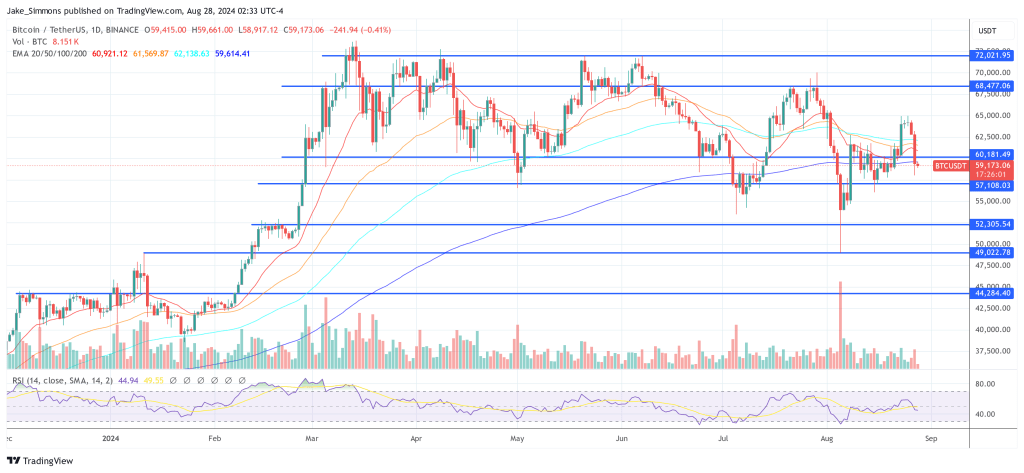
At press time, BTC traded at $59,173.

Related Posts