
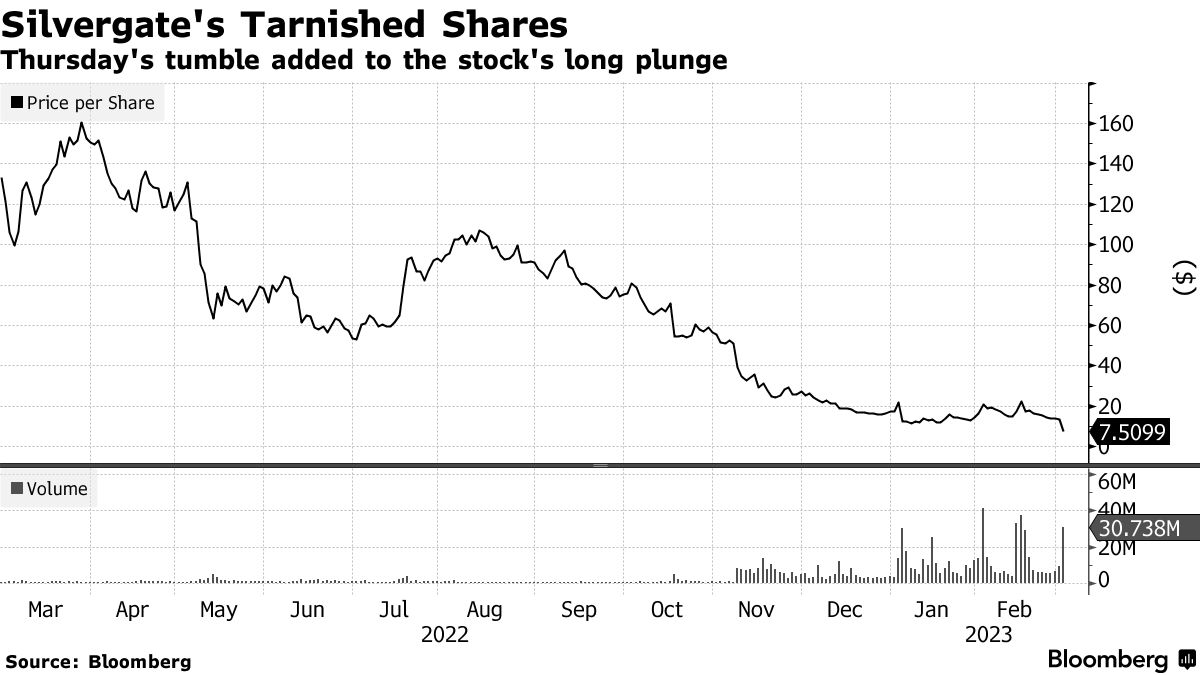
Silvergate Capital Corp.’s woes deepened on Thursday, a day after the bank raised questions about whether it can stay in business, with the shares plummeting to a record low and key partners cutting off ties to the crypto-friendly bank.
The bank set off alarms with a filing Wednesday that said losses might leave Silvergate with less capital than it needs, and that it’s evaluating its ability to continue as a going concern.
Investors and business partners headed for the exits, with the stock slumping 58%, its biggest drop ever, to a record low. Meanwhile, Coinbase Global Inc., Galaxy Digital Holdings Ltd., Paxos Trust Co. and other crypto firms decided to stop accepting or initiating payments through Silvergate. The exodus threatens the bank’s key source of deposits and a platform for crypto participants to transfer money among one other.
“In light of recent developments & out of an abundance of caution, Coinbase is no longer accepting or initiating payments to or from Silvergate,” Coinbase said on Twitter. “Coinbase will be facilitating institutional client cash transactions with our other banking partners.”
Galaxy Digital, the crypto financial services firm founded by Michael Novogratz, said it continues to have no material exposure to Silvergate. The company took the action “to ensure client and firm assets are secure as part of our vigorous risk-management process,” its spokesperson said in an email.
Paxos issued a similar statement, and Gemini Trust Co., Crypto.com and Cboe Clear Digital LLC are all suspending transfers with Silvergate as well. Circle Internet Financial Ltd. said it’s “unwinding certain services” with Silvergate.
Bitstamp Ltd. went a step further, warning customers of potential losses if they make fresh deposits via Silvergate. “Bitstamp cannot be responsible for any funds deposited into the Silvergate bank account,” the crypto exchange said in a blog post Thursday. “If you do choose to deposit funds into this account, you do so at your own risk.”
At Coinbase all client funds continue to be safe, accessible & available.
In light of recent developments & out of an abundance of caution, Coinbase is no longer accepting or initiating payments to or from Silvergate.
— Coinbase (@coinbase)
March 2, 2023
Silvergate said Wednesday that it couldn’t hand in its annual report on time to the Securities and Exchange Commission, which spurred at least three analysts to cut their ratings. Canaccord Genuity Group Inc. lowered the bank to hold, while JPMorgan Chase & Co. downgraded the stock to underweight and Compass Point Research & Trading LLC cut it to neutral. Morgan Stanley analyst Manan Gosalia, who already had a sell-equivalent rating on the stock, removed his price target entirely, citing the “high level of uncertainty” around the firm.
JPMorgan said Silvergate is facing continued challenges to its liquidity, and that its Tier 1 leverage ratio for the holding company was 5.36%, just “slightly above the well-capitalized level of 5%.”
“People are genuinely scared after that news, and it’s hard to say it’s not justified,” said J. Austin Campbell, adjunct professor of Columbia Business School, who runs an independent consulting business for crypto firms. “If you look back at 2008, when counterparties start missing regulatory reports or SEC filing deadlines, that was a very bad sign.”
Campbell said he’s been contacted by no fewer than five crypto players, including trading firms, asset management firms and crypto projects, asking for advice on where they should move bank accounts.
What Bloomberg Intelligence Says:
“With Silvergate’s going-concern warning, the bank’s liquidity is at risk if other customers aside from Coinbase decide to limit or reduce activity with Silvergate. A large majority of its $3.8 billion of digital crypto deposits as of 4Q were above the FDIC’s insurance limit of $250,000. Silvergate’s delay in filing its 10-K comes amid increased regulatory and legal scrutiny.”
— Arnold Kakuda, BI senior credit analyst, and Nicholas Beckwith, BI credit associate analyst
“Silvergate is working diligently to file its 10-K as soon as possible and has no further comment at this time,” a spokesperson said Thursday, referring to the overdue report.
The shaky status of the bank, which holds federally insured deposits and more than $11 billion in assets, will add fuel to a debate among US lawmakers and regulators over whether banks can manage the risks that come with digital assets.
“It confirms the fears that many regulators have had,” said Todd Baker, a senior fellow at Columbia University’s Richman Center for Business, Law and Public Policy. “If this bank fails, it’s going to be held up as an example of why banks should be extremely conservative in dealing with crypto companies.”
Even if that doesn’t happen, Silvergate’s travails will stoke even greater caution on the part of regulators, he said.
In early January, three top financial regulators — the Federal Reserve, Office of the Comptroller of the Currency and Federal Deposit Insurance Corp. — issued a blunt warning to banks that crypto-related risks that can’t be controlled shouldn’t be allowed to infect the banking system.
Silvergate added to the US policy debate when it revealed in January how it was stabilizing its balance sheet after selling billions in assets to pay depositors. By the end of last year the firm held $4.3 billion in short-term Federal Home Loan Bank advances, a program originally set up under President Herbert Hoover to bolster mortgage lending.
Silvergate’s troubles offer a stark reminder to investors that a lender’s true strength lies in its core deposits —the consumer checking and savings accounts that are likely to remain with a bank even amid market and rate volatility, RBC Capital Markets Managing Director Gerard Cassidy said in an interview.
“Those are gold in a higher-interest-rate environment,” he said, drawing a distinction between those deposits and “hot money,” or cheaper sources of funding that are ultimately more volatile, such as the interest-free deposits Silvergate carried on behalf of crypto firms. “Those deposits, in a rising-rate environment, if you don’t pay up for them, they leave.”
On Wednesday, Silvergate listed a Justice Department probe and increased regulatory scrutiny among factors that could ultimately affect financial results.
“The best we can tell, this is not the savings and loan crisis,” said Ian Katz, a managing director with Capital Alpha Partners. “It looks to be pretty isolated.”
If the fallout within banking is limited, Katz said, regulators will interpret it as vindication for the approach they’ve taken.
Still, Silvergate’s current predicament will make other banks all the more reluctant to work with crypto ventures, resulting in a chilling effect on that industry, said Henry Elder, head of decentralized finance at digital-asset manager Wave Financial.
“They were the crypto bank,” Elder said. “You are certainly not going to see anyone come out as a crypto bank until there’s more clarity.”