Bitcoin's Identity Anxiety in 2026: 4 Paths to $150,000

marsbitXuất bản vào 2026-02-05Cập nhật gần nhất vào 2026-02-05

Tóm tắt

The article "Bitcoin's Identity Crisis in 2026: Four Paths to $150,000" analyzes Bitcoin's significant price drop on January 29, 2026, when it fell 15% from $96,000 to $80,000. The author argues that Bitcoin is currently trading under four conflicting identities: an inflation hedge, a tech stock, digital gold, and an institutional reserve asset. This identity crisis causes inconsistent and chaotic price movements, as Bitcoin fails to behave predictably under different market conditions—such as falling during both a stock market crash and hawkish Fed signals. Data shows Bitcoin's correlation with Nasdaq rising to 0.68 and its volatility correlating with stock volatility at 0.88, indicating it acts more like a leveraged tech bet than a uncorrelated asset. The author outlines four potential resolution paths: adoption as a strategic reserve (leading to $120K-$150K), normalization as a risk asset ($80K-$110K), acceptance as a true inflation hedge ($110K-$140K), or failure as a diversifier ($40K-$60K). Key indicators to watch include correlation shifts, government adoption announcements, on-chain metrics, and volatility normalization. The conclusion emphasizes that until its fundamental identity is resolved, Bitcoin's price will remain driven by institutional positioning and correlation algorithms rather than utility or adoption.

Author: Luis Flavio Nunes

Compiled by: Deep Tide TechFlow

Deep Tide Introduction: On January 29, 2026, Bitcoin plummeted 15% in a single day, falling from $96,000 to $80,000. The strangeness lies in this: when the stock market crashed, it should have risen as a safe-haven asset, but it fell; when the Federal Reserve signaled a hawkish stance, it should have fallen as a risk asset, but it also fell. Bitcoin collapsed in both opposing events.

This article points out that Bitcoin is simultaneously playing four contradictory identities: inflation hedge, tech stock, digital gold, and institutional reserve asset. When these four identities vie for control, the result is chaos.

The author proposes four possible resolution paths and analyzes which path will push Bitcoin to $150,000.

Full text as follows:

On January 29, 2026, Bitcoin plummeted 15% in a single day, falling from $96,000 to $80,000. What is striking is not the crash itself, but that Bitcoin fell during two simultaneous, opposing events.

The stock market crashed. This should have helped Bitcoin as a safe-haven asset.

The Federal Reserve signaled tightening policy. This should have hit Bitcoin as a risk asset.

Bitcoin collapsed in both events. It moved with stocks when it should have moved opposite them. It fell on hawkish news when digital gold should have risen. The fundamental logic of the market's understanding of what Bitcoin actually is was broken.

Four Incompatible Identities

Bitcoin is simultaneously traded as four different assets. Each identity demands different price behavior. When all four identities vie for control, the result is chaos.

Identity One: Inflation Hedge

Bitcoin has a fixed supply of 21 million coins. When governments print money and devalue currency, Bitcoin should rise. This was the original promise. Digital scarcity triumphs over government printing presses.

The data tells a different story. In 2025, when inflation fears dominated the markets, gold rose 64%. Bitcoin fell 26%. When the Consumer Price Index (CPI) showed unexpected increases, Bitcoin sometimes rose. When Core Personal Consumption Expenditures (Core PCE) showed inflation, Bitcoin sometimes fell. The reaction was random, not consistent.

If Bitcoin were truly an inflation hedge, it should react the same way to all inflation signals. Instead, it reacts to some signals and ignores others. This suggests Bitcoin is reacting to something else, perhaps energy prices that affect mining costs and consumer inflation.

Identity Two: Tech Stock

Bitcoin moves in sync with the Nasdaq. The 30-day correlation reached 0.68. When tech stocks fall on growth concerns, Bitcoin falls. When the Fed hints at tightening and tech stocks sell off, Bitcoin sells off harder.

If Bitcoin is a tech stock, investors might as well buy the Nasdaq index directly. Tech stocks don't pay dividends, but they generate revenue and profits. Bitcoin generates neither. A pure tech bet through actual tech stocks makes more sense.

The problem goes deeper. Bitcoin was supposed to be uncorrelated with traditional markets. That was the whole value proposition. If Bitcoin is just a leveraged Nasdaq bet, it has no place in a portfolio already holding stocks.

Identity Three: Digital Gold

In late January, when investors fled risk, gold soared to $5,500. Bitcoin crashed to $80,000. At the exact moment digital gold should have proven its value, the two assets moved in opposite directions.

Bitcoin's correlation with gold turned negative in 2026. Precisely negative 0.27. When gold rose 3.5% on hawkish Fed news, Bitcoin fell 15%. The Bitcoin-to-gold ratio hit a record low of 16.68x.

If Bitcoin is digital gold, it failed the most basic test. Gold works as a crisis hedge because it moves away from risk assets when panic rises. Bitcoin moves with risk assets, proving it is not gold in any meaningful sense.

Identity Four: Institutional Reserve Asset

Some companies and governments hold Bitcoin as a strategic reserve. Japan's Metaplanet holds 35,100 Bitcoin. The US government integrates seized Bitcoin into its strategic reserves. This narrative suggests Bitcoin will become a core holding for pension funds and central banks.

The behavior doesn't match the story. Institutional investors are not holding through volatility. They are running basis trades, selling volatility, and treating Bitcoin as a trading tool. ETF flows mainly show arbitrage activity, not long-term conviction buying.

If institutions truly saw Bitcoin as a reserve asset like gold, they would accumulate during crashes and never sell. Instead, they sell during crashes and buy on rallies. This is trader behavior, not reserve manager behavior.

Valuation Paradox

Each identity implies a different fair value for Bitcoin.

If Bitcoin is an inflation hedge, based on gold's performance under similar monetary conditions, the price should be $120,000 to $150,000.

If Bitcoin is a tech stock, based on correlation with the Nasdaq and lack of cash flow, the price should be $50,000 to $70,000.

If Bitcoin is digital gold, based on gold's 65-year value trajectory applied to digital scarcity, the price should exceed $150,000.

If Bitcoin is an institutional reserve asset, the price should track government and corporate adoption rates, suggesting a year-end level of $100,000 to $120,000.

The current price of $80,000 satisfies none of these frameworks. It is in the middle, pleasing no model and validating no thesis. This isn't the market finding equilibrium. It's a market that cannot agree on what it is pricing.

When Wall Street Can't Define What It Owns

Robbie Mitchnick manages digital asset strategy at BlackRock, the world's largest asset manager. In March 2025, he said something remarkable:

"Bitcoin fundamentally looks like digital gold. But some days it doesn't trade like that. Tariffs get announced, and it falls like a stock, which confuses me because I don't understand why tariffs would affect Bitcoin. The answer is they don't."

Even Bitcoin's primary institutional advocates admit confusion. If BlackRock doesn't understand what Bitcoin is, how can retail investors be expected to know?

This confusion creates a mechanical problem. When institutions cannot classify an asset, they default to correlation-based risk models. These models assume historical correlations persist. When correlations shift suddenly, as in January, institutions must rebalance their portfolios. Rebalancing during a crash means forced selling. Forced selling creates a cascade effect.

Think of it like a ship's autopilot. The autopilot steers based on past wind patterns. When the wind suddenly changes direction, the autopilot overcorrects, causing violent swings. Human judgment could smooth the course, but the autopilot only knows historical patterns. Bitcoin's identity crisis is the changing wind, and the institutional algorithms are the autopilot overcorrecting in the storm.
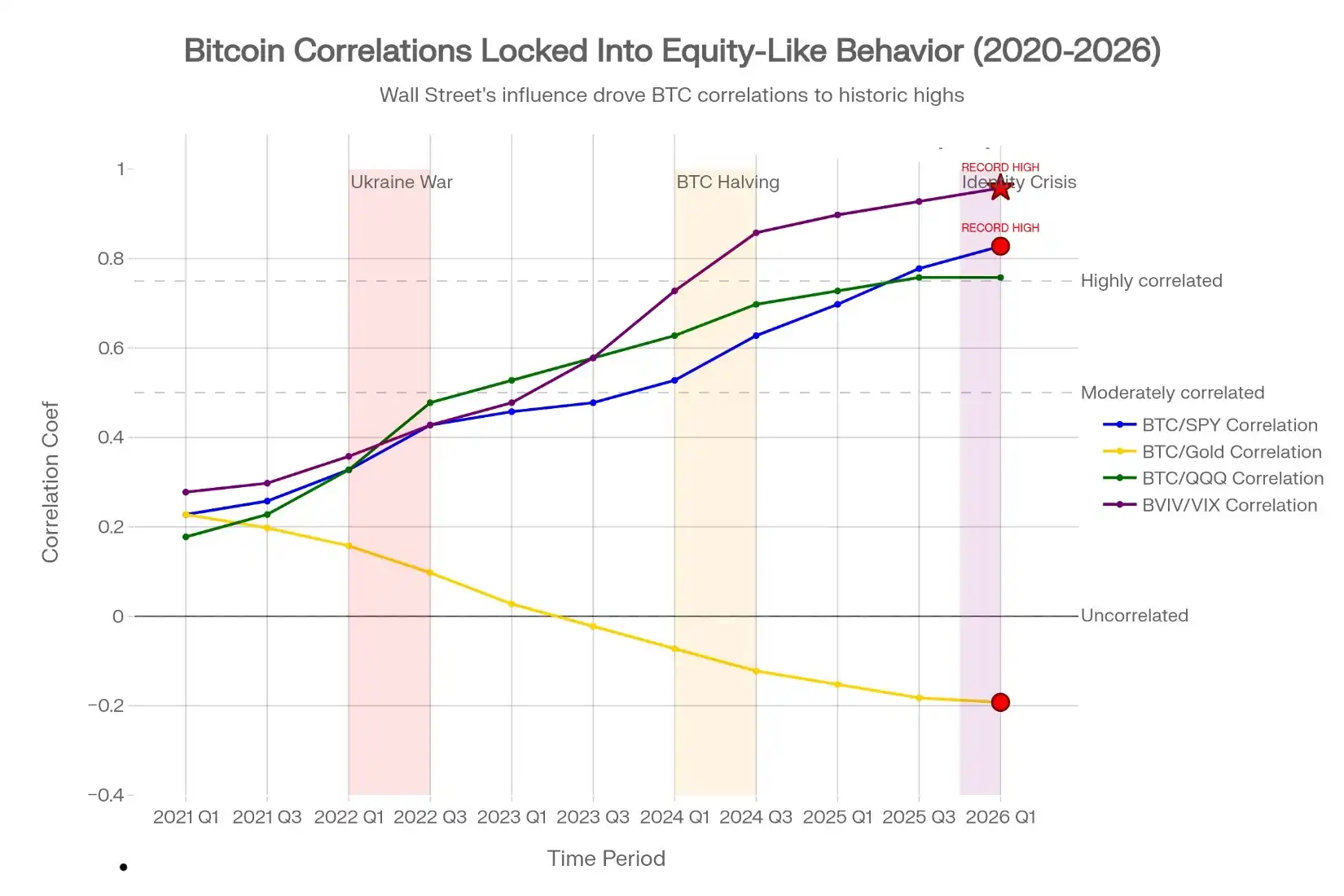
The Death of Diversification: Bitcoin's correlation with stocks surged from 0.15 (2021) to 0.75 (January 2026), a five-year shift driven entirely by institutional risk management, not Bitcoin adoption or fundamentals. The more damaging metric: Bitcoin volatility now correlates with stock volatility at 0.88 (purple line), the highest level ever recorded. This proves Bitcoin is traded mechanically based on stocks, not its own utility. Investors buying Bitcoin as a hedge are actually buying a leveraged, volatile stock bet, amplifying losses during crashes rather than offsetting them.

Volatility Homogenization

Bitcoin's volatility now moves in sync with stock market volatility. The correlation between Bitcoin volatility and the VIX stock volatility index reached 0.88 in January 2026. This is the highest reading ever recorded.

In 2020, this correlation was 0.2. Bitcoin volatility was independent. By 2026, it had become identical to stock volatility.

This is because institutional traders sell volatility across all asset classes simultaneously. When the VIX rises above certain levels, algorithms automatically sell Bitcoin, stocks, and commodities to reduce portfolio volatility. This mechanical selling has nothing to do with Bitcoin fundamentals. It is pure risk management, applied equally across all assets.

The result is that Bitcoin has lost independent price discovery. Its price is no longer driven by adoption, usage, or scarcity. It is driven by correlation assumptions and volatility control algorithms.

The data proves this. In January 2026, even as the price rebounded to $96,000, Bitcoin's daily active addresses were declining. Transaction volume was falling even as institutional adoption was supposedly accelerating. The Lightning Network, which processes actual Bitcoin payments, grew 266% year-over-year. Yet the price fell.

Usage was up. Price was down. This proves that what drives the price is positioning and correlation, not fundamentals.

Reflexivity Trap

George Soros described reflexivity as a feedback loop where price movements themselves drive further movements, independent of fundamentals.

Bitcoin is caught in reflexivity.

Institutions assume a 0.75 correlation between Bitcoin and stocks. Options traders build hedges based on this assumption. When stocks move 2%, algorithms trigger a 2% move in Bitcoin. This creates a self-fulfilling prophecy. Bitcoin moves with stocks, so traders think it's a stock. Retail investors adopt this view and trade accordingly. The actual Bitcoin fundamentals become irrelevant. The price is completely detached from utility.

This is not temporary confusion. It is structural. Until institutions agree on what Bitcoin is, the reflexivity loop will persist. Every rally will contain the seeds of the next crash because the market cannot agree on why the rally is happening.

What Retail Investors Actually Own

Most retail investors think they are buying diversification when they buy Bitcoin. They believe Bitcoin protects against inflation and reduces stock exposure. The math proves otherwise.

Take a simple example. An investor holds $100,000 in stocks and allocates $5,000 to Bitcoin, expecting diversification.

When stocks fall 10%, the portfolio loses $9,000. But Bitcoin, with a 0.75 correlation to stocks, falls 15%. The Bitcoin position loses $750. Total loss: $9,750.

Without Bitcoin, the loss would have been $9,000. Bitcoin made the portfolio worse, not better. This correlation means Bitcoin amplifies stock losses, not offsets them.

True diversification requires negative correlation. Bonds are negatively correlated with stocks during risk-off periods. Gold is negatively correlated during crises. Bitcoin is positively correlated, making it useless as a hedge.

The Inevitable Resolution

Bitcoin cannot sustain four conflicting identities. The market will force a resolution in 2026 through one of four paths.

Path One: Strategic Reserve

Governments and corporations treat Bitcoin like gold reserves. They buy and never sell. Price volatility becomes irrelevant as holders measure success in decades, not quarters. Institutions stop trading Bitcoin and start hoarding it. Price finds equilibrium based on slow, steady accumulation. This path leads to $120,000 to $150,000 by year-end.

Path Two: Risk Asset Normalization

Institutions formally classify Bitcoin as a commodity derivative or stock analogue. They build risk models that account for extreme volatility. They accept that Bitcoin is not a hedge but a leveraged bet on monetary expansion. Position sizes are adjusted accordingly. Correlations become predictable because everyone agrees on what Bitcoin is. Price trades in an $80,000 to $110,000 range with lower volatility.

Path Three: Inflation Hedge Acceptance

After resolving which inflation metric matters, the market agrees Bitcoin reacts to monetary debasement, not consumer price changes. Correlation with stocks falls to 0.3 or 0.4. Bitcoin becomes a true alternative to gold. This path leads to $110,000 to $140,000 as portfolio managers allocate for inflation protection.

Path Four: Diversification Failure

Institutions realize Bitcoin cannot diversify a stock portfolio. A 0.75 correlation is too high to justify an allocation. Capital flows reverse as portfolio managers exit. Retail investors understand Bitcoin is not a hedge. Price falls to $40,000 to $60,000 as the strategic allocation story collapses.

The most likely outcome is a slow resolution in 2026. Bitcoin will gradually shift from risk asset to reserve asset, with periodic corrections as institutions recalibrate. Price will consolidate between $80,000 and $110,000 until one path dominates.

What to Watch

Four indicators will show which path Bitcoin takes.

  • Correlation Inflection: If Bitcoin stops moving with stocks and correlation drops below 0.5, it becomes a hedge again. This favors Path Three.
  • Government Announcements: If a major government formally allocates Bitcoin to reserves, Path One accelerates. Watch for announcements from the US, EU, or Japan.
  • On-Chain Metrics: If daily active addresses and transaction volume reverse higher while price is flat or falling, fundamentals are improving even as speculation wanes. This suggests long-term strength.
  • Volatility Normalization: If the correlation between Bitcoin volatility and stock volatility drops below 0.60, institutional volatility selling is easing. This allows true price discovery to return.

These indicators don't require capital to track. They provide better insight than price charts.

Conclusion

Bitcoin's fall to $80,000 was no accident. It was Bitcoin confronting a question it has avoided since institutional money arrived: What am I?

Until this question has a clear answer, every rally will contain the seeds of the next crash. Bitcoin will move with stocks when it should diverge. It will fall on news that should help it. It will rise on developments that shouldn't matter.

This is not temporary confusion. It is a structural identity crisis that will define the entire 2026 narrative.

Investors buying Bitcoin as an inflation hedge will be disappointed during inflation panics. Investors buying it for diversification will be disappointed when it amplifies stock losses. Investors buying it as digital gold will be disappointed when it trades like a tech stock.

The only investors who will succeed are those who understand that Bitcoin is currently none of these things. It is a positioning-driven, correlation-dependent, volatility-controlled instrument that has temporarily lost its connection to its fundamental purpose.

The crash exposed this truth. The recovery will depend on Bitcoin's ability to answer what it is before the institutions decide the answer for it.


Câu hỏi Liên quan

QWhat are the four conflicting identities that Bitcoin is simultaneously trying to embody, according to the article?

AThe four conflicting identities are: 1) Inflation hedge, 2) Tech stock, 3) Digital gold, and 4) Institutional reserve asset.

QWhat specific event on January 29, 2026, is used to illustrate Bitcoin's identity crisis?

AOn January 29, 2026, Bitcoin crashed 15% from $96,000 to $80,000. It fell even though the stock market crashed (when it should have risen as a safe haven) and the Fed signaled a tightening policy (when it should have fallen as a risk asset).

QWhat is the core problem with Bitcoin's correlation to traditional markets, as described in the article?

AThe core problem is that Bitcoin's correlation with the Nasdaq reached 0.68 and its volatility became correlated with stock market volatility (VIX) at 0.88. This means it amplifies stock losses instead of providing diversification, making it a useless hedge.

QWhat are the four possible resolution paths for Bitcoin's identity crisis, and which one is predicted to lead to a price of $150,000?

AThe four paths are: 1) Strategic Reserve (leads to $120K-$150K), 2) Risk Asset Normalization ($80K-$110K), 3) Inflation Hedge Acceptance ($110K-$140K), and 4) Diversification Failure ($40K-$60K). The Strategic Reserve path (Path One) is the one that could push the price toward $150,000.

QAccording to the article, what key indicators should be watched to determine which path Bitcoin will take?

AThe four indicators are: 1) A correlation inflection point (if correlation with stocks drops below 0.5), 2) Government announcements of adding Bitcoin to reserves, 3) On-chain metrics like daily active addresses increasing while price is flat/falling, and 4) Volatility normalization (if Bitcoin's volatility correlation with the VIX drops below 0.60).

Nội dung Liên quan

Polymarket Bị Kẹt: Bài Kiểm Tra Thực Sự Sau Khi Vượt Qua Giai Đoạn Lưu Lượng Tăng Đột Biến

Polymarket, nền tảng dự đoán thị trường hàng đầu, đang đối mặt với thách thức lớn khi trải nghiệm giao dịch xuống cấp do hạ tầng không theo kịp đà tăng trưởng. Phó chủ tịch kỹ thuật Josh Stevens thừa nhận vấn đề và công bố kế hoạch cải tổ toàn diện, bao gồm: giảm độ trễ dữ liệu, sửa lỗi hủy lệnh, xây dựng lại hệ thống order book (CLOB), nâng cao hiệu suất website, và quan trọng nhất là di chuyển chain (chain migration). Nguyên nhân sâu xa nằm ở việc Polymarket không còn là ứng dụng dự đoán đơn thuần mà đã phát triển thành một nền tảng giao dịch tần suất cao. Polygon, từng là lựa chọn chi phí thấp hoàn hảo, giờ đây trở thành rào cản kỹ thuật. Động thái này ngay lập tức thu hút sự quan tâm của các blockchain khác như Solana, Sui, Algorand... trong khi Polygon nỗ lực giữ chân ứng dụng quan trọng này - nguồn đóng góp phí giao dịch đáng kể cho hệ sinh thái của họ. Bài kiểm tra thực sự của Polymarket không chỉ là chọn chain mới, mà là xây dựng một hệ thống giao dịch đủ mạnh và ổn định để giữ chân người dùng trong giai đoạn tăng trưởng mới, nơi độ tin cậy quan trọng hơn bao giờ hết.

Odaily星球日报2 giờ trước

Polymarket Bị Kẹt: Bài Kiểm Tra Thực Sự Sau Khi Vượt Qua Giai Đoạn Lưu Lượng Tăng Đột Biến

Odaily星球日报2 giờ trước

Điều chỉnh kỳ vọng giảm cho chu kỳ tăng giá tiếp theo của BTC

Tác giả Alex Xu, một nhà đầu tư Bitcoin lâu năm, đã chia sẻ quyết định giảm dần tỷ trọng BTC trong danh mục đầu tư của mình, từ vị thế lớn nhất xuống còn khoảng 30%, và giải thích lý do cho việc điều chỉnh kỳ vọng về đỉnh giá trong chu kỳ bull market tiếp theo. Các lý do chính bao gồm: 1. **Năng lượng tăng trưởng tiềm năng giảm:** Các chu kỳ trước được thúc đẩy bởi việc mở rộng đối tượng đầu tư theo cấp số nhân (từ cá nhân đến tổ chức). Chu kỳ tới cần sự chấp nhận từ các quỹ đầu tư quốc gia hoặc ngân hàng trung ương, điều này khó xảy ra trong 2-3 năm tới. 2. **Chi phí cơ hội cá nhân:** Tìm thấy nhiều cơ hội đầu tư hấp dẫn khác (cổ phiếu công ty) với mức giá hợp lý. 3. **Tác động tiêu cực từ sự thu hẹp của ngành crypto:** Nhiều mô hình Web3 (SocialFi, GameFi...) không thành công, dẫn đến sự thu hẹp của toàn ngành và làm chậm tốc độ tăng trưởng số người nắm giữ BTC. 4. **Áp lực từ nhà mua lớn nhất (MicroStrategy):** Chi phí huy động vốn của MicroStrategy tiếp tục tăng cao (lãi suất 11.5%), có thể làm giảm tốc độ mua vào và gây áp lực bán. 5. **Sự cạnh tranh từ Vàng được token hóa:** Sản phẩm vàng token hóa (tokenized gold) đã thu hẹp khoảng cách về tính dễ chia nhỏ, dễ mang theo và dễ xác minh so với BTC. 6. **Vấn đề ngân sách bảo mật:** Phần thưởng khối giảm sau mỗi lần halving làm trầm trọng thêm vấn đề ngân sách cho bảo mật mạng lưới. Tác giả vẫn giữ một phần BTC đáng kể và sẵn sàng mua lại nếu các lý kiến trên được giải quyết hoặc xuất hiện các yếu tố tích cực mới, với điều kiện giá cả phù hợp.

marsbit2 giờ trước

Điều chỉnh kỳ vọng giảm cho chu kỳ tăng giá tiếp theo của BTC

marsbit2 giờ trước

Giao dịch

Giao ngay
Hợp đồng Tương lai

Bài viết Nổi bật

AGENT S là gì

Agent S: Tương Lai của Tương Tác Tự Động trong Web3 Giới thiệu Trong bối cảnh không ngừng phát triển của Web3 và tiền điện tử, các đổi mới đang liên tục định nghĩa lại cách mà cá nhân tương tác với các nền tảng kỹ thuật số. Một dự án tiên phong như vậy, Agent S, hứa hẹn sẽ cách mạng hóa tương tác giữa con người và máy tính thông qua khung tác nhân mở của nó. Bằng cách mở đường cho các tương tác tự động, Agent S nhằm đơn giản hóa các nhiệm vụ phức tạp, cung cấp các ứng dụng chuyển đổi trong trí tuệ nhân tạo (AI). Cuộc khám phá chi tiết này sẽ đi sâu vào những phức tạp của dự án, các tính năng độc đáo của nó và những tác động đối với lĩnh vực tiền điện tử. Agent S là gì? Agent S đứng vững như một khung tác nhân mở đột phá, được thiết kế đặc biệt để giải quyết ba thách thức cơ bản trong việc tự động hóa các nhiệm vụ máy tính: Thu thập Kiến thức Cụ thể theo Miền: Khung này học một cách thông minh từ nhiều nguồn kiến thức bên ngoài và kinh nghiệm nội bộ. Cách tiếp cận kép này giúp nó xây dựng một kho lưu trữ phong phú về kiến thức cụ thể theo miền, nâng cao hiệu suất của nó trong việc thực hiện nhiệm vụ. Lập Kế Hoạch Qua Các Tầm Nhìn Nhiệm Vụ Dài Hạn: Agent S sử dụng lập kế hoạch phân cấp tăng cường kinh nghiệm, một cách tiếp cận chiến lược giúp phân chia và thực hiện các nhiệm vụ phức tạp một cách hiệu quả. Tính năng này nâng cao đáng kể khả năng quản lý nhiều nhiệm vụ con một cách hiệu quả và hiệu suất. Xử Lý Các Giao Diện Động, Không Đều: Dự án giới thiệu Giao Diện Tác Nhân-Máy Tính (ACI), một giải pháp đổi mới giúp nâng cao tương tác giữa các tác nhân và người dùng. Sử dụng các Mô Hình Ngôn Ngữ Lớn Đa Phương Thức (MLLMs), Agent S có thể điều hướng và thao tác các giao diện người dùng đồ họa đa dạng một cách liền mạch. Thông qua những tính năng tiên phong này, Agent S cung cấp một khung vững chắc giải quyết các phức tạp liên quan đến việc tự động hóa tương tác giữa con người với máy móc, mở ra nhiều ứng dụng trong AI và hơn thế nữa. Ai là Người Tạo ra Agent S? Mặc dù khái niệm về Agent S là hoàn toàn đổi mới, thông tin cụ thể về người sáng lập vẫn còn mơ hồ. Người sáng lập hiện vẫn chưa được biết đến, điều này làm nổi bật giai đoạn sơ khai của dự án hoặc sự lựa chọn chiến lược để giữ kín các thành viên sáng lập. Bất chấp sự ẩn danh, sự chú ý vẫn tập trung vào khả năng và tiềm năng của khung này. Ai là Các Nhà Đầu Tư của Agent S? Vì Agent S còn tương đối mới trong hệ sinh thái mã hóa, thông tin chi tiết về các nhà đầu tư và những người tài trợ tài chính của nó không được ghi chép rõ ràng. Sự thiếu vắng thông tin công khai về các nền tảng đầu tư hoặc tổ chức hỗ trợ dự án dấy lên câu hỏi về cấu trúc tài trợ và lộ trình phát triển của nó. Hiểu biết về sự hỗ trợ là rất quan trọng để đánh giá tính bền vững và tác động tiềm năng của dự án. Agent S Hoạt Động Như Thế Nào? Tại cốt lõi của Agent S là công nghệ tiên tiến cho phép nó hoạt động hiệu quả trong nhiều bối cảnh khác nhau. Mô hình hoạt động của nó được xây dựng xung quanh một số tính năng chính: Tương Tác Giống Như Con Người: Khung này cung cấp lập kế hoạch AI tiên tiến, cố gắng làm cho các tương tác với máy tính trở nên trực quan hơn. Bằng cách bắt chước hành vi của con người trong việc thực hiện nhiệm vụ, nó hứa hẹn nâng cao trải nghiệm người dùng. Ký Ức Tường Thuật: Được sử dụng để tận dụng các trải nghiệm cấp cao, Agent S sử dụng ký ức tường thuật để theo dõi lịch sử nhiệm vụ, từ đó nâng cao quy trình ra quyết định của nó. Ký Ức Tình Huống: Tính năng này cung cấp cho người dùng hướng dẫn từng bước, cho phép khung này cung cấp hỗ trợ theo ngữ cảnh khi các nhiệm vụ diễn ra. Hỗ Trợ OpenACI: Với khả năng chạy cục bộ, Agent S cho phép người dùng duy trì quyền kiểm soát đối với các tương tác và quy trình làm việc của họ, phù hợp với tinh thần phi tập trung của Web3. Tích Hợp Dễ Dàng với Các API Bên Ngoài: Tính linh hoạt và khả năng tương thích với nhiều nền tảng AI khác nhau đảm bảo rằng Agent S có thể hòa nhập liền mạch vào các hệ sinh thái công nghệ hiện có, làm cho nó trở thành lựa chọn hấp dẫn cho các nhà phát triển và tổ chức. Những chức năng này cùng nhau góp phần vào vị trí độc đáo của Agent S trong không gian tiền điện tử, khi nó tự động hóa các nhiệm vụ phức tạp, nhiều bước với sự can thiệp tối thiểu của con người. Khi dự án phát triển, các ứng dụng tiềm năng của nó trong Web3 có thể định nghĩa lại cách mà các tương tác kỹ thuật số diễn ra. Thời Gian Phát Triển của Agent S Sự phát triển và các cột mốc của Agent S có thể được tóm tắt trong một dòng thời gian nêu bật các sự kiện quan trọng của nó: 27 tháng 9, 2024: Khái niệm về Agent S được ra mắt trong một bài nghiên cứu toàn diện mang tên “Một Khung Tác Nhân Mở Sử Dụng Máy Tính Như Một Con Người,” trình bày nền tảng cho dự án. 10 tháng 10, 2024: Bài nghiên cứu được công bố công khai trên arXiv, cung cấp một cái nhìn sâu sắc về khung và đánh giá hiệu suất của nó dựa trên tiêu chuẩn OSWorld. 12 tháng 10, 2024: Một video trình bày được phát hành, cung cấp cái nhìn trực quan về khả năng và tính năng của Agent S, thu hút thêm sự quan tâm từ người dùng và nhà đầu tư tiềm năng. Những dấu mốc trong dòng thời gian không chỉ minh họa sự tiến bộ của Agent S mà còn chỉ ra cam kết của nó đối với sự minh bạch và sự tham gia của cộng đồng. Những Điểm Chính Về Agent S Khi khung Agent S tiếp tục phát triển, một số thuộc tính chính nổi bật, nhấn mạnh tính đổi mới và tiềm năng của nó: Khung Đổi Mới: Được thiết kế để cung cấp cách sử dụng máy tính trực quan giống như tương tác của con người, Agent S mang đến một cách tiếp cận mới cho việc tự động hóa nhiệm vụ. Tương Tác Tự Động: Khả năng tương tác tự động với máy tính thông qua GUI đánh dấu một bước tiến tới các giải pháp tính toán thông minh và hiệu quả hơn. Tự Động Hóa Nhiệm Vụ Phức Tạp: Với phương pháp mạnh mẽ của nó, nó có thể tự động hóa các nhiệm vụ phức tạp, nhiều bước, làm cho các quy trình nhanh hơn và ít sai sót hơn. Cải Tiến Liên Tục: Các cơ chế học tập cho phép Agent S cải thiện từ các trải nghiệm trước đó, liên tục nâng cao hiệu suất và hiệu quả của nó. Tính Linh Hoạt: Khả năng thích ứng của nó trên các môi trường hoạt động khác nhau như OSWorld và WindowsAgentArena đảm bảo rằng nó có thể phục vụ một loạt các ứng dụng rộng rãi. Khi Agent S định vị mình trong bối cảnh Web3 và tiền điện tử, tiềm năng của nó để nâng cao khả năng tương tác và tự động hóa quy trình đánh dấu một bước tiến quan trọng trong công nghệ AI. Thông qua khung đổi mới của mình, Agent S minh họa cho tương lai của các tương tác kỹ thuật số, hứa hẹn một trải nghiệm liền mạch và hiệu quả hơn cho người dùng trên nhiều ngành công nghiệp khác nhau. Kết luận Agent S đại diện cho một bước nhảy vọt táo bạo trong sự kết hợp giữa AI và Web3, với khả năng định nghĩa lại cách chúng ta tương tác với công nghệ. Mặc dù vẫn còn ở giai đoạn đầu, những khả năng cho ứng dụng của nó là rộng lớn và hấp dẫn. Thông qua khung toàn diện của mình giải quyết các thách thức quan trọng, Agent S nhằm đưa các tương tác tự động lên hàng đầu trong trải nghiệm kỹ thuật số. Khi chúng ta tiến sâu hơn vào các lĩnh vực tiền điện tử và phi tập trung, các dự án như Agent S chắc chắn sẽ đóng một vai trò quan trọng trong việc định hình tương lai của công nghệ và sự hợp tác giữa con người với máy tính.

Tổng lượt xem 660Xuất bản vào 2025.01.14Cập nhật vào 2025.01.14

AGENT S là gì

Làm thế nào để Mua S

Chào mừng bạn đến với HTX.com! Chúng tôi đã làm cho mua Sonic (S) trở nên đơn giản và thuận tiện. Làm theo hướng dẫn từng bước của chúng tôi để bắt đầu hành trình tiền kỹ thuật số của bạn.Bước 1: Tạo Tài khoản HTX của BạnSử dụng email hoặc số điện thoại của bạn để đăng ký tài khoản miễn phí trên HTX. Trải nghiệm hành trình đăng ký không rắc rối và mở khóa tất cả tính năng. Nhận Tài khoản của tôiBước 2: Truy cập Mua Crypto và Chọn Phương thức Thanh toán của BạnThẻ Tín dụng/Ghi nợ: Sử dụng Visa hoặc Mastercard của bạn để mua Sonic (S) ngay lập tức.Số dư: Sử dụng tiền từ số dư tài khoản HTX của bạn để giao dịch liền mạch.Bên thứ ba: Chúng tôi đã thêm những phương thức thanh toán phổ biến như Google Pay và Apple Pay để nâng cao sự tiện lợi.P2P: Giao dịch trực tiếp với người dùng khác trên HTX.Thị trường mua bán phi tập trung (OTC): Chúng tôi cung cấp những dịch vụ được thiết kế riêng và tỷ giá hối đoái cạnh tranh cho nhà giao dịch.Bước 3: Lưu trữ Sonic (S) của BạnSau khi mua Sonic (S), lưu trữ trong tài khoản HTX của bạn. Ngoài ra, bạn có thể gửi đi nơi khác qua chuyển khoản blockchain hoặc sử dụng để giao dịch những tiền kỹ thuật số khác.Bước 4: Giao dịch Sonic (S)Giao dịch Sonic (S) dễ dàng trên thị trường giao ngay của HTX. Chỉ cần truy cập vào tài khoản của bạn, chọn cặp giao dịch, thực hiện giao dịch và theo dõi trong thời gian thực. Chúng tôi cung cấp trải nghiệm thân thiện với người dùng cho cả người mới bắt đầu và người giao dịch dày dạn kinh nghiệm.

Tổng lượt xem 1.3kXuất bản vào 2025.01.15Cập nhật vào 2025.03.21

Làm thế nào để Mua S

Thảo luận

Chào mừng đến với Cộng đồng HTX. Tại đây, bạn có thể được thông báo về những phát triển nền tảng mới nhất và có quyền truy cập vào thông tin chuyên sâu về thị trường. Ý kiến ​​của người dùng về giá của S (S) được trình bày dưới đây.

活动图片