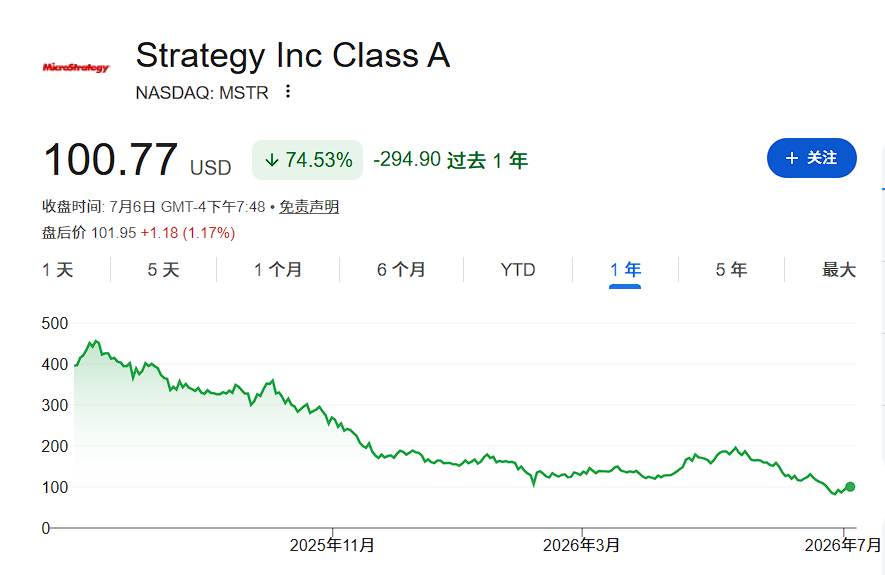
Holding 4% of Global Bitcoin! Market Closely Watches MSTR's "Bitcoin Selling Logic", Stock Price Has Fallen 75% in a Year

华尔街日报Xuất bản vào 2026-07-07Cập nhật gần nhất vào 2026-07-07

Tóm tắt

MicroStrategy, the world's largest corporate holder of Bitcoin (approx. 4% of supply), faces mounting liquidity pressures, forcing a shift from its "never sell" pledge. The company recently sold 3,588 BTC for $216 million, its largest sale ever, to cover preferred stock dividends, marking a significant scaling up from a small, symbolic sale in May. This move underscores a fundamental challenge to its business model: using stock premium as "currency" to buy Bitcoin continuously. A key metric, mNAV (enterprise value vs. Bitcoin holdings), has fallen below 1, indicating the market values the company below its Bitcoin stash, eroding its core acquisition logic. With annual dividend obligations around $1.5 billion and software cash flow insufficient, MicroStrategy is caught in a mathematical bind. Its $2.55 billion cash buffer provides ~17 months of coverage, but if financing remains tight and mNAV stays depressed, the company may face pressure for larger Bitcoin sales, posing a potential systemic risk to the crypto market given its massive holdings.

MicroStrategy is using Bitcoin to pay for its capital structure. This company, the world's largest corporate holder of Bitcoin, is facing a mathematical dilemma triggered by its own business model — as the stock price premium vanishes and the financing window narrows, the "never sell" promise has quietly given way to the pressure of real-world liquidity.

An article by Wall Street Journal writes that MicroStrategy disclosed on July 6th that it sold 3,588 Bitcoins between June 29th and July 5th, raising approximately $216 million, to pay dividends for its preferred shares. This is the company's largest single Bitcoin sale in history, and its third sale since launching its Bitcoin strategy in 2020.

Following this announcement, MSTR's stock price fell over 5% intraday, and Bitcoin dropped to around $61,800, below the company's average holding cost of approximately $75,700. The company confirmed an $8.32 billion digital asset impairment loss for Q2, as Bitcoin prices fell 14% during the same period.

Market caution stems not only from the sale itself but also from the underlying shift in logic. MicroStrategy holds 843,775 Bitcoins, accounting for about 4% of the global Bitcoin supply. Any large-scale selling could significantly impact the coin's price.

According to Wall Street Journal analysis, MicroStrategy's core valuation metric, mNAV, has fallen below 1, meaning the market values the company at less than the value of its Bitcoin holdings. This fundamentally undermines its business logic of "exchanging premium stock for Bitcoin."

"Never Sell" Promise Softens, Sale Scale Expands by a Hundredfold

MicroStrategy had long regarded "never selling Bitcoin" as the cornerstone of its business model, but this promise has developed significant cracks.

In late May, the company broke precedent for the first time, selling 32 Bitcoins for about $2.5 million to pay preferred stock dividends, emphasizing it was merely fulfilling its promise to preferred stock investors and did not represent a strategic shift.

However, the latest sale scale has expanded to 3,588 Bitcoins, roughly a hundred times the amount sold in May. According to the company's disclosure, 1,363 were sold at an average price of about $59,300, with the remaining 2,225 sold at around $60,800.

An article by Wall Street Journal writes that proceeds from this sale will be specifically used to pay the Q2 dividends for four preferred securities (STRF, STRE, STRK, STRD) and the June monthly dividend for STRC. Selling Bitcoin is no longer a one-time, symbolic operation but is gradually being integrated into the company's routine financing system.

Notably, on June 29th, MicroStrategy officially announced that its board had authorized the sale of up to $1.25 billion worth of Bitcoin for stock buybacks and to pay interest and preferred stock dividends. This marks the company's formal abandonment at the official level of its "hold Bitcoin at all costs" philosophy.

It's worth noting that the capital structure supporting this business model is under increasing pressure.

Analyst Zach Pandl points out that MicroStrategy's annual preferred stock dividend payout alone is about $1.5 billion, far exceeding what its software business cash flow can cover. When cash reserves are insufficient, the company can only continue financing or sell Bitcoin.

As of July 5th, MicroStrategy holds 843,775 Bitcoins with a cash reserve of $2.55 billion. The company estimates this cash buffer provides about 17 months of runway for interest and preferred stock dividend payments without needing to tap its crypto assets.

MicroStrategy's operational logic is becoming clearer: continuously buy Bitcoin when financing is smooth; sell small amounts of Bitcoin to pay dividends when financing tightens, maintaining the closed loop of its capital operations system.

Although after its first sale in late May, the company quickly bought another 1,550 Bitcoins, and also completed large-scale purchases of $2.54 billion and $2 billion in April and May respectively, the sustainability of this system is being questioned as Bitcoin prices face downward pressure.

mNAV Falls Below 1, Core Business Logic Faces Fundamental Challenge

The core of MicroStrategy's business model lies in using its stock premium as "currency" to continuously buy Bitcoin. The quantitative anchor for this logic is precisely the company's self-created mNAV metric.

According to Wall Street Journal analysis, MicroStrategy defines mNAV as the multiple of the company's enterprise value relative to the value of its Bitcoin holdings. During its peak, this metric remained at a high premium level for a long time, allowing the company to continuously issue stock to buy more Bitcoin, operating similarly to traditional acquisition-driven companies using highly valued stock as currency for serial acquisitions.

However, as MSTR's stock price has fallen about 75% over the past year, mNAV fell below 1 last month, meaning the market values MicroStrategy at less than the book value of its Bitcoin holdings. This "snowball" logic has started to work in reverse.
More alarmingly, this metric itself has a systematic overvaluation problem. The Wall Street Journal points out that when calculating enterprise value, MicroStrategy uses the principal amount of debt and the face value of preferred stock, not their market value. However, as the company's bonds and preferred stock prices have fallen sharply along with the stock price, this calculation method has become severely distorted.

Taking June 26th as an example, MicroStrategy reported its mNAV was about 0.99, but if calculated using the market value of debt and preferred stock, the actual mNAV was only about 0.89. At that time, the company's debt was trading at a 7% discount, and its various series of preferred stock had a combined discount of about 28%.

As of last Thursday's close, MicroStrategy's website showed an mNAV of 1.09, but the actual figure calculated using market values was only about 1.04, leaving the premium space extremely limited.

Selling Pressure and Market Chain Reaction

The scale of MicroStrategy's Bitcoin holdings gives any selling action systemic significance at the market level.

MicroStrategy holds about 4% of the global Bitcoin supply. Even the small-scale operation in May, selling just 32 Bitcoins for $2.5 million, had a noticeable downward pressure on Bitcoin's price and MSTR's stock price.

Analysis suggests that although this sale of 3,588 Bitcoins is still a tiny fraction of its holdings, market concern about potential large-scale selling has significantly intensified.

According to MicroStrategy's own logic, when mNAV remains in a discounted state, the company should sell Bitcoin to buy back its own securities. Investors are closely watching whether this signal will evolve into large-scale action.

To stabilize preferred stock prices, MicroStrategy increased the dividend rate on its largest preferred stock series, STRC, to 12% on June 29th, trying to attract buyers and push the price back to par value. This move itself indicates the company's focus on the market price of its preferred stock far exceeds the attitude presented in its mNAV calculation.

The Wall Street Journal notes that if the market once again fixes MicroStrategy's valuation in the discount range and it persists, the company will face a scenario where its cash runs out, forcing it to tap its Bitcoin reserves on a large scale. MicroStrategy may have bought itself some time, but no one can be sure just how long that time will last.


Tiền kỹ thuật số thịnh hành

Câu hỏi Liên quan

QWhat is the core reason for MicroStrategy's recent change in its 'never sell bitcoin' policy?

AThe core reason is the increasing liquidity pressure stemming from its capital structure. With its stock premium disappearing and the financing window narrowing, MicroStrategy's commitment to holding bitcoin has given way to the reality of needing funds to pay substantial annual preferred stock dividends (approximately $1.5 billion), which its software business cash flow cannot cover.

QWhat is the mNAV metric, and why is it significant for understanding MicroStrategy's business model?

AmNAV (MicroStrategy Net Asset Value) is a company-created metric defined as the ratio of its enterprise value to the value of its bitcoin holdings. It is significant because MicroStrategy's core business model relies on using its stock as a 'currency' to buy more bitcoin, which only works when mNAV is above 1 (meaning the market values the company *more* than just its bitcoin). Its recent drop below 1 challenges this fundamental model.

QHow did the scale of MicroStrategy's latest bitcoin sale on July 6 compare to its first sale in May, and what was the purpose of the proceeds?

AThe latest sale of 3,588 bitcoin was approximately 100 times larger than the first sale of 32 bitcoin in May. The proceeds from the July sale, amounting to about $216 million, were specifically used to pay quarterly dividends on several series of its preferred securities (STRF, STRE, STRK, STRD) and a monthly dividend on the STRC preferred stock.

QAccording to the analysis in the article, what is the problem with MicroStrategy's calculation of its mNAV metric?

AThe article states that MicroStrategy's calculation of mNAV is systematically overestimated. It uses the face value (par value) of its debt and preferred stock in the enterprise value calculation, rather than their actual, lower market trading value. This inflates the mNAV figure. For example, when the official mNAV was 0.99, the 'real' mNAV calculated using market values was only about 0.89.

QWhy are market participants concerned about MicroStrategy's potential future bitcoin sales, despite its recent sale being a small fraction of its total holdings?

AMarket participants are concerned because MicroStrategy holds approximately 4% of the global bitcoin supply, making any significant sale potentially impactful on the price. Furthermore, if its mNAV remains below 1, the logical action for the company according to its own framework would be to sell bitcoin to buy back its discounted securities. The fear is that this could trigger a large-scale, sustained selling pressure.

Nội dung Liên quan

Open USD có thể chống đỡ tham vọng của Stripe không?

Open USD (OUSD) không phải là stablecoin riêng của Stripe, mà là một dự án được quản lý bởi Open Standard với sự tham gia của nhiều công ty như Stripe, Visa, Mastercard, BlackRock, Shopify... Động thái này đánh dấu tham vọng lớn hơn của Stripe: chuyển từ một công ty cung cấp API thanh toán thuần túy sang một mạng lưới tổ chức dòng tiền toàn cầu (money movement network). OUSD cho phép Stripe có cơ hội sở hữu tài sản thanh toán mặc định, thay đổi cơ chế phân phối lợi ích (chia sẻ doanh thu từ tài sản dự trữ cho các đối tác phân phối), và cung cấp một lớp tiền lập trình được cho thương mại tự động (agentic commerce). Điều này giúp Stripe không chỉ kết nối các mạng lưới thanh toán truyền thống mà còn tham gia định hình mạng lưới tài chính mới. Tuy nhiên, OUSD khó có thể thay thế ngay USDC - vốn có lợi thế về thanh khoản và hệ sinh thái. Giá trị cốt lõi của OUSD nằm ở mô hình kinh doanh chia sẻ lợi ích và quản trị mở, thách thức cách phân phối giá trị truyền thống trong ngành stablecoin. Động thái này là một mảnh ghép trong chiến lược tổng thể của Stripe, cùng với việc mua lại Bridge, phát triển Tempo blockchain và Privy, nhằm nắm bắt cơ hội từ làn sóng AI và thanh toán tự động. Mục tiêu cuối cùng là biến Stripe thành hạ tầng mặc định cho dòng tiền trong nền kinh tế internet tương lai, vượt ra khỏi vai trò một nhà xử lý thanh toán thông thường.

链捕手5 phút trước

Open USD có thể chống đỡ tham vọng của Stripe không?

链捕手5 phút trước

Tuần này trên Crypto | Jupiter, NEAR, Jito và 6 dự án khác dồn dập sự kiện, một 'lịch xúc tác' để biết ai đáng theo dõi

**Tóm tắt: Lịch trình xúc tác tuần này cho các dự án tiền điện tử** Tuần này chứng kiến một loạt sự kiện quan trọng từ 7 dự án, hứa hẹn tác động đến thị trường: * **Jupiter (JUP):** Ra mắt phiên bản thử nghiệm riêng tư cho GUM (Thị trường Thống nhất Khổng lồ) vào 6/7, một bước tiến trong tầm nhìn trở thành sàn giao dịch "vạn vật". * **NEAR Protocol (NEAR):** Buổi livestream "The Big Reveal" vào 16:00 UTC ngày 7/7, được đồn đoán là công bố nâng cấp SPICE hoặc công nghệ "hộp đen" cho doanh nghiệp. * **Berachain (BERA):** Thực hiện hard fork lớn "PoL Next" trong ngày 7-8/7, đơn giản hóa mô hình token bằng cách loại bỏ BGT và hợp nhất giá trị vào BERA. * **Zcash (ZEC):** Nâng cấp Ironwood dự kiến kích hoạt vào 21/7, nhằm khắc phục triệt để lỗ hổng nghiêm trọng trong hồ bảo mật Orchard được phát hiện trước đó. * **Lighter (LIT):** Dự kiến ra mắt cổ phiếu token hóa vào tuần tới. Lợi thế lớn là tích hợp làm DEX phái sinh mặc định trên Robinhood Chain (L2 của Robinhood). * **Jito (JTO):** Dự kiến ra mắt nền tảng giao dịch JTX vào giữa tháng 7, cho phép tự giám sát với mục tiêu thu hút dòng lệnh. ~80% doanh thu giao thức sẽ dùng để mua lại JTO. * **Ether.fi (ETHFI):** Đã đề xuất triển khai một instance Aave V4 riêng để làm nền tảng cho thẻ Visa EtherFi Cash, hiện đang trong giai đoạn bỏ phiếu của DAO. **Lưu ý chung:** Các sự kiện này chủ yếu tác động đến tâm lý và kỳ vọng thị trường. Nhà đầu tư cần thận trọng với rủi ro như lịch mở khóa token, áp lực bán ra sau tin tốt, hoặc sự chậm trễ/không đạt kỳ vọng của sản phẩm.

marsbit16 phút trước

Tuần này trên Crypto | Jupiter, NEAR, Jito và 6 dự án khác dồn dập sự kiện, một 'lịch xúc tác' để biết ai đáng theo dõi

marsbit16 phút trước

Kinh tế Token đang viết lại quy tắc thương mại của 'thước đo' AI như thế nào? | Quan sát ngành ToB

Token đang trở thành "thước đo" mới trong kỷ nguyên AI, định hình lại các quy tắc thương mại. Lượng gọi Token hàng ngày ở Trung Quốc đã tăng hơn 1.000 lần trong hai năm, dự báo toàn cầu sẽ đạt 15 Peta Token vào năm 2030. Tuy nhiên, giá trị thực tế của Token chênh lệch lớn giữa các ngành, từ 0,01 USD đến 1.000 USD cho mỗi triệu Token. Ông A Mộc của Lenovo đưa ra "Ba định luật" về kinh tế Token: 1) Định luật quán tính - chi phí đơn vị Token giảm liên tục nhờ đổi mới chip, tối ưu hóa hệ thống và điều phối thông minh; 2) Định luật gia tốc - giá trị đơn vị Token tăng nhanh nhờ tích hợp sâu vào quy trình, kỹ thuật hóa và các yếu tố hỗ trợ; 3) Định luật điểm kỳ dị - khi đường giá trị vượt đường chi phí, AI tạo ra giá trị gia tăng và quy mô hóa đổi mới. Trên thực tế, nhiều doanh nghiệp đang đối mặt với chi phí AI tăng vọt và khó khăn trong việc định giá Token do chênh lệch chất lượng và "lạm phát Token" từ các tác nhân AI. Để giải quyết, ngành công nghiệp đang phát triển các tiêu chuẩn cho Token chất lượng cao và các giải pháp như "Nhà máy Token" của Lenovo để quản lý chi phí hiệu quả. Mục tiêu cuối cùng là vượt qua "điểm kỳ dị", biến AI thành công cụ sản xuất đổi mới trên quy mô lớn.

marsbit28 phút trước

Kinh tế Token đang viết lại quy tắc thương mại của 'thước đo' AI như thế nào? | Quan sát ngành ToB

marsbit28 phút trước

Đức Gửi Thêm Bitcoin Tới Kraken Và Coinbase Trong Khi Nỗi Lo Bán Tháo Vẫn Tiếp Diễn

Chính phủ Đức tiếp tục chuyển Bitcoin tới các sàn Kraken và Coinbase, làm dấy lên lo ngại về áp lực bán tháo. Các ví do chính phủ kiểm soát đã thực hiện thêm một đợt chuyển BTC tới hai sàn giao dịch lớn này, khiến thị trường tập trung theo dõi nguy cơ bán ra từ phía nhà nước trong bối cảnh BTC cố gắng ổn định. Các giao dịch này được theo dõi bởi Arkham Intelligence. Việc chuyển tiền vào các sàn như Kraken và Coinbase - những nơi có thanh khoản sâu - cho thấy khả năng bán hàng loạt là hoàn toàn khả thi, khiến các nhà giao dịch lo lắng và định giá trước khả năng này. Khác với chuyển động của "cá voi" thông thường có thể vì nhiều mục đích, ví thanh lý của chính phủ có mục đích rõ ràng hơn, làm tăng suy đoán rằng số coin này sắp được phân phối hoặc bán ra. Sự phục hồi của Bitcoin hiện phụ thuộc vào khả năng hấp thụ lượng cung này. Nếu nhu cầu từ ETF, người mua spot và các nhà tạo lập thị trường đủ mạnh, thiệt hại có thể được kiểm soát. Tuy nhiên, nếu các lần chuyển tiếp tục diễn ra trong điều kiện thanh khoản mỏng, mỗi đợt chuyển mới sẽ như một đợt thử thách mới với thị trường.

bitcoinist37 phút trước

Đức Gửi Thêm Bitcoin Tới Kraken Và Coinbase Trong Khi Nỗi Lo Bán Tháo Vẫn Tiếp Diễn

bitcoinist37 phút trước

Giao dịch

Giao ngay

Bài viết Nổi bật

Làm thế nào để Mua 4

Chào mừng bạn đến với HTX.com! Chúng tôi đã làm cho mua 4 (4) trở nên đơn giản và thuận tiện. Làm theo hướng dẫn từng bước của chúng tôi để bắt đầu hành trình tiền kỹ thuật số của bạn.Bước 1: Tạo Tài khoản HTX của BạnSử dụng email hoặc số điện thoại của bạn để đăng ký tài khoản miễn phí trên HTX. Trải nghiệm hành trình đăng ký không rắc rối và mở khóa tất cả tính năng. Nhận Tài khoản của tôiBước 2: Truy cập Mua Crypto và Chọn Phương thức Thanh toán của BạnThẻ Tín dụng/Ghi nợ: Sử dụng Visa hoặc Mastercard của bạn để mua 4 (4) ngay lập tức.Số dư: Sử dụng tiền từ số dư tài khoản HTX của bạn để giao dịch liền mạch.Bên thứ ba: Chúng tôi đã thêm những phương thức thanh toán phổ biến như Google Pay và Apple Pay để nâng cao sự tiện lợi.P2P: Giao dịch trực tiếp với người dùng khác trên HTX.Thị trường mua bán phi tập trung (OTC): Chúng tôi cung cấp những dịch vụ được thiết kế riêng và tỷ giá hối đoái cạnh tranh cho nhà giao dịch.Bước 3: Lưu trữ 4 (4) của BạnSau khi mua 4 (4), lưu trữ trong tài khoản HTX của bạn. Ngoài ra, bạn có thể gửi đi nơi khác qua chuyển khoản blockchain hoặc sử dụng để giao dịch những tiền kỹ thuật số khác.Bước 4: Giao dịch 4 (4)Giao dịch 4 (4) dễ dàng trên thị trường giao ngay của HTX. Chỉ cần truy cập vào tài khoản của bạn, chọn cặp giao dịch, thực hiện giao dịch và theo dõi trong thời gian thực. Chúng tôi cung cấp trải nghiệm thân thiện với người dùng cho cả người mới bắt đầu và người giao dịch dày dạn kinh nghiệm.

Tổng lượt xem 588Xuất bản vào 2025.10.20Cập nhật vào 2026.06.02

Làm thế nào để Mua 4

Thảo luận

Chào mừng đến với Cộng đồng HTX. Tại đây, bạn có thể được thông báo về những phát triển nền tảng mới nhất và có quyền truy cập vào thông tin chuyên sâu về thị trường. Ý kiến ​​của người dùng về giá của 4 (4) được trình bày dưới đây.

活动图片