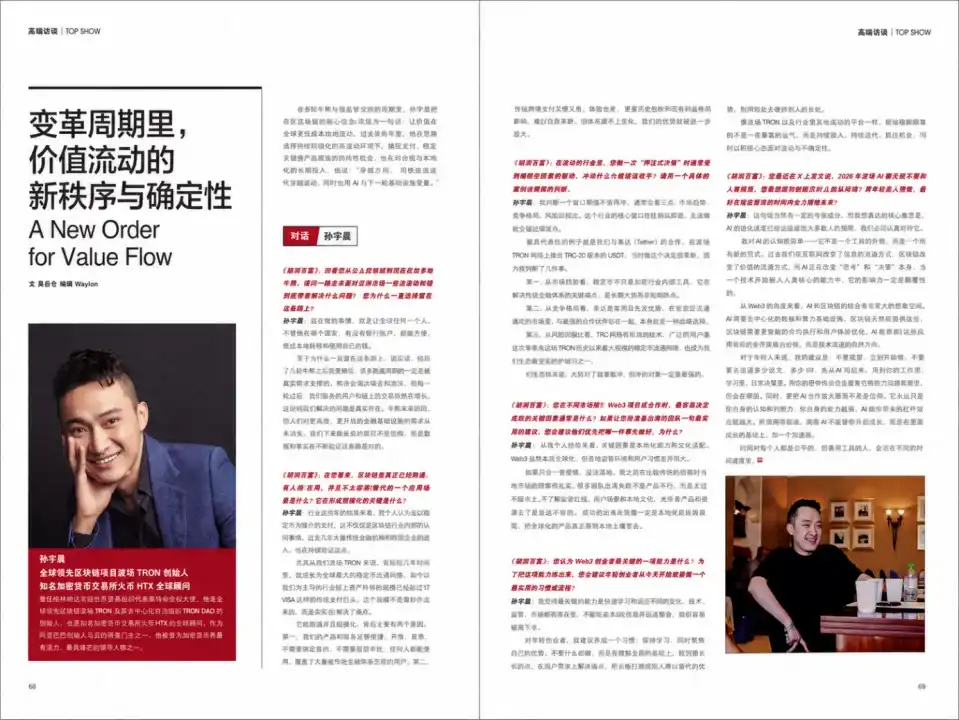
Justin Sun’s Interview with Hurun Report: A New Order and Certainty for Value Flow in the Era of Transformation

marsbitDipublikasikan tanggal 2026-05-28Terakhir diperbarui pada 2026-05-28

Abstrak

In an interview with *Hurun Report*, Justin Sun, founder of TRON, discussed the evolution of the Web3 industry as it moves from initial exploration to large-scale adoption. He emphasized that the core value of blockchain lies in building an open and inclusive internet of value, enabling anyone globally to transfer and use funds efficiently and at low cost, regardless of location or access to banking. Sun highlighted that projects with lasting impact are those built on genuine demand and real-world usage. He pointed to the stablecoin payment ecosystem as the most mature and scalable application currently, noting that TRON has rapidly become one of the world's largest stablecoin networks. The circulation of USDT on TRON has surpassed $86.3 billion, driven by actual use cases such as cross-border transfers and daily payments, demonstrating strong network effects. Regarding strategy, Sun outlined a methodology combining data-driven iteration, rapid execution, and user-centric focus. He cited the decision to partner with Tether to launch TRC-20 USDT as a key strategic move, based on an assessment of market trends and long-term potential, which has become a significant growth engine for the TRON ecosystem. On globalization, Sun stressed the importance of local compliance and cultural adaptation, noting that success in different markets depends on deep understanding and local partnerships. He also addressed the convergence of AI and blockchain, describing it as a transformative d...

As the Web3 industry moves into deeper waters and global financial infrastructure undergoes accelerated restructuring, blockchain is evolving from early exploration to large-scale application. As an authoritative institution with broad influence in business and investment, the in-depth interview by the renowned magazine Hurun Report is regarded as a significant industry indicator. Recently, Justin Sun, founder of TRON, shared his views on key topics such as stablecoin payments, global pathways, and AI integration trends during an interview with Hurun Report. His insights reflect a critical stage where Web3 infrastructure is transitioning from "feasibility verification" to "global adoption."
Stablecoins Build Global Value Flow Networks, Web3 Infrastructure Enters Scaling Phase

In the Hurun Report interview, Justin Sun succinctly summarized his long-term core objective: "To enable any individual worldwide, regardless of location or bank account access, to transfer and utilize their funds at low cost and with high efficiency." This statement fundamentally reveals the value essence of blockchain technology—building an open and inclusive value internet.

He further noted that after enduring multiple bull-bear cycles, projects capable of weathering market fluctuations must be rooted in genuine demand and practical utility. The continuous growth in on-chain user scale and transaction volume serves as a key metric for evaluating industry direction. Against this backdrop, the on-chain payment system centered around stablecoins has emerged as the most mature and scalable application scenario.

In the Hurun Report interview, Justin Sun mentioned that TRON has rapidly evolved into one of the world's largest stablecoin circulation networks, with its on-chain asset transfer volume even surpassing certain traditional payment networks. This growth is not driven by short-term market sentiment but by sustained usage in real-world scenarios such as cross-border remittances, value storage, and daily payments. Official data indicates that the circulating volume of USDT on the TRON network now exceeds $86.3 billion, reflecting strong network effects driven by authentic user demand.

From a structural perspective, the scaling of stablecoin payments benefits from two factors: firstly, the open and permissionless nature of blockchain networks enables them to reach user groups underserved by traditional financial systems; secondly, the limitations of traditional cross-border payment systems in terms of efficiency, cost, and user experience create significant opportunities for next-generation infrastructure. Justin Sun believes this trend represents a "natural substitution" of existing financial systems by technological advancement rather than short-term competition.

Globalization Strategy and Technology Integration: Building Long-Term Competitive Advantages in Web3

When discussing enterprise growth and strategic decision-making, Justin Sun presented a highly systematic methodology in the Hurun Report interview. He summarized the key success factors as a combination of "data-driven iteration, rapid execution, and user orientation," emphasizing that in a fast-changing technological environment, single-dimensional capabilities are insufficient for sustaining long-term competitiveness. Synergy among these elements is essential for efficient experimentation and precise decision-making.

At the organizational level, he proposed a management framework based on "clear direction, layered support, and a sense of ownership among all members" to avoid deviations and loss of control during rapid expansion. This flat and agile organizational structure is seen as a crucial foundation for Web3 enterprises to maintain competitiveness in highly uncertain environments.

Regarding critical strategic decisions, Justin Sun reflected on TRON’s collaboration with Tether to launch TRC-20 USDT. He stated that this decision was based on a comprehensive assessment of market trends, competitive landscapes, and risk-reward ratios: stablecoins represent a long-term trend in financial system evolution, top-tier assets exhibit significant network effects, and the upside potential in this field far outweighs potential risks. This partnership has since become a key growth engine for the TRON ecosystem and established its core competitive moat in the stablecoin space.

On global expansion, Justin Sun emphasized that while Web3 inherently possesses cross-border attributes, its practical implementation heavily relies on local compliance and cultural adaptation. In the Hurun Report interview, he pointed out that significant differences exist across markets in regulatory frameworks, user habits, and business environments. The success of a project often depends on the depth of understanding of these differences and the ability to build local partnership networks.

Furthermore, Justin Sun expressed clear views on AI development. In the interview, he noted that AI is not merely a tool upgrade but a reconstruction of "thinking and decision-making capabilities." Its integration with blockchain in areas such as data, computing power, and intelligent execution will become a key direction for the next phase of technological evolution. Blockchain provides decentralized infrastructure for AI, while AI enhances the intelligence and user experience of blockchain systems. The convergence of the two holds long-term strategic value.

For industry participants and young entrepreneurs, Justin Sun’s core advice in the Hurun Report interview is that continuous learning and rapid adaptation are the most critical abilities in highly uncertain environments. At the same time, one should focus investments on building irreplaceable core strengths based on a holistic understanding of the industry, rather than dispersing resources across multiple tracks.

From early-stage technology verification and market exploration to the large-scale application phase represented by stablecoins, and extending to AI integration and global compliance implementation, TRON is driving the adoption and evolution of the value internet through infrastructure capabilities, globalization strategies, and forward-looking technological positioning.


Kripto yang Sedang Tren

Pertanyaan Terkait

QAccording to Justin Sun's interview with *Hurun Report*, what is described as the most mature and scalable application scenario currently within the Web3 infrastructure evolution?

AAccording to Justin Sun's interview with *Hurun Report*, the on-chain payment system with stablecoins at its core is described as the most mature and currently scalable application scenario.

QWhat key advantages of blockchain networks, as highlighted by Justin Sun, facilitate the large-scale adoption of stablecoin payments compared to traditional systems?

AJustin Sun highlighted that blockchain networks' openness and permissionless nature allow them to reach user groups underserved by traditional finance, while traditional cross-border payment systems' limitations in efficiency, cost, and user experience create significant replacement potential.

QWhat is the long-term goal of Justin Sun and TRON, as summarized in his interview with *Hurun Report*?

AJustin Sun's long-term goal for TRON, as summarized in the interview, is to enable 'anyone in the world, regardless of location or whether they have a bank account, to transfer and use their funds with low cost and high efficiency.'

QWhat strategic factors contributed to the success of TRON's collaboration with Tether to launch TRC-20 USDT, according to Justin Sun's explanation?

AAccording to Justin Sun, the decision was based on a comprehensive judgment of market trends, competitive landscape, and risk-reward ratio, recognizing stablecoins as a long-term trend in financial evolution where leading assets exhibit strong network effects, with the upside far outweighing potential risks.

QHow does Justin Sun view the relationship between AI and blockchain, and what potential does their integration hold?

AJustin Sun views AI as a reconstruction of 'thinking and decision-making capabilities.' He believes the integration of AI and blockchain in data, computing power, and intelligent execution will be a crucial direction for technological evolution, with blockchain providing decentralized infrastructure for AI, and AI enhancing blockchain's intelligence and user experience.

Bacaan Terkait

Setelah Investasi R&D Menyusul AS, Kompetisi Chip Tiongkok-AS Masih Sekadar Soal Uang?

Menurut laporan terbaru Asosiasi Industri Semikonduktor Amerika Serikat (SIA), berdasarkan paritas daya beli (PPP), pengeluaran riset dan pengembangan (R&D) China di bidang semikonduktor telah menyusul bahkan sedikit melampaui AS pada 2024. Ini mencerminkan kemampuan China dalam memobilisasi sumber daya R&D skala besar. Namun, perlu dicatat bahwa jika diukur dengan nilai tukar pasar, pengeluaran AS masih jauh lebih tinggi. Struktur belanja R&D China condong ke pengembangan eksperimental (lebih dari 80%), yang mendukung aplikasi industri dan peningkatan kapasitas produksi. Sementara itu, proporsi AS untuk penelitian dasar sekitar dua kali lipat China (15% vs 7%). Perbedaan ini menunjukkan bahwa sistem sains China lebih didorong oleh perusahaan, sedangkan AS memiliki sistem riset publik dan universitas yang mendanai lebih banyak penelitian jangka panjang. Dalam industri semikonduktor itu sendiri, perusahaan AS masih memimpin dalam pengeluaran R&D absolut (USD 76,8 miliar pada 2025) dan proporsi pendapatan yang dialokasikan untuk R&D. Siklus bisnis mereka yang sehat—dari laba ke R&D ke produk baru—sulit ditiru. Kompetisi semikonduktor kini bukan lagi sekadar soal jumlah uang. Pada level investasi ini, efisiensi menjadi kunci. Tantangan bagi China termasuk mengalokasikan dana dengan lebih fokus (menghindari duplikasi), membangun siklus validasi pelanggan yang berkelanjutan sehingga produk domestik dibeli berulang kali, serta memperkuat jembatan antara penelitian dasar dan rekayasa industri. Yang terpenting adalah membangun mekanisme yang mampu bertahan dalam ketidakpastian jangka panjang dan mengubah investasi menjadi kemampuan industri yang nyata dan kompetitif.

marsbit6m yang lalu

Setelah Investasi R&D Menyusul AS, Kompetisi Chip Tiongkok-AS Masih Sekadar Soal Uang?

marsbit6m yang lalu

10% Keluarga AS Menguasai 88% Kekayaan, Bagaimana Kue Dibagi di Era AI?

AI meningkatkan produktivitas, namun juga memperburuk ketimpangan distribusi pendapatan. Laporan dari China Finance 40 Forum (CF40) menunjukkan bahwa pada periode 2019 hingga kuartal I 2026, kekayaan ekuitas langsung keluarga AS hampir dua kali lipat, dari sekitar $29 triliun menjadi $55 triliun, dengan lonjakan pesat terjadi setelah 2023 didorong oleh kenaikan harga saham terkait AI. Dari pertumbuhan sekitar $21 triliun antara 2022 dan kuartal I 2026, 10% keluarga terkaya mengambil porsi sekitar 88% ($18.5 triliun), sementara 50% keluarga terbawah hanya mendapatkan sekitar 1% ($0.2 triliun). Pola ini mencerminkan ketimpangan awal dari teknologi AI, di mana rumah tangga kaya mendapat porsi kue ekonomi yang lebih besar. Huang Yiping dari CF40 menganalisis bahwa kemajuan teknologi besar, seperti Revolusi Industri Pertama yang menyebabkan "Jeda Engels," sering kali awalnya memperlebar kesenjangan dengan upah buruh yang stagnan dan keuntungan modal yang meningkat. AI sebagai teknologi generik dapat mempengaruhi distribusi pendapatan melalui empat mekanisme: bias modal (penurunan porsi pendapatan buruh), polarisasi tugas (penggantian pekerjaan menengah), kesenjangan keterampilan digital, dan mekanisme amplifikasi ketimpangan kekayaan melalui keuntungan modal. Ketimpangan ini berisiko memperparah masalah permintaan agregat yang lemah, karena kelompok berpenghasilan tinggi memiliki kecenderungan konsumsi marginal yang lebih rendah. Untuk mengatasi hal ini, Huang Yiping menyarankan tiga strategi: 1) **Pertahanan**: Memperkuat jaring pengaman sosial, penegakan antitrust di bidang AI, dan prioritas penciptaan lapangan kerja. 2) **Pemberdayaan**: Mereformasi sistem pendidikan untuk mencakup literasi AI dan pelatihan keterampilan seumur hidup agar pekerja dapat berkolaborasi dengan AI. 3) **Penyeimbangan Kembali**: Menjelajahi kebijakan seperti pajak redistributif pada keuntungan AI berlebih, mengklarifikasi hak milik data, dan potensi dana untuk berbagi manfaat AI secara lebih luas guna memastikan kemakmuran yang inklusif.

marsbit13m yang lalu

10% Keluarga AS Menguasai 88% Kekayaan, Bagaimana Kue Dibagi di Era AI?

marsbit13m yang lalu

Setelah keputusan Fed tentang suku bunga dan pernyataan Kevin Warsh, para ahli berkumpul dan berbagi komentar terbaru mereka!

Setelah keputusan Federal Reserve untuk mempertahankan suku bunga dan pernyataan dari Kevin Warsh, para ahli berbagi pandangan mereka. Tiga anggota komite yang menentang keputusan menunjukkan kemungkinan periode kebijakan yang lebih independen dan berbeda di dalam FOMC. Meskipun imbal hasil obligasi turun sedikit dan dolar melemah pasca-keputusan, para ahli menilai kenaikan suku bunga pada pertemuan September masih mungkin. Mark Hackett mencatat bahwa tiga suara menentang bisa mengindikasikan tren baru di Fed, dengan anggota yang bertindak lebih mandiri. Ia menyebut rally pasar sebagai 'relief rally', tetapi menekankan bahwa arah pasar masih belum jelas sebelum konferensi pers Ketua Fed Kevin Warsh. Audrey Child-Freiman menyatakan bahwa meskipun imbal hasil obligasi turun dan dolar melemah, tiga suara penentang menunjukkan Fed tetap bersikap hawkish. Ia percaya skenario bullish, di mana imbal hasil obligasi tinggi mendukung dolar, masih berlaku untuk bulan-bulan musim panas, tetapi kemungkinan kenaikan suku bunga pada September tetap ada. Analis Chris Anstey menyoroti perlunya memantau pergerakan imbal hasil obligasi pemerintah AS 10-tahun selama dan setelah konferensi pers Warsh. Kenaikan berkelanjutan dalam imbal hasil jangka panjang bisa menandakan kekhawatiran investor bahwa Fed tidak cukup agresif mengendalikan inflasi, yang dapat menjadi faktor negatif bagi Warsh. Diane Swonk, ekonom utama di KPMG, berpendapat bahwa Fed seharusnya menaikkan suku bunga sekarang dan kemungkinan akan melakukannya pada September. Ia memperingatkan bahwa inflasi tinggi yang telah berlangsung hampir lima tahun berisiko menjadi bagian permanen dari sistem ekonomi jika tidak ditangani. *Ini bukan rekomendasi investasi.

cryptonews.ru4j yang lalu

Setelah keputusan Fed tentang suku bunga dan pernyataan Kevin Warsh, para ahli berkumpul dan berbagi komentar terbaru mereka!

cryptonews.ru4j yang lalu

Trading

Spot

Artikel Populer

Cara Membeli FLOW

Selamat datang di HTX.com! Kami telah membuat pembelian Flow (FLOW) menjadi mudah dan nyaman. Ikuti panduan langkah demi langkah kami untuk memulai perjalanan kripto Anda.Langkah 1: Buat Akun HTX AndaGunakan alamat email atau nomor ponsel Anda untuk mendaftar akun gratis di HTX. Rasakan perjalanan pendaftaran yang mudah dan buka semua fitur.Dapatkan Akun SayaLangkah 2: Buka Beli Kripto, lalu Pilih Metode Pembayaran AndaKartu Kredit/Debit: Gunakan Visa atau Mastercard Anda untuk membeli Flow (FLOW) secara instan.Saldo: Gunakan dana dari saldo akun HTX Anda untuk melakukan trading dengan lancar.Pihak Ketiga: Kami telah menambahkan metode pembayaran populer seperti Google Pay dan Apple Pay untuk meningkatkan kenyamanan.P2P: Lakukan trading langsung dengan pengguna lain di HTX.Over-the-Counter (OTC): Kami menawarkan layanan yang dibuat khusus dan kurs yang kompetitif bagi para trader.Langkah 3: Simpan Flow (FLOW) AndaSetelah melakukan pembelian, simpan Flow (FLOW) di akun HTX Anda. Selain itu, Anda dapat mengirimkannya ke tempat lain melalui transfer blockchain atau menggunakannya untuk memperdagangkan mata uang kripto lainnya.Langkah 4: Lakukan trading Flow (FLOW)Lakukan trading Flow (FLOW) dengan mudah di pasar spot HTX. Cukup akses akun Anda, pilih pasangan perdagangan, jalankan trading, lalu pantau secara real-time. Kami menawarkan pengalaman yang ramah pengguna baik untuk pemula maupun trader berpengalaman.

285 Total TayanganDipublikasikan pada 2024.12.10Diperbarui pada 2026.06.02

Cara Membeli FLOW

Diskusi

Selamat datang di Komunitas HTX. Di sini, Anda bisa terus mendapatkan informasi terbaru tentang perkembangan platform terkini dan mendapatkan akses ke wawasan pasar profesional. Pendapat pengguna mengenai harga FLOW (FLOW) disajikan di bawah ini.

活动图片