XRP Ledger Gets AI Security Upgrade As Ripple Prepares For Bigger Growth

bitcoinistОпубликовано 2026-03-28Обновлено 2026-03-28

Введение

Ripple is implementing a major structural shift in how security is handled on the XRP Ledger (XRPL), tying its next phase of security work directly to its ambitions in global payments and tokenized assets. The overhaul integrates AI-assisted testing, a dedicated red team, stricter amendment reviews, and a broader modernization of the codebase. AI is being used to proactively discover vulnerabilities, shift from reactive debugging, and simulate complex edge cases at scale. The red team has already uncovered over 10 bugs. RippleX team emphasized that resilience must be a process of continuous hardening. Governance around network amendments will also be formalized with multiple audits and clearer readiness criteria. The next XRPL release will focus solely on bug fixes and improvements, prioritizing security and reliability over new features as the ledger aims for institutional-grade growth.

Ripple says it is overhauling how security is handled on the XRP Ledger, adding AI-assisted testing, a dedicated red team, stricter amendment review standards, and a broader push to modernize parts of the codebase. Notably, Ripple is explicitly tying XRPL’s next phase of security work to its ambitions in global payments, tokenized assets, and institutional financial infrastructure.

In its March 26 blog post, Ripple framed the initiative less as a narrow tooling upgrade and more as a structural shift in how XRPL is maintained. Senior Director of Engineering at RippleX Ayo Akinyele wrote that XRPL has been running since 2012 and, over that period, has processed more than 100 million ledgers, facilitated over 3 billion transactions, and secured billions in value transfer. That operating history, Ripple argued, is both a strength and a complication: a long-lived production codebase carries legacy assumptions, older design decisions, and engineering patterns that may no longer match the demands of a larger, more complex network.

The company’s core argument is that AI changes the security equation by making it easier to explore edge cases and hidden failure modes at scale. “AI allows us to shift from reactive debugging to proactive, systematic discovery of vulnerabilities, strengthening the ledger faster and with greater confidence than ever before,” Akinyele wrote. He added that for XRPL, resilience “must be continuous: not a one-time validation, but an ongoing process of hardening, testing and improving as XRPL evolves.”

Ripple broke the plan into several layers. It said AI is being integrated across the software development lifecycle through adversarial code scanning, AI-assisted reviews on every pull request, threat modeling, attack-surface mapping, and simulations of edge cases and stress scenarios that would be difficult to generate manually. The company also said it has established a dedicated AI-assisted red team focused on how XRPL features interact in real-world conditions, especially where legacy logic meets newer functionality.

That red-team effort is already producing findings, according to Ripple and developers involved in the initiative. In the blog post, Ripple said the team has uncovered “10+ bugs,” with only low-severity issues disclosed publicly so far and all findings being prioritized for fixes. In a separate X post, Mayukha Vadari said the effort had already been “incredibly fruitful,” adding that the team had found “a number of bugs across a range of severities.” She described the project as “exactly the kind of continuous, adversarial push XRPL needs as it continues to grow.”

Ripple is also using the moment to address broader code quality issues that sit above any single bug. The post says many problems in long-lived systems stem from structural weaknesses such as limited type safety, inconsistent feature interactions, weak invariant enforcement, and assumptions that are either undocumented or not enforced. The implication is that Ripple is not only trying to catch vulnerabilities earlier, but to reduce the conditions that allow classes of vulnerabilities to recur.

Another major part of the announcement is governance around amendments. Ripple said significant changes will face multiple independent security audits, expanded bug bounty incentives, more attackathons, and clearer readiness criteria before activation. It also said those criteria will be defined and published with the XRPL Foundation, signaling an attempt to formalize the security bar for network changes rather than evaluate them on a looser, case-by-case basis.

Notably, Ripple also highlighted that the next XRPL release will focus on bug fixes and improvements without introducing new features, a choice that suggests hardening the stack is taking priority over shipping more functionality. As XRPL pushes deeper into tokenized assets, payments, and institutional DeFi, Ripple is making the case that the next stage of growth depends less on novelty and more on whether the ledger can keep raising its reliability threshold in public.

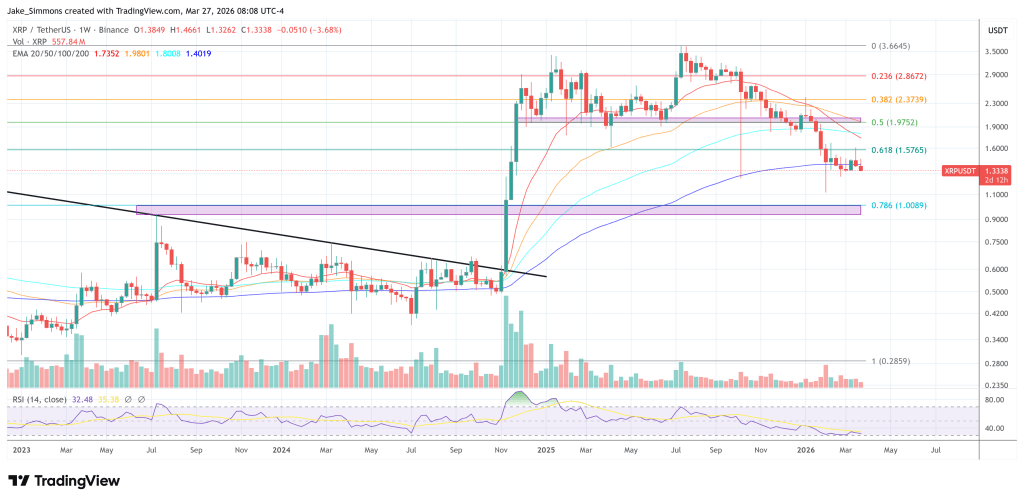
At press time, XRP traded at $1.33.

XRP falls below the 200-week EMA again, 1-week chart | Source: XRPUSDT on TradingView.com

Связанные с этим вопросы

QWhat are the key components of Ripple's security upgrade for the XRP Ledger?

ARipple's security upgrade includes AI-assisted testing, a dedicated red team, stricter amendment review standards, adversarial code scanning, AI-assisted reviews on every pull request, threat modeling, attack-surface mapping, and simulations of edge cases and stress scenarios.

QHow does Ripple claim AI will change the security approach for XRPL?

ARipple claims AI changes the security equation by shifting from reactive debugging to proactive, systematic discovery of vulnerabilities, allowing them to explore edge cases and hidden failure modes at scale, thereby strengthening the ledger faster and with greater confidence.

QWhat has the dedicated AI-assisted red team already discovered according to the announcement?

AThe dedicated AI-assisted red team has uncovered over 10 bugs, with only low-severity issues disclosed publicly so far. The findings are described as 'incredibly fruitful,' including a number of bugs across a range of severities.

QWhat is the focus of the next XRPL release as mentioned in the blog post?

AThe next XRPL release will focus on bug fixes and improvements without introducing new features, indicating that hardening the stack and improving reliability is taking priority over adding more functionality.

QHow is Ripple changing the governance process for significant amendments to the XRPL?

ASignificant amendments will now face multiple independent security audits, expanded bug bounty incentives, more attackathons, and clearer readiness criteria before activation. These criteria will be defined and published with the XRPL Foundation to formalize the security bar for network changes.

Похожее

Arthur Hayes Analysis: AI Bubble Nears Burst, Crypto Market Faces Short-Term Pressure

Arthur Hayes argues that the current AI market is a bubble poised to burst, which will exert downward pressure on the crypto market in the near term. The core trigger is rising oil prices due to the US-Iran conflict and a blockade of the Strait of Hormuz. Higher energy costs directly increase the operational expenses of AI data centers, squeezing profit margins for companies like Google, Anthropic, and OpenAI. Hayes predicts that persistent inflation from high oil prices will force Trump, in a bid to win the November election, to turn public sentiment against the AI industry. He may propose regulations and taxes on data centers and AI companies to appeal to voters concerned about costs and job displacement. Such political rhetoric could shatter market confidence. Furthermore, the market is unlikely to healthily absorb the massive concurrent IPOs of SpaceX, Anthropic, and OpenAI, which together seek valuations in the trillions. The combination of soaring energy costs, overwhelming equity supply, and negative political pressure will puncture the AI bubble. Hayes notes that nearly all new USD liquidity since 2022 has flowed into AI, leaving crypto like Bitcoin behind. When the AI bubble bursts, liquidity will contract sharply, pulling down all risk assets, including cryptocurrencies. In response, Hayes's fund, Maelstrom, has sold all AI-related stocks and non-core cryptocurrencies. It maintains core positions in Bitcoin and Ethereum while increasing exposure to energy sector equities, betting on rising oil and gas prices. He expects Bitcoin to bottom after the AI-led market decline, before rallying again with future monetary easing.

Foresight News14 мин. назад

Arthur Hayes Analysis: AI Bubble Nears Burst, Crypto Market Faces Short-Term Pressure

Foresight News14 мин. назад

To C, To B, and the Next Big Thing Called To A

After To C and To B, the Next Wave is To A: Serving AI Agents In a recent quarterly earnings call, Meituan's Wang Xing introduced a new concept: To A (To Agent), signifying that future business services will increasingly target AI Agents as primary clients, not just consumers or merchants. This shift implies that internet giants must now consider how to make their services more appealing for AI Agents to recommend, fundamentally altering traditional distribution logic. This "To A era" is prompting an unusual trend of alliances among major tech companies. Unlike previous competitive battles, firms like Meituan, Tencent, JD.com, Huawei, OPPO, and OpenAI are rapidly forming partnerships. The reason is strategic: as AI Agents become the primary user interface, handling tasks from a single command (e.g., "Book a Japanese restaurant for tomorrow"), the risk for platforms is being bypassed entirely. Companies are positioning themselves within this new value chain. Three primary strategies are emerging: 1. **Super-Entry Points + Service Providers:** Platforms like Tencent's Yuanbao, WeChat, and ChatGPT aim to be the first-stop Agent, integrating various services (food delivery, shopping, travel) from partners like Meituan and JD.com. 2. **Apps as Callable Services:** Companies like Meituan, JD.com, and Uber are ensuring their core services remain accessible and callable by external Agents, shifting from front-end apps to back-end capabilities. 3. **System-Level Agent Entry Points:** Smartphone makers (Huawei, Honor, OPPO) are leveraging their OS-level AI assistants to control the initial user command, redistributing it to relevant service apps. While alliances offer mutual benefit—entry points gain service capabilities, and service providers gain traffic—inherent conflicts of interest exist. A dominant Agent platform could eventually attempt to connect directly with suppliers (restaurants, hotels), bypassing current aggregators like Meituan or Ctrip. Other unresolved challenges include the potential for Agent recommendations to become a new form of paid ranking and unclear accountability for faulty recommendations. The current rush to form alliances is a defensive move by service providers to secure their position before the landscape solidifies. In this To A-driven restructuring, the greatest risk is not losing the race but failing to hear the starting gun.

marsbit23 мин. назад

To C, To B, and the Next Big Thing Called To A

marsbit23 мин. назад

The More Lifelike the Robot, the More Terrifying? Unveiling the 'Uncanny Valley Effect' in the Era of Humanoid Robots

As humanoid robots become increasingly lifelike, they confront a significant psychological barrier known as the "Uncanny Valley Effect," a concept proposed by Japanese roboticist Masahiro Mori in 1970. This phenomenon describes a dip in human comfort and acceptance when robots appear almost, but not perfectly, human. Minor imperfections in facial expressions, eye movements, or skin texture trigger a subconscious sense of unease, as the brain detects something trying, yet failing, to mimic a person. Examples range from the controversial human-like robot Sophia to animated characters in films like *The Polar Express*. The effect poses a key design challenge for robotics companies. Some, like Boston Dynamics, avoid it entirely by creating highly capable but visibly mechanical robots. Others, like Hanson Robotics, push for greater human likeness despite the risk. For consumer robots, especially in homes, most manufacturers opt for stylized or clearly mechanical designs to ensure broader acceptance. While the Uncanny Valley remains a powerful force, its impact may diminish over time through technological advancements that achieve near-perfect realism or through generational familiarity as people grow accustomed to interacting with humanoid machines. Ultimately, navigating this psychological frontier requires as much understanding of human perception as of robotics technology itself.

marsbit24 мин. назад

The More Lifelike the Robot, the More Terrifying? Unveiling the 'Uncanny Valley Effect' in the Era of Humanoid Robots

marsbit24 мин. назад

Торговля

Спот
Фьючерсы

Популярные статьи

Что такое XRP 2.0

XRP 2.0: Новая грань в мире криптовалют Введение в XRP 2.0 В постоянно развивающейся сфере криптовалют появляются новые проекты, стремящиеся к вниманию и внедрению. Один из таких многообещающих проектов - это XRP 2.0, новая криптовалюта, созданная для использования передовых технологий блокчейна и надежных методов шифрования. Хотя название вызывает ассоциации с XRP от Ripple, важно отметить, что XRP 2.0 функционирует независимо, сосредоточив внимание на повышении безопасности сделок, конфиденциальности и масштабируемости. Поскольку цифровая финансовая среда все больше принимает децентрализованные решения, XRP 2.0 намерена внести значимый вклад в web3 и общее расширение криптопроектов. Что такое XRP 2.0? XRP 2.0 в своей основе - это проект криптовалюты, цель которого - создать безопасную и децентрализованную экосистему цифровой валюты. Его базовая технология интегрирует сложные принципы блокчейна с современными методами шифрования. Основная цель XRP 2.0 - утвердиться как надежная и эффективная платформа, позволяющая быстро осуществлять транзакции с приоритетом на улучшенную защиту конфиденциальности для своих пользователей. Проект рекламируется как решение многих недостатков, с которыми сталкиваются существующие криптовалюты, предлагая систему, способную обрабатывать более высокий объем транзакций с улучшенной скоростью и конфиденциальностью. Эта универсальность позиционирует XRP 2.0 как значимого конкурента на рынке, переполненном различными цифровыми валютами. Кто создатель XRP 2.0? Идентичность создателя XRP 2.0 была обозначена как «Уилбур». Однако исчерпывающие данные о Уилбуре или связанном с ним проекте остаются неясными. Анонимность многих создателей криптовалют не является редким явлением в этой отрасли и часто применяется для сохранения определенной степени конфиденциальности и безопасности. Кто инвесторы XRP 2.0? <pна данный момент конкретная информация о инвестиционных фондах или организациях, поддерживающих xrp 2.0, не доступна публично. в секторе криптовалют поддержка репутабельными инвесторами может существенно повлиять на кредитоспособность и успех проекта, однако прозрачность в отношении финансовых спонсоров 2.0 еще была установлена. Как работает XRP 2.0? XRP 2.0 выделяется использованием сочетания технологий блокчейна и продвинутых алгоритмов шифрования, что обеспечивает безопасные и децентрализованные транзакции. Его инновационная структура включает уникальные функции, разработанные для повышения вовлеченности пользователей и расширения функциональности за пределами традиционных транзакций с криптовалютами. Среди этих функций XRP 2.0 интегрирует возможности с искусственным интеллектом, такие как текст в изображение и текст в речь. Эти дополнения разработаны для улучшения интерактивной работы пользователей, способствуя более широкому применению в различных секторах. Соединяя технологические достижения с дизайном, ориентированным на пользователя, XRP 2.0 стремится привлечь внимание разнообразных индивидуумов и предприятий, стремящихся интегрировать решения с криптовалютой в свои бизнес-процессы. Хронология XRP 2.0 Для понимания XRP 2.0 необходимо рассмотреть ключевые события, которые определили его путь до сих пор: 23 июля 2023 года: XRP 2.0 представлен как новый проект криптовалюты, стремящийся революционизировать возможности безопасных и децентрализованных транзакций в области блокчейна. 8 сентября 2023 года: Запуск другого проекта, XRP20, который представляет собой токен ERC-20 на блокчейне Ethereum и не имеет отношения к XRP 2.0. 13 ноября 2023 года: XRP Ledger подвергается значительному обновлению с выпуском программного обеспечения серверов rippled версии 2.0.0. Важно отметить, что это развитие не связано с проектом криптовалюты XRP 2.0. Ключевые моменты о XRP 2.0 Чтобы выделить суть XRP 2.0, возникают несколько критически важных факторов: Уникальные особенности: Включение таких функций, как основанные на ИИ текст в изображение и текст в речь, дополнительно разнообразит потенциальные приложения XRP 2.0. Технология блокчейна: Структура использует современные механизмы блокчейна и протоколы шифрования, обеспечивая безопасную и децентрализованную среду для транзакций. Масштабируемость и конфиденциальность: XRP 2.0 придает приоритет повышенным мерам защиты конфиденциальности в процессах транзакций и масштабируемости, необходимой для привлечения растущей базы пользователей. Нет связи с Ripple: Важно отметить, что, несмотря на свое название, XRP 2.0 не имеет никаких отношений или сотрудничества с XRP от Ripple, что отличает его операционные рамки и цели в экосистеме криптовалют. Заключение XRP 2.0 представляет собой амбициозное начинание в сфере криптовалют, стремясь предложить сочетание безопасности, конфиденциальности и эффективности в цифровых транзакциях. Интегрируя сложные технологии и удобные функции, проект стремится расширить горизонты того, что может достичь криптовалюта в современной цифровой экономике. Хотя анонимность его создателя и отсутствие раскрытых инвесторов могут вызвать вопросы у некоторых, акцент XRP 2.0 на передовых функциональных возможностях и децентрализации увеличивает его привлекательность на фоне все более переполненного крипто-рынка. Поскольку мир криптовалют продолжает развиваться, XRP 2.0 может еще стать ключевым игроком в расширении безопасных и масштабируемых блокчейн-решений.

198 просмотров всегоОпубликовано 2024.04.05Обновлено 2024.12.03

Что такое XRP 2.0

Неделя обучения по популярным токенам 13: запуск основной сети HIP-4 ожидается в середине 2026 года на фоне смещения фокуса рынка к масштабируемому внедрению ключевых криптоактивов, включая XRP

HIP-4 представит децентрализованные рынки прогнозов без разрешений, бинарные (исходные) контракты и опционы 0DTE.

1.3k просмотров всегоОпубликовано 2026.04.22Обновлено 2026.04.22

Неделя обучения по популярным токенам 13: запуск основной сети HIP-4 ожидается в середине 2026 года на фоне смещения фокуса рынка к масштабируемому внедрению ключевых криптоактивов, включая XRP

Обсуждения

Добро пожаловать в Сообщество HTX. Здесь вы сможете быть в курсе последних новостей о развитии платформы и получить доступ к профессиональной аналитической информации о рынке. Мнения пользователей о цене на XRP (XRP) представлены ниже.

活动图片