Will Ethereum Foundation’s $93M stake help ETH mirror Bitcoin’s 2020 run?

ambcryptoОпубликовано 2026-04-04Обновлено 2026-04-04

Введение

Scarcity is a key market driver, though its impact is not immediate. The article draws parallels between Bitcoin's 2020 cycle, where reduced supply post-halving and large-scale accumulation led to a parabolic price increase, and Ethereum's current setup. Recently, the Ethereum Foundation staked an additional $93M in ETH, contributing to a new all-time high of 38.5M ETH (31.67% of supply) being staked. This suggests a structural supply shock is building, with ETH's consolidation around $2k appearing as accumulation rather than weakness. If broader market conditions shift to risk-on and large bids return, Ethereum could potentially mirror Bitcoin's 2020 expansion phase.

Scarcity has always been one of the strongest market drivers for risk-on moves.

That said, it’s rarely an instant catalyst. The process takes time, tests patience, and forces the market to prove conviction. In other words, scarcity doesn’t immediately impact price action. Instead, it quietly builds a support base until real demand steps in. That’s usually when markets transition into parabolic runs.

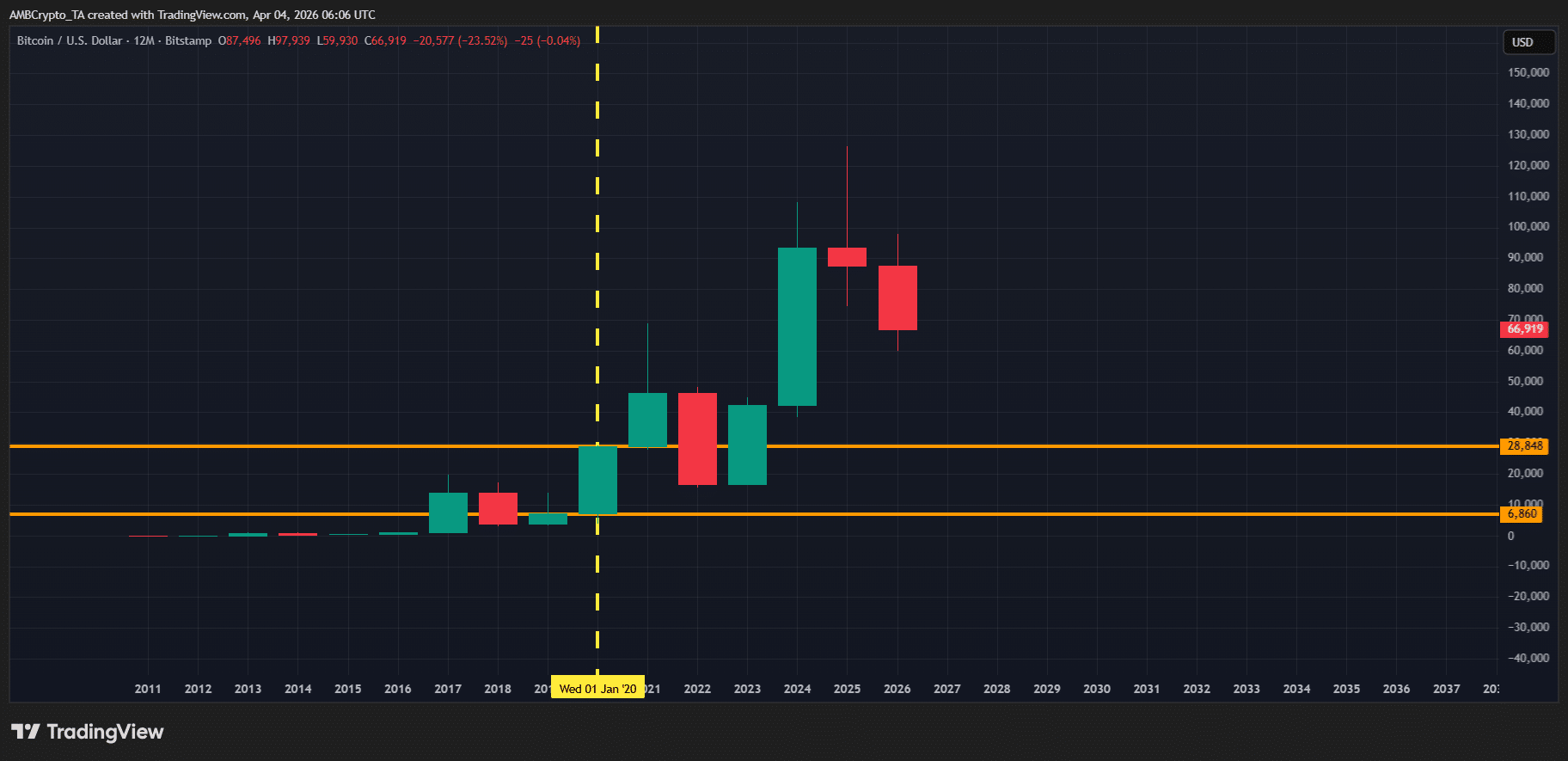
A clear example is Bitcoin’s [BTC] 2020 cycle. The Bitcoin halving cut new BTC issuance from 12.5 to 6.25 BTC per block, tightening supply. Around the same time, Strategy [MSTR] started accumulating BTC, while global central banks flooded markets with liquidity after the COVID-19 shock. Now, market participants are speculating that Ethereum [ETH] may be setting up along a similar path.

Source: TradingView (BTC/USDT)

Technically, if ETH mirrors this setup, the structure supports a potential parabolic expansion.

In 2020, Bitcoin finished the cycle up roughly 305%, breaking into a new all-time high above $20k for the first time. The halving created the initial supply shock, but the real parabolic move started once large treasury bids entered the market and aggressively absorbed available supply, accelerating price discovery.

In this context, Ethereum’s consolidation around the $2k level starts to carry greater significance. The key question now is whether a similar supply dynamic is quietly forming beneath the asset. If so, could ETH replicate a Bitcoin-style 2020 parabolic expansion once markets shift back into a risk-on environment?

Ethereum’s supply crunch builds ahead of a risk-on shift

Looking at Ethereum’s supply setup, it’s no surprise speculation around a BTC-style rally is starting to build.

According to on-chain data, the Ethereum Foundation staked another $93 million worth of ETH, bringing its total staked holdings to roughly $139 million in under a week. Technically, the move coincided with ETH’s 3.53% weekly rally, helping price reclaim the $2k level. However, the trend goes beyond a single participant.

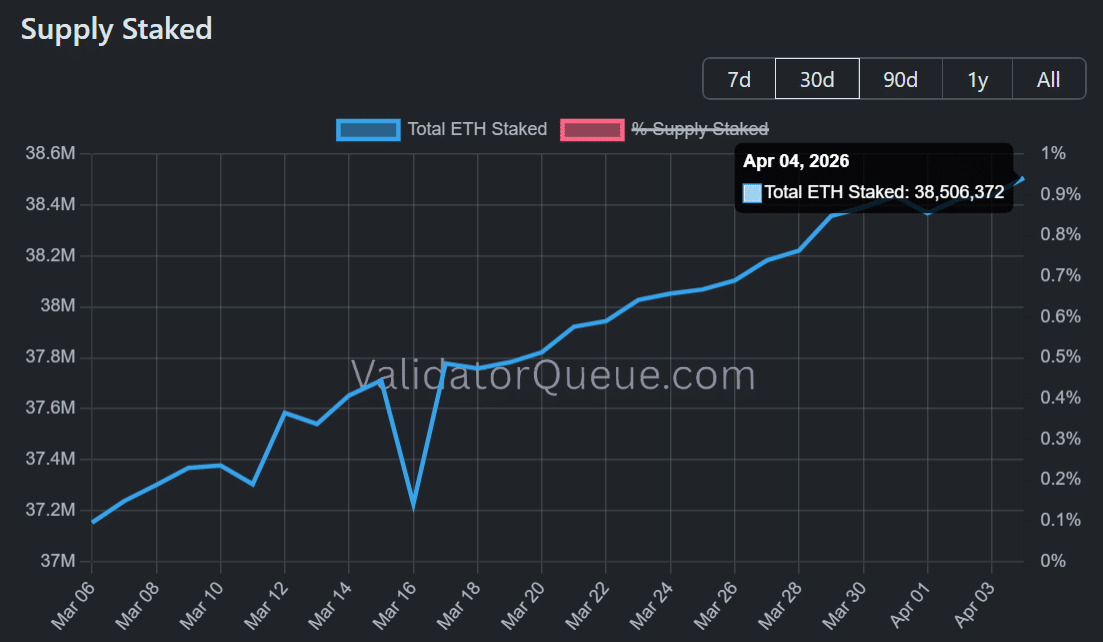
Data from Validator Queue shows Ethereum’s total staked supply reaching a new all-time high of 38.5 million ETH. That’s about 31.67% of circulating supply. Notably, despite March’s risk-off conditions, nearly 1.5 million ETH were added to staking during the month, reinforcing the ongoing supply-tightening narrative.

Source: Validator Queue

Against this backdrop, Ethereum’s technical resilience doesn’t appear to be a fluke.

Instead, with a structural supply shock building underneath, ETH’s consolidation around the $2k level increasingly looks like accumulation rather than weakness, suggesting the market may be forming a base ahead of the next expansion phase once treasury bids return.

Consequently, if broader market conditions flip back to risk-on, Ethereum tracking a Bitcoin-style 2020 move begins to look increasingly plausible.


Final Summary

  • Rising ETH staking and whale accumulation are tightening available supply, reinforcing accumulation around the $2k level.
  • If treasury bids and macro liquidity return, Ethereum could transition from consolidation into a Bitcoin-style 2020 parabolic expansion.

Похожее

Yang Ge Gary: Agent Economy and AI Sub-Microeconomics

"Agent Economy and AI Submicroeconomics" by Gary Yang discusses the evolution of AI Agent economies, written from Singapore in June 2026. The author observes a significant "civilizational generational gap" in AI development, particularly highlighted by events in Silicon Valley. The article identifies a current bottleneck in the transition from Human-to-Agent (H2A) economies to true Agent-to-Agent (A2A) ecosystems. While AI Payment protocols are rapidly emerging, many implementations remain non-AI-native, focusing on traditional human decision-making models rather than leveraging autonomous Agent decision-making. A core thesis is the inevitable formation of an **Agent Economy**, defined as a system where autonomous AI Agents create, exchange, and capitalize value independently. This requires new infrastructure: **AI Protocols**, which are the foundational rules and standards for Agent interaction. The piece explores the relationship and current gap between AI Protocols and Crypto Protocols, suggesting political and regulatory factors from traditional finance are temporarily constraining development. However, a future fusion into a mature Digital Protocol system is deemed inevitable based on first principles. The author introduces **AI Agent Submicroeconomics**, contrasting it with human economics. Key differences include higher transaction frequency, lower value per transaction, efficiency-driven (not emotion-driven) decisions, task-oriented (not consumption-oriented) behavior, and near-zero organizational and communication costs. A biological analogy is drawn, comparing an Agent to a cell, its LLM to a nucleus, and its protocol stack to a cell membrane. The rise of **AIFi** (AI Finance) is presented as a natural consequence, where value originates from AI-native activities and is subsequently tokenized and financialized. This contrasts with DeFi/TradFi, where finance is the source of value. The concept of a **Financial Chip (FinChip)**—an autonomous AI Agent integrated with a crypto smart contract—is highlighted as key infrastructure for this new economy. The conclusion emphasizes that **AI-Native** thinking represents a paradigm shift distinct from "Internet+" upgrades. It requires reasoning from first principles, focusing on energy-value shortest paths and maximum efficiency, which presents a steep learning curve and significant challenge for all participants in this rapidly evolving field.

marsbit28 мин. назад

Yang Ge Gary: Agent Economy and AI Sub-Microeconomics

marsbit28 мин. назад

ViaBTC CEO Haipo Yang: Looking Back at the Decade, Re-understanding the Value of Crypto

In "A Decade in Retrospect: Re-evaluating the Value of Crypto," ViaBTC & CoinEx CEO Haipo Yang reflects on the cryptocurrency industry's evolution since founding ViaBTC in 2016. Initially a niche interest, Crypto has fundamentally transformed key financial infrastructures like market making, trading, settlement, and issuance through open protocols, as seen with Uniswap and GMX, and enabled efficient cross-border transfers via stablecoins. While acknowledging speculation's role in fueling innovation and liquidity, Yang warns it often overshadows real demand. He distinguishes between blockchain (a trust-minimizing technology), Web3 (an application model requiring genuine utility), and Crypto assets. The latter's value derives from block space as a commodity (e.g., gas fees) and "sovereign liquidity premium" (e.g., Bitcoin's censorship resistance), with most tokens lacking such dual support. Looking ahead, Yang argues the next decade's focus should shift from "open participation" to "sustainable participation," emphasizing reliable infrastructure. He predicts consolidation towards networks with strong security and liquidity (like Bitcoin and Ethereum), and sees DeFi becoming a specialized tool rather than a mass replacement for traditional finance. Crypto will integrate into traditional finance (e.g., via Bitcoin ETFs) but may sacrifice some decentralization for mainstream adoption. Real future demand may come from AI agents and machine economies needing permissionless settlement. Ultimately, Yang believes Crypto's enduring value lies not in hype or replacing everything, but in verifiably reducing trust costs, increasing efficiency, and providing stable, transparent services across market cycles.

marsbit29 мин. назад

ViaBTC CEO Haipo Yang: Looking Back at the Decade, Re-understanding the Value of Crypto

marsbit29 мин. назад

Торговля

Спот
Фьючерсы

Популярные статьи

Как купить S

Добро пожаловать на HTX.com! Мы сделали приобретение Sonic (S) простым и удобным. Следуйте нашему пошаговому руководству и отправляйтесь в свое крипто-путешествие.Шаг 1: Создайте аккаунт на HTXИспользуйте свой адрес электронной почты или номер телефона, чтобы зарегистрироваться и бесплатно создать аккаунт на HTX. Пройдите удобную регистрацию и откройте для себя весь функционал.Создать аккаунтШаг 2: Перейдите в Купить криптовалюту и выберите свой способ оплатыКредитная/Дебетовая Карта: Используйте свою карту Visa или Mastercard для мгновенной покупки Sonic (S).Баланс: Используйте средства с баланса вашего аккаунта HTX для простой торговли.Третьи Лица: Мы добавили популярные способы оплаты, такие как Google Pay и Apple Pay, для повышения удобства.P2P: Торгуйте напрямую с другими пользователями на HTX.Внебиржевая Торговля (OTC): Мы предлагаем индивидуальные услуги и конкурентоспособные обменные курсы для трейдеров.Шаг 3: Хранение Sonic (S)После приобретения вами Sonic (S) храните их в своем аккаунте на HTX. В качестве альтернативы вы можете отправить их куда-либо с помощью перевода в блокчейне или использовать для торговли с другими криптовалютами.Шаг 4: Торговля Sonic (S)С легкостью торгуйте Sonic (S) на спотовом рынке HTX. Просто зайдите в свой аккаунт, выберите торговую пару, совершайте сделки и следите за ними в режиме реального времени. Мы предлагаем удобный интерфейс как для начинающих, так и для опытных трейдеров.

1.4k просмотров всегоОпубликовано 2025.01.15Обновлено 2026.06.02

Как купить S

Sonic: Обновления под руководством Андре Кронье – новая звезда Layer-1 на фоне спада рынка

Он решает проблемы масштабируемости, совместимости между блокчейнами и стимулов для разработчиков с помощью технологических инноваций.

2.3k просмотров всегоОпубликовано 2025.04.09Обновлено 2025.04.09

Sonic: Обновления под руководством Андре Кронье – новая звезда Layer-1 на фоне спада рынка

HTX Learn: Пройдите обучение по "Sonic" и разделите 1000 USDT

HTX Learn — ваш проводник в мир перспективных проектов, и мы запускаем специальное мероприятие "Учитесь и Зарабатывайте", посвящённое этим проектам. Наше новое направление .

1.8k просмотров всегоОпубликовано 2025.04.10Обновлено 2025.04.10

HTX Learn: Пройдите обучение по "Sonic" и разделите 1000 USDT

Обсуждения

Добро пожаловать в Сообщество HTX. Здесь вы сможете быть в курсе последних новостей о развитии платформы и получить доступ к профессиональной аналитической информации о рынке. Мнения пользователей о цене на S (S) представлены ниже.

活动图片