When Wall Street's ETH Starts to 'Earn': From BlackRock's ETHB to Ethereum's Asset Attribute Shift

marsbitОпубликовано 2026-03-22Обновлено 2026-03-22

Введение

Wall Street Embraces Staking: BlackRock's ETHB and Ethereum's Shift to a Yield-Generating Asset On March 12, 2026, BlackRock launched the iShares Staked Ethereum Trust (ETHB) on Nasdaq, a groundbreaking Ethereum ETF that not only holds spot ETH but also stakes a significant portion (70-95%) of its assets to generate and distribute yield to investors. This move effectively answers a long-debated question: whether ETH can be accepted by mainstream finance as a yield-bearing asset. ETHB operates by delegating staking to professional validators like Figment via Coinbase Prime. It distributes approximately 82% of the staking rewards (estimated at 2.3%-2.5% APY after fees) to shareholders monthly, while retaining 18% as service fees and charging a 0.25% annual management fee. This provides a predictable, automated cash flow, though it lacks the compounding effect of native on-chain staking unless investors manually reinvest distributions. This development is significant as it marks the formal entry of staking—a core crypto-native activity—into Wall Street's asset framework. Under new SEC leadership, regulatory barriers have eased, allowing BlackRock to legitimize staking rewards as a viable investment return. This paves the way for other PoS-based ETFs (e.g., Solana, Cardano) and may shift substantial capital from traditional spot ETFs to yield-generating products. While on-chain staking options remain popular (e.g., native staking, liquid staking via Lido/Rocket Pool, or wal...

Author:imToken

March 12, 2026, marked a historic moment for Ethereum staking.

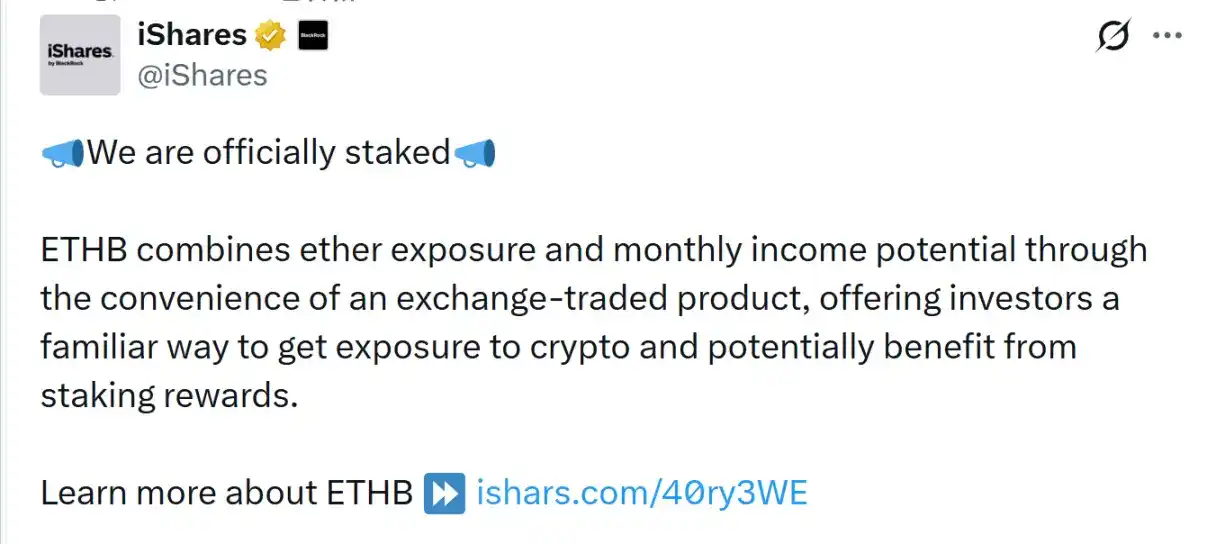
BlackRock, the world's largest asset management company, officially launched the staking-yield Ethereum ETF 'iShares Staked Ethereum Trust' (ticker: ETHB) on Nasdaq—it not only holds Ethereum spot assets but also stakes a large portion of them on-chain and periodically distributes the收益 to investors.

It can be said that, after more than a year of market discussion, the launch of ETHB has substantially resolved the core issue that has remained pending since the introduction of Ethereum spot ETFs: can ETH be formally accepted by the mainstream financial system as a 'yield-bearing asset'?

This also marks the formal entry of 'Staking,' a behavior once exclusive to on-chain native users, into Wall Street's asset allocation framework.

I. What is ETHB and How Does It Work?

From the timing and market environment perspective, the launch of BlackRock's ETHB is可谓 opportune.

On one hand, BlackRock's iShares Bitcoin Trust (IBIT) now manages over $55 billion in assets, and the iShares Ethereum Trust (ETHA) manages around $6.5 billion, proving institutional acceptance of crypto asset ETFs. On the other hand, discussions and policy preparations around allowing ETFs to participate in staking, from the U.S. to Hong Kong, have been ongoing for over a year.

The biggest difference between ETHB and previous Ethereum spot ETFs like ETHA is that it doesn't let ETH sit idle.

要知道传统加密 ETF 的运作模式非常简单,通常是buy ETH, custody it, track price movements, and then do nothing. ETHB introduces a key change: it allows the held ETH assets to participate in network consensus and generate yield:

It stakes 70% to 95% of its ETH holdings through Coinbase Prime,委托给 professional validators like Figment, allowing the assets to actively participate in maintaining Ethereum network consensus and earn staking rewards.

Breaking down this mechanism:

  • Investors buy ETHB fund shares;
  • The fund uses raised capital to buy spot ETH;
  • Most ETH is staked;
  • Approximately 82% of the staking rewards are distributed monthly to fund shareholders, the remaining 18% is retained by BlackRock and others as service fees;
  • The fund also charges a 0.25% annual management fee (a preferential rate of 0.12% for the first $2.5 billion in assets under management in the first year);

This also highlights the core value of compound staking. Taking stETH as an example, after users stake ETH, the stETH token balance automatically increases with staking rewards,无需 any manual operation. Each reward becomes part of the principal, generating new收益.

For ETHB, we can do a similar calculation—Ethereum's current on-chain annual staking yield is approximately between 2.8% and 3.1%. Since ETHB distributes about 3.1% × 82% to investors, the actual yield after deducting management fees is around 2.3%~2.5%.

Although the数字看起来不算高, the key is that it is a continuous, automatic, and predictable cash flow, meaning普通 investors who buy ETHB will now also be able to enjoy compound interest.

Of course, although ETHB distributes rewards monthly, if investors do not actively reinvest the distributed收益 to purchase additional ETF shares, they cannot enjoy the effect of compound叠加, which may, to some extent, give on-chain native staking a slight advantage in long-term收益.

II. Why is the Emergence of ETHB So Important?

The significance of ETHB far exceeds the birth of a new fund.

As is well known, during the tenure of former U.S. Securities and Exchange Commission (SEC) Chairman Gary Gensler, all Ethereum ETF applications were required to remove the staking function,理由是 staking might constitute an unregistered security. With Gensler's departure, the regulatory stance明显转向 under new Chairman Paul Atkins, ultimately paving the way for ETHB's birth.

And BlackRock currently manages over $130 billion in crypto-related ETP assets. Its iShares series captured approximately 95% of the global digital asset ETP net inflows in 2025. When an institution of this massive size writes 'Staking' into its product architecture, the signal it sends to the entire market is that staking yield is now a legitimate, sustainable source of investment return.

Therefore, it is highly likely that, similar to the queue of Ethereum, Solana, and others following Bitcoin ETF approvals, after this ETHB issuance, staking ETF applications for PoS networks like Solana, Cardano, Polkadot will also enter the review queue successively. All crypto asset ETF issuers will quickly follow suit.

We can even foresee that within the next six months, a significant amount of spot ETF funds will flow back into yield-generating ETFs.

In fact, as early as January this year, some Ethereum ETFs began testing this field, allowing holders to receive interest定期 like holding securities—Grayscale's Grayscale Ethereum Staking ETF (ETHE) has already distributed staking收益 to existing shareholders, marking the first time a U.S. spot crypto asset exchange-traded product distributed staking收益 to holders.

While this might seem routine chain operation to Web3 Native players, in the history of crypto finance, it marks the first time Ethereum's native yield has been packaged into the standard shell of traditional finance, undoubtedly a milestone.

It must be emphasized that this does not mean Ethereum staking has achieved full compliance, nor does it represent a unified regulatory stance on ETF staking services. But economically, a key change has occurred: non-crypto-native users, for the first time, indirectly obtained the native yield generated by the Ethereum network consensus without needing to understand nodes, private keys, or on-chain operations.

From this perspective, Ethereum Staking has taken a crucial step into the broader capital视野.

III. What's Next?

Of course, not everyone will obtain staking收益 by buying ETHB. For most crypto users, a more direct way is to participate on-chain.

We still need to review the main Ethereum staking methods, which primarily consist of three paths.

First is definitely native staking, but it requires users to stake at least 32 ETH and run an independent validator node. Therefore, while it offers the highest yield and is the most decentralized, the门槛 is higher, making it more suitable for deep users with strong technical capabilities.

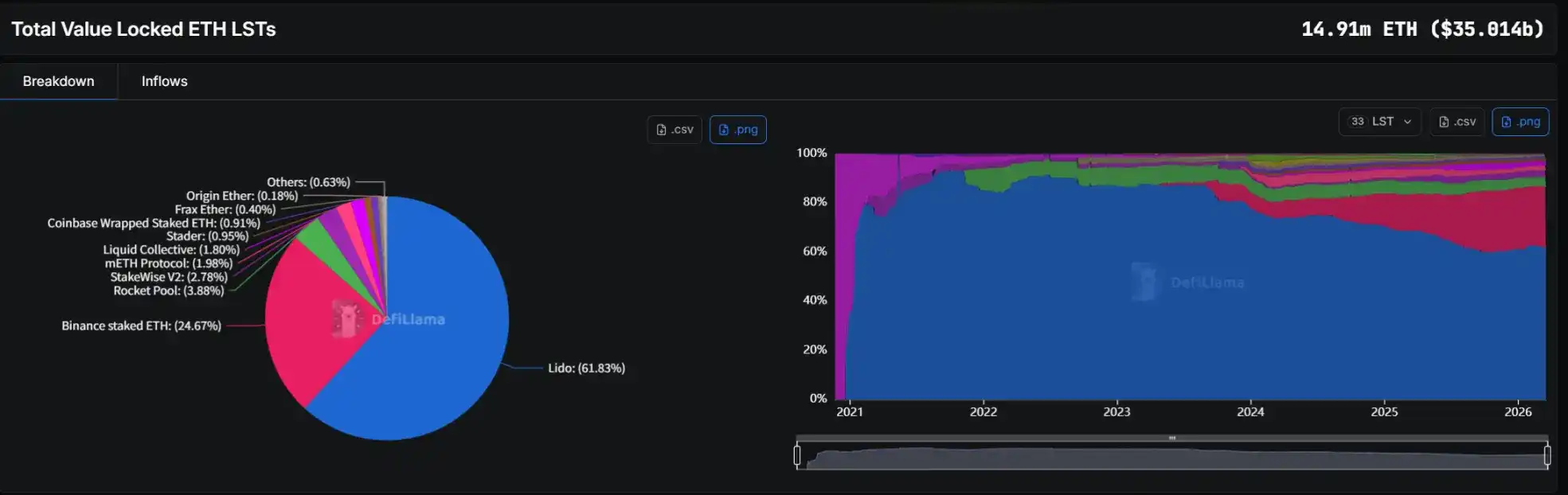
Second is the currently mainstream liquid staking, with a total volume of nearly 15 million ETH, worth over $35 billion. Users can participate through protocols like Lido (stETH), Rocket Pool (rETH), etc., without needing 32 ETH.

And after staking, users receive liquidity tokens pegged 1:1 to the original asset, which can continue to participate in DeFi activities, offering the most significant compound effect.

Source: DeFiLlama

Then there is node staking, primarily through wallets that support staking functionality for direct participation. It's操作简单, suitable for non-technical users, which also places higher demands on supporting infrastructure like wallets.

Overall, the launch of BlackRock's ETHB is a significant milestone in Ethereum staking's journey from an 'on-chain native behavior' to a 'mainstream financial product.' It validates the legitimacy of staking yield and accelerates the process of institutional capital flowing into the ETH ecosystem.

But for ordinary token holders, the more important signal is: staking, as a way to keep assets continuously working, has been recognized by the world's largest asset management institution.

When ETH starts to earn yield automatically, the pricing logic of the asset also changes. It is no longer just a speculative asset waiting for appreciation, but a 'yield machine' that can continuously generate cash flow. Whether through ETFs or on-chain staking, this trend is already irreversible.

And you, are you ready to put your ETH to work?

Связанные с этим вопросы

QWhat is the significance of BlackRock's ETHB ETF in the context of Ethereum's asset properties?

ABlackRock's ETHB ETF marks a historic moment by introducing staking rewards to mainstream finance, effectively transforming Ethereum from a speculative asset into a yield-generating one. It legitimizes staking as a sustainable investment return and signals broader institutional acceptance of Ethereum's native yield mechanism within traditional financial frameworks.

QHow does the ETHB ETF differ from traditional cryptocurrency ETFs in terms of asset utilization?

ATraditional crypto ETFs typically hold assets idle, tracking price movements without active utilization. In contrast, ETHB actively deploys 70% to 95% of its ETH holdings into staking via professional validators like Figment, generating rewards distributed to investors, thus introducing a yield component absent in conventional ETFs.

QWhat are the key operational steps and fee structures of BlackRock's ETHB ETF?

AETHB operates by: 1) Investors purchasing fund shares; 2) Fund using capital to buy ETH; 3) Staking most ETH through Coinbase Prime and validators; 4) Distributing ~82% of staking rewards monthly to investors, retaining 18% as fees; 5) Charging a 0.25% annual management fee (0.12% for the first $25B in assets).

QWhy is the regulatory approval of staking in ETFs like ETHB considered a milestone?

AIt overcomes previous SEC restrictions under Gary Gensler, where staking was viewed as unregistered securities. New leadership under Paul Atkins enabled this shift, allowing non-crypto-native investors to access Ethereum's native yields without technical knowledge, bridging decentralized finance with traditional investment products.

QHow might ETHB impact the broader landscape of cryptocurrency ETFs and investor behavior?

AETHB sets a precedent for other PoS-based ETFs (e.g., Solana, Cardano) to incorporate staking, potentially shifting capital from non-yielding现货 ETFs to yield-generating ones. It encourages investors to view crypto assets as productive capital, accelerating institutional inflows and normalizing staking收益 in portfolios.

Похожее

Has the 'Digital Gold' Narrative for BTC Failed?

**Title: Has the "Digital Gold" Narrative for Bitcoin Failed?** The article argues that Bitcoin's "digital gold" narrative remains valid despite a recent sharp price decline (from a peak near $126k in Oct 2025 to briefly under $61k in Feb 2026). It presents a long-term investment framework based on three core points: **1. Viewing Bitcoin as an Asset:** Bitcoin is presented as a superior potential store of value compared to gold. Key arguments are its absolute scarcity (21 million cap), superior portability, and transparent auditability via its public ledger. While acknowledging its current use in early, volatile stages (~3-4% global adoption), the author draws parallels to the early, disruptive phases of the internet and e-commerce. **2. Understanding the Recent Downturn:** The current ~50% correction is framed as a predictable, consensus-driven cycle following its post-halving peak (the 2024 halving preceded the Oct 2025 high). A crucial factor is a historic "changing of hands": the influx of new institutional buyers via ETFs allowed early, low-cost holders (miners, OG believers) to take profits. The author notes that while severe, Bitcoin's historical drawdowns (e.g., 93% in 2011, 77% in 2021-22) have been progressively smaller, suggesting maturing holder structure and decreasing volatility over time. **3. The Long-Term Perspective:** The long-term thesis hinges on Bitcoin capturing a portion of gold's market value. With Bitcoin's market cap at ~$1.4 trillion (at $70k) versus gold's ~$20 trillion, significant upside potential exists if the "digital gold" narrative is partially realized. However, the author strongly cautions that short-term risks remain, the bottom is unpredictable, and high volatility is inherent. The real risk is not Bitcoin failing but poor personal position management (over-leverage, wrong capital) and a lack of deep understanding, which can force investors out during severe downturns. The conclusion uses Amazon's 95% crash post-2000 dot-com bubble and subsequent 42x recovery as an analogy. The ultimate question is not if Bitcoin's price will rise, but if an investor's strategy and conviction can withstand the volatility to see the long-term play out. The recent divergence (gold up, Bitcoin down) is posed not as a narrative failure, but as potential evidence of this ongoing, painful transition from a speculative asset to a mainstream allocation.

marsbit5 ч. назад

Has the 'Digital Gold' Narrative for BTC Failed?

marsbit5 ч. назад

Has BTC's 'Digital Gold' Narrative Failed?

The article discusses Bitcoin's "digital gold" narrative, its recent price drop, and long-term outlook through the perspective of "Jason". It argues the narrative is not a failure but that Bitcoin represents a superior, new asset class due to its fixed supply (21 million), portability, and auditability. The piece compares its current ~3-4% global adoption rate to early internet/e-commerce, suggesting significant growth potential. Regarding the 2025-2026 price decline (from ~$126k to briefly under $61k), the author views it as a predictable, consensus-driven sell-off within Bitcoin's ~4-year cycle post-halving, exacerbated by a major "handover" from early, low-cost holders to new institutional buyers via ETFs. A key observation is that historical peak-to-trough drawdowns have lessened over time (e.g., 93% in 2011 to ~50% in 2026), indicating maturing volatility as holder structure changes. For the long term, the author uses a simple framework: Bitcoin's total market cap (~$1.4T at $70k) is only about 7% of gold's (~$20T). Even capturing 30-50% of gold's value would imply substantial upside. However, the article strongly cautions against viewing this as investment advice, emphasizing extreme volatility and the critical importance of risk management, position sizing, and deep fundamental understanding to survive severe drawdowns. It concludes by drawing a parallel to Amazon's 95% crash in 2000 and subsequent 42x recovery, stressing that the key is surviving market cycles to realize long-term potential.

链捕手5 ч. назад

Has BTC's 'Digital Gold' Narrative Failed?

链捕手5 ч. назад

From Code to Cognition: A Ten-Thousand-Word Guide to the Evolution of the Robot Brain

"From Code to Cognition: The Evolution of Robot Brains" The journey of robotic intelligence has shifted dramatically from manually coded systems to AI-driven brains. For decades, robots relied on layered software stacks—perception, state estimation, planning, control—each handcrafted. While predictable, they lacked adaptability. The 2010s saw deep learning revolutionize perception (e.g., object detection) and control (via reinforcement learning), but learned skills remained narrow. The arrival of Large Language Models (LLMs) marked a turning point. LLMs acted as high-level planners, interpreting natural language instructions and generating sequences of actions for traditional robotic systems to execute. However, true integration came with Visual-Language-Action (VLA) models, which fused vision, language, and motion prediction into a single network. Pioneered by models like RT-2 and open-source projects like OpenVLA, VLAs enable robots to reason and act directly from visual input and commands. The most advanced humanoid robots now employ a "dual-brain" architecture: a slow-thinking, large VLA (System 2) for reasoning and planning, and a fast-reacting, small network (System 1) for high-frequency motion control, sometimes with an even lower-level System 0 for balance. This split balances cognition with the physics of real-time movement. Computation is split between onboard hardware (e.g., NVIDIA Jetson) for safety-critical control loops and cloud/edge servers for non-critical tasks like learning and interfaces. A crucial driver is the open-source ecosystem—models like GR00T and OpenVLA allow startups to build upon pre-trained brains and fine-tune them with their own data, accelerating development. Despite progress, current systems struggle with recovery from errors, sample inefficiency, and long-horizon tasks. This has spurred the rise of **World Models**—neural networks that predict the consequences of actions. By simulating possible futures before acting (like NVIDIA Cosmos or Meta V-JEPA), robots can plan, recover, and generalize better. This represents the next frontier: shifting intelligence from learned reactions to an internal model of physics and cause-and-effect. The field is rapidly evolving. While not yet at its "ChatGPT moment," the convergence of cheaper hardware, scalable simulation, and world models points toward robots that are increasingly capable, adaptive, and useful. The question is shifting from "what can robots do?" to "what *should* they do?"

marsbit5 ч. назад

From Code to Cognition: A Ten-Thousand-Word Guide to the Evolution of the Robot Brain

marsbit5 ч. назад

Торговля

Спот
Фьючерсы

Популярные статьи

Как купить S

Добро пожаловать на HTX.com! Мы сделали приобретение Sonic (S) простым и удобным. Следуйте нашему пошаговому руководству и отправляйтесь в свое крипто-путешествие.Шаг 1: Создайте аккаунт на HTXИспользуйте свой адрес электронной почты или номер телефона, чтобы зарегистрироваться и бесплатно создать аккаунт на HTX. Пройдите удобную регистрацию и откройте для себя весь функционал.Создать аккаунтШаг 2: Перейдите в Купить криптовалюту и выберите свой способ оплатыКредитная/Дебетовая Карта: Используйте свою карту Visa или Mastercard для мгновенной покупки Sonic (S).Баланс: Используйте средства с баланса вашего аккаунта HTX для простой торговли.Третьи Лица: Мы добавили популярные способы оплаты, такие как Google Pay и Apple Pay, для повышения удобства.P2P: Торгуйте напрямую с другими пользователями на HTX.Внебиржевая Торговля (OTC): Мы предлагаем индивидуальные услуги и конкурентоспособные обменные курсы для трейдеров.Шаг 3: Хранение Sonic (S)После приобретения вами Sonic (S) храните их в своем аккаунте на HTX. В качестве альтернативы вы можете отправить их куда-либо с помощью перевода в блокчейне или использовать для торговли с другими криптовалютами.Шаг 4: Торговля Sonic (S)С легкостью торгуйте Sonic (S) на спотовом рынке HTX. Просто зайдите в свой аккаунт, выберите торговую пару, совершайте сделки и следите за ними в режиме реального времени. Мы предлагаем удобный интерфейс как для начинающих, так и для опытных трейдеров.

1.4k просмотров всегоОпубликовано 2025.01.15Обновлено 2026.06.02

Как купить S

Sonic: Обновления под руководством Андре Кронье – новая звезда Layer-1 на фоне спада рынка

Он решает проблемы масштабируемости, совместимости между блокчейнами и стимулов для разработчиков с помощью технологических инноваций.

2.3k просмотров всегоОпубликовано 2025.04.09Обновлено 2025.04.09

Sonic: Обновления под руководством Андре Кронье – новая звезда Layer-1 на фоне спада рынка

HTX Learn: Пройдите обучение по "Sonic" и разделите 1000 USDT

HTX Learn — ваш проводник в мир перспективных проектов, и мы запускаем специальное мероприятие "Учитесь и Зарабатывайте", посвящённое этим проектам. Наше новое направление .

1.8k просмотров всегоОпубликовано 2025.04.10Обновлено 2025.04.10

HTX Learn: Пройдите обучение по "Sonic" и разделите 1000 USDT

Обсуждения

Добро пожаловать в Сообщество HTX. Здесь вы сможете быть в курсе последних новостей о развитии платформы и получить доступ к профессиональной аналитической информации о рынке. Мнения пользователей о цене на S (S) представлены ниже.

活动图片