Western Union launches USDPT on Solana: March rally for SOL?

ambcryptoОпубликовано 2026-03-05Обновлено 2026-03-05

Введение

Western Union has launched a new stablecoin, USDPT, on the Solana blockchain, signaling strong institutional confidence in the network’s capabilities. This partnership enhances Western Union’s position in the stablecoin market by enabling efficient cross-border transactions. The development comes amid growing stablecoin ecosystem on Solana, with Grayscale reporting a record $650 billion in stablecoin volume in February—even as SOL’s price declined. Increased stablecoin activity, including Circle minting $1 billion USDC on Solana, points to strong underlying liquidity and on-chain demand. This liquidity surge may position Solana for a potential rally in March, especially if market sentiment remains positive. The network’s deepening capital flows and institutional backing strengthen its long-term fundamentals despite regulatory and competitive pressures.

No doubt, over the years, stablecoins have bridged TradFi and DeFi by enabling banks to process payments faster and at lower cost, directly improving efficiency and the overall user experience.

In this context, the critical factor is the Layer-1 network chosen to facilitate this bridge. Notably, Solana [SOL] appears to be strategically positioning itself to capitalize on this opportunity through another key partnership.

Western Union, a global financial services company, has launched USDPT, a new stablecoin on Solana, clearly signaling its confidence in the network’s capability to deliver stablecoin services to users.

At a macro level, the partnership structurally strengthens Western Union’s competitive position in the expanding stablecoin market, as leveraging blockchain infrastructure enables seamless cross-border transactions.

The more consequential question, however, is what this development means for Solana. As stablecoin regulations tighten and competition among Layer-1 networks intensifies, does this partnership reinforce confidence in its long-term fundamentals?

Considering how a recent report by Grayscale highlighted Solana’s growing stablecoin market, USDPT’s launch could not have come at a better time, positioning the network at the forefront of a potential March rally.

Stablecoin surge fuels renewed bullish case for Solana

High liquidity directly drives a network’s long-term growth.

The reasoning is simple. The more liquid a chain is, the easier it becomes to move capital across different sectors like NFTs, RWAs, and staking. This naturally increases on-chain activity and overall network strength.

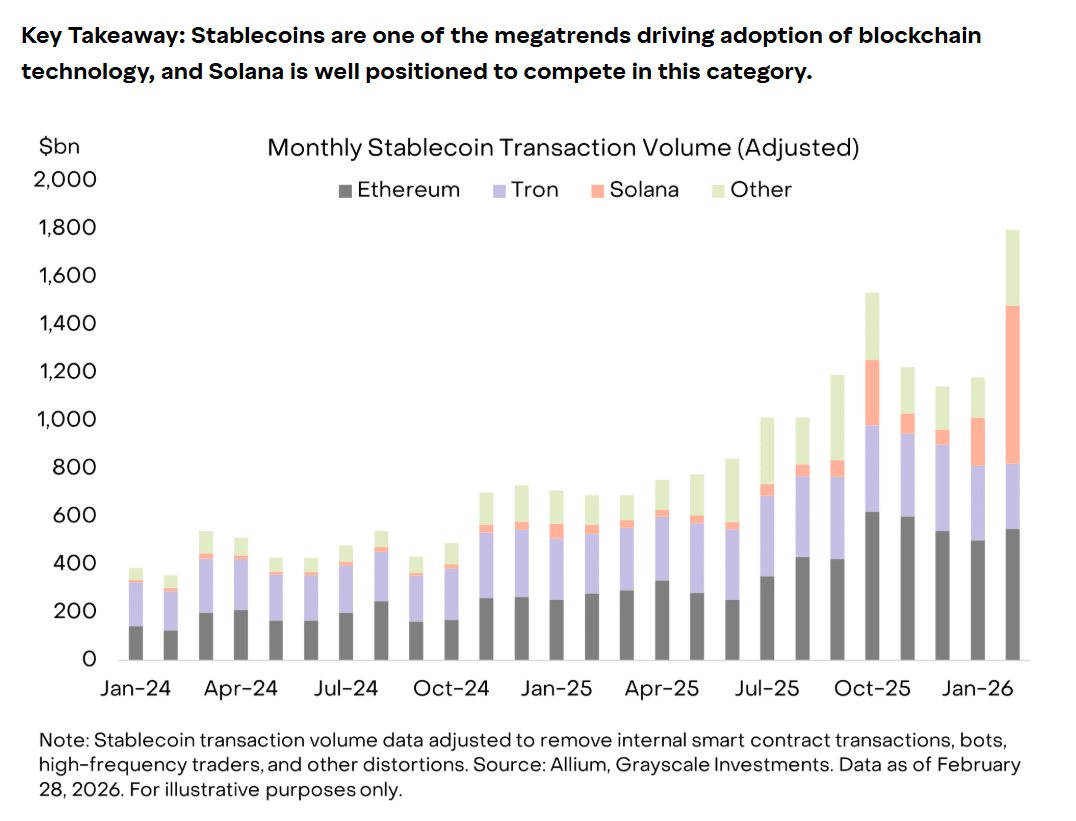
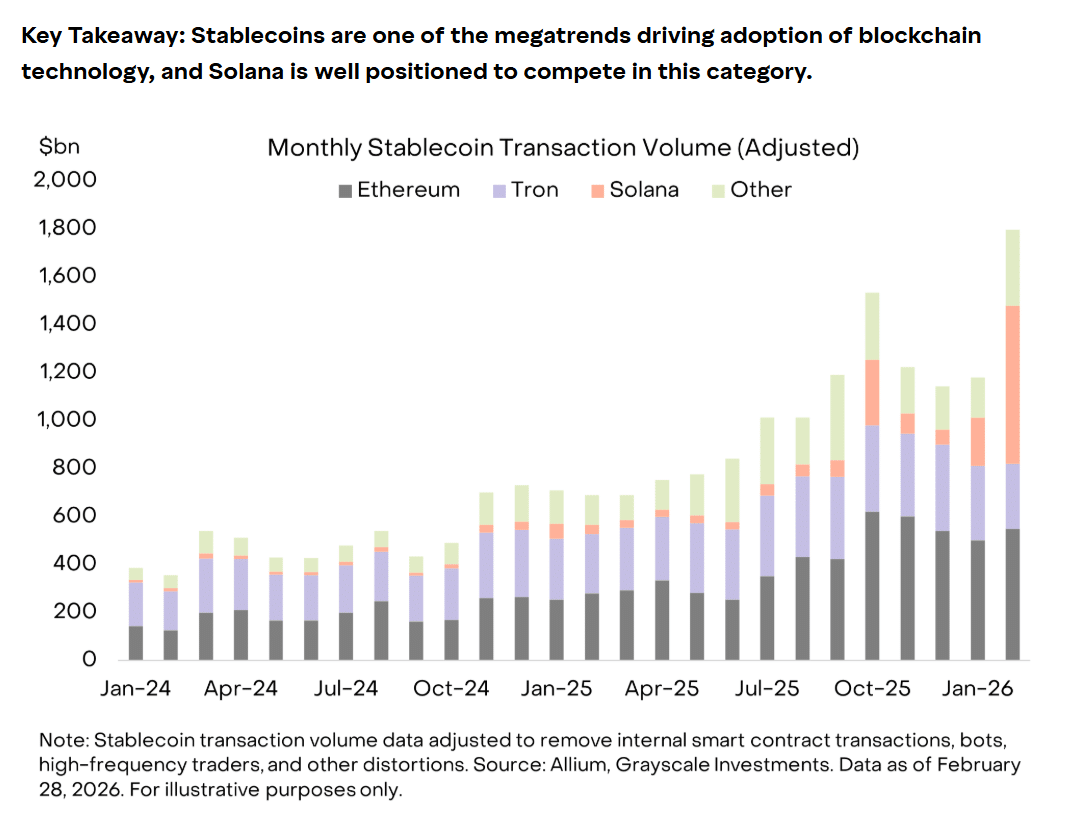
Grayscale’s statement that February was a record month for stablecoins on Solana carries weight in this context. The report noted that stablecoin volume on Solana hit an all‐time high of $650 billion.

Source: Grayscale

Notably, this expansion occurred while SOL saw its weakest monthly run of the year, closing February down 19.98%. This divergence suggests that underlying transactional activity persisted despite price weakness.

Within this context, Circle minting $1 billion in USDC on Solana following the Middle East conflict carries structural importance. Elevated stablecoin issuance during a risk-off phase increases on-chain liquidity depth.

When you add the USDPT launch to the mix, the added liquidity boosts Solana’s capital flows. With Grayscale highlighting strong underlying demand, the setup points to a potential liquidity‐driven repricing.

In this context, SOL’s breakout above $90 may only mark the beginning. With deeper stablecoin liquidity and steady on‐chain activity, Solana appears well‐positioned to lead in March if risk‐on sentiment persists.


Final Summary

  • Solana is seeing stronger liquidity and institutional backing, with moves from Western Union and Circle boosting on-chain activity.
  • Record stablecoin volume, highlighted by Grayscale, shows solid demand, which could support further upside if market sentiment improves.

Связанные с этим вопросы

QWhat is the significance of Western Union launching USDPT on Solana?

AWestern Union's launch of the USDPT stablecoin on Solana signals strong institutional confidence in the network's capability to handle stablecoin services, strengthens its competitive position in cross-border transactions, and adds significant capital flow and liquidity to the Solana ecosystem.

QHow did Solana's stablecoin volume perform in February according to Grayscale?

AGrayscale reported that February was a record month for stablecoins on Solana, with stablecoin volume hitting an all-time high of $650 billion, indicating robust underlying demand despite SOL's price decline of 19.98% that month.

QWhy is the partnership with Western Union and Circle's USDC minting important for Solana?

AThe partnership with Western Union and Circle's minting of $1 billion USDC on Solana during a risk-off phase structurally enhances on-chain liquidity depth, boosts capital flows, and positions Solana at the forefront of potential growth, reinforcing long-term fundamentals.

QWhat does high liquidity mean for a blockchain network like Solana?

AHigh liquidity on a blockchain network like Solana facilitates easier movement of capital across various sectors such as NFTs, RWAs, and staking, which increases on-chain activity, strengthens the network, and supports long-term growth and potential price repricing.

QHow might Solana's position in the stablecoin market affect its performance in March?

AWith record stablecoin volumes, increased liquidity from new partnerships and USDC minting, and strong underlying demand, Solana is well-positioned to lead a potential March rally if risk-on sentiment persists, possibly extending its breakout above $90.

Похожее

OpenAI Post-Training Engineer Weng Jiayi Proposes a New Paradigm Hypothesis for Agentic AI

OpenAI engineer Weng Jiayi's "Heuristic Learning" experiments propose a new paradigm for Agentic AI, suggesting that intelligent agents can improve not just by training neural networks, but also by autonomously writing and refining code based on environmental feedback. In the experiment, a coding agent (powered by Codex) was tasked with developing and maintaining a programmatic strategy for the Atari game Breakout. Starting from a basic prompt, the agent iteratively wrote code, ran the game, analyzed logs and video replays to identify failures, and then modified the code. Through this engineering loop of "code-run-debug-update," it evolved a pure Python heuristic strategy that achieved a perfect score of 864 in Breakout and performed competitively with deep reinforcement learning (RL) algorithms in MuJoCo control tasks like Ant and HalfCheetah. This approach, termed Heuristic Learning (HL), contrasts with Deep RL. In HL, experience is captured in readable, modifiable code, tests, logs, and configurations—a software system—rather than being encoded solely into opaque neural network weights. This offers potential advantages in explainability, auditability for safety-critical applications, easier integration of regression tests to combat catastrophic forgetting, and more efficient sample use in early learning stages, as demonstrated in broader tests on 57 Atari games. However, the blog acknowledges clear limitations. Programmatic strategies struggle with tasks requiring long-horizon planning or complex perception (e.g., Montezuma's Revenge), areas where neural networks excel. The future vision is a hybrid architecture: specialized neural networks for fast perception (System 1), HL systems for rules, safety, and local recovery (also System 1), and LLM agents providing high-level feedback and learning from the HL system's data (System 2). The core proposition is that in the era of capable coding agents, a significant portion of an AI's learned experience could be maintained as an auditable, evolving software system.

marsbit42 мин. назад

OpenAI Post-Training Engineer Weng Jiayi Proposes a New Paradigm Hypothesis for Agentic AI

marsbit42 мин. назад

Your Claude Will Dream Tonight, Don't Disturb It

This article explores the recent phenomenon of AI companies increasingly using anthropomorphic language—like "thinking," "memory," "hallucination," and now "dreaming"—to describe machine learning processes. Focusing on Anthropic's newly announced "Dreaming" feature for its Claude Agent platform, the piece explains that this function is essentially an automated, offline batch processing of an agent's operational logs. It analyzes past task sessions to identify patterns, optimize future actions, and consolidate learnings into a persistent memory system, akin to a form of reinforcement learning and self-correction. The article draws parallels to similar features in other AI agent systems like Hermes Agent and OpenClaw, which also implement mechanisms for reviewing historical data, extracting reusable "skills," and strengthening long-term memory. It notes a key difference from human dreaming: these AI "dreams" still consume computational resources and user tokens. Further context is provided by discussing the technical challenges of managing AI "memory" or context, highlighting the computational expense of large context windows and innovations like Subquadratic's new model claiming drastically longer contexts. The core critique argues that this strategic use of human-centric vocabulary does more than market products; it subtly reshapes user perception. By framing algorithms with terms associated with consciousness, companies blur the line between tool and autonomous entity. This linguistic shift can influence user expectations, tolerance for errors, and even perceptions of responsibility when systems fail, potentially diverting scrutiny from the companies and engineers behind the technology. The article concludes by speculating that terms like "daydreaming" for predictive task simulation might be next, continuing this trend of embedding the idea of an "inner life" into computational processes.

marsbit44 мин. назад

Your Claude Will Dream Tonight, Don't Disturb It

marsbit44 мин. назад

Торговля

Спот
Фьючерсы

Популярные статьи

Обсуждения

Добро пожаловать в Сообщество HTX. Здесь вы сможете быть в курсе последних новостей о развитии платформы и получить доступ к профессиональной аналитической информации о рынке. Мнения пользователей о цене на SOL (SOL) представлены ниже.

活动图片