Western Union launches USDPT on Solana: March rally for SOL?

ambcryptoОпубликовано 2026-03-05Обновлено 2026-03-05

Введение

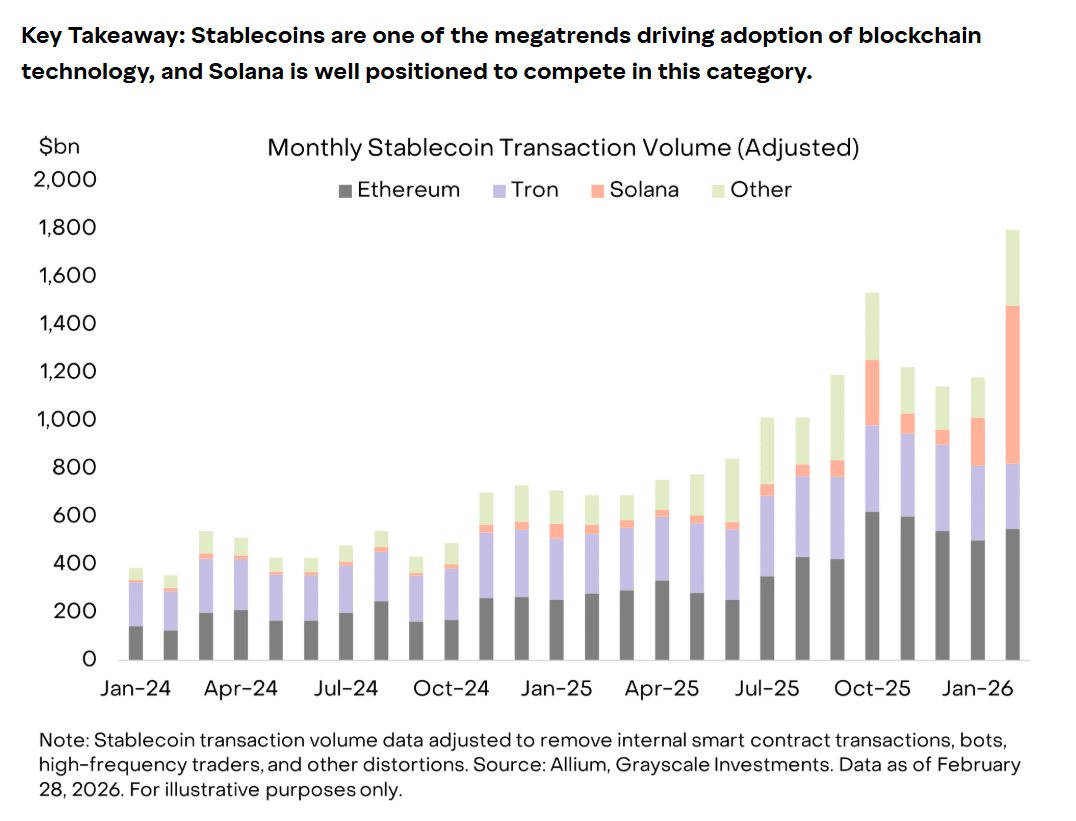
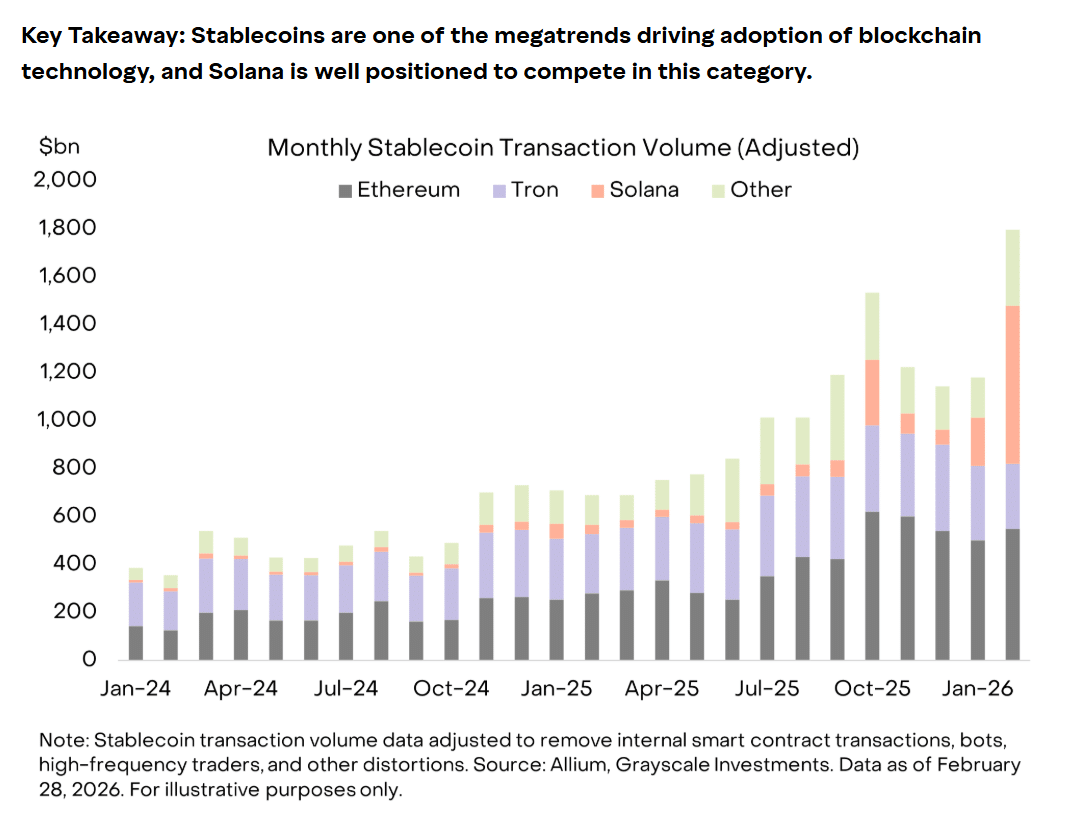
Western Union has launched a new stablecoin, USDPT, on the Solana blockchain, signaling strong institutional confidence in the network’s capabilities. This partnership enhances Western Union’s position in the stablecoin market by enabling efficient cross-border transactions. The development comes amid growing stablecoin ecosystem on Solana, with Grayscale reporting a record $650 billion in stablecoin volume in February—even as SOL’s price declined. Increased stablecoin activity, including Circle minting $1 billion USDC on Solana, points to strong underlying liquidity and on-chain demand. This liquidity surge may position Solana for a potential rally in March, especially if market sentiment remains positive. The network’s deepening capital flows and institutional backing strengthen its long-term fundamentals despite regulatory and competitive pressures.

No doubt, over the years, stablecoins have bridged TradFi and DeFi by enabling banks to process payments faster and at lower cost, directly improving efficiency and the overall user experience.

In this context, the critical factor is the Layer-1 network chosen to facilitate this bridge. Notably, Solana [SOL] appears to be strategically positioning itself to capitalize on this opportunity through another key partnership.

Western Union, a global financial services company, has launched USDPT, a new stablecoin on Solana, clearly signaling its confidence in the network’s capability to deliver stablecoin services to users.

At a macro level, the partnership structurally strengthens Western Union’s competitive position in the expanding stablecoin market, as leveraging blockchain infrastructure enables seamless cross-border transactions.

The more consequential question, however, is what this development means for Solana. As stablecoin regulations tighten and competition among Layer-1 networks intensifies, does this partnership reinforce confidence in its long-term fundamentals?

Considering how a recent report by Grayscale highlighted Solana’s growing stablecoin market, USDPT’s launch could not have come at a better time, positioning the network at the forefront of a potential March rally.

Stablecoin surge fuels renewed bullish case for Solana

High liquidity directly drives a network’s long-term growth.

The reasoning is simple. The more liquid a chain is, the easier it becomes to move capital across different sectors like NFTs, RWAs, and staking. This naturally increases on-chain activity and overall network strength.

Grayscale’s statement that February was a record month for stablecoins on Solana carries weight in this context. The report noted that stablecoin volume on Solana hit an all‐time high of $650 billion.

Source: Grayscale

Notably, this expansion occurred while SOL saw its weakest monthly run of the year, closing February down 19.98%. This divergence suggests that underlying transactional activity persisted despite price weakness.

Within this context, Circle minting $1 billion in USDC on Solana following the Middle East conflict carries structural importance. Elevated stablecoin issuance during a risk-off phase increases on-chain liquidity depth.

When you add the USDPT launch to the mix, the added liquidity boosts Solana’s capital flows. With Grayscale highlighting strong underlying demand, the setup points to a potential liquidity‐driven repricing.

In this context, SOL’s breakout above $90 may only mark the beginning. With deeper stablecoin liquidity and steady on‐chain activity, Solana appears well‐positioned to lead in March if risk‐on sentiment persists.


Final Summary

  • Solana is seeing stronger liquidity and institutional backing, with moves from Western Union and Circle boosting on-chain activity.
  • Record stablecoin volume, highlighted by Grayscale, shows solid demand, which could support further upside if market sentiment improves.

Связанные с этим вопросы

QWhat is the significance of Western Union launching USDPT on Solana?

AWestern Union's launch of the USDPT stablecoin on Solana signals strong institutional confidence in the network's capability to handle stablecoin services, strengthens its competitive position in cross-border transactions, and adds significant capital flow and liquidity to the Solana ecosystem.

QHow did Solana's stablecoin volume perform in February according to Grayscale?

AGrayscale reported that February was a record month for stablecoins on Solana, with stablecoin volume hitting an all-time high of $650 billion, indicating robust underlying demand despite SOL's price decline of 19.98% that month.

QWhy is the partnership with Western Union and Circle's USDC minting important for Solana?

AThe partnership with Western Union and Circle's minting of $1 billion USDC on Solana during a risk-off phase structurally enhances on-chain liquidity depth, boosts capital flows, and positions Solana at the forefront of potential growth, reinforcing long-term fundamentals.

QWhat does high liquidity mean for a blockchain network like Solana?

AHigh liquidity on a blockchain network like Solana facilitates easier movement of capital across various sectors such as NFTs, RWAs, and staking, which increases on-chain activity, strengthens the network, and supports long-term growth and potential price repricing.

QHow might Solana's position in the stablecoin market affect its performance in March?

AWith record stablecoin volumes, increased liquidity from new partnerships and USDC minting, and strong underlying demand, Solana is well-positioned to lead a potential March rally if risk-on sentiment persists, possibly extending its breakout above $90.

Похожее

Missed Out on SpaceX's IPO? Take a Look at SpaceX's Complete Supply Chain

SpaceX is now public, but its high valuation and losses may deter some investors. However, the real opportunity, as seen with Apple, Tesla, and Nvidia, may lie in its extensive supply chain. SpaceX, funded primarily by its profitable Starlink service, spends hundreds of billions annually on components for its rockets, satellites, and planned orbital AI data centers, creating significant revenue streams for suppliers. Key suppliers are categorized by their indispensability. The first group includes irreplaceable players like **NVIDIA** (GPUs for AI supercomputers), **Eutelsat (SATS)** (spectrum rights), **Filtronic** (millimeter-wave amplifiers), **Materion (MTRN)** (beryllium alloys), and **STMicroelectronics (STM)** (phased array chips). The second category comprises suppliers costly to replace due to long certification cycles or deep integration, such as **Honeywell (HON)** (flight controls), **Carpenter Technology (CRS)** (specialty steel), **Hexcel (HXL)** (carbon fiber), **Broadcom (AVGO)** (data switching), and **Linde** (industrial gases). The third group involves high-volume, cost-critical manufacturers for mass-produced items like Starlink terminals. Major players here include Taiwanese contract manufacturer **Wistron NeWeb (6285)** and several Chinese-listed firms: **Sunway Communication (300136)**, **Parker Advanced Materials (605123)**, **Western Superconducting (002149)**, and **Yingliu Co., Ltd. (603308)**. Other niche providers include **Tianyin Electromechanical**, **Tongyu Communication**, **Trimble (TRMB)**, **Astronics (ATRO)**, and **CTSH**. The timing is now relevant because: 1) SpaceX's procurement is accelerating with plans for 100 launches in 2026, 30 million Starlink terminals, and orbital data centers. 2) Its IPO has brought unprecedented transparency to its supply chain. 3) This phase mirrors early days of the Tesla supply chain boom. The investment thesis shifts from betting on SpaceX's stock to betting on the steady, order-book-driven revenues of its essential suppliers. Risks remain, such as commodity cycles, geopolitical factors, and technological shifts, but the supply chain offers a potentially less speculative path to participate in SpaceX's growth.

marsbit12 мин. назад

Missed Out on SpaceX's IPO? Take a Look at SpaceX's Complete Supply Chain

marsbit12 мин. назад

Jane Street: The Most Powerful Behind-the-Scenes Operator in the Crypto Industry

Jane Street: Crypto's Most Powerful Behind-the-Scenes Operator A recent 13F filing revealed Jane Street, the secretive Wall Street quant giant, drastically reduced its Bitcoin ETF holdings while increasing stakes in Ethereum ETFs. This move highlights its role not as a directional investor, but as a critical infrastructure player extracting "tolls" from crypto's institutionalization. The firm, founded in 2000 and famously lacking a CEO, has systematically embedded itself across crypto markets. It acts as a key Authorized Participant (AP) and market maker for major Bitcoin and Ethereum ETFs, profiting from arbitrage between ETF shares and underlying assets. Its approach combines quantitative prowess with a willingness to hold positions for structural arbitrage, differing from pure high-frequency traders. Jane Street faces allegations related to the 2022 Terra (LUNA) collapse. A lawsuit claims it used non-public information to withdraw $85 million in UST minutes before a critical withdrawal by Terraform Labs, allegedly exacerbating the crash and avoiding over $200 million in losses. The company denies the claims. Further indicating its reach, a wallet suspected to be operated by Jane Street ("JaneStreetIndia") was identified on the prediction market Polymarket. This bot executed over 11,000 high-frequency trades on short-term crypto price movements with a near-perfect win rate, showcasing a套利 strategy divorced from traditional prediction. Beyond trading, Jane Street holds equity in crypto infrastructure like Kraken, 1inch, and Arbitrum, and mining stocks. Its strategy is clear: avoid betting on winners, but secure a position in the market's essential plumbing. By becoming a ubiquitous part of the liquidity infrastructure—from ETFs to OTC trading and potentially链上 markets—Jane Street operates as a market force itself, raising questions about whether crypto's decentralized,散户-friendly alpha is being permanently eroded by traditional finance's most sophisticated players.

Foresight News15 мин. назад

Jane Street: The Most Powerful Behind-the-Scenes Operator in the Crypto Industry

Foresight News15 мин. назад

U.S.-Iran Ceasefire: How Much of a Bitcoin Rally Can a Truce Agreement Support?

Headline: "U.S.-Iran Truce: How Much Can a Ceasefire Agreement Propel Bitcoin's Rebound?" On June 15th, Bitcoin rebounded to around $67,255, marking its first return to the $67,000 level since falling below $60,000 earlier in June. Ethereum and Solana also saw significant gains. The immediate driver for this market-wide recovery in crypto and global risk assets was the signing of a U.S.-Iran ceasefire memorandum, with a formal ceremony scheduled for June 19th. The agreement, which includes reopening the Strait of Hormuz, caused oil prices to plunge roughly 5%, easing inflation expectations and boosting prospects for Federal Reserve rate cuts. This macroeconomic shift fueled a rally in U.S. equities, with the Dow Jones hitting a record high. SpaceX's spectacular post-IPO performance further energized market sentiment. However, on-chain and derivatives data from Glassnode suggest this move is more indicative of a technical rebound from deeply oversold conditions rather than a confirmed trend reversal. The crypto market is undergoing noticeable capital rotation. While Bitcoin ETFs recently saw their worst outflows on record, the bleeding has slowed significantly. Meanwhile, new altcoin ETFs for assets like XRP and Solana are attracting substantial inflows, causing Bitcoin's market dominance to drop to 58%. Despite the rebound, the Crypto Fear & Greed Index remains in "Extreme Fear" territory at 22. The price quickly retreated after touching the $67,000 resistance level, indicating selling pressure persists. Analysis shows short-term speculative supply has been heavily washed out, with holder structure shifting toward a more long-term profile. While panic is subsiding and some on-chain metrics point to accumulation at lower prices, the market currently lacks the strong, sustained institutional buying needed to establish a new bullish trend.

Foresight News31 мин. назад

U.S.-Iran Ceasefire: How Much of a Bitcoin Rally Can a Truce Agreement Support?

Foresight News31 мин. назад

Copper, the Gold of 2026

Copper: The New Gold for 2026? Market focus has shifted from AI chips to underlying infrastructure, with copper emerging as a key narrative. Its role is evolving beyond "Dr. Copper"—a traditional indicator of economic cycles—due to structural demand growth from AI data centers (requiring massive electrical infrastructure), grid expansion, EVs, and re-industrialization. Estimates suggest data centers alone could require 300,000 tons of copper by 2050. The core bullish thesis is not just demand but a severe supply constraint. New copper mines take ~17 years to develop, while ore grades are declining and new discoveries are scarce, potentially leading to a 30% supply deficit by 2035. This supply rigidity, coupled with strategic importance, is giving copper a "gold-like" scarcity narrative. Major macro investors, including Stanley Druckenmiller, are allocating to copper as a hedge against dollar weakness and for its exposure to energy transition and geopolitics. Traders like Pierre Andurand have projected prices could reach $40,000/ton. Capital inflows are visible in surging futures trading volumes. Copper mining stocks act as leveraged plays on copper prices. Companies like Freeport-McMoRan (FCX) and Southern Copper (SCCO), as well as Chinese miners like CMOC, have seen significant volatility, offering high upside but also steep drawdowns, reflecting operational and geopolitical risks. While copper remains cyclical and won't fully replicate gold's monetary role, its long-term fundamentals have shifted. Its new scarcity premium, driven by a tightening supply structure and expanding electrical demand, suggests its "goldification" is just beginning.

marsbit38 мин. назад

Copper, the Gold of 2026

marsbit38 мин. назад

Торговля

Спот
Фьючерсы

Популярные статьи

Обсуждения

Добро пожаловать в Сообщество HTX. Здесь вы сможете быть в курсе последних новостей о развитии платформы и получить доступ к профессиональной аналитической информации о рынке. Мнения пользователей о цене на SOL (SOL) представлены ниже.

活动图片