Wall Street’s bid on crypto dominated 2025 but what’s the demand outlook for 2026?

cointelegraphОпубликовано 2025-12-22Обновлено 2025-12-22

Введение

Wall Street's embrace of crypto dominated 2025, with massive institutional inflows into spot Bitcoin ETFs reaching $57 billion. However, the market faced a correction late in the year, raising questions about 2026's demand outlook. Key factors include the continuation of institutional adoption, the impact of AI industry growth on risk assets, and potential regulatory clarity from the Clarity Act. Federal Reserve policy shifts and rate cuts are viewed as bullish, but may collide with a softening job market and rising consumer costs. The performance of tech equities and the monetization of AI investments will also significantly influence crypto markets. Overall, 2026 presents a bullish macro backdrop, but its trajectory hinges on these complex, interconnected narratives.

2025 was a blockbuster year for Bitcoin (BTC) and the wider crypto market as crypto-friendly legislators platformed growth-focused regulation and Wall Street finally accepted Bitcoin, Ether (ETH), and numerous altcoins as a valid asset class worthy of inclusion in an investment portfolio.

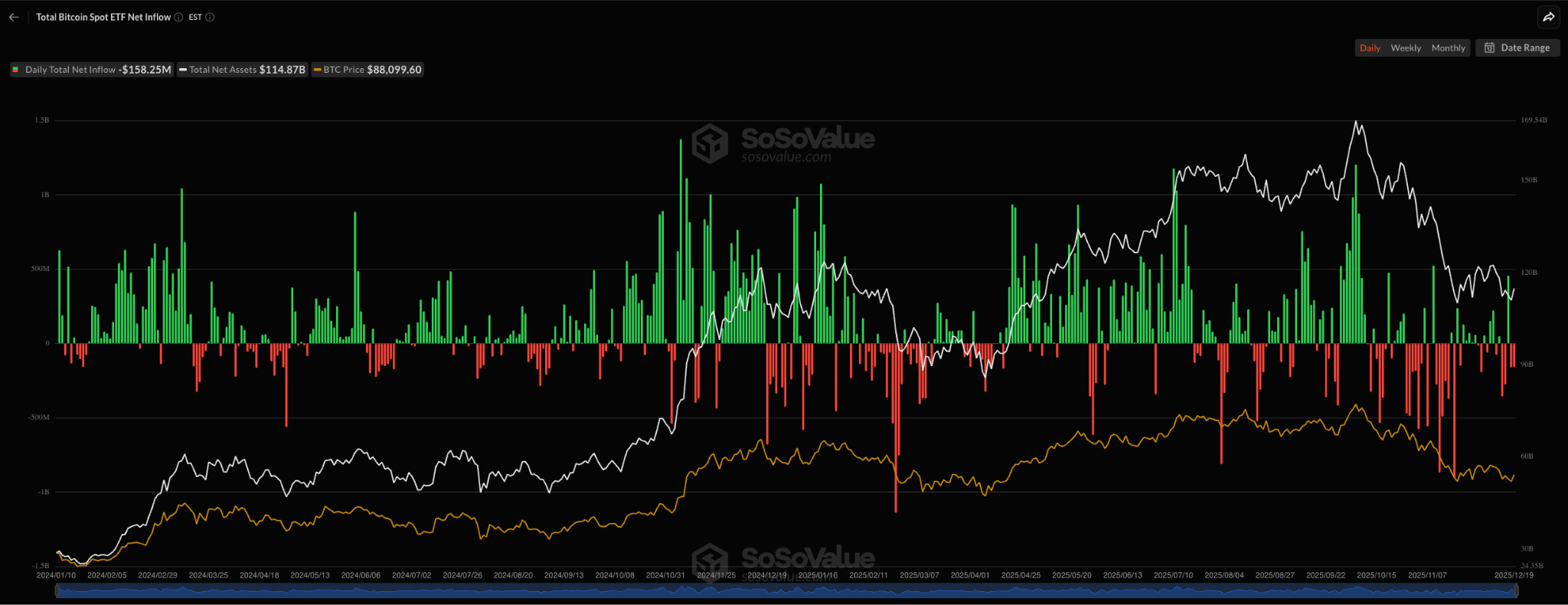
The global bid on Bitcoin, Ether and Solana’s SOL (SOL) token was near immeasurable, with total net flows into the spot Bitcoin ETFs reaching $57 billion and the total net assets across the ETFs reaching $114.8 billion.

Spot Bitcoin ETF netflows in 2025. Source: SoSoValue.com

Going into 2026, the real question is, will the pace of institutional, corporate and government-level adoption, which were critical price drivers in 2025, continue? Since October, the robust inflows to the spot Bitcoin ETF tapered off and, in some cases, turned into a sellers' market for weeks on end, and this was followed by a 30% correction in BTC and 50% in Ether.

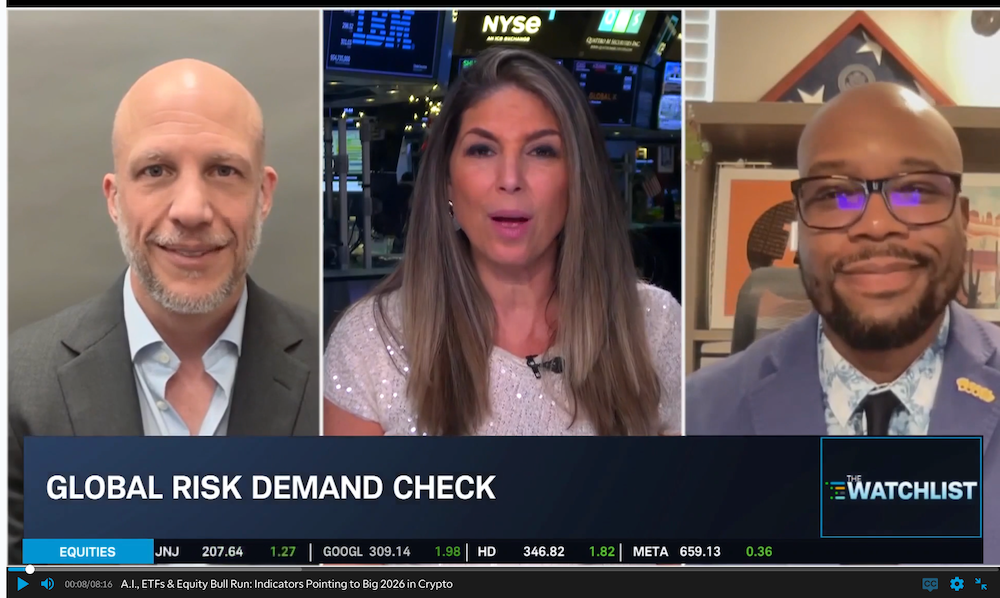
In an interview with Schwab Network’s Nicole Petallides, Cointelegraph Head of Markets Ray Salmond said that the crypto market’s performance in early 2026 will depend on a range of factors.

Given how the narratives surrounding AI, Fed rate cuts, a strategic Bitcoin reserve and ETF flows drove the market, I’m curious to see if the same narratives catalyze price upside in 2026 or will a new narrative need to emerge to bring buyers back into the markets?”

Beyond the ETF flows and demand across spot markets like Binance and Coinbase, investor sentiment regarding the immense size of the AI industry buildout and the performance of the tech-heavy S&P 500 is likely to have a direct impact on crypto markets.

The AI buildout, company valuations, fundraising, IPO performance, and whether datacenter hyperscalers continue to propel the equities markets alongside MAG7 will remain at the forefront of everyone’s mind.

In the interview, Salmond explained that rapid balance sheet expansion was a strategy that supercharged tech-related equities in 2025 as hyperscalers spent double-digit billions on data centers, compute, Nvidia GPUs and energy. At some point in 2026, the expectation will be that these companies demonstrate that they can monetize their investments, or at least finance the expansions from their internal cash flow.

In the latter half of 2025, Oracle, Meta and Nvidia saw their stock prices fall as the market questioned whether there was a chance that some of these companies’ free cash flow could go negative. If investors smell smoke related to debt-heavy, cash-poor AI and quantum computing companies in 2026, there’s likely to be some negative reaction. How these shockwaves carry over to the SPX, DOW, and, by proxy, crypto is something investors will need to keep on the watch list.

Will passing the Clarity Act supercharge altcoins, DeFi and large caps?

A bullish event worth watching in the early part of 2026 will be whether or not the Clarity Act becomes law. The crypto lobby aimed to have this act passed into law before the end of the year, but the lengthy government shutdown delayed progress on hammering it out.

If passed, the Clarity Act will provide clearer rules and the necessary environment for FinTech innovators to sandbox in the US, and the hope is that more offshored crypto businesses will headquarter back in the United States.

It will define which regulatory bodies (SEC and CFTC) have jurisdiction over various crypto assets, depending on whether they are classified as securities or commodities. There’s also a strong emphasis on consumer protections, and a better framework in this area could provide the necessary transparency that businesses and consumers need to confidently invest in crypto assets.

Will a Trump-aligned Fed chair and easy money policy turbocharge markets?

The Federal Reserve’s policy shift is expected to further morph into an easy money regime, and President Trump’s early 2026 Fed chair selection is anticipated to bring up to 100 basis points in rate cuts.

According to Salmond,

“Crypto investors view Fed rate cuts as bullish for risk assets, but we’ve got a Tale of Two Cities scenario where the data collides with the most bullish perspectives.”
AI, ETFs and Equities Bull Run in 2026. Source: Schwab Network

Salmond explained that” the job market is softening and this cooling trend is predicted to carry on in 2026. The 'transitory' impact of the Trump tariffs has resulted in elevated goods and services costs, health insurance premiums will rise, and retail investor confidence may drop as layoffs are announced, consumer debt rises, and disposable income falls.”

At the same time, “investors expect Fed rate cuts to result in lower mortgage rates, compel banks to loosen the purse strings for lending, and lure consumers to go buy more stuff. But, the potential return of easy money policy and big government spending essentially confirms that the US is kicking the debt bomb further down the road.”

Related: JPMorgan explores crypto trading for institutional clients: Report

In Q1 2026, the dilemma investors will have to contend with is whether there are signals that prove that the Fed's easy money trade is being front-run and possibly sold on confirmation, or will the evolving Fed policy also reinvigorate the bull market seen across equities in 2025 and extend to crypto?

Investors who prioritize optionality and a nimble footprint should be able to avoid some of the pitfalls of a narrative and speculation-driven market, where the MAG7 and AI markets could prove to be overvalued.

On paper, the big picture view for 2026 is bullish, especially when considering the Trump economic mandate, Fed policy, and crypto-friendly regulation, but it’s the unknown outcomes of the AI buildout and the actual impact of rate cuts on the consumer and economy that are going to determine the direction markets take in Q1 and Q2.

This article does not contain investment advice or recommendations. Every investment and trading move involves risk, and readers should conduct their own research when making a decision. While we strive to provide accurate and timely information, Cointelegraph does not guarantee the accuracy, completeness, or reliability of any information in this article. This article may contain forward-looking statements that are subject to risks and uncertainties. Cointelegraph will not be liable for any loss or damage arising from your reliance on this information.


Похожее

Retail Ecology Dwindles, ZKsync Bets on Bank Pilots for a Breakthrough

Amidst declining retail activity, ZKsync is pivoting to target institutional banking as its primary growth strategy. The article explores this shift, contrasting it with the competitive "survival of the fittest" narrative by highlighting a cooperative model inspired by naturalist Peter Kropotkin. ZKsync is developing infrastructure like its private, permissioned Prividium suite for banks (e.g., Deutsche Bank's use case via Memento), enabling private transactions with public verifiability via zero-knowledge proofs. This appeals to institutions needing privacy, compliance, and Ethereum-based settlement security, unlike fully private chains (e.g., JPMorgan's Kinaxis) or consortium models (e.g., R3 Corda). However, this strategic focus has coincided with a steep decline in its public DeFi ecosystem, evidenced by plunging TVL and the departure of major protocols like Aave due to low fees. The network's future now hinges on banking adoption, with upcoming pilots like the Cari Network involving regional banks holding over $600 billion in deposits. A significant challenge is balancing this institutional focus with ZKsync's decentralized governance. Banks must operate on a network where rules and fees (denominated in the volatile ZK token) can be changed via community vote, and where a Security Council holds emergency control—a stark contrast to the predictable, contract-bound environments of traditional finance. The coming 18 months will test whether ZKsync can successfully onboard traditional banks onto a dynamically governed public chain or if institutions will ultimately revert to proprietary solutions.

Foresight News37 мин. назад

Retail Ecology Dwindles, ZKsync Bets on Bank Pilots for a Breakthrough

Foresight News37 мин. назад

The Recursive AI Anthropic Warned About: Tian Yuandong's New Company Has Just Taken the "First Step"

Anthropic recently highlighted the rapid progress toward "recursive self-improvement," where AI systems autonomously design and train their successors. In response, Recursive Superintelligence, a new company co-founded by former Meta researcher Tian Yuan Dong, has publicly demonstrated its first step toward automating AI research. The company released a system designed to autonomously execute the full AI research cycle: generating ideas, implementing code, running experiments, and learning from results. It validated this approach by achieving state-of-the-art results on three diverse benchmarks: 1. **NanoChat Autoresearch:** Optimizing a small language model's validation loss under a fixed 5-minute GPU budget, improving upon the community's best result. 2. **NanoGPT Speedrun:** Reducing the time to train a GPT model to a specific loss on 8 H100 GPUs from 79.7 seconds to 77.5 seconds, beating a highly optimized, human-driven community effort. 3. **SOL-ExecBench:** Improving the overall score on NVIDIA's suite of 235 GPU kernel optimization tasks by 18%, closing the gap to the hardware limit. The system discovered novel optimizations in this highly specialized domain without direct human expertise. Recursive's system operates as a general framework, capable of parallel exploration and cross-task knowledge transfer while incorporating safeguards against reward hacking. The company, backed by $650M in funding and a star-studded team including Richard Socher and Alexey Dosovitskiy, aims to create AI that recursively enhances its own research capabilities. This development represents an early but concrete move toward a new paradigm where AI accelerates its own advancement. It occurs alongside Anthropic's warnings about the need for industry coordination and potential pauses when recursive self-improvement thresholds are reached, highlighting the dual trajectory of rapid technical progress and growing calls for careful stewardship.

marsbit44 мин. назад

The Recursive AI Anthropic Warned About: Tian Yuandong's New Company Has Just Taken the "First Step"

marsbit44 мин. назад

The Gold Buy-on-the-Dip Guide: Watch Interest Rates, Not Just War

"Gold Buying Guide: Focus on Interest Rates, Not Just War" Four months ago, gold buyers likely didn't anticipate buying at a peak that even a war couldn't sustain. After hitting a record high of $5,596 on January 29, gold entered a bear market just 91 days later, its fastest decline since 2008. A key trigger was the Fed's hawkish shift, highlighting that monetary policy, not geopolitics, is the primary driver. The article argues that the traditional "buy gold in turmoil" script has changed. While the US-Iran conflict initially boosted prices, the sustained rally in oil prices heightened inflation fears, forcing central banks to maintain or consider tighter policy. Since gold yields no interest, higher rates increase its opportunity cost, eroding its appeal. This dynamic was evident when gold fell sharply on May 18 despite positive peace talks, as lower oil prices eased inflation and thus rate hike pressures. The recent sell-off is also part of a broader market deleveraging. Correlations between gold, Nasdaq, and Bitcoin spiked as leveraged investors sold liquid assets to cover losses, creating a synchronized downturn. Historically, gold bottoms align with policy shifts, not conflict resolutions. The 2008 and 2022 bear markets ended with shifts to extreme easing and peak inflation expectations, respectively. For potential buyers, the author suggests monitoring three signals: 1) Peak interest rate hike expectations, 2) Reopening of the Strait of Hormuz (to ease oil/inflation pressure), and 3) A return to net inflows for Gold ETFs, indicating the end of forced selling. While predicting the exact bottom is impossible, the author's personal strategy involves scaling into a position across price levels like $4000, $3700, and $3500, committing no more than 30% of the intended total allocation initially, and adding the remainder only if key signals emerge. The core conclusion: In turbulent times, watching interest rates is more crucial than watching wars.

marsbit50 мин. назад

The Gold Buy-on-the-Dip Guide: Watch Interest Rates, Not Just War

marsbit50 мин. назад

Recent On-Chain Review: No Clear Narrative Under U.S. Stock Market Pressure, Just Hype

This article analyzes the current state of the Solana meme coin and community token ecosystem, highlighting a market caught between two dominant forces: attention-based PvP and a gradual return to community-centric projects. The first part explores the "Attention PvP" dynamic, where success is driven by celebrity endorsements, viral events, and speed. Examples include $JOTCHUA, which surged after its meme creator's social media activity, and $WORLDCUP, which outperformed a similar Base chain project ($PITCH) largely due to influencer support. The recent "pump.fun GO" feature, allowing bounty tasks for token promotion, is critiqued for fostering sensationalist and often negative stunts—like people getting token tickers tattooed on their bodies for rewards—reminiscent of old internet shock content. In contrast, the article points to a resurgence of organic, community-driven tokens that survive market volatility through strong holder bases and shared ideology, not just hype. Influencer Ansem is cited, arguing that durable meme coins rely on communities willing to endure losses and promote their core message daily. Examples given are older tokens like $neet (anti-work ethos), $troll, $buttcoin, and $triplet, which have maintained relative price stability. A prime example of this community-build model is the new project $KINS, the token for the browser-based MMORPG Kintara. Its success stems not from advanced graphics but from consistently delivering updates, fostering player trust, and creating genuine engagement (e.g., in-game economies, events, property auctions). It has attracted a growing player base and even notable KOLs as participants, demonstrating that sustainable growth can come from building trust rather than orchestrating pumps. The article concludes by questioning whether the market is ultimately a game of mutual trust or mutual deception, expressing hope that such reflection might lead to a healthier ecosystem.

marsbit50 мин. назад

Recent On-Chain Review: No Clear Narrative Under U.S. Stock Market Pressure, Just Hype

marsbit50 мин. назад

Торговля

Спот
Фьючерсы

Популярные статьи

Как купить S

Добро пожаловать на HTX.com! Мы сделали приобретение Sonic (S) простым и удобным. Следуйте нашему пошаговому руководству и отправляйтесь в свое крипто-путешествие.Шаг 1: Создайте аккаунт на HTXИспользуйте свой адрес электронной почты или номер телефона, чтобы зарегистрироваться и бесплатно создать аккаунт на HTX. Пройдите удобную регистрацию и откройте для себя весь функционал.Создать аккаунтШаг 2: Перейдите в Купить криптовалюту и выберите свой способ оплатыКредитная/Дебетовая Карта: Используйте свою карту Visa или Mastercard для мгновенной покупки Sonic (S).Баланс: Используйте средства с баланса вашего аккаунта HTX для простой торговли.Третьи Лица: Мы добавили популярные способы оплаты, такие как Google Pay и Apple Pay, для повышения удобства.P2P: Торгуйте напрямую с другими пользователями на HTX.Внебиржевая Торговля (OTC): Мы предлагаем индивидуальные услуги и конкурентоспособные обменные курсы для трейдеров.Шаг 3: Хранение Sonic (S)После приобретения вами Sonic (S) храните их в своем аккаунте на HTX. В качестве альтернативы вы можете отправить их куда-либо с помощью перевода в блокчейне или использовать для торговли с другими криптовалютами.Шаг 4: Торговля Sonic (S)С легкостью торгуйте Sonic (S) на спотовом рынке HTX. Просто зайдите в свой аккаунт, выберите торговую пару, совершайте сделки и следите за ними в режиме реального времени. Мы предлагаем удобный интерфейс как для начинающих, так и для опытных трейдеров.

1.4k просмотров всегоОпубликовано 2025.01.15Обновлено 2026.06.02

Как купить S

Sonic: Обновления под руководством Андре Кронье – новая звезда Layer-1 на фоне спада рынка

Он решает проблемы масштабируемости, совместимости между блокчейнами и стимулов для разработчиков с помощью технологических инноваций.

2.3k просмотров всегоОпубликовано 2025.04.09Обновлено 2025.04.09

Sonic: Обновления под руководством Андре Кронье – новая звезда Layer-1 на фоне спада рынка

HTX Learn: Пройдите обучение по "Sonic" и разделите 1000 USDT

HTX Learn — ваш проводник в мир перспективных проектов, и мы запускаем специальное мероприятие "Учитесь и Зарабатывайте", посвящённое этим проектам. Наше новое направление .

1.8k просмотров всегоОпубликовано 2025.04.10Обновлено 2025.04.10

HTX Learn: Пройдите обучение по "Sonic" и разделите 1000 USDT

Обсуждения

Добро пожаловать в Сообщество HTX. Здесь вы сможете быть в курсе последних новостей о развитии платформы и получить доступ к профессиональной аналитической информации о рынке. Мнения пользователей о цене на S (S) представлены ниже.

活动图片