US Treasury Debt Balloons On Ripple’s XRPL, You Should See The Figures

bitcoinistОпубликовано 2026-01-27Обновлено 2026-01-27

Введение

US Treasury debt tokenized on Ripple's XRP Ledger (XRPL) has surged to over $150.19 million, reflecting rapid institutional adoption. This growth is part of XRPL surpassing $1 billion in total tokenized assets, which also include stablecoins, private credit, commodities, and equity. While XRPL holds 1.4% of the total $10 billion in on-chain tokenized Treasuries, it has seen a 2,900% increase from 2025. Tokenization enables faster settlement, transparency, and reduced reliance on intermediaries, signaling a major shift in how traditional financial assets are managed and traded using blockchain technology.

Blockchain technology is beginning to absorb traditional government assets at an alarming pace, with Ripple’s XRP Ledger (XRPL) now hosting US Treasury debt in digital form. The latest reports have revealed a massive increase in tokenized treasuries on the ledger, reflecting not just rising governmental interest in the blockchain but also growing institutional adoption.

US Treasury Debt Skyrockets On Ripple’s XRPL

Over the past year, tokenized US Treasury debt on the XRP Ledger has skyrocketed to more than $150.19 million. Data from the tokenized asset analytics platform RWA.xyz shows that digital platforms such as OpenEden Digital, Zeconomy, Ondo, and Archax have been the primary drivers behind this latest surge in activity and volume.

XRPL data also shows that US Treasury debt has not been the only asset class to experience growth on the network. Recent reports revealed that the XRP Ledger achieved a significant milestone, surpassing $1 billion in total tokenized assets. While tokenized US treasury debt contributed significantly to this growth, other asset classes, including stablecoins, private credit, commodities, and private equity, have also recorded substantial volume, reflecting the network’s expanding role in global digital finance.

Stablecoins recorded the highest volume of over $338 million within the $1 billion tokenized asset growth, representing approximately 160% more than US Treasury debt. In comparison, private equity accounted for $55.2 million, reflecting less than 33% of tokenized treasuries.
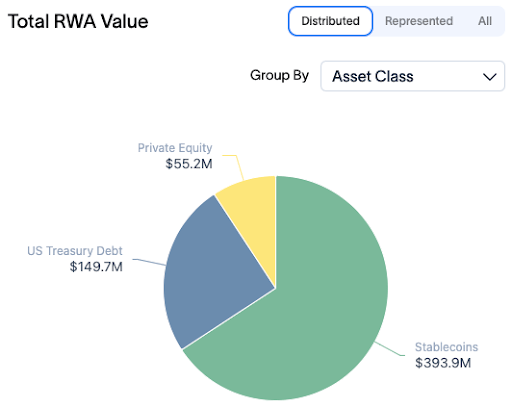
Source: Chart from RWA.xyz

Across all networks, tokenized US Treasury holdings have now reached about $10 billion. While the percentage held by the XRP Ledger is impressive, it still represents just 1.4% of the total. Nonetheless, the growth rate of US Treasury debt on XRPL is striking, showing a more than 2,900% increase from the roughly $5 million on the network in 2025.

The recent surge in tokenized US Treasury debt on the XRP Ledger underscores the expanding integration of traditional finance with blockchain technology. It also reflects the rising demand for Real-World Asset (RWA) tokenization, which has become a fundamental aspect of Ripple and XRPL’s utility and key driver of the network’s growth and expansion into broader markets.

Why This Is A Big Deal

Historically, US Treasury debt was tracked and recorded through conventional banking and government systems. As a result, trading relied heavily on intermediaries, transactions and settlements were slow, and most retail investors had limited access. At the same time, Paper records and centralized systems dominated the market, making processes less transparent and tedious.

However, the introduction of blockchain technology has significantly improved how debt is represented and managed. On the XRP Ledger, Treasury debt can now be tokenized, allowing near-instant settlement and real-time verification on a public network. This reduces the reliance on intermediaries and introduces a new level of transparency and security compared to traditional methods.

The rise of tokenized Treasury debt also signals changes in investor behavior and broader market dynamics. It shows that blockchain-based assets can now compete with traditional markets, offering faster, more efficient, and accessible alternatives for institutions and governments.

XRP trading at $1.88 on the 1D chart | Source: XRPUSDT on Tradingview.com

Связанные с этим вопросы

QWhat is the total value of tokenized US Treasury debt currently hosted on Ripple's XRP Ledger (XRPL)?

AThe total value of tokenized US Treasury debt on Ripple's XRP Ledger has skyrocketed to more than $150.19 million.

QWhich digital platforms are named as the primary drivers behind the surge in tokenized treasuries on XRPL?

AThe primary drivers are digital platforms such as OpenEden Digital, Zeconomy, Ondo, and Archax.

QWhat milestone did the XRP Ledger recently achieve in terms of total tokenized assets?

AThe XRP Ledger recently surpassed $1 billion in total tokenized assets.

QHow does the tokenized US Treasury debt on XRPL compare to the total across all networks?

AThe tokenized US Treasury debt on XRPL represents about 1.4% of the total $10 billion held across all networks.

QWhat are some key benefits of tokenizing Treasury debt on a blockchain like XRPL compared to traditional methods?

ATokenizing Treasury debt on the XRPL allows for near-instant settlement, real-time verification on a public network, reduces reliance on intermediaries, and introduces a new level of transparency and security.

Похожее

Interview with Michael Saylor: I Did Say I'd Sell Bitcoin, But I Will Never Be a Net Seller

**Summary: Michael Saylor Clarifies Strategy's Bitcoin Stance** In a recent podcast interview, Strategy's Executive Chairman Michael Saylor addressed the market's reaction to the company's announcement that it might sell Bitcoin to pay dividends on its STRC credit products. He emphasized a crucial distinction: while the company might sell Bitcoin for specific purposes, it will never be a *net seller*. Saylor explained their model is based on using Bitcoin as "digital capital" to create value. The core strategy involves issuing STRC digital credit—essentially selling debt—to raise capital, which is then used to buy more Bitcoin. He estimates Bitcoin appreciates at roughly 40% annually. A small portion of these capital gains (e.g., ~2.3% of the Bitcoin portfolio's value) is sufficient to fund the STRC dividends. Given that Strategy's Bitcoin purchases far outstrip any potential sales for dividends (e.g., buying $3.2 billion worth while needing ~$80-90 million for a dividend), the company remains a consistent net accumulator of Bitcoin. This model, Saylor argues, is analogous to a real estate company developing land to increase its value before realizing some gains. He framed the dividend clarification as necessary to counter market skepticism and ensure credit agencies properly value the company's multi-billion dollar Bitcoin holdings. Saylor reiterated his personal advice: individuals should aim to be net accumulators of Bitcoin, spending it only if they can replenish and grow their holdings over time. Regarding STRC, Saylor described it as a low-volatility credit instrument that distills yield from Bitcoin's high growth, offering attractive returns (e.g., ~11-12% yield) for risk-averse investors. He noted that Strategy's STRC issuance now constitutes about 60% of the U.S. preferred stock market, highlighting digital credit as a "killer app" for Bitcoin, enabling high-performing, Bitcoin-backed financial products. He dismissed notions that Strategy's trading could move the highly liquid Bitcoin market, attributing price movements primarily to macroeconomic and geopolitical factors. Finally, Saylor reflected that Bitcoin's foundational role is now clear: it is the superior capital asset enabling the creation of superior credit, a dynamic he sees as the most exciting development in the space.

marsbit7 мин. назад

Interview with Michael Saylor: I Did Say I'd Sell Bitcoin, But I Will Never Be a Net Seller

marsbit7 мин. назад

380,000 Apps Exposed, 2,000+ Apps Leaked Secrets: AI Programming Turns 'Intranet' into Public Internet

Israeli cybersecurity firm RedAccess uncovered a severe data exposure trend linked to "vibe coding" or AI-powered software development tools. Their research found approximately 38,000 publicly accessible web applications built with platforms like Lovable, Base44, Netlify, and Replit. Of these, an estimated 2,000 apps exposed sensitive corporate and personal data, including medical records, financial information, internal strategic documents, and customer chat logs. In some cases, access even granted administrative privileges. The core issue stems from default privacy settings that make applications public by default, combined with a lack of built-in security controls (like authentication) in the AI-generated code. This allows employees without security expertise—"citizen developers"—to easily create and deploy applications that bypass standard corporate security reviews. The exposed apps, often indexed by search engines, are trivially discoverable. While some platform providers (Replit, Lovable, Wix/Base44) argue that security configuration is the user's responsibility and question the validity of some findings, security researchers confirm the widespread reality of such exposures. This pattern, also noted in prior studies, highlights a critical security gap as AI democratizes app creation, potentially leading to massive, unintentional data leaks.

marsbit1 ч. назад

380,000 Apps Exposed, 2,000+ Apps Leaked Secrets: AI Programming Turns 'Intranet' into Public Internet

marsbit1 ч. назад

Attracting Global Capital, Asia's New 'Super Cycle' Is Unfolding

Investors are turning to Asia as the next frontier for global equity growth, with a new "super cycle" unfolding across the region. Driven by the AI revolution, Asian markets, particularly South Korea, have seen significant rallies. According to Morgan Stanley analysis, the underlying drivers of Asia's industrial cycle are shifting from traditional sectors like real estate and manufacturing to massive investments in AI infrastructure, energy security and transition, and supply chain resilience. Fixed asset investment in Asia is projected to grow from around $11 trillion in 2025 to $16 trillion by 2030, with a 7% annual growth rate from 2026-2030. The AI wave is a primary catalyst, driving immense capital expenditure for chips, servers, data centers, and power systems. Asia is central to this hardware supply chain. In China, AI investment is focused on building a full-system domestic capability, with the local AI chip market potentially reaching $86 billion by 2030. Beyond AI, China's export story is expanding from EVs and batteries to robotics. The country already captures about half of new global industrial robot demand and over 90% of humanoid robot shipments. This growth phase mirrors the early stages of China's EV export boom. Simultaneously, energy security investments, spurred by AI's massive power needs, are rising, with China benefiting from its leadership in solar, batteries, and EVs. Regional defense spending is also increasing structurally, supporting demand for advanced manufacturing. The main beneficiaries are China, South Korea, and Japan, positioned in core supply chain areas. However, risks remain, including potential overcapacity, profit margin pressures from competition, persistent technological restrictions, geopolitical friction, and workforce displacement due to AI-driven automation. Market volatility is also expected to increase as investor expectations diverge on the realization of these capital investment and export themes.

marsbit1 ч. назад

Attracting Global Capital, Asia's New 'Super Cycle' Is Unfolding

marsbit1 ч. назад

Торговля

Спот
Фьючерсы

Популярные статьи

Как купить S

Добро пожаловать на HTX.com! Мы сделали приобретение Sonic (S) простым и удобным. Следуйте нашему пошаговому руководству и отправляйтесь в свое крипто-путешествие.Шаг 1: Создайте аккаунт на HTXИспользуйте свой адрес электронной почты или номер телефона, чтобы зарегистрироваться и бесплатно создать аккаунт на HTX. Пройдите удобную регистрацию и откройте для себя весь функционал.Создать аккаунтШаг 2: Перейдите в Купить криптовалюту и выберите свой способ оплатыКредитная/Дебетовая Карта: Используйте свою карту Visa или Mastercard для мгновенной покупки Sonic (S).Баланс: Используйте средства с баланса вашего аккаунта HTX для простой торговли.Третьи Лица: Мы добавили популярные способы оплаты, такие как Google Pay и Apple Pay, для повышения удобства.P2P: Торгуйте напрямую с другими пользователями на HTX.Внебиржевая Торговля (OTC): Мы предлагаем индивидуальные услуги и конкурентоспособные обменные курсы для трейдеров.Шаг 3: Хранение Sonic (S)После приобретения вами Sonic (S) храните их в своем аккаунте на HTX. В качестве альтернативы вы можете отправить их куда-либо с помощью перевода в блокчейне или использовать для торговли с другими криптовалютами.Шаг 4: Торговля Sonic (S)С легкостью торгуйте Sonic (S) на спотовом рынке HTX. Просто зайдите в свой аккаунт, выберите торговую пару, совершайте сделки и следите за ними в режиме реального времени. Мы предлагаем удобный интерфейс как для начинающих, так и для опытных трейдеров.

1.3k просмотров всегоОпубликовано 2025.01.15Обновлено 2025.03.21

Как купить S

Sonic: Обновления под руководством Андре Кронье – новая звезда Layer-1 на фоне спада рынка

Он решает проблемы масштабируемости, совместимости между блокчейнами и стимулов для разработчиков с помощью технологических инноваций.

2.2k просмотров всегоОпубликовано 2025.04.09Обновлено 2025.04.09

Sonic: Обновления под руководством Андре Кронье – новая звезда Layer-1 на фоне спада рынка

HTX Learn: Пройдите обучение по "Sonic" и разделите 1000 USDT

HTX Learn — ваш проводник в мир перспективных проектов, и мы запускаем специальное мероприятие "Учитесь и Зарабатывайте", посвящённое этим проектам. Наше новое направление .

1.8k просмотров всегоОпубликовано 2025.04.10Обновлено 2025.04.10

HTX Learn: Пройдите обучение по "Sonic" и разделите 1000 USDT

Обсуждения

Добро пожаловать в Сообщество HTX. Здесь вы сможете быть в курсе последних новостей о развитии платформы и получить доступ к профессиональной аналитической информации о рынке. Мнения пользователей о цене на S (S) представлены ниже.

活动图片