Three Scenarios for BTC's Future Direction and a Duel Between Two Strong Forces | Special Invited Analysis

Odaily星球日报Опубликовано 2026-05-12Обновлено 2026-05-12

Введение

**Title: Three Scenarios for BTC's Future Trajectory and a Key Duel | Invited Analysis** The market remains at a critical juncture. Over the past week, Bitcoin (BTC) consolidated broadly between $79,500 and $80,600, validating previous technical analysis. The current focus is on whether this marks the start of a new uptrend or a pause within a larger correction. **BTC Multi-Cycle Analysis & Three Possible Scenarios** BTC's daily chart structure, following its peak at $126,200 in October 2025, presents three primary technical scenarios based on Elliott Wave theory: 1. **Bullish Scenario (End of Correction):** The corrective A-B-C wave from $126,200 ended at the $60,000 low in February 2026. The current price action is the start of a major Wave I uptrend. A subsequent Wave II pullback would not break below $60,000. 2. **Bearish Scenario 1 (Complex Correction):** The correction is unfolding as an A-B-C-D-E pattern. The current move from $60,000 is a D-wave rally. After its completion, a final E-wave decline could potentially breach the $60,000 level. 3. **Bearish Scenario 2 (Larger Correction):** The entire move down from $126,200 to $60,000 was a large A-wave. The current rally is a B-wave correction within a larger A-B-C structure, to be followed by a C-wave decline below $60,000. *Analysis suggests Scenario 2 is less probable due to time disproportions between waves. The battle is effectively between the Bullish Scenario (1) and Bearish Scenario (3).* **Key BTC Levels &...

The market never lies; it simply remains silent.

When prices linger in critical zones, both bulls and bears are waiting for an answer.

Over the past week, Bitcoin completed the wide-range oscillation we previously predicted within the core zone of $79,500 to $80,600. The market's price action has validated the effectiveness of our technical logic. However, validation is merely the starting point; the real game begins this week.

BTC's daily chart correction structure stands at a crossroads with three diverging paths: Is it the starting point of a new rising wave, or a midpoint in a larger-scale correction? Wave analysis can provide a framework, but the market ultimately votes with its price. Regarding HYPE, its seven-wave structure is clearly discernible. Whether it can break through the key level around $45.76 will become the variable most worth watching closely this week.

In this week's article, we will continue to approach from a multi-timeframe perspective, analyzing the structure, judging the direction, and formulating plans. Strategy is ready; discipline is self-held.

Summary of Core Trading Views for This Week:

• Analysis of BTC's Multi-Timeframe Price Structure (Detailed in Part One)
• BTC Market Forecast and Mid-/Short-Term Trading Strategies for This Week. (Detailed in Part Two)
• Analysis of HYPE's Daily Chart Price Structure. (Detailed in Part Three)
• HYPE Market Forecast and Short-Term Trading Strategies for This Week. (Detailed in Part Four)

Market Validation of Last Week's Trading Strategy and Core Views:

• Validation of BTC Market Forecast: In last week's article, we pointed out that we should focus on observing the battle between bulls and bears over the core zone of $79,500 to $80,600 and judged that the market was likely to experience wide-range oscillation there. Current market movements have largely validated our previous view.

One: Analysis of Bitcoin's Multi-Timeframe Price Structure

1. Analysis of BTC's Daily Chart Price Structure: (Three Scenarios for BTC's Subsequent Wave Structure)

Bitcoin _ Daily Candlestick Chart:

Chart One

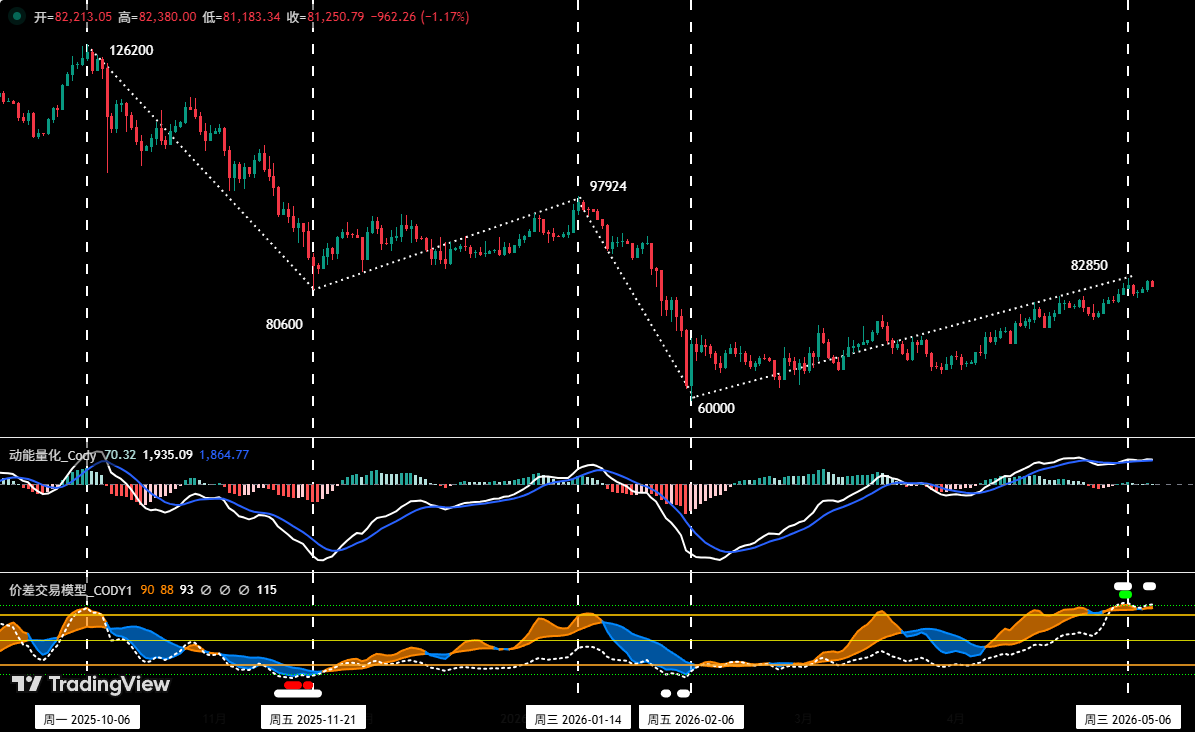
As shown in (Chart One), since reaching the high of $126,200 in October 2025, Bitcoin has entered an adjustment cycle lasting about 7 months (216 days). There is significant divergence in the market regarding the subsequent direction. The bearish view argues that the downtrend is not over yet; after the recent rebound concludes, the price will still correct and break below the $60,000 low. The bullish view believes that the adjustment starting from $126,200 ended at $60,000, marking a reversal of the correction trend. The rebound since February is the start of a new upward trend. Next, we will analyze this daily chart correction structure based on Elliott Wave Theory rules and propose three technical scenarios for the subsequent movement for your reference.

1. Scenario One: Adjustment Concluded, New Rising Wave Initiated (Bullish View)

This view holds: The daily-level adjustment starting from the previous high of $126,200 is an A-B-C three-wave structure, with Wave C ending at $60,000. Currently, Major Wave I (the initial rising wave) is underway.

Wave A (Decline): $126,200 (2025-10-06) to $80,600 (2025-11-21), lasting 46 days, maximum decline ~36%.
Wave B (Rebound): $80,600 (2025-11-21) to $97,924 (2026-01-14), lasting 54 days, maximum increase ~21.5%.
Wave C (Decline): $97,924 (2026-01-14) to $60,000 (2026-02-06), lasting 23 days, maximum decline ~38.7%.
• Major Wave I (Initial Rising Wave): $60,000 (2026-02-06) to present, has run for 94 days, maximum increase ~38.1% so far, still ongoing.
• Potential Major Wave II (Correction Wave): The adjustment wave to run after Major Wave I ends. Its low point will not break below $60,000.

2. Scenario Two: Complex Five-Wave Adjustment Structure, Currently in Wave D Rebound (Bearish View One)

This view holds: The daily-level adjustment starting from the previous high of $126,200 may complete as an A-B-C-D-E five-wave structure. Currently, Wave D rebound is underway.

Wave A (Decline): $126,200 (2025-10-06) to $80,600 (2025-11-21), lasting 46 days, maximum decline ~36%.
Wave B (Rebound): $80,600 (2025-11-21) to $97,924 (2026-01-14), lasting 54 days, maximum increase ~21.5%.
Wave C (Decline): $97,924 (2026-01-14) to $60,000 (2026-02-06), lasting 23 days, maximum decline ~38.7%.
• Wave D (Rebound Wave): $60,000 (2026-02-06) to present, has run for 94 days, maximum increase ~38.1% so far, still ongoing.
• Potential Wave E (Decline Wave): The correction wave to run after Wave D rebound ends. Its low point may break below $60,000.

3. Scenario Three: Larger-Level Adjustment Structure (e.g., Weekly), Currently in Wave B Rebound (Bearish View Two)

This view holds: The daily-level adjustment starting from the previous high of $126,200 may be part of a larger-level A-B-C three-wave adjustment structure. Currently, Wave B rebound is underway.

Wave A (Decline): $126,200 (2025-10-06) to $60,000 (2026-02-06), lasting 112 days, maximum decline ~52.5%.
• Wave B (Rebound Wave): $60,000 (2026-02-06) to present, lasting 94 days, maximum increase ~38.1% so far, still ongoing.
• Potential Wave C (Decline Wave): The correction wave to run after Wave B rebound ends. Its low point may break below $60,000.

4. Summary:

• From the perspective of Elliott Wave time rules and pattern harmony, in Scenario Two, Waves B and D are rebound waves of the same degree. However, the current Wave D rebound cycle (94 days) has significantly exceeded the Wave B rebound cycle (54 days). Therefore, due to the excessive extension of Wave D in the time dimension, it disrupts the balance of the wave structure, thereby significantly reducing the probability of this scenario occurring.
• Based on the above analysis, if Scenario Two is excluded, the probability of the market choosing Scenario One (bullish) and Scenario Three (bearish) increases accordingly. As for which of the two has a higher probability, it involves a comprehensive judgment of multiple dimensions, which we will delve into in the next weekly review.

2. In-depth Analysis of BTC's Hourly Chart Structure: (Using the 4-hour chart as the analysis timeframe)

Bitcoin _ 4-hour Candlestick Chart

Chart Two

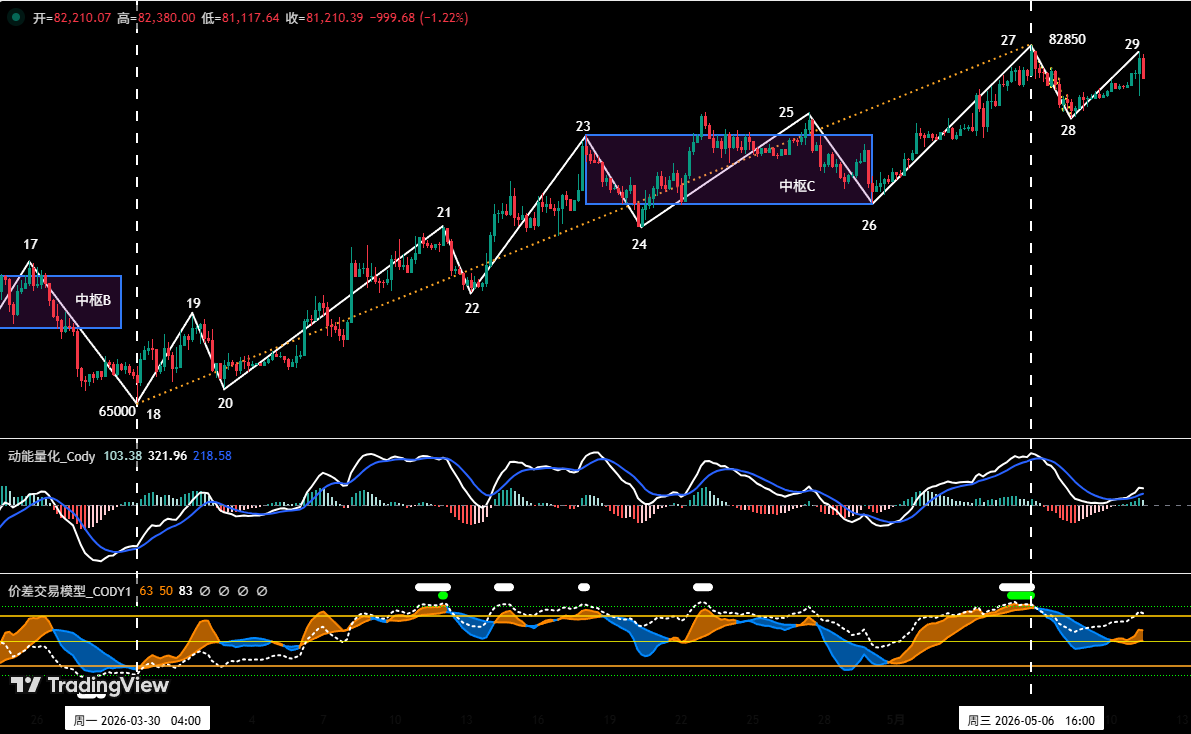
As shown in (Chart Two), the price is currently above central pivot C and is developing segment 28-29.

• If the price effectively holds support above the upper boundary of central pivot C (around $78,500), the high-range wide oscillation pattern will be maintained.
• If the price effectively breaks below the lower boundary of central pivot C (around $75,000), a daily-level correction may initiate.

Two: Bitcoin's Market Forecast and Trading Strategies for This Week

1. BTC Market Forecast for This Week:

Core view this week: The key to this week's movement lies in observing the battle between bulls and bears over the upper and lower boundaries of central pivot C. The gain or loss of this area can serve as an important basis for judging whether the price can continue its rebound or turn downward for adjustment.

2. Core Resistance Levels:

• First Resistance Zone: $83,500~$84,500 region (previous area of concentrated bulls/bears transactions)
• Second Resistance Zone: $89,000~$90,500 region (previous consolidation platform)

3. Core Support Levels:

• First Support Level: $78,500~$79,500 region (near the upper boundary of the central pivot)
• Second Support Level: $73,500~$75,000 region (previous important support level)
• Third Support Level: $69,500~$70,500 region (previous important support level)

4. Trading Strategies for This Week (Excluding Impact of Sudden News)

1. Mid-term Strategy:

Bitcoin _ Daily Candlestick Chart: (Position Monitoring Model)

Chart Three

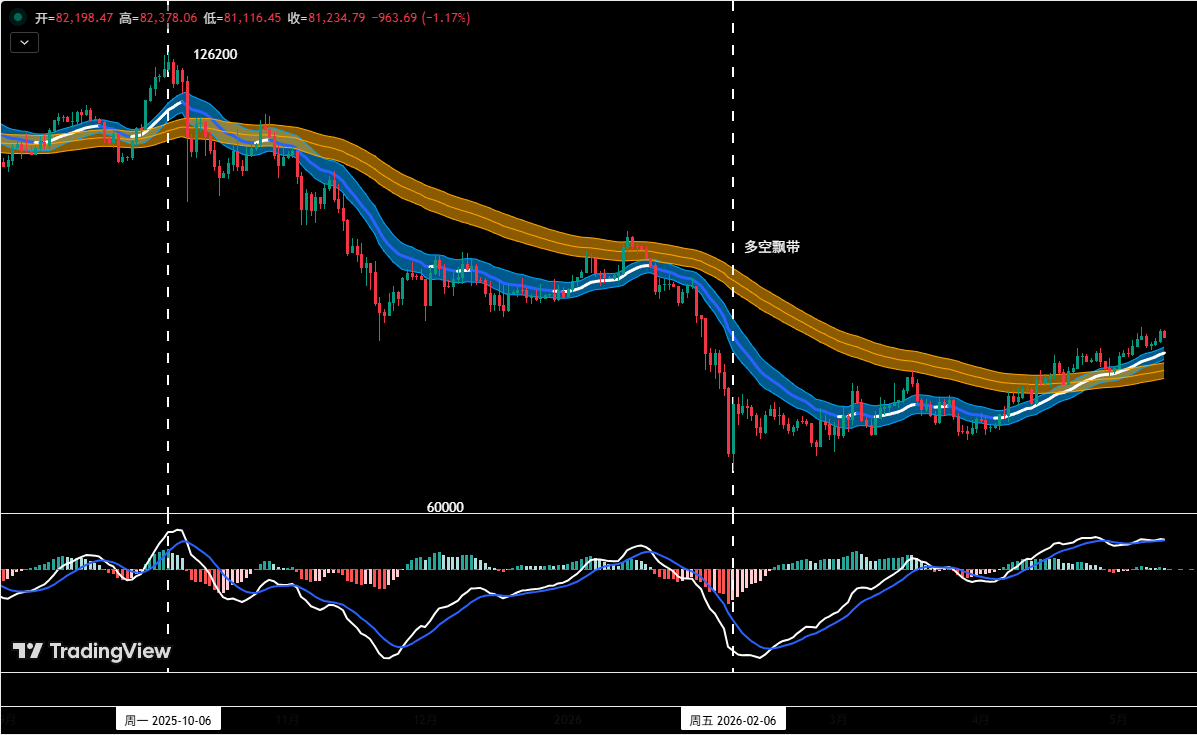
Position Monitoring Model: As shown in (Chart Three), based on trading rules, the market's mid-term direction is not yet clear. This week, the mid-term strategy is to maintain a cash position and wait patiently, avoiding chasing rallies or selling off in panic, until the direction becomes clear before entering positions.

2. Short-term Strategy: Use 30% of capital, set stop-loss points, and look for "price difference" opportunities based on support and resistance levels. (Use 30-minute/60-minute charts as the operation timeframe).

3. In short-term operations, to dynamically respond to the market's complex evolution, we have prepared two specific operation plans in advance, A/B.

Plan A: Effective Holding Above, Go Long on Dips.

• Entry: When the price effectively holds above the $78,500~$79,500 region and combines with bottom signals from the quantitative model, a long position below 20% can be established.
• Risk Control: Initial stop-loss set below $78,500.
• Exit: When rebounding near important resistance levels and combined with model signals, gradually close positions to take profits.

Plan B: Effective Break Below Support, Go Short on Rallies.

• Entry: When the price effectively breaks below the $73,500~$75,000 support region and combines with top signals from the model, a short position below 30% can be established.
• Risk Control: Initial stop-loss set above $76,500.
• Exit: When declining to important support levels and combined with model signals, gradually close positions to take profits.

Three: Analysis of HYPE's Daily Chart Price Structure:

HYPE_ Daily Candlestick Chart

Chart Four

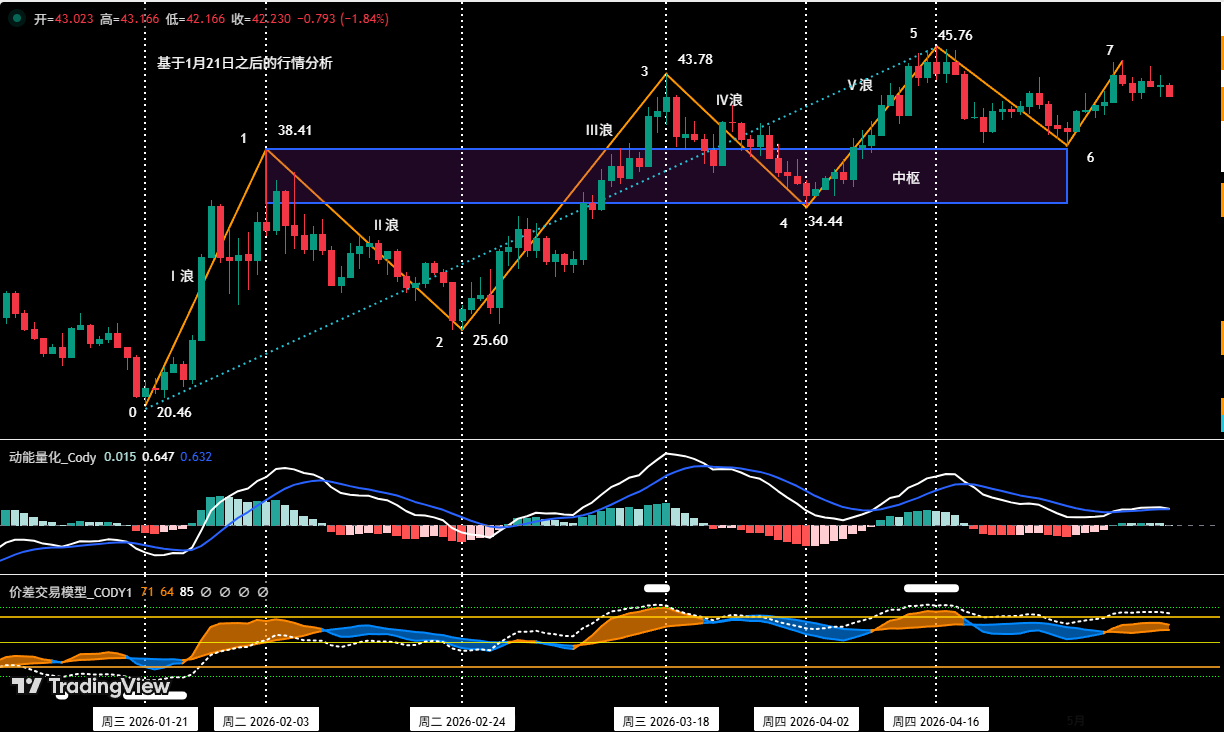
1. As shown in (Chart Four), the uptrend of HYPE starting from the low of $20.46 on January 21 can be divided into a seven-segment structure in the daily chart: 0-1, 1-2, 2-3, 3-4, 4-5, 5-6, 6-7. In the first five segments, prices continuously made new highs, forming a volatile rising structure. In the last two segments, because endpoint 7 ($44.79) is lower than endpoint 5 ($45.76), it is currently viewed as a correction structure.

2. (Chart Four) shows that because the price movements of segments 1-2, 2-3, and 3-4 overlap with each other, they together form an "uptrend central pivot."

Four: HYPE's Market Forecast and Short-Term Trading Strategies for This Week

1. HYPE Market Forecast for This Week:

Core view on HYPE this week:

• Focus on observing whether the price can break through the previous high of $45.76 in subsequent movements. A breakout would indicate the current movement is still within the daily-level uptrend structure.
• Pay attention to the battle between bulls and bears near the upper and lower boundaries of the central pivot.

2. HYPE Short-Term Trading Strategies for This Week:

• This week's short-term operations will be formulated based on the gain or loss of the two key price levels: the upper boundary of the central pivot ($38.41) and the lower boundary of the central pivot ($34.44).
• Long Strategy: If the price retraces to near $38.41, finds support, shows signs of stabilization, and combines with bottom signals triggered by the two major models, consider a light long position. Position size must be controlled below 30%, and stop-loss discipline must be strictly observed.
• Short Strategy: If the price effectively breaks below the support near $34.44 and combines with top signals triggered by the two major models, consider a light short position. Position size must be controlled below 30%, and stop-loss discipline must be strictly observed.

Five: Special Reminders:

1. When opening a position: Immediately set the initial stop-loss level.
2. When profit reaches 1%: Move the stop-loss to the entry cost price (breakeven point) to ensure capital safety.
3. When profit reaches 2%: Move the stop-loss to the level representing a 1% profit.
4. Continuous tracking: Thereafter, for every additional 1% profit in price, move the stop-loss up 1% accordingly, dynamically protecting and locking in profits.

Financial markets change rapidly. All market analysis and trading strategies require dynamic adjustment. All views, analysis models, and operation strategies mentioned in this article originate from personal technical analysis and are solely for personal trading log purposes. They do not constitute any investment advice or basis for operation. Markets involve risks; investing requires caution. Please do not make decisions based solely on this content.

Связанные с этим вопросы

QAccording to the article, what are the three technical wave-based scenarios for BTC's future trend after its correction cycle?

AThe three wave-based scenarios for BTC's future trend are: 1) Adjustment complete, new uptrend initiated (Bullish view - A-B-C correction finished, now in major Wave I up). 2) Complex five-wave correction structure, currently in Wave D rebound (Bearish view one - A-B-C-D-E structure, in Wave D). 3) Larger-degree (e.g., weekly) correction structure, currently in Wave B rebound (Bearish view two - larger A-B-C structure, in Wave B).

QWhy does the article consider the probability of the second scenario (five-wave correction) to be low?

AThe probability of the second scenario (five-wave correction) is considered low because in this scenario, Wave B and Wave D are supposed to be corrective waves of the same degree. However, the current Wave D rebound has lasted 94 days, which significantly exceeds the 54-day duration of the prior Wave B rebound. This excessive extension in the time dimension disrupts the equilibrium of the wave structure, thus greatly reducing its likelihood.

QWhat is the key price zone for judging whether BTC can continue its rebound or start a downward adjustment this week?

AThe key price zone for judging BTC's direction this week is the area defined by the upper and lower rails of 'Central C' on the 4-hour chart. Specifically, observing whether the price effectively holds above the upper rail (around $78,500-$79,500) or breaks below the lower rail (around $75,000) is crucial. Holding above suggests maintaining a wide-range oscillation, while breaking below may initiate a daily-level adjustment.

QWhat is the critical price level for HYPE this week, and what does its breakthrough signify?

AThe critical price level for HYPE this week is the previous high of $45.76. The article states that whether the price can break through this level in subsequent movements is a key focus. A successful breakthrough would indicate that the current price action is still within the daily-level upward structure.

QWhat are the two specific short-term operation plans (A and B) provided for BTC, and what are their respective triggers?

AThe two short-term operation plans for BTC are: Plan A (Effective Holding, Go Long on Dips): Triggered when the price effectively holds above the $78,500-$79,500 area, combined with a bottom signal from the quantitative model. A long position of less than 20% can be established. Plan B (Effective Break of Support, Go Short on Rebound): Triggered when the price effectively breaks below the $73,500-$75,000 support area, combined with a top signal from the model. A short position of less than 30% can be established.

Похожее

Fei-Fei Li's Team Clarifies the Concept of 'World Models', Sora Merely a Renderer

"World Models" has become a widely used yet confusing term in AI. To address this, a team led by Fei-Fei Li and World Labs proposed a functional taxonomy based on the Partially Observable Markov Decision Process framework. This taxonomy categorizes systems called "world models" into three distinct projections: Renderers, Simulators, and Planners. Renderers, like OpenAI's Sora and other video generation models, focus on producing photorealistic visual outputs for human perception. They prioritize visual fidelity over physical accuracy. Simulators, such as NVIDIA Omniverse, aim to compute precise future environmental states for computational tasks like engineering analysis or digital twins. Planners, like Vision-Language-Action models, take in observations and goals to output executable actions for robots or agents. The article clarifies that most current "world models," including Sora, are primarily Renderers. They generate convincing visuals but lack the core ability to simulate state transitions based on actions, a key requirement for a true world model in classic reinforcement learning definitions. This conceptual confusion has practical implications, leading to potential misalignment in technology selection, investment, and public understanding of AI capabilities. Clear categorization is crucial. It helps enterprises avoid costly mistakes (e.g., using a renderer for robot training), allows investors to accurately assess markets, and enables researchers to build comparable benchmarks. While future systems may integrate these functions, recognizing current boundaries is essential for honest assessment and progress.

marsbit51 мин. назад

Fei-Fei Li's Team Clarifies the Concept of 'World Models', Sora Merely a Renderer

marsbit51 мин. назад

Bloomberg Uncovered: How Do China's Wealthy Circumvent the Annual $50,000 Limit to Transfer Assets?

**Summary: How Wealthy Chinese Circumvent $50,000 Annual Foreign Exchange Limits** Despite China's strict capital controls, including an annual $50,000 per person foreign exchange quota, an estimated $150 billion in funds still leaves the country annually via various gray and underground channels. This report outlines the evolution of China's "capital wall" and the methods used to bypass it. **The Evolving Capital Controls:** * **Foundation (1994):** The system of "current account convertibility with strict capital account controls" was established. * **Quota Set (2007):** The $50,000 individual annual forex purchase limit was formalized. * **Crackdown Begins (2015-2017):** Following market volatility, enforcement tightened. Banks were required to scrutinize transactions, and channels like using UnionPay cards for Hong Kong insurance premiums or buying overseas property were blocked. * **Digital & Legal Upgrades (2024-2026):** Enhanced algorithms now flag suspicious patterns (e.g., "smurfing"). The Common Reporting Standard (CRS) provides Chinese tax authorities with data on citizens' offshore accounts. Unlicensed cross-border brokers have been targeted. **Five Primary Methods for Moving Capital:** 1. **Underground Banking / "Hawala" (Duiqiao):** The largest-scale method. No money crosses borders. Clients pay RMB to a domestic account; an overseas associate deposits equivalent foreign currency into the client's offshore account. Risks include high fees, account freezes, and legal penalties. 2. **"Smurfing" or "Ant Moving":** Using multiple individuals' $50,000 quotas to pool funds for one offshore recipient. Increasingly detected by anti-money laundering algorithms. 3. **Trade Invoice Manipulation:** Businesses over-invoice imports or under-invoice exports via offshore shell companies, creating a pretext to transfer excess funds abroad under the guise of trade. 4. **Channel Migration:** After a crackdown on internet brokers, funds flow toward more compliant but costly channels like major banks' cross-border wealth management services or Qualified Domestic Institutional Investor (QDII) quotas. 5. **Structural Arrangements:** High-net-worth individuals use complex, high-cost legal structures involving offshore trusts, insurance, and investment migration programs to transfer asset ownership. **Regulatory Response: Focusing on People, Not Just Money** The current strategy extends oversight from enterprises to **individual residents**. Tools like CRS allow retroactive visibility into offshore assets. Cryptocurrencies, once seen as a potential loophole, are now actively monitored and prosecuted as an illegal channel. The underlying driver remains: with significant wealth concentrated among millions of affluent households seeking diversification amid domestic economic shifts, the incentive to move assets offshore persists despite regulatory barriers.

marsbit1 ч. назад

Bloomberg Uncovered: How Do China's Wealthy Circumvent the Annual $50,000 Limit to Transfer Assets?

marsbit1 ч. назад

Торговля

Спот
Фьючерсы

Популярные статьи

Тест по Bitcoin Биткоина

HTX Learn: Изучите Bitcoin halving и Заработаете Токены USDT

3.1k просмотров всегоОпубликовано 2024.04.16Обновлено 2024.04.16

Тест по Bitcoin  Биткоина

Что такое $BITCOIN

ЦИФРОВОЕ ЗОЛОТО ($BITCOIN): Комплексный анализ Введение в ЦИФРОВОЕ ЗОЛОТО ($BITCOIN) ЦИФРОВОЕ ЗОЛОТО ($BITCOIN) — это проект на основе блокчейна, работающий в сети Solana, который стремится объединить характеристики традиционных драгоценных металлов с инновациями децентрализованных технологий. Хотя он носит имя Биткойн, часто называемого “цифровым золотом” из-за его восприятия как средства хранения ценности, ЦИФРОВОЕ ЗОЛОТО является отдельным токеном, предназначенным для создания уникальной экосистемы в ландшафте Web3. Его цель — позиционировать себя как жизнеспособный альтернативный цифровой актив, хотя детали его применения и функциональности все еще развиваются. Что такое ЦИФРОВОЕ ЗОЛОТО ($BITCOIN)? ЦИФРОВОЕ ЗОЛОТО ($BITCOIN) — это токен криптовалюты, специально разработанный для использования в блокчейне Solana. В отличие от Биткойна, который выполняет широко признанную роль хранения ценности, этот токен, похоже, сосредоточен на более широких приложениях и характеристиках. Примечательные аспекты включают: Инфраструктура блокчейна: Токен построен на блокчейне Solana, известном своей способностью обрабатывать высокоскоростные и недорогие транзакции. Динамика предложения: ЦИФРОВОЕ ЗОЛОТО имеет максимальное предложение, ограниченное 100 квадриллионами токенов (100P $BITCOIN), хотя детали о его обращающемся предложении в настоящее время не раскрыты. Утилита: Хотя точные функциональные возможности не описаны, есть указания на то, что токен может быть использован для различных приложений, потенциально связанных с децентрализованными приложениями (dApps) или стратегиями токенизации активов. Кто создатель ЦИФРОВОГО ЗОЛОТА ($BITCOIN)? На данный момент личность создателей и команды разработчиков, стоящих за ЦИФРОВЫМ ЗОЛОТОМ ($BITCOIN), остается неизвестной. Эта ситуация типична для многих инновационных проектов в области блокчейна, особенно тех, которые связаны с децентрализованными финансами и феноменом мем-криптовалют. Хотя такая анонимность может способствовать культуре, ориентированной на сообщество, она усиливает опасения по поводу управления и ответственности. Кто инвесторы ЦИФРОВОГО ЗОЛОТА ($BITCOIN)? Доступная информация указывает на то, что у ЦИФРОВОГО ЗОЛОТА ($BITCOIN) нет известных институциональных спонсоров или значительных венчурных капиталовложений. Проект, похоже, функционирует по модели пирингового взаимодействия, сосредоточенной на поддержке и принятии сообществом, а не на традиционных путях финансирования. Его активность и ликвидность в основном сосредоточены на децентрализованных биржах (DEX), таких как PumpSwap, а не на устоявшихся централизованных торговых платформах, что еще больше подчеркивает его подход, ориентированный на grassroots. Как работает ЦИФРОВОЕ ЗОЛОТО ($BITCOIN) Операционные механизмы ЦИФРОВОГО ЗОЛОТА ($BITCOIN) можно подробно описать на основе его дизайна блокчейна и характеристик сети: Механизм консенсуса: Используя уникальный механизм доказательства истории (PoH) Solana в сочетании с моделью доказательства доли (PoS), проект обеспечивает эффективную валидацию транзакций, что способствует высокой производительности сети. Токеномика: Хотя конкретные дефляционные механизмы не были подробно описаны, большое максимальное предложение токенов подразумевает, что оно может быть предназначено для микротранзакций или нишевых случаев использования, которые еще предстоит определить. Интероперабельность: Существует потенциал для интеграции с более широкой экосистемой Solana, включая различные платформы децентрализованных финансов (DeFi). Однако детали относительно конкретных интеграций остаются неуточненными. Хронология ключевых событий Вот хронология, которая подчеркивает значимые вехи, касающиеся ЦИФРОВОГО ЗОЛОТА ($BITCOIN): 2023: Первоначальное развертывание токена происходит в блокчейне Solana, отмеченное его адресом контракта. 2024: ЦИФРОВОЕ ЗОЛОТО приобретает видимость, когда оно становится доступным для торговли на децентрализованных биржах, таких как PumpSwap, позволяя пользователям обменивать его на SOL. 2025: Проект наблюдает спорадическую торговую активность и потенциальный интерес к инициативам, возглавляемым сообществом, хотя на данный момент не зафиксировано никаких значительных партнерств или технических достижений. Критический анализ Сильные стороны Масштабируемость: Основная инфраструктура Solana поддерживает высокие объемы транзакций, что может повысить полезность $BITCOIN в различных сценариях транзакций. Доступность: Потенциально низкая цена торговли за токен может привлечь розничных инвесторов, способствуя более широкому участию благодаря возможностям дробного владения. Риски Отсутствие прозрачности: Отсутствие публично известных спонсоров, разработчиков или процесса аудита может вызвать скептицизм относительно устойчивости и надежности проекта. Волатильность рынка: Торговая активность сильно зависит от спекулятивного поведения, что может привести к значительной волатильности цен и неопределенности для инвесторов. Заключение ЦИФРОВОЕ ЗОЛОТО ($BITCOIN) является интригующим, но неоднозначным проектом в быстро развивающейся экосистеме Solana. Хотя он пытается использовать нарратив “цифрового золота”, его отход от установленной роли Биткойна как средства хранения ценности подчеркивает необходимость более четкого различения его предполагаемой утилиты и структуры управления. Будущее принятие и усвоение, вероятно, будут зависеть от решения текущей непрозрачности и более четкого определения его операционных и экономических стратегий. Примечание: Этот отчет охватывает синтезированную информацию, доступную на октябрь 2023 года, и с тех пор могут произойти события.

99 просмотров всегоОпубликовано 2025.05.13Обновлено 2025.05.13

Что такое $BITCOIN

Fractal Bitcoin: масштабирование Биткоина с помощью рекурсивной системы

Fractal Bitcoin — масштабное Layer-1-решнение, созданное на базе кода Биткоина, позволяющего достигать бесконечного масштабирования с помощью рекурсивного подхода.

2.3k просмотров всегоОпубликовано 2025.06.30Обновлено 2025.06.30

Fractal Bitcoin: масштабирование Биткоина с помощью рекурсивной системы

Обсуждения

Добро пожаловать в Сообщество HTX. Здесь вы сможете быть в курсе последних новостей о развитии платформы и получить доступ к профессиональной аналитической информации о рынке. Мнения пользователей о цене на BTC (BTC) представлены ниже.

活动图片