This Could Be the AI-Powered Siri We Get

marsbitОпубликовано 2026-05-29Обновлено 2026-05-29

Введение

Apple is set to unveil a major overhaul of Siri at its upcoming WWDC event, marking its most significant update since the AI assistant's debut in 2011. Faced with criticism for lagging behind competitors like ChatGPT and Google Gemini, the new Siri will feature a completely redesigned interface with a dark theme and chatbot-style interaction, deeply integrated with the Dynamic Island. Key upgrades include persistent conversation memory, addressing a long-standing user complaint. Most notably, Apple will reportedly allow third-party AI models, such as Google Gemini and Anthropic's Claude, to be integrated directly into Siri, transforming it into an AI model distribution platform. This strategic shift positions iOS not as having the single best AI model, but as the best platform for accessing and utilizing various AI models through superior system-level integration. Apple's approach leverages its strengths in hardware-software integration, privacy, and access to user data (contacts, calendar, photos) to create a differentiated experience, even while potentially relying on external infrastructure like Google's for some queries. This move represents a calculated bet that the ultimate AI advantage lies not in having the most powerful model, but in which system can integrate and utilize AI most seamlessly for the user. The success of this strategy will be tested by whether the new Siri can win back users who have grown accustomed to more advanced standalone AI tools.

Once again, Apple's WWDC is just around the corner. For Apple, the most important thing is not just the farewell speech by 'old leader' Tim Cook, but the urgent need to answer the world's expectations for 'AI'.

Apple must confront its most embarrassing question of the past three years—why does the world's most expensive smartphone come with the dumbest AI assistant?

On May 28th local time, ten days before the event, foreign media provided a glimpse of the answer.

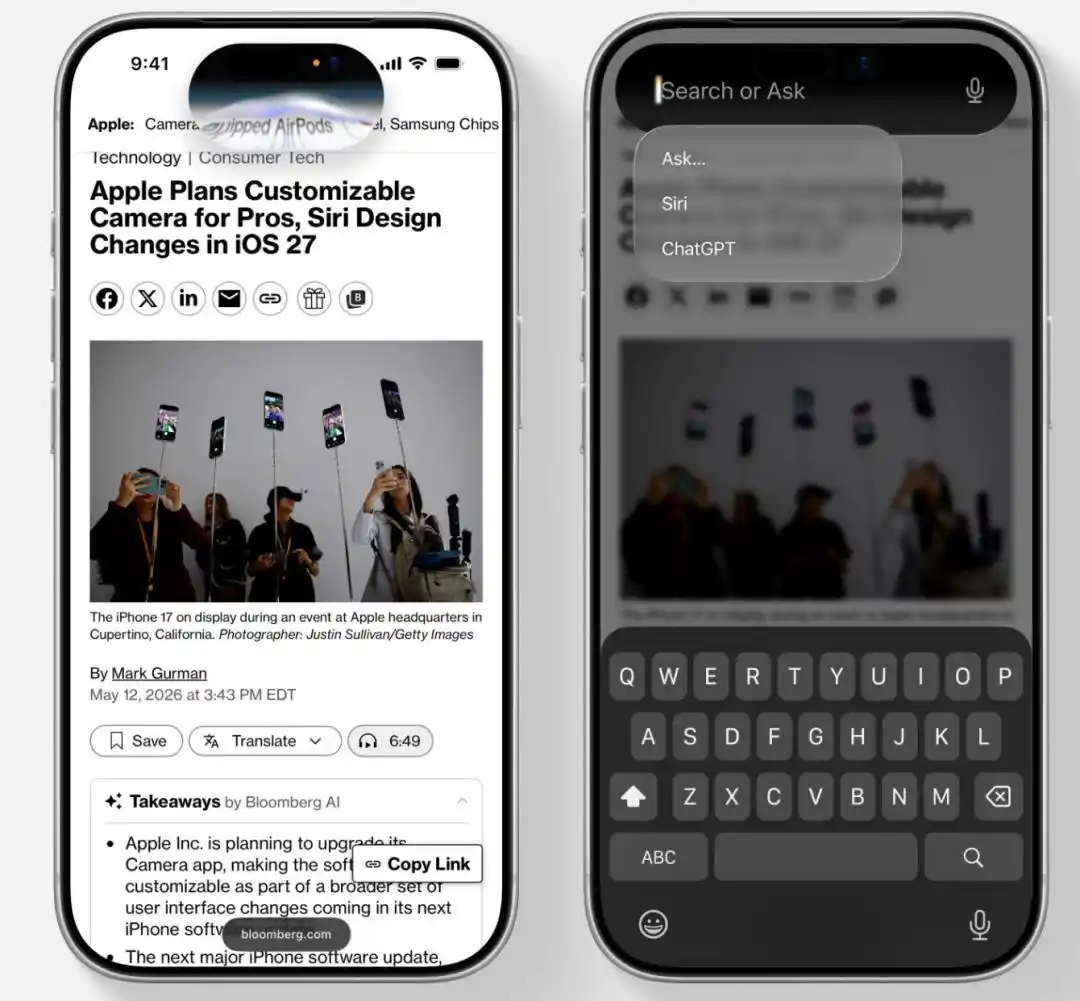
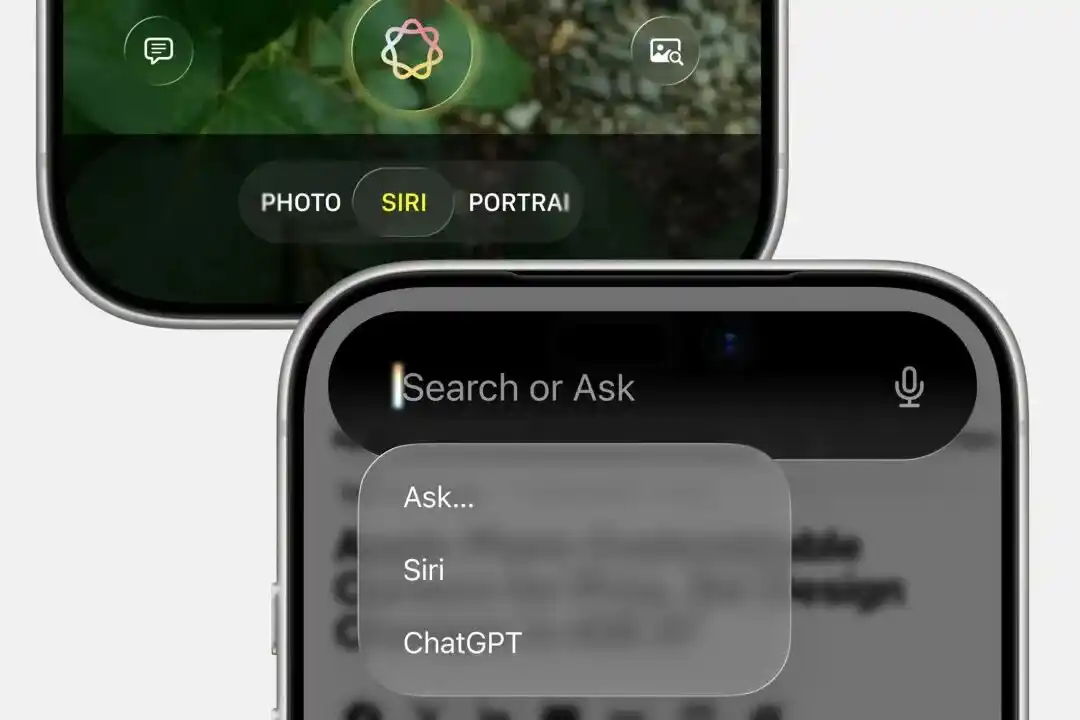
Reportedly, the scale of this Siri revamp is unprecedented since Siri's debut with the iPhone 4S in 2011. The new interface adopts a dark color scheme, is rebuilt with a chatbot interaction paradigm, and is deeply integrated with the Dynamic Island.

More crucially, Apple will allow users to directly 'plug in' Google's Gemini and Anthropic's Claude into the Siri experience—Siri is set to become a distribution platform for AI models.

Everyone will wonder, what will Siri infused with AI actually look like?

01. A Complete Interface Overhaul

According to a Bloomberg report, the new version of Siri has several core changes. Looking at them together reveals Apple's complete logic.

Possible Siri and Dynamic Island fusion interaction | Image source: Instagram

The first is a complete interface rebuild. A chatbot-style interaction interface, dark color scheme, Dynamic Island integration—Siri transforms from a 'pop-up layer' into an independent application experience entry point. This is more than a visual upgrade; it importantly implies that Apple wants users to treat Siri as a tool they 'actively use', not a voice command line occasionally summoned.

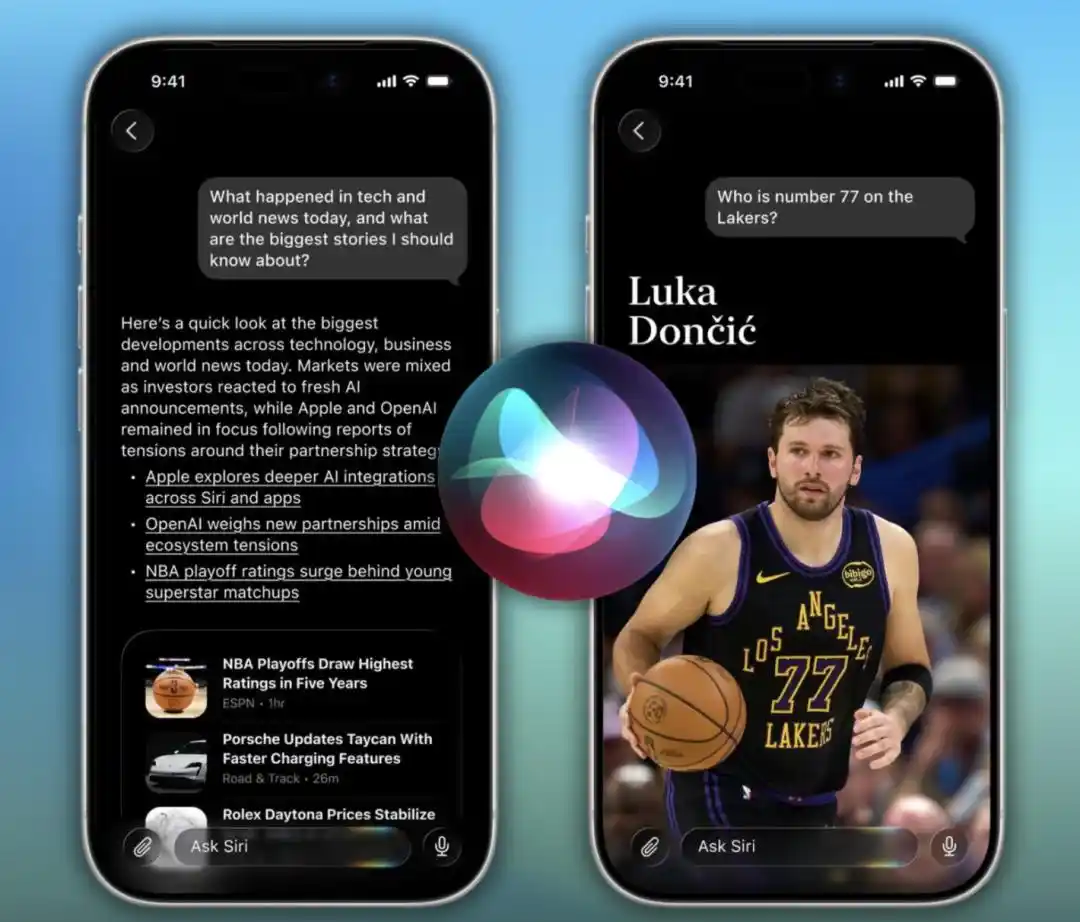
The second is conversational persistence. For years, one of the biggest pain points of talking to Siri was its lack of memory. Every wake-up started from zero—no context, no continuity. The new Siri reportedly fixes this issue—it sounds like a small thing, but it's the foundational condition for the 'assistant' feeling to be valid.

The third, and most noteworthy, is the 'Extensions framework'—allowing third-party AI models to plug into Siri.

The deeper implication of this design is that Apple is no longer taking 'building the best AI model' as its sole path, but rather repositioning iOS as 'the platform for the best AI models to compete'. Just as the App Store doesn't require Apple to develop all apps itself, the new Siri ecosystem doesn't need Apple to outperform everyone in model capabilities—it just needs to bring in all the models and retain users through system-level integration.

Put simply, Apple is fighting the 'model' war with a 'platform' logic.

02. Siri's Three Years of Debt

To understand the weight of this revamp, one must first understand how passive Apple has been in recent years.

In 2023, ChatGPT burst onto the scene, redefining 'conversational AI'. In 2024, Google embedded Gemini into Android, and Samsung turned AI features into selling points. The entire industry accelerated at a breakneck pace, and what was Siri doing? It was still misunderstanding user commands, still interpreting 'set an alarm for 8 AM tomorrow' as opening the alarm app.

Apple, of course, hasn't been idle. At WWDC 2024, Apple Intelligence debuted with great fanfare, promising a host of deeply integrated AI features. But the reality is that many features were either delayed, available only in specific regions, or their actual experience fell far short of the on-stage demos. A long-time Apple tech analyst bluntly stated, 'This doesn't feel like a finished comeback; it feels more like Apple finally arrived at the AI race—only to find itself still in mid-development.'

After three years of accumulated disparity, Apple desperately needs a true turnaround victory.

Two days ago, Apple quietly launched the subdomain genai.apple.com. This small move created significant ripples in tech circles—many interpreted it as a signal that Apple is making final public relations preparations for this WWDC's 'AI transformation'.

03. The Must-Answer Conundrum

But there is a paradox here, already being discussed by many media outlets.

One of Apple's long-standing core moats is privacy. 'Your data is processed only on your device' is Apple's core promise to users and the reason for architectures like Private Cloud Compute.

Now, to make Siri more powerful, Apple is planning to introduce Google's infrastructure to handle some AI queries.

This isn't a technical problem; it's a trust problem.

Possible Siri Q&A interface | Image source: Instagram

When Apple personally breaks the red line of 'only using its own computing infrastructure', its privacy promise to users is no longer absolute. Users can, of course, choose not to use the Google Gemini integration, but 'can choose not to use' and 'doesn't touch by default' are two entirely different things. How Apple explains this shift to users during the keynote will be one of the most-watched details on June 8th.

Furthermore, there's an even more fundamental question. A user on Reddit asked a simple but pointed question—if the Claude inside Siri offers the same experience as using Claude directly, why would I use a shelled version?

Apple must provide a compelling answer, and currently, there seems to be only one candidate—system-level integration: an AI that can access contacts, calendar, photos, health data is a completely different experience from an AI that runs in isolation.

This is Apple's last and most important bargaining chip.

While there is much criticism of Apple's AI pace, a counter-narrative is also circulating—maybe Apple is slow because it's waiting for others to step on the landmines first.

Over the past two years, OpenAI, Google, and Meta have invested hundreds of billions of dollars in data centers, chips, and model training, raising concerns about an AI bubble. In contrast, Apple's strategy seems to be: don't rush to build the 'strongest model', but once the track stabilizes, use its core strength of 'system integration' to catch up from behind.

To some extent, the iOS 27 layout is fulfilling this logic. Don't compete head-on in model capability, but bring in both Gemini and Claude, then build differentiated experience moats using capabilities Android cannot replicate, like the Dynamic Island, personal data permissions, and on-device processing.

This isn't a hasty catch-up by a laggard; it's a calculated bet.

The bet is: the endgame of AI is not about whose model is strongest, but whose system uses models most seamlessly.

On June 8th, Apple will present its complete answer. Whether Siri can truly impress users already accustomed to ChatGPT and Gemini will be the real test of this high-stakes gamble.

Fifteen years later, Siri owes its users an explanation.

*Cover image source: Instagram

This article is from the WeChat public account "GeekPark" (ID: geekpark), author: Hua Lin Wu Wang

Связанные с этим вопросы

QWhat is the most significant change to Siri's interface according to the article?

AThe most significant change is a complete rebuild of Siri's interface, adopting a chatbot-style interactive interface with a dark color scheme and deep integration with Dynamic Island. This transforms Siri from a pop-up layer into an independent application experience entry point.

QWhat is one of the biggest historical shortcomings of Siri that the new version aims to fix?

AOne of the biggest historical shortcomings is Siri's lack of conversational persistence. Siri did not remember context from previous interactions, forcing users to start from scratch with each new request. The new version reportedly fixes this by introducing memory and continuity to conversations.

QHow is Apple's strategy for the new Siri described in relation to competing AI models?

AApple's strategy is described as positioning iOS as a 'platform for the best AI models to compete.' Instead of solely trying to build the best AI model itself, Apple is introducing an 'Extensions framework' to allow third-party AI models like Google Gemini and Anthropic's Claude to be integrated into Siri. This approach uses a 'channel' logic to compete in the 'model' war.

QWhat privacy paradox does Apple face with the new Siri, according to the article?

AApple faces the paradox of needing to utilize external AI infrastructure, like Google's, to enhance Siri's capabilities, which may conflict with its long-standing core promise of user privacy that emphasizes on-device data processing. This move challenges Apple's principle of 'only using its own computing infrastructure' and raises a user trust issue that Apple must address.

QWhat is described as Apple's 'final and most important chip' in creating a differentiated AI experience?

AApple's 'final and most important chip' is its system-level integration. The ability of its AI to access and utilize personal data from contacts, calendar, photos, and health data—coupled with features like Dynamic Island and on-device processing—creates a fundamentally different experience compared to isolated AI models, which Android cannot easily replicate.

Похожее

Jensen Huang: Vera Rubin Full Mass Production, AI Agent a Key Focus, Challenging Intel to Target the Next-Generation AI PC Gateway

NVIDIA CEO Jensen Huang delivered the keynote speech at GTC Taipei 2026, announcing several major product launches and strategic directions. The company's Vera Rubin architecture is now in full-scale production, with OpenAI, Anthropic, and SpaceX among the first customers. NVIDIA highlighted AI Agent as a key future focus, introducing the Vera CPU designed for AI agents and the Vera BlueField-4 STX for secure, chip-level AI storage processing. A significant move involves challenging Intel in the PC market. NVIDIA, in collaboration with MediaTek, is developing the RTX SPARK PC chip (manufactured by TSMC) for Windows systems, set to launch this fall for laptops and desktops. This signals NVIDIA's push into the next-generation AI PC arena, aiming to provide a vertically integrated core computing platform for the entire Windows ecosystem, similar to Apple's approach. Other announcements include the new Nemotron 3 Ultra AI model and the NVIDIA DSX platform, described as a complete "playbook" for building AI factories, allowing performance simulation and validation before physical deployment. In automotive, the DRIVE Hyperion platform was positioned as a global robotaxi platform, with major Chinese automakers like BYD, Geely, Zeekr, Xiaomi, and Pony.ai already adopting or developing autonomous driving solutions based on it. The Alpamayo 2 super open inference model for robotaxis was also introduced. For robotics, NVIDIA unveiled the Isaac GR00T humanoid robot reference platform for academic research and a large open-source agent tools and skills suite for Physical AI. The company plans to collaborate with global humanoid robot manufacturers, including China's Unitree, whose H2 Plus robot served as the reference hardware for the GR00T platform demonstration.

marsbit5 мин. назад

Jensen Huang: Vera Rubin Full Mass Production, AI Agent a Key Focus, Challenging Intel to Target the Next-Generation AI PC Gateway

marsbit5 мин. назад

Running MoE on Mobile Phones? Meta Proposes MobileMoE, Speeding Up iPhone 16 Pro by 3.8x

Meta's MobileMoE, a mobile-optimized Mixture-of-Experts (MoE) language model architecture, enables efficient on-device large language model (LLM) inference for the first time on commercial smartphones. Designed for decoder-only Transformers, it replaces dense feed-forward layers with MoE layers. Key design choices include 8 experts with granularity g=8, top-4 routing, and a shared expert. The model undergoes a four-stage training process: pre-training, intermediate training, supervised fine-tuning, and quantization-aware training. Results show MobileMoE models, with similar memory footprint, achieve equal or higher average accuracy across 14 foundational benchmarks while using only 1/2 to 1/4 of the FLOPs compared to dense baselines. After INT4 quantization, they remain competitive. Notably, on an iPhone 16 Pro, MobileMoE-S demonstrates significant speedups: up to 3.8x faster in the prompt phase and 2.2-3.4x faster in per-token generation compared to a dense counterpart, with lower peak memory usage. While MobileMoE establishes a new Pareto frontier for on-device LLMs in accuracy-compute trade-offs, particularly excelling in code and math tasks, it currently lags behind models like Qwen3.5 2B in advanced instruction following and knowledge reasoning. Future work includes improving post-training techniques, exploring NPU deployment, and managing the runtime memory sensitivity of MoE models to varying inputs.

marsbit10 мин. назад

Running MoE on Mobile Phones? Meta Proposes MobileMoE, Speeding Up iPhone 16 Pro by 3.8x

marsbit10 мин. назад

Bitcoin's Weak Rebound Fails to Mask Adjustment Trend, HYPE's Top Signal Warns of Short-Term Risks | Invited Analysis

**Title:** Bitcoin's Weak Rebound Fails to Mask Downtrend; HYPE Top Signal Alerts of Short-Term Risks | Exclusive Analysis **Abstract:** This weekly market analysis examines the current technical structures of Bitcoin and HYPE, outlining key trading strategies. Bitcoin's daily chart shows it has broken below the median line of its primary ascending channel, indicating structural weakness. It is currently experiencing a weak rebound within a short-term descending channel, targeting resistance at $75,000-$76,000. Failure to break above this zone could lead to a resumption of the downtrend, testing support at $69,500-$70,500. Trading strategies include positioning for a rebound rejection (Plan A) or a breakdown below key support (Plan B) with controlled short positions. For HYPE, the 4-hour chart reveals a potential seven-wave advance from the May 14 low, now showing signs of exhaustion. A bearish divergence (momentum weakening) has been observed, coupled with a top signal from the proprietary "Spread Trading Model" at potential endpoint 47. The key this week is to monitor if a confirmed top forms here, especially upon a breach of the $62.5-$64.57 support area. If broken, a larger corrective move towards $54-$56.30 is anticipated. The short-term strategy for HYPE focuses on cautious long entries only upon confirmed stabilization within the support zone. The report also details a successful short BTC trade from the previous week, yielding a ~5.07% profit, executed based on model signals and price action. Strict risk management rules, including dynamic stop-loss adjustments, are emphasized.

marsbit26 мин. назад

Bitcoin's Weak Rebound Fails to Mask Adjustment Trend, HYPE's Top Signal Warns of Short-Term Risks | Invited Analysis

marsbit26 мин. назад

Торговля

Спот
Фьючерсы

Популярные статьи

Неделя обучения по популярным токенам (2): 2026 может стать годом приложений реального времени, сектор AI продолжает оставаться в тренде

2025 год — год институциональных инвесторов, в будущем он будет доминировать в приложениях реального времени.

1.8k просмотров всегоОпубликовано 2025.12.16Обновлено 2025.12.16

Неделя обучения по популярным токенам (2): 2026 может стать годом приложений реального времени, сектор AI продолжает оставаться в тренде

Обсуждения

Добро пожаловать в Сообщество HTX. Здесь вы сможете быть в курсе последних новостей о развитии платформы и получить доступ к профессиональной аналитической информации о рынке. Мнения пользователей о цене на AI (AI) представлены ниже.

活动图片