This American Earns $250 Million a Year from Podcasting, Luo Yonghao Is Learning from Him

marsbitОпубликовано 2025-12-23Обновлено 2025-12-23

Введение

Joe Rogan, a comedian and UFC commentator, hosts "The Joe Rogan Experience," the world's largest podcast. Known for its long-form, unscripted conversations, the show has featured high-profile guests like Elon Musk, Donald Trump, and Jensen Huang. Musk’s 2018 appearance, where he smoked a joint, went viral with over 69 million views and impacted Tesla’s stock. In 2020, Spotify secured exclusive rights to the podcast for $200 million, later renewing in 2024 for $250 million without exclusivity. Rogan’s informal, curiosity-driven style attracts audiences distrustful of mainstream media, particularly young men. His interview with Trump during the 2024 election, viewed over 50 million times, was credited as a key factor in Trump’s victory. In China, figures like Luo Yonghao are attempting similar formats, but face challenges due to shorter content preferences and less mature monetization. Rogan’s influence is coupled with controversy, including spreading misinformation on COVID-19 vaccines and conspiracy theories, highlighting the tension between free speech and responsible broadcasting.

Written by: David, Deep Tide TechFlow

You might not listen to podcasts, but you must have seen this scene.

In 2018, a picture of Musk holding a hand-rolled cigarette, surrounded by smoke, spread across the internet, becoming one of his most iconic and viral moments.

However, few people know where this scene took place, and even fewer care about who was sitting opposite him.

Actually, this was a recording session for an American podcast.

The host handed Musk a cigarette mixed with marijuana and tobacco. Musk asked, "This is legal, right?" and then took a puff.
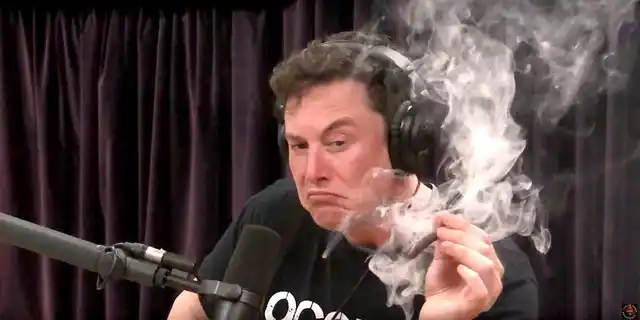
The next day, Tesla's stock price dropped by 9%.

To this day, this episode has over 69 million views on YouTube, making it the most-watched episode in the podcast's history.

What kind of show, what kind of host, could make the world's richest man do such a thing on camera?

During the 2024 US presidential election, Trump also spent three hours on this show for an interview. In his victory speech, he specifically thanked the host by name; two weeks ago, NVIDIA CEO Jensen Huang also sat in this studio, talking about AI and the chip war for two and a half hours, garnering over 2.8 million views within two weeks.

His name is Joe Rogan. His show, "The Joe Rogan Experience," is currently the world's largest podcast.

From Comedian to Podcast King, A Show Worth $250 Million

Joe Rogan's podcast influence is built on an unconventional personal resume.

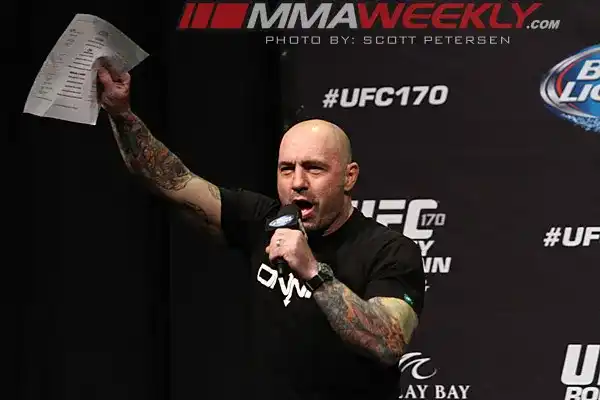
Comedian, reality show host, UFC commentator. Put these three identities together, and it doesn't seem like the profile of someone who would create the world's largest podcast.

He is not a traditional interview show host, not the kind of straight-laced, classically trained media personality. His background is actually in entertainment and the fighting world, not journalism.

But it is precisely this "unconventional" path that allowed him to create something completely different from traditional media; his ability to connect and his viewership far surpass many professional media programs.
Initially, Joe Rogan was a comedian, doing stand-up in Boston clubs in the 90s. Later, he moved to Los Angeles, acted in sitcoms for a few years, and hosted a reality show called "Fear Factor."

The show followed a shock-value format, making contestants eat bugs, jump from tall buildings, relying on gross-out and刺激 to boost ratings. In today's short-video environment, it would definitely be categorized as vulgar but high-traffic.

But what really made him break through was another job.

Starting in 1997, he worked as a commentator for the UFC, sitting cageside at the Octagon to explain mixed martial arts matches, a job he held for over twenty years. This work solidified his standing in the fighting community and accumulated a large loyal male audience for him.
In 2009, he started recording podcasts at home.

Like the starting point for many podcasts, the equipment was simple, there were no sponsors, and no business plan. But each one lasted two to three hours, chatting with friends or guests about anything.

Looking back, all those messy previous experiences actually came in handy.

Having been a comedian, he knew how to make conversations interesting and rhythmic. Having hosted a reality show, he was also comfortable being relaxed on camera. Being a UFC commentator for twenty years meant this audience was already used to listening to him talk.

Furthermore, he isn't an expert in any single field, which gives him an unconventional advantage:

He can unabashedly ask "dumb questions."

Facing a physicist, he'll ask about the most basic concepts; facing a politician, he doesn't press for policy details, but talks about "what you personally really think." This style is something you simply don't see in traditional media.

Television interviews have strict time limits, hosts must quickly get to the point. News interviews emphasize confrontation, journalists must dig out what the interviewee doesn't want to say.

Rogan's show does the opposite, giving you three hours, unedited, uninterrupted, talking about whatever you want.

The result is that many celebrities say things on his show they wouldn't say elsewhere. Musk smoking marijuana is just one example. Zuckerberg came on to talk about MMA training, looking more like a normal person than in any Congressional hearing.

Slowly, Joe Rogan's podcast became the go-to place for celebrities to "show their real side." Traditional media interviews are performances; here, they can be themselves.

As more and more celebrities appeared, the show became increasingly valuable.

In 2020, Spotify bought the exclusive distribution rights to "The Joe Rogan Experience" for $200 million, the largest deal in podcast industry history at the time.

In 2022, Rogan faced a media storm for negative comments about certain COVID-19 vaccines on his podcast, leading to several musicians pulling their music from Spotify in protest.

Right at this critical juncture, another video platform, Rumble, publicly offered $100 million to poach his podcast, but Rogan didn't bite.

In 2024, he renewed his licensing deal with Spotify, but the price rose to $250 million.
Moreover, this time he no longer accepted exclusivity; the show returned to being available simultaneously on Spotify, YouTube, and Apple Podcasts. Spotify paid more money but got fewer rights.

In 2025, "The Joe Rogan Experience" simultaneously topped the annual podcast charts on Spotify, Apple Podcasts, and YouTube for the first time.

A chat show that started recording at home sixteen years ago is now valued higher than many traditional media companies.

Podcast Chats, Precise Vote Pulling

On October 25, 2024, during the final stretch of the election campaign, Trump sat down in Rogan's Austin studio.

This episode lasted a full three hours. After recording, Trump rushed to a campaign rally in Michigan, making thousands of supporters wait an extra three hours.

What did they talk about for three hours?

UFOs. Trump said he interviewed fighter pilots who told him they saw spherical objects moving four times faster than an F-22 fighter jet.

The beds in the White House. He genuinely described his feelings the first time he walked into the Lincoln Bedroom, thinking the bed was huge because Lincoln was six foot six.

Tariffs. Trump also proposed replacing income tax entirely with tariffs. Rogan asked: "Are you serious?"

Trump said: "Of course, why not? In the 1880s, when our country was at its richest, it was all thanks to tariffs."

These topics seem unrelated, but they share one commonality:

They are things traditional political interviews would absolutely never discuss.

TV networks ask about policy details, press on controversial statements, and stick to time limits. No serious political journalist would let a presidential candidate spend ten minutes talking about UFOs and Lincoln's bed.
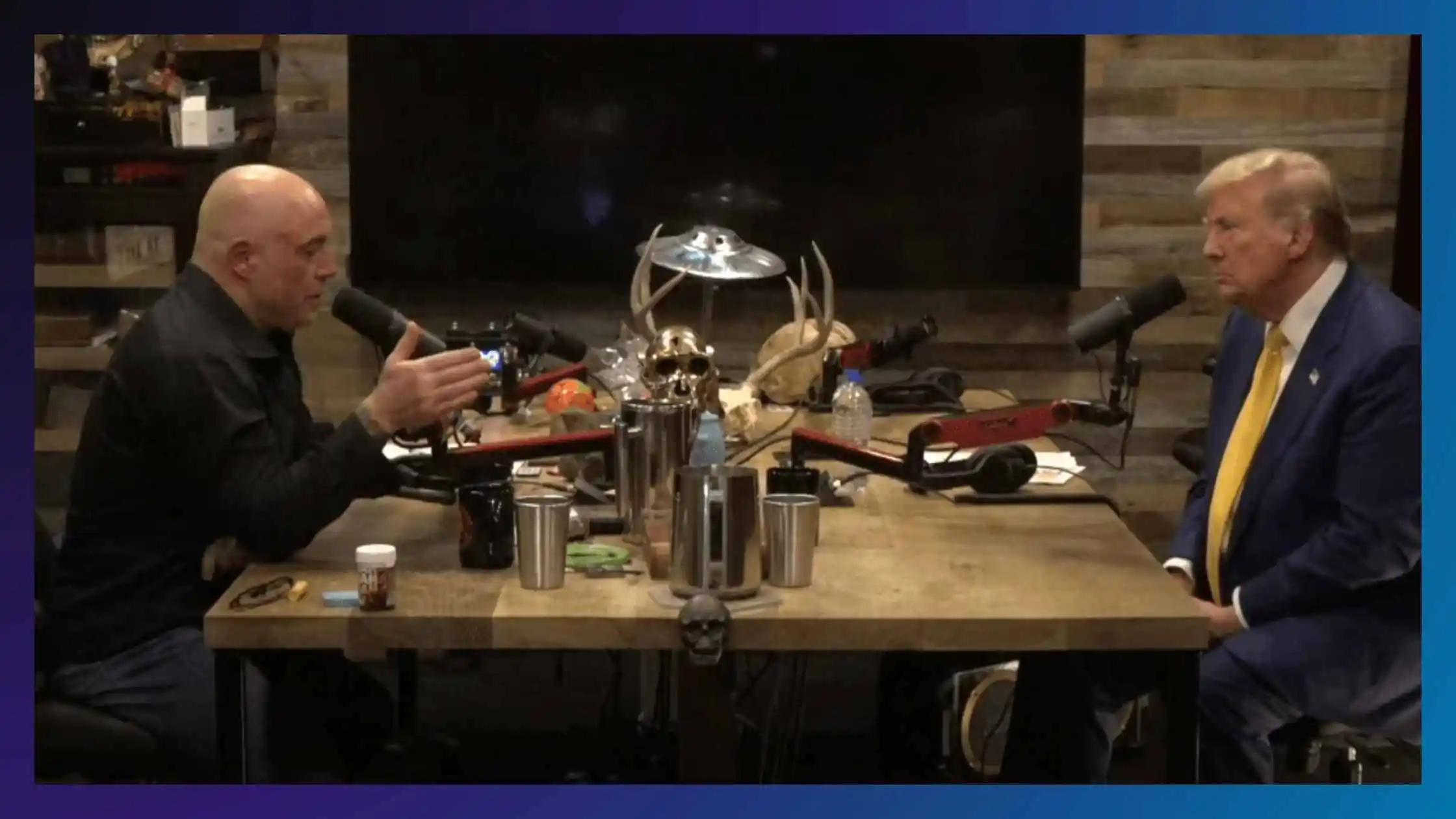
But this is precisely the characteristic of Rogan's show. Three hours, no interruptions, no set agenda, talk about whatever you want.

The audience sees not a candidate constrained by media frameworks, but a complete Trump: curious, with outrageous ideas, capable of casual conversation.

Rogan's own comment actually sums up the show's effect well:

"You say a lot of crazy things, but when traditional media takes those things and makes news out of them, it actually makes you more popular. Because people are tired of that scripted politician-speak. Even if they disagree with you, at least they know this person is real."

This sense of authenticity is especially effective with Rogan's audience.

Data from foreign research institutions shows that 80% of the show's listeners are male, with over half aged 18 to 34. Politically, 35% identify as independent, 32% lean Republican, and 27% lean Democratic. These people share a common characteristic:

They don't watch traditional TV news much, generally distrust mainstream media, but they spend hours each week listening to Rogan chat.

In other words, this is a group that is very hard to reach through traditional political communication. And Trump spending three hours sitting across from a host they trust, speaking in a relaxed, informal manner, was far more effective than any campaign ad.

After the episode went live, YouTube views quickly surpassed 50 million.

The entire video was chopped into countless clips, spreading across X, TikTok, and Instagram. Every soundbite, every outrageous statement, became standalone content, reaching people who would never click on a three-hour video.

Meanwhile, Trump's presidential election opponent, Harris, did not go on the show.

Reportedly, both sides talked, and Rogan publicly invited her. But Harris's team wanted to keep the duration under an hour, which Rogan refused. He said on his show:

"It's not that I didn't want to invite her, it's that she didn't want to come."

For comparison, Trump's episode garnered over 50 million views, while Harris's appearance on another podcast, "Call Her Daddy," got 600,000 views.

The election ended, Trump won. In his victory speech, UFC President Dana White specifically thanked Joe Rogan, listing him as one of the功臣 (key contributors) to the win.

A podcast being named in the thank-you list of a presidential victory speech is a first in American political history.

Chinese Mirror, Attempts by Luo Yonghao and Others

Can Joe Rogan's model be replicated in China?

Some are trying.

In June 2025, Luo Yonghao revealed at an AI conference that DeepSeek founder Liang Wenfeng suggested he leverage his "talent for speaking." A few months later, he launched a video podcast on Bilibili called "Luo Yonghao's Crossroads," positioning it as a counterpart to Joe Rogan and Lex Fridman.
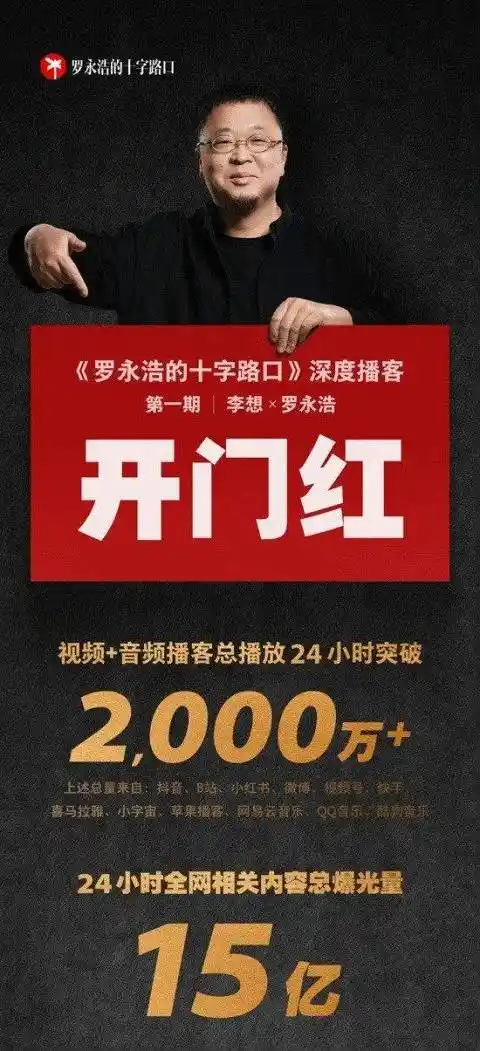
The show format is very similar to The Joe Rogan Experience: long conversations, minimal editing, three to five hours per episode.

The first guest was Li Xiang, founder of Li Auto. The two talked for four hours, from childhood trauma to his relationship with Wang Xing, daring to ask and answer anything. The reaction in the comments was:

In the short-video era, this kind of "long and satisfying super large cup" is too rare.

Luo Yonghao isn't the only one. Chen Luyu, Yu Qian, Li Dan, Yang Di—these famous talk show hosts have纷纷入驻 (flocked to) B站 (Bilibili) to do video podcasts. B站 has also made heavy investments, pouring 10 billion-level traffic support into it during the summer, providing free recording venues in Beijing, Shanghai, Guangzhou, and Hangzhou, and planning to launch AI creation tools专属 (exclusive) for podcasts.

It seems that China's video "podcast元年 (first year)" has finally arrived, but it's not that simple.

When Luo Yonghao was in conversation with Tim from '影视飓风' (Film Tornado), he mentioned his video views are around 20-30 million, while Tim believed "reaching 100 million counts as火 (being popular)." This actually reveals a structural problem:

In China's internet traffic ecosystem, long-form content is inherently at a disadvantage.

Over the past few years, users have been trained by short videos into the habit of "watching a three-minute summary of a movie." The algorithms of Douyin (TikTok) and Kuaishou reward completion rates; a three-hour video has almost no place in the recommendation pool.

More ironically, the highlight moments of many long video podcasts are often spread through几十秒 (tens-of-seconds) long clips on Douyin and Xiaohongshu.

At the same time, monetization is also a challenge.

The US podcast industry's advertising revenue exceeded $2 billion in 2024, with top hosts able to secure exclusive contracts worth hundreds of millions of dollars. In China, a podcast brand with nearly 500,000 subscribers might charge less than 40,000 RMB for a single host-read ad, with annual net income possibly only around 100,000 RMB.

YouTube has a mature AdSense revenue sharing system; the longer the video, the more ad slots, the higher the income—this incentivizes long-form content through its profit mechanism. B站's monetization capability is far from reaching this level.

There is an even more fundamental problem:

A large part of Rogan's influence comes from his ability to host people like Trump, Musk, and Huang Renjun, and these people are willing to say things on his show they wouldn't say elsewhere.

This status as an "information首发地 (first release location)" requires long-accumulated trust and a unique media environment.

Luo Yonghao can invite Li Xiang, He Xiaopeng, Zhou Hongyi—this is already the top-tier lineup in China's tech circle. But there are natural boundaries regarding the openness of topics.

So, can Joe Rogan's model be replicated in China?

The form can be learned, but the soil is different.

Controversy and Boundaries

Writing this far, there's an unavoidable question: Joe Rogan is a controversial figure.

In 2022, he caused a storm by questioning the effectiveness of COVID-19 vaccines on his show. Spotify did not drop Rogan, but added "content advisory" labels to all episodes discussing COVID-19 and removed over 70 old episodes.

This wasn't his first brush with trouble.

In 2024, he discussed the origins of AIDS with a guest on his show, spreading some claims that have been refuted by the medical community, drawing public criticism from the American Foundation for AIDS Research.

A Yale University study found that among the top ten most popular podcasts in the US, eight had spread erroneous or misleading information about climate change, with Rogan's show being among them.

His show is also a hub for various American conspiracy theories.

From the JFK assassination to UFOs, from big pharma to government surveillance, he maintains an "open attitude" towards these topics. Critics argue this provides a platform for misinformation, while his supporters believe it challenges mainstream narratives.

In July 2025, he posted on X:

"Salute to those who still don't believe in conspiracy theories, your ability to hold your ground is admirable." This post received over 15 million views.

This is also the complexity of Joe Rogan.

He is not a person of consistent stances. For example, supporting same-sex marriage, marijuana legalization, and universal healthcare are typical liberal positions. But he also questions mainstream media and provides a platform for controversial figures, which also makes him a darling of conservatives.

The reason his show has influence is precisely because he doesn't belong to any single camp. Those who have lost trust in mainstream media find an "anti-establishment" alternative in him.

But the same特质 (trait) also makes him a node for spreading misinformation. When someone with an audience of hundreds of millions says "I'm just asking questions," the questions themselves shape public perception.

This is also the inherent tension of the podcast medium:

Its charm lies in being real, relaxed, and unlimited, but when its influence reaches a certain scale, "unlimited" itself becomes a problem.

Joe Rogan is a product of this era, and also a mirror of it.

Связанные с этим вопросы

QWho is Joe Rogan and what is the name of his podcast?

AJoe Rogan is a comedian, UFC commentator, and the host of 'The Joe Rogan Experience', which is currently the world's largest podcast.

QHow much did Spotify pay for the exclusive distribution rights to 'The Joe Rogan Experience' in 2020 and 2024?

ASpotify paid $200 million for the exclusive rights in 2020 and renewed the deal for $250 million in 2024, though the show was no longer exclusive.

QWhat was a significant political impact of Joe Rogan's podcast during the 2024 U.S. election?

ADonald Trump appeared on the podcast for a three-hour interview, which garnered over 50 million views on YouTube. Trump later thanked Joe Rogan in his victory speech, marking the first time a podcast was acknowledged in a U.S. presidential election victory speech.

QWhat are some of the controversies surrounding Joe Rogan and his podcast?

AJoe Rogan has faced controversy for spreading misinformation, including questioning the efficacy of COVID-19 vaccines, discussing debunked theories about AIDS origins, and hosting episodes that spread climate change misinformation and conspiracy theories.

QHow is Luo Yonghao (罗永浩) in China attempting to replicate Joe Rogan's success?

ALuo Yonghao launched a video podcast on Bilibili called 'Luo Yonghao's Crossroads', featuring long-form, minimally edited conversations of 3-5 hours with guests like Li Xiang, founder of Li Auto, in a style similar to Joe Rogan's.

Похожее

US Government Suddenly Halts Anthropic's Strongest Model, "Quasi-IPO Stock Price" Plunges 3.7% Overnight

U.S. Government Halts Anthropic's Top AI Models, 'Pre-IPO' Price Drops 3.7% On June 12, the U.S. government ordered Anthropic to shut down access to its two most powerful AI models, Claude Fable 5 and Claude Mythos 5, citing national security concerns. The directive, issued by the Department of Commerce, required Anthropic to block access for all foreign nationals, leading the company to disable the models globally for all users. Anthropic strongly opposed the move, arguing the government's basis was a "narrow jailbreak vulnerability" and warning that applying such a standard industry-wide would effectively halt all frontier model deployments. The news impacted Anthropic's implied valuation in speculative markets. The Anthropic perpetual contract on Hyperliquid fell approximately 3.7% to around $1,627, down from highs above $1,800 following the models' release. Unauthorized tokenized products linked to Anthropic on Solana also saw significant declines. The models, launched just days earlier on June 9, represented a major capability leap for Anthropic. Fable 5 was its first public release of a "Mythos"-tier model above its flagship Claude Opus. The shutdown creates an ironic situation for Anthropic, a company founded on "AI safety" principles, and adds uncertainty to its ongoing IPO preparations. The company is actively engaging with regulators to resolve what it calls a "misunderstanding" and restore service.

marsbit18 мин. назад

US Government Suddenly Halts Anthropic's Strongest Model, "Quasi-IPO Stock Price" Plunges 3.7% Overnight

marsbit18 мин. назад

SpaceX IPO Creates Trillion-Dollar Billionaire: Musk's Wealth Equals Half of Crypto Market

SpaceX's record-breaking IPO has propelled Elon Musk to become the first modern billionaire with a personal net worth exceeding $1 trillion, reaching $1.11 trillion according to Bloomberg. This staggering wealth surpasses the total market capitalization of all cryptocurrencies excluding Bitcoin and equals roughly half of the entire crypto market's value. The milestone highlights extreme wealth concentration and the significant devaluation of the altcoin market, whose total cap has nearly halved since late 2025 as capital flows into large tech stocks. SpaceX's Nasdaq debut saw its valuation hit $2.2 trillion, with shares soaring from a $135 offer price to close at $161. Its first-day trading volume of $85 billion set a new global IPO record. Musk owns 42% of the company. Despite his wealth dwarfing the altcoin sector, Musk maintains deep ties to digital assets. He personally holds Bitcoin, Ethereum, and Dogecoin, while his companies, SpaceX and Tesla, collectively hold over 30,000 Bitcoin, ranking among the top corporate BTC holders globally. His acquisition and integration of financial data tools into X (formerly Twitter) further connect his ecosystem to the markets. Ultimately, Musk's trillion-dollar status underscores the immense wealth controlled by tech founders, though this fortune remains largely tied to volatile stock prices rather than liquid assets.

Foresight News25 мин. назад

SpaceX IPO Creates Trillion-Dollar Billionaire: Musk's Wealth Equals Half of Crypto Market

Foresight News25 мин. назад

Hardcore First Look | Ocean Embodied Intelligence Company 'Shihang Intelligence' Secures Record-Breaking 1 Billion in Funding, Zhu Xiaohu, Temasek Place Bets

Breaking News | Ocean Embodied Intelligence company "Shihang Intelligent" secures a record-breaking 1 billion RMB (approximately 10 billion yuan) in Series A financing, with investment from Zhu Xiaohu and Temasek. Author: Qiu Xiaofen | Editor: Yuan Silai Ocean Embodied Intelligence company "Shihang Intelligent" has completed its Series A funding round, raising over 1 billion RMB. This marks the largest single funding round in the global marine robotics field to date. Investors include upstream momentum funds from chip companies "Moore Thread" and "Kunlunxin," Singapore's state-owned investment platform Vertex Growth, and listed company Dyneo, among others. Existing investors like GSR Ventures (whose founder Zhu Xiaohu has invested for the fifth time), Vertex Ventures China, Hua Ying Capital, and Long Capital also significantly increased their investments. Founder and CEO Chen Xiaobo, a 1989-born alumnus of Harbin Engineering University, is a long-time expert in underwater robotics. He received the National Defense Science and Technology Progress Award at age 28 (the youngest recipient) and led the development of China's first commercial underwater cleaning robot. The funds will be used for core technology R&D, global market expansion, and building the industry chain ecosystem to scale the application of marine robots in complex underwater scenarios. The ocean is considered one of the most challenging environments for robotics due to low light, high turbidity, complex currents, limited communication, high pressure, and corrosion. "Shihang Intelligent" focuses on developing core underlying technologies for marine robots, covering six key systems: power, control, sensing, navigation, sealing, and deployment. Its robots are capable of operating at depths from 0 to 10,000 meters with full degrees of freedom, performing complex maneuvers, autonomous navigation, and multi-robot collaboration. Applications include ship cleaning, underwater security, offshore wind power, marine ranching, and seabed inspection. The company's order value for the first half of 2026 alone has exceeded 1 billion RMB. Its "Orca Robot" is used by major shipping companies and has performed maintenance on over a thousand large vessels. In April of this year, the company launched its ocean embodied large model "Cangqiong CEORION." Unlike traditional remote-controlled or pre-programmed robots, this model integrates environmental perception, task understanding, and action generation into a single end-to-end architecture. Trained on millions of hours of commercial operation data and simulation data, it covers 12 major underwater operation scenarios. In simulations, it achieved over 90% task success rate and over 70% zero-shot adaptation capability to unseen environments. A built-in physics reasoning module reduces collision risk by 80%, enabling autonomous operation even with weak or no communication. Recently, "Shihang Intelligent" was selected as a core technology partner for Singapore's Maritime and Port Authority national hull inspection and cleaning program. These advancements indicate marine robotics is moving from pilot projects to scaled applications, with real-world operations generating valuable data to continuously improve robot capabilities. CEO Chen Xiaobo stated the company will continue investing in core marine robotics technology, the embodied intelligence model, and global application scenarios to expand into more high-risk, high-difficulty, and high-value underwater operations.

marsbit51 мин. назад

Hardcore First Look | Ocean Embodied Intelligence Company 'Shihang Intelligence' Secures Record-Breaking 1 Billion in Funding, Zhu Xiaohu, Temasek Place Bets

marsbit51 мин. назад

Three Months, 35 Billion Yuan: Investors Rush to Grab the OpenAI of the Physical World

Investors flock to a physical AI startup as the race for the "OpenAI of the physical world" heats up. Ji Jia Shi Jie (GigaWorld), a company dedicated to developing Artificial General Intelligence (AGI) for the physical world, has raised 3.5 billion RMB (approximately $490 million) in just three months, according to a report from investment media outlet Touzijie. The latest B2 funding round of 1 billion RMB attracted a wide range of top-tier investors, including sovereign wealth funds, industrial capital, and financial institutions. This brings the total funding for the young company, now valued over 10 billion RMB, to 3.5 billion RMB across three recent rounds. The company is led by Huang Guan, a post-90s Tsinghua University PhD with extensive experience in AI, autonomous driving, and entrepreneurship. Its core innovation is a "dual-pyramid" system comprising a five-layer data pyramid (from internet videos to real-world robot data) and a three-layer algorithm pyramid focused on world simulation, action alignment, and reinforcement learning. This system underpins its key models: the "World Action Model" (e.g., GigaBrain series for robot control) and the "World Generation Model" (e.g., GigaWorld series for simulating and understanding the physical world). Its models have reportedly achieved top rankings in global robotics benchmarks. Ji Jia Shi Jie argues that while current digital AGI excels in information processing, the next frontier is physical AGI—systems that can understand and interact with the real world. The company believes the field is approaching its "GPT-3 moment," a key inflection point in capability scaling. To achieve this, the company is pursuing a dual-market strategy. For the consumer (C) market, it launched the "SeeLight" brand and its S1 general-purpose humanoid robot, which has secured initial orders for deployment in real homes. For the business (B) market, it focuses on industrial automation with its Maker series robots, having signed agreements for large-scale deployment in factories, and its DriveDreamer world model for autonomous driving, which is already in use with over 30 automakers and tech companies. The report concludes that by bridging the gap between digital intelligence and physical action, Ji Jia Shi Jie aims to unlock a new wave of productivity, ultimately bringing physical AGI into everyday life.

marsbit1 ч. назад

Three Months, 35 Billion Yuan: Investors Rush to Grab the OpenAI of the Physical World

marsbit1 ч. назад

What's the Connection Between Pinduoduo's Huang Zheng and Blockchain?

This text explores the unexpected connection between Pinduoduo founder Colin Huang and blockchain, as suggested in his article *Turning Capitalism Upside Down*. Huang argues Pinduoduo's core business is about managing "uncertainty." He posits that wealth flows to the rich because they absorb life's uncertainties (e.g., illness, job loss) that devastate the poor, who pay a premium for certainty through insurance or stable prices. Pinduoduo's model attempts a "reverse insurance": by aggregating consumer demand via group-buying and flash sales, it creates a large, predictable order for manufacturers. This certainty allows factories to remove risk premiums, passing savings back as lower prices, thus partially reversing the wealth flow. The key obstacle, Huang notes, is that an individual's buying intent is an unreliable promise. He then asks if blockchain is the natural solution for this "reverse insurance." The text elaborates that blockchain, through smart contracts with binding deposits, could transform casual intent into a costly-to-break, enforceable commitment. This replaces interpersonal trust with coded rules, making promises credible, pricable, and resistant to fraud. Finally, the author draws a parallel to Bitcoin, framing two paths to creating certainty: the "Pinduoduo path" of aggregating decentralized will into scale, and the "Bitcoin path" of locking rules into immutable code. Both sacrifice something—personal freedom or system flexibility—to manufacture trust and predictability.

链捕手2 ч. назад

What's the Connection Between Pinduoduo's Huang Zheng and Blockchain?

链捕手2 ч. назад

Торговля

Спот
Фьючерсы

Популярные статьи

Как купить SFP

Добро пожаловать на HTX.com! Мы сделали приобретение SafePal (SFP) простым и удобным. Следуйте нашему пошаговому руководству и отправляйтесь в свое крипто-путешествие.Шаг 1: Создайте аккаунт на HTXИспользуйте свой адрес электронной почты или номер телефона, чтобы зарегистрироваться и бесплатно создать аккаунт на HTX. Пройдите удобную регистрацию и откройте для себя весь функционал.Создать аккаунтШаг 2: Перейдите в Купить криптовалюту и выберите свой способ оплатыКредитная/Дебетовая Карта: Используйте свою карту Visa или Mastercard для мгновенной покупки SafePal (SFP).Баланс: Используйте средства с баланса вашего аккаунта HTX для простой торговли.Третьи Лица: Мы добавили популярные способы оплаты, такие как Google Pay и Apple Pay, для повышения удобства.P2P: Торгуйте напрямую с другими пользователями на HTX.Внебиржевая Торговля (OTC): Мы предлагаем индивидуальные услуги и конкурентоспособные обменные курсы для трейдеров.Шаг 3: Хранение SafePal (SFP)После приобретения вами SafePal (SFP) храните их в своем аккаунте на HTX. В качестве альтернативы вы можете отправить их куда-либо с помощью перевода в блокчейне или использовать для торговли с другими криптовалютами.Шаг 4: Торговля SafePal (SFP)С легкостью торгуйте SafePal (SFP) на спотовом рынке HTX. Просто зайдите в свой аккаунт, выберите торговую пару, совершайте сделки и следите за ними в режиме реального времени. Мы предлагаем удобный интерфейс как для начинающих, так и для опытных трейдеров.

267 просмотров всегоОпубликовано 2026.05.22Обновлено 2026.06.02

Как купить SFP

Как купить CTR

Добро пожаловать на HTX.com! Мы сделали приобретение Citrea (CTR) простым и удобным. Следуйте нашему пошаговому руководству и отправляйтесь в свое крипто-путешествие.Шаг 1: Создайте аккаунт на HTXИспользуйте свой адрес электронной почты или номер телефона, чтобы зарегистрироваться и бесплатно создать аккаунт на HTX. Пройдите удобную регистрацию и откройте для себя весь функционал.Создать аккаунтШаг 2: Перейдите в Купить криптовалюту и выберите свой способ оплатыКредитная/Дебетовая Карта: Используйте свою карту Visa или Mastercard для мгновенной покупки Citrea (CTR).Баланс: Используйте средства с баланса вашего аккаунта HTX для простой торговли.Третьи Лица: Мы добавили популярные способы оплаты, такие как Google Pay и Apple Pay, для повышения удобства.P2P: Торгуйте напрямую с другими пользователями на HTX.Внебиржевая Торговля (OTC): Мы предлагаем индивидуальные услуги и конкурентоспособные обменные курсы для трейдеров.Шаг 3: Хранение Citrea (CTR)После приобретения вами Citrea (CTR) храните их в своем аккаунте на HTX. В качестве альтернативы вы можете отправить их куда-либо с помощью перевода в блокчейне или использовать для торговли с другими криптовалютами.Шаг 4: Торговля Citrea (CTR)С легкостью торгуйте Citrea (CTR) на спотовом рынке HTX. Просто зайдите в свой аккаунт, выберите торговую пару, совершайте сделки и следите за ними в режиме реального времени. Мы предлагаем удобный интерфейс как для начинающих, так и для опытных трейдеров.

260 просмотров всегоОпубликовано 2026.05.25Обновлено 2026.06.02

Как купить CTR

Обсуждения

Добро пожаловать в Сообщество HTX. Здесь вы сможете быть в курсе последних новостей о развитии платформы и получить доступ к профессиональной аналитической информации о рынке. Мнения пользователей о цене на A (A) представлены ниже.

活动图片