The White House Did the Math: How Much More Could Banks Lend If Stablecoin Interest Is Banned?

marsbitОпубликовано 2026-04-13Обновлено 2026-04-13

Введение

The White House Council of Economic Advisers (CEA) refuted a previous claim that interest-bearing stablecoins could reduce bank lending by $1.5 trillion, estimating the actual impact at just $2.1 billion—nearly 700 times smaller. The key argument centers on where stablecoin reserves are allocated. Most major issuers, like Tether and Circle, hold the majority of reserves in U.S. Treasuries and repurchase agreements, not bank deposits. Only a small portion (around 12% for USDC) is held in bank deposits subject to 100% reserve requirements—the only scenario that meaningfully reduces bank lending capacity. Even if a ban on stablecoin interest payments drove an estimated $54.4 billion back to banks, only 12% of that would affect lending capacity. After accounting for reserve requirements and banks’ existing excess liquidity, the net increase in lending would be minimal. The report also highlights negative side effects: an $800 million annual welfare loss for stablecoin holders and potential reduced foreign demand for U.S. Treasuries, which could raise borrowing costs. The cost-benefit ratio of an interest ban is estimated at 6.6, making it an inefficient policy with clear costs and uncertain benefits.

Written & Compiled by: KarenZ, Foresight News

Last summer, during the debate over the "GENIUS Act" in the U.S. Congress, economist Andrew Nigrinis threw out a number—if stablecoins could pay interest, bank loans could evaporate by $1.5 trillion.

This number spread quickly in Washington. Banking lobby groups used it as an argument, some lawmakers used it as a reason, and ultimately a clear prohibition was added to the bill: any stablecoin issuer is prohibited from paying interest or returns to holders. The logic is straightforward—if you can earn more money on-chain, who would still deposit money in banks? With fewer deposits, banks have no ammunition, and borrowers suffer as a result.

Sounds reasonable, right?

However, the "GENIUS Act" did not explicitly restrict third-party platforms from offering interest-like yields. But parts of the currently proposed "CLARITY Act" attempt to plug this loophole.

In April this year, the White House Council of Economic Advisers (CEA) released a research report saying: wait, this claim might be a bit overblown. The CEA directly responded to this logic using a full set of equilibrium models and reached a possibly unexpected conclusion: banning stablecoins from distributing yields has a very small effect on protecting bank lending.

The number they calculated is: $2.1 billion, not $1.5 trillion—a difference of nearly 700 times.

Where Does a Dollar Go After Entering a Stablecoin?

The statement "stablecoins suck away deposits" sounds very visual, but it skips a key step—what does the issuer do with that money after it's used to buy the stablecoin?

The CEA breaks it down into three scenarios:

Scenario 1: The issuer buys Treasury bonds with the reserves:

A user withdraws $1 from Bank A to buy a stablecoin. The issuer takes this $1 and immediately buys a Treasury bond from a dealer. The dealer, after selling the bond, deposits the received $1 into Bank B. The final result: Bank A has one less deposit, Bank B has one more deposit. The total amount of deposits in the entire banking system remains unchanged; it just changed which bank owns it.

Scenario 2: The issuer deposits the reserves as cash in a bank, but the bank is required to hold 100% reserves:

Again, $1 enters the stablecoin system, and the issuer deposits it into Bank C. The book deposit of Bank C remains unchanged, but regulations require Bank C to back this deposit with 100% central bank reserves—meaning this $1 is "locked up" and cannot be expanded into loans via the credit multiplier. This is the true meaning of loss of bank lending capacity.

Scenario 3: Reserves flow into a money market fund:

If the fund then buys Treasury bonds, the logic returns to Scenario 1.

If the fund deposits the cash into the Fed's overnight reverse repo facility (ON RRP), this money becomes a liability of the Fed and is no longer a commercial bank deposit—but the CEA points out that this phenomenon is common to the entire non-bank financial system, not unique to stablecoins.

Therefore, the core of the issue is not the total amount of deposits, but the structure of the deposits—what proportion of stablecoin reserves actually enter that "100% reserved, un-lendable" pocket?

The CEA breaks this down. The two largest issuers in the current market, Tether and Circle, together account for over 80% of the stablecoin market share. What they do with the USD they receive from users is basically one thing: buying U.S. short-term Treasury bonds. Circle's reserve report for the end of 2025 shows that 88% of USDC reserves are held in Treasury bonds and repurchase agreements, with only 12% held in the form of bank deposits. Tether is even more extreme; out of its $147.2 billion in reserves, bank deposits are only $34 million, not even a fraction.

The only scenario that truly affects bank lending capacity is when the issuer deposits the reserves in a bank, and regulations require that bank to hold 100% reserves against that money. That is, for Circle's USDC reserves, only 12% of the reserves take this path. The remaining 88% continues to circulate within the banking system.

Even If It Leaks Out, It Has to Be Caught by Three Nets

Assume stablecoins no longer pay interest, and users start moving money back to banks. But for this capital to become actual bank loans, it must pass through three checkpoints.

First checkpoint: How much capital would actually flow back to banks? The report, referencing historical elasticity data from money market funds for calibration, estimates that under the baseline scenario, approximately $54.4 billion would shift from stablecoins back to traditional deposits due to the yield dropping to zero. This number itself is already high—a significant portion of stablecoin holders are not in it for the yield at all; they want the speed of cross-border transfers or a dollar account independent of their local banking system. Whether it pays interest or not has little impact on their decision.
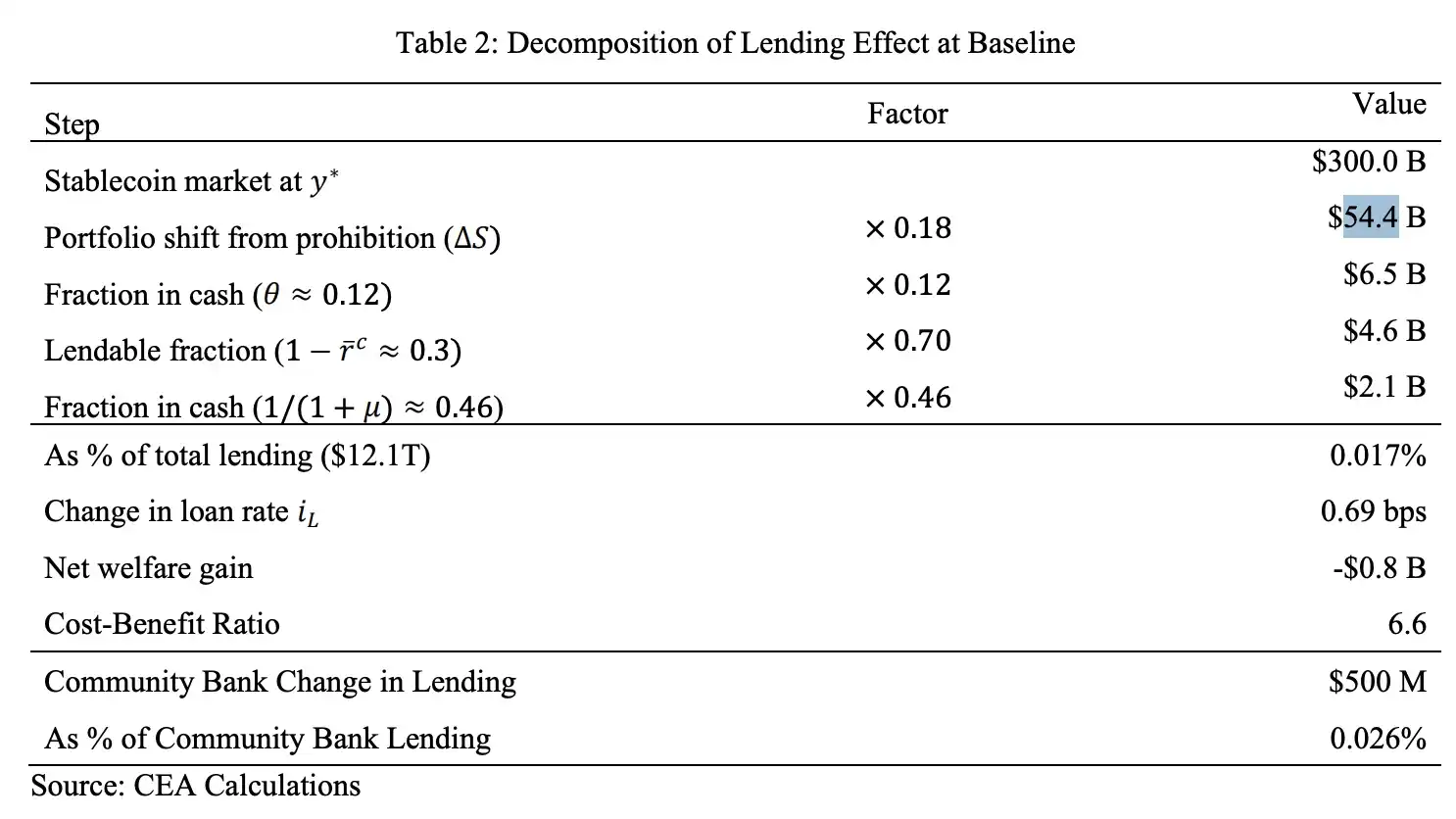
Second checkpoint: Out of this $54.4 billion, how much actually changes bank lending capacity? Only the 12% (in the case of USDC) portion, which is about $6.5 billion. The other 88% was circulating in the Treasury market before and after the ban, having no net impact on bank lending capacity.

Third checkpoint: Can the $6.5 billion entering banks be fully lent out? No. Banks need to hold reserves. The current effective reserve ratio in the U.S. banking system is about 30%, leaving 70% as lendable funds. Moreover, the Fed currently maintains an "ample reserves" framework, with banks collectively holding over $1 trillion in excess liquidity buffers—for every new dollar of lending capacity, ultimately less than 50 cents becomes a real loan, with the rest being actively absorbed by banks into their liquidity buffers.

After passing through these three checkpoints, $54.4 billion becomes $2.1 billion, only 0.02% of total loans (about $12 trillion).

Then calculate the cost on the other side: stablecoin holders lose the approximately 3.5% annualized yield they could have obtained, resulting in a net welfare loss of about $800 million per year.

In the CEA's words, the cost-benefit ratio of this ban is 6.6, meaning the cost is 6.6 times the benefit, making it very inefficient.

How Was That $1.5 Trillion Calculated?

Since the White House model gives $2.1 billion, where did the original $1.5 trillion come from?

The CEA traces its origins in the report. Nigrinis's (2025) estimate directly borrowed the model established by Whited, Wu, and Xiao (2023) for Central Bank Digital Currency (CBDC)—CBDC, as a liability of the Fed, would directly withdraw deposits from the commercial banking system; for every dollar entering, bank loans decrease by about 20 cents. Nigrinis directly applied this multiplier to the stablecoin scenario, while assuming stablecoins would expand massively after offering competitive yields, ultimately推算 (推算 - calculated/derived) the $1.5 trillion loan contraction.

The problem is, there is an essential difference between CBDC and stablecoins: CBDC is a central bank liability; deposits entering it leave the commercial banking system. The reserves of stablecoins mostly flow back to commercial banks through the Treasury market. Nigrinis's model did not track where this money went; it only saw deposits decreasing at one bank, not increasing at another.

This is the fundamental difference between partial equilibrium and general equilibrium. Mistaking the loss of one bank for the loss of the entire system naturally leads to an error of orders of magnitude.

Another Overlooked Account

The report specifically points out an effect not covered by the model but working in the opposite direction: stablecoins' overseas demand for U.S. Treasury bonds.

Over 80% of stablecoin transactions occur outside the U.S.,背后是 (behind which are) ordinary users in countries with unstable currencies using dollar stablecoins as savings tools. This group supports real demand for U.S. Treasury bonds; IMF data shows that the scale of U.S. Treasury bonds held by stablecoin issuers has surpassed that of Saudi Arabia. BIS research shows that every $3.5 billion inflow into stablecoins can depress the 3-month Treasury yield by 5 to 8 basis points. If the ban suppresses stablecoin adoption, this overseas demand channel contracts, U.S. Treasury financing costs rise, and this cost might directly offset that tiny increment on the bank lending side.

So, what does all this actually illustrate?

It's not that stablecoins have no impact on banks, but rather that the source of that impact, to a very large extent, is not "whether they can pay interest." The真正关键的 (truly crucial) thing is what proportion of the stablecoin issuer's reserves are placed in that must-be-100%-reserved lockbox. If regulations push this proportion higher in the future, the impact would才开始变得显著 (begin to become significant).

Regarding the ban on paying interest, for bank lending, the cost-benefit ratio is 6.6; for the stablecoin ecosystem, it cuts off its ability to provide competitive yields to ordinary users; for U.S. Treasury financing, it might even be counterproductive.

One piece of legislation, with no clear beneficiary, but with clear losers. This is what is truly thought-provoking about this report.


Трендовые криптовалюты

Связанные с этим вопросы

QWhat was the original claim made by economist Andrew Nigrinis regarding stablecoin interest and bank lending?

AAndrew Nigrinis claimed that if stablecoins could pay interest, bank loans could be reduced by $1.5 trillion.

QAccording to the White House CEA report, what is the estimated impact on bank lending from banning stablecoin interest payments?

AThe CEA report estimates that banning stablecoin interest payments would only increase bank lending by $2.1 billion, not $1.5 trillion.

QWhat is the key difference between a CBDC and a stablecoin that the CEA report highlights to explain the discrepancy in the estimates?

AThe key difference is that a CBDC is a central bank liability that removes deposits from the commercial banking system, while stablecoin reserves largely flow back into the commercial banking system through the Treasury market.

QWhat percentage of Circle's USDC reserves are held in Treasury bonds and repurchase agreements, according to the article?

A88% of Circle's USDC reserves are held in Treasury bonds and repurchase agreements.

QWhat unintended consequence does the article suggest could result from suppressing stablecoin adoption through an interest ban?

ASuppressing stablecoin adoption could reduce foreign demand for U.S. Treasury bonds, potentially increasing U.S. Treasury financing costs.

Похожее

Диалог с Далио: Сейчас мы находимся в пузыре ИИ, 1% моего инвестиционного портфеля — это биткоин

Источник: интервью Рэя Далио, основателя Bridgewater Associates, для подкаста "The Diary Of A CEO". Далио, предсказавший кризис 2008 года, обсуждает "большой цикл" — концепцию, охватывающую долговые проблемы, растущее неравенство и геополитические сдвиги. Он указывает, что текущий ажиотаж вокруг ИИ демонстрирует классические признаки пузыря, который может лопнуть из-за высокой долговой нагрузки, роста процентных ставок и чрезмерной эмиссии акций, что способно привести к рецессии. Для защиты личного капитала в неопределенные времена Далио советует диверсификацию: вместо хранения наличных инвестировать в акции, золото, облигации. Сам он держит около 1% портфеля в биткоине, считая его "твердыми деньгами", но предпочитает физическое золото из-за его статуса резервного актива и независимости от технологических рисков. Говоря о влиянии ИИ, Далио отмечает, что технология заменяет не только физический труд, но и элементы мышления, что увеличит разрыв между капиталом и трудом. Ключевыми останутся человеческие качества — эмоции и интуиция, а успеха добьются те, кто научится работать в партнерстве с ИИ. На геополитической арене, по его мнению, мир движется к регионализации с центрами в виде США и Китая. Вовлечение США в конфликты, подобные иранскому, обнажает снижение их абсолютного влияния. Внутренние вызовы, такие как дебаты о налогах на богатство, риск капитального бегства и низкая производительность, также ставят под вопрос стабильность традиционных держав в текущей фазе цикла.

marsbit1 ч. назад

Диалог с Далио: Сейчас мы находимся в пузыре ИИ, 1% моего инвестиционного портфеля — это биткоин

marsbit1 ч. назад

7.2 трлн вон за один день: иностранные инвесторы установили рекорд чистых покупок в пятницу! Уолл-Стрит: встречный ветер в плане ликвидности на южнокорейском рынке уже утих

Капиталы возвращаются на южнокорейский рынок акций. 31 июля иностранные инвесторы осуществили чистые покупки акций KOSPI на рекордные 7,2 трлн вон за один день, что стало самым высоким показателем в истории. По данным Citigroup, эта цифра знаменует собой кардинальный разворот после месяцев масштабного оттока средств нерезидентов. В июле чистые продажи иностранными инвесторами значительно сократились до 9,8 трлн вон по сравнению с 48,4 трлн и 44,5 трлн вон в июне и мае соответственно. Одновременно внутренние пенсионные и инвестиционные фонды в июле вернулись к чистым покупкам на 1,0 трлн вон. Дополнительным фактором снижения волатильности стали новые правила Комиссии по финансовым услугам (FSC), ужесточившие с 31 июля доступ розничных инвесторов к ETF с плечом на отдельные акции. После введения норм торговый оборот таких инструментов упал примерно вдвое. Citigroup сохраняет целевую точку для KOSPI на уровне 10000 пунктов, отмечая ослабление давления со стороны движения капиталов. Аналитики видят поддержку рынку в устойчивости фундаментальных показателей сектора чипов памяти, низких оценках KOSPI, сильной экономике и благоприятной политике властей, включая возможные меры по поддержке ликвидности.

marsbit1 ч. назад

7.2 трлн вон за один день: иностранные инвесторы установили рекорд чистых покупок в пятницу! Уолл-Стрит: встречный ветер в плане ликвидности на южнокорейском рынке уже утих

marsbit1 ч. назад

Как стать человеком, которого искусственный интеллект никогда не сможет заменить

В статье рассматривается вопрос о том, как остаться незаменимым в эпоху искусственного интеллекта. Автор утверждает, что вместо страха перед ИИ следует сосредоточиться на развитии качеств, которые машины не смогут заменить. Он критикует «зарплатное рабство» — зависимость от работы, не приносящей удовлетворения, и предлагает путь к финансовой независимости через создание собственного дела. Ключ к успеху — развитие пяти элементов: самостоятельности (агентности), вкуса, умения убеждать, упорства и способности к итерациям. Главное — не просто создавать что-либо (сегодня это может каждый), а создавать что-то ценное, востребованное и уметь это продвигать. Автор считает, что наиболее важным навыком будущего является создание контента (медиа), а не просто написание кода, поскольку ценность контента субъективна и требует уникального человеческого вкуса и суждения. ИИ может помочь в производстве, но не заменит оригинальность мысли и связь с аудиторией. В качестве практического шага предлагается упражнение: за 15 минут ответить на вопросы, чтобы обнаружить свои уникальные знания, опыт и точку зрения, которые станут основой для личного бренда и дела жизни. Первый шаг — немедленно опубликовать свою основную идею, чтобы получить обратную связь от реального мира и начать процесс роста. Цель — стать «непригодным для найма», построив жизнь вокруг собственного творчества и экспертизы.

marsbit3 ч. назад

Как стать человеком, которого искусственный интеллект никогда не сможет заменить

marsbit3 ч. назад

Благодаря броскам кубиков ключи от биткоинов хранятся в автономном режиме, но не все будут этим заниматься

Статья посвящена практике генерации сид-фраз для биткоин-кошельков с помощью бросков кубиков в свете уязвимости, обнаруженной в аппаратных кошельках Coldcard. Подчеркивается, что физический бросок кубика (дающий около 2.6 бит энтропии за бросок) создает высококачественную случайность, поскольку предсказать результат практически невозможно из-за множества переменных. Для создания стандартной сид-фразы из 12 слов (128 бит энтропии) требуется около 50 бросков, а для повышенной безопасности рекомендуется 99 и более. В связи с инцидентом Coldcard, когда неисправный генератор случайных чисел в прошивке (2021-2026 гг.) мог создавать предсказуемые ключи, выяснилось, что сид-фразы, сгенерированные вручную через кубики, были защищены от этой уязвимости. Однако исследование показало, что другие функции устройства (создание бумажных кошельков, ключей для мультиподписи, паролей и т.д.) по-прежнему использовали скомпрометированный генератор, подвергая риску владельцев даже с безопасной основной сид-фразой. Автор отмечает, что, хотя метод с кубиками криптографически надежен, он непрактичен для массового использования из-за трудоемкости, высокой вероятности ошибок при вводе и необходимости строгой дисциплины для сохранения секретности процесса. Делается вывод, что будущее безопасности лежит в создании надежных аппаратных генераторов случайных чисел и понятных интерфейсов, а ручные методы остаются нишевым инструментом для опытных пользователей. Владельцам Coldcard рекомендуется обновить прошивку и проверить/заменить все ключи, сгенерированные уязвимыми функциями.

cryptonews.ru6 ч. назад

Благодаря броскам кубиков ключи от биткоинов хранятся в автономном режиме, но не все будут этим заниматься

cryptonews.ru6 ч. назад

Торговля

Спот

Популярные статьи

Как купить HOUSE

Добро пожаловать на HTX.com! Мы сделали приобретение Housecoin (HOUSE) простым и удобным. Следуйте нашему пошаговому руководству и отправляйтесь в свое крипто-путешествие.Шаг 1: Создайте аккаунт на HTXИспользуйте свой адрес электронной почты или номер телефона, чтобы зарегистрироваться и бесплатно создать аккаунт на HTX. Пройдите удобную регистрацию и откройте для себя весь функционал.Создать аккаунтШаг 2: Перейдите в Купить криптовалюту и выберите свой способ оплатыКредитная/Дебетовая Карта: Используйте свою карту Visa или Mastercard для мгновенной покупки Housecoin (HOUSE).Баланс: Используйте средства с баланса вашего аккаунта HTX для простой торговли.Третьи Лица: Мы добавили популярные способы оплаты, такие как Google Pay и Apple Pay, для повышения удобства.P2P: Торгуйте напрямую с другими пользователями на HTX.Внебиржевая Торговля (OTC): Мы предлагаем индивидуальные услуги и конкурентоспособные обменные курсы для трейдеров.Шаг 3: Хранение Housecoin (HOUSE)После приобретения вами Housecoin (HOUSE) храните их в своем аккаунте на HTX. В качестве альтернативы вы можете отправить их куда-либо с помощью перевода в блокчейне или использовать для торговли с другими криптовалютами.Шаг 4: Торговля Housecoin (HOUSE)С легкостью торгуйте Housecoin (HOUSE) на спотовом рынке HTX. Просто зайдите в свой аккаунт, выберите торговую пару, совершайте сделки и следите за ними в режиме реального времени. Мы предлагаем удобный интерфейс как для начинающих, так и для опытных трейдеров.

704 просмотров всегоОпубликовано 2025.04.27Обновлено 2026.06.02

Как купить HOUSE

Обсуждения

Добро пожаловать в Сообщество HTX. Здесь вы сможете быть в курсе последних новостей о развитии платформы и получить доступ к профессиональной аналитической информации о рынке. Мнения пользователей о цене на HOUSE (HOUSE) представлены ниже.

活动图片












