The Person Who 'Killed' PayPal Wants to Buy It

比推Опубликовано 2026-02-24Обновлено 2026-02-24

Введение

A potential acquisition that could reshape the global payments landscape is under discussion, as Stripe—valued at $159 billion—is reportedly considering acquiring all or parts of PayPal, which has a market cap of just $43 billion. The news drove PayPal’s stock up nearly 7%. PayPal has faced significant challenges: its stock fell 46% over the past year amid rising competition from Apple Pay, Google Pay, and agile rivals like Adyen and Stripe. Despite its vast user network of 438 million active accounts and strong presence in cross-border transactions, PayPal has struggled to keep pace with shifting user behaviors and the rise of embedded and social payments. However, PayPal retains valuable assets, including Braintree (processing around $700 billion annually), Venmo (with 100 million monthly active users), and a deeply entrenched global payments infrastructure. A key underlying motive for the deal is stablecoins. PayPal launched its own stablecoin, PYUSD, adopting a centralized approach to digital currency. In contrast, Stripe has pursued an infrastructure-focused strategy, acquiring stablecoin infrastructure firm Bridge and launching “Open Issuance”—a platform that enables businesses to issue their own stablecoins. Stripe is also developing Tempo, a Layer-1 blockchain aimed at challenging traditional settlement networks like SWIFT. A combined Stripe-PayPal entity could create a powerful Web3 payment ecosystem, integrating PYUSD with Tempo’s fast, low-cost transactions and...

A transaction that could rewrite the global payment industry landscape is quietly brewing.

On February 24, Bloomberg reported: Private payment giant Stripe, led by the Collison brothers, is considering acquiring all or part of the business of the veteran payment pioneer PayPal. On the day the news broke, PayPal's stock price surged nearly 7%.

One is a private unicorn valued at $159 billion, the other is a former king with a market cap of only $43 billion but a vast user network. Behind this potential deal lies not just a shift in market share, but a deeper game about the future form of payments—especially crypto/stablecoin payments.

PayPal's Dilemma and Trump Cards

To understand why this potential deal has caused such a stir, first look at two sets of numbers.

Over the past 12 months, PayPal's stock price has fallen nearly 46%, with its market capitalization hovering around $40 billion. Meanwhile, the yet-to-be-publicly-listed Stripe recently valued itself at $159 billion in an employee stock buyback—the former is less than a third of the latter.
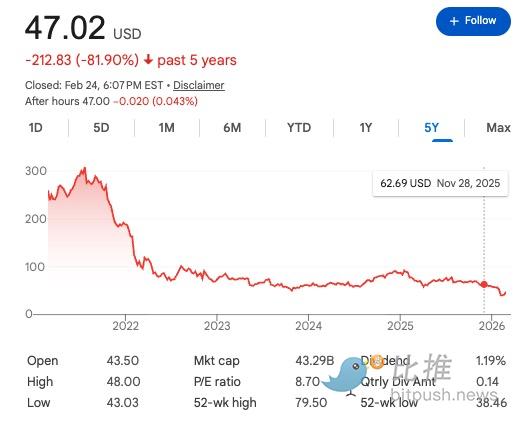
Behind this inversion is PayPal's business being squeezed from multiple dimensions.

The competitive landscape has long been turned upside down. Apple Pay and Google Pay have locked down the consumer entry point via mobile operating systems, while new forces like Adyen and Stripe are constantly encroaching on the territory with their technical flexibility on the business side. PayPal, which once made its name as a "third-party guarantor," is gradually losing the scarcity of being a connector in an era of increasingly diversified payment entry points.
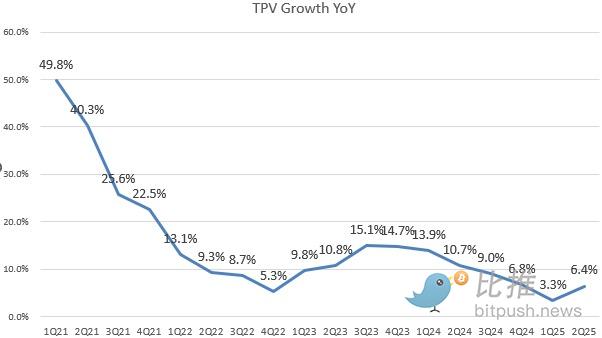
User habits are also quietly evolving. With the explosion of social payments and embedded finance, people prefer to complete transactions at the moment of consumption rather than jumping to a heavy third-party page. Whether it's Stripe's one-click payment or Apple Pay's biometrics, they seem more convenient than that blue icon interface that requires remembering a password. Although PayPal holds the social ace Venmo, it has always struggled to convert it into a commercial engine.

The most fundamental pain point is the loss of market confidence in its growth potential. In the old world of fiat payments, PayPal's imagination has nearly reached its ceiling; in its foray into crypto, it launched the stablecoin PYUSD but was criticized for being "compliant but lacking endogenous transaction demand," failing to penetrate the DeFi ecosystem or create unique value in its own B2B cross-border scenarios.

However, despite its beleaguered fundamentals, PayPal still holds several "chips" that tech giants covet.
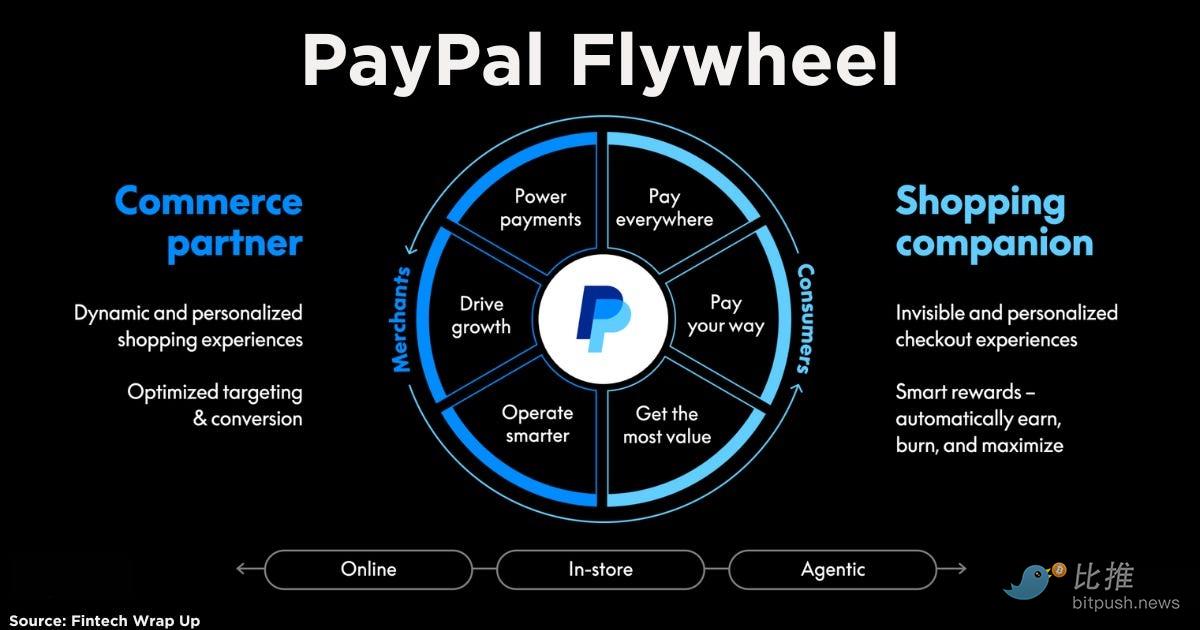
First is Braintree, processing about $700 billion in payments annually, valued by Bernstein at $10 to $15 billion. If acquired, Stripe's total payment volume would jump to $2.1 trillion, widening the gap in competition with rivals like Adyen.

Second is Venmo, a P2P app with over 100 million monthly active users, valued at about $5 billion. For Stripe, which has long "stayed behind the scenes," this is a valuable consumer touchpoint: a form of "last-mile visibility."

Third is a global network沉淀 (precipitated) over nearly three decades: clearing infrastructure deeply embedded in cross-border trade across more than 200 countries, and 438 million active accounts with real card bindings and credit history. Although it appears old, it is the most stable bridge to the global commercial periphery. PayPal recently launched the PayPal World plan, potentially reaching over 2 billion users through partnerships with Tenpay, UPI, etc. This "interoperability" connecting Eastern and Western payment systems is precisely the strategic entry ticket that is difficult for any competitor to replicate.

Nearly three decades of accumulation have not been in vain. It's just a pity that the one who best knows how to use this ticket may no longer be PayPal itself.

Stablecoins Become the Hidden Main Line

However, a word repeatedly mentioned by Wall Street analysts reveals the deeper ambition of this deal: stablecoins.

"A combined Stripe and PayPal could become a significant player in the stablecoin space, as stablecoins are increasingly becoming a more critical part of global commerce," Mizuho analyst Dan Dolev said bluntly.

Looking at the actions of both companies over the past two years, it's not hard to see that cryptocurrency—especially stablecoins—has become a future they are both betting on. But their strategic paths are截然不同 (distinctly different).

PayPal has chosen a path of "controlling the network with a coin," its underlying logic继承 (inheriting) and延续 (continuing) the centralized thinking of the SWIFT era. PayPal crafted PYUSD as a carefully designed "digital dollar." When ordinary consumers see PYUSD in their PayPal wallet, they don't need to understand whether it's a digital currency or fiat, nor whether the underlying settlement is blockchain or the traditional banking system. The familiar UI interface makes the digital currency just another foreign currency type. PayPal aims to extend the advantages of its payment network to the on-chain world, thereby building a closed-loop ecosystem centered on PYUSD. In April this year, it even launched a "PYUSD Hold Rewards Program," offering users a 3.7% annualized yield, hoping to drive growth in cross-border payment business through stablecoin transaction volume.
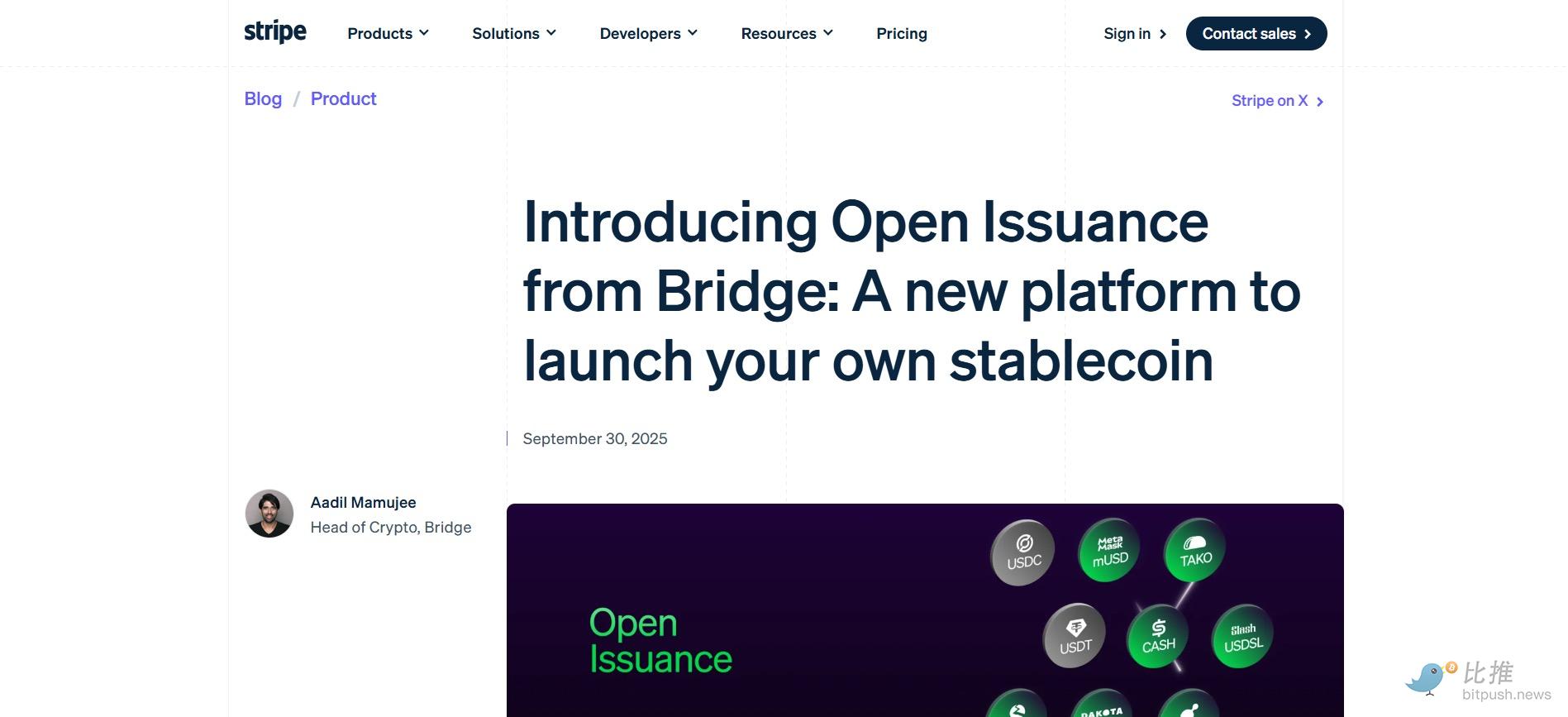
Stripe's layout is more systematic. In 2024, it acquired stablecoin infrastructure company Bridge for $1.1 billion, its largest acquisition to date. But the true ambition only became fully apparent with the launch of its "Open Issuance" platform—it is not fully betting on issuing its own stablecoin but is striving to become the "arsenal" in the stablecoin payment field, empowering other enterprises to issue, manage, and use stablecoins by building powerful infrastructure and developer tools.

The core of "Open Issuance" is that every enterprise can issue its own stablecoin through Stripe and enjoy reserve interest income. This "issuance as a service" model cleverly shifts value capture: while other traditional stablecoin issuers are still calculating basis point spreads, Stripe abandons reliance on reserve interest and instead builds a new profit model based on service fees. It shifts the value focus from "issuance" to "distribution."
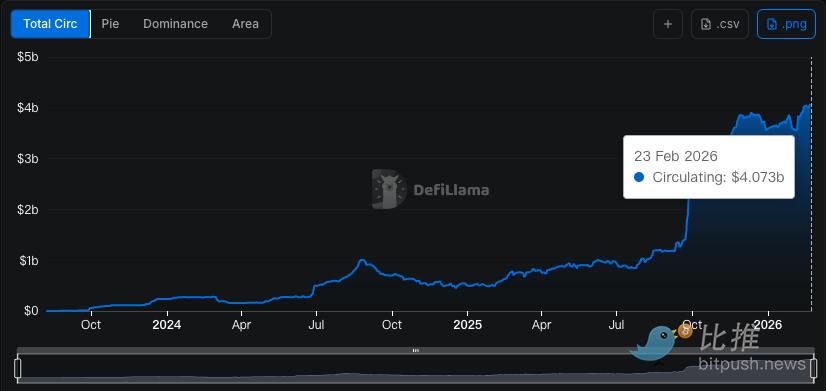
The most critical piece is Tempo. Stripe is building this Layer 1 public chain focused on payments in partnership with Paradigm, targeting traditional clearing networks like SWIFT. Overlaying these two strategic maps, the logic behind Stripe's potential acquisition of PayPal becomes clearer: Stripe has the future-facing on-chain payment infrastructure (Tempo, Open Issuance), while PayPal has a ready-made user network (400 million accounts) and a market-tested stablecoin product (PYUSD).

If PYUSD is connected to the Tempo chain, leveraging its sub-second confirmation and low-cost features, and then reaching hundreds of millions of consumers through Venmo, a "Web3 payment closed loop"游离 (operating) outside the traditional banking clearing system would become a reality for the first time. This is not just complementary at the product level but a dimensional reduction strike on the existing global financial infrastructure.

An even more imaginative scenario is AI Agent payments. Unlike the traditional banking system, an AI Agent can have its own crypto wallet address, through which it can receive, store, and send funds. This makes automatic清算 (clearing) between AIs very convenient and efficient, especially suitable for micro-payment scenarios that are small in amount and have transaction context. The x402 payment protocol launched by Stripe this year is paving the way for this future—allowing developers to conduct automatic machine-to-machine settlements via the Base chain using USDC, expanding the payment scenario from "person-to-person" to "machine-to-machine." And PayPal's 400 million accounts are恰好 (precisely) the ideal "withdrawal exit" for these AI Agents.

Regulatory and Integration Challenges

Of course, the final落地 (landing) of this deal still faces huge uncertainties. Insiders emphasized that discussions are still in the early stages, and whether an agreement can be reached is still unknown.

Regulation is the sword of Damocles hanging overhead. The combination of two payment giants (combined TPV nearly $3.7 trillion) will inevitably attract high attention from antitrust agencies. Raymond James analysts believe potential acquirers could include large tech companies like Alphabet, Meta, Microsoft, Amazon, and Apple, but the feasibility of a deal is questionable given the limited financial information available for the private company Stripe.

Furthermore, the difficulty of cultural integration should not be underestimated. Stripe is known for its geek culture and developer-friendly approach, with co-founder John Collison recently stating the company is "in no rush to go public"; while PayPal is a publicly listed company with 400 million C-end users. How to reconcile these two截然不同 (distinctly different) genes will be a challenge the Collison brothers must face.

Even so, the rumor itself is symbolic enough. It marks that the global payment industry is undergoing a profound revaluation: the scale of the old era is no longer a moat, and the infrastructure capability面向未来 (facing the future) is becoming the key weight determining discourse power.

For Stripe, if the acquisition of PayPal succeeds, it will be an intergenerational "snake swallowing an elephant"; if it fails, at least the market has seen its ambition: it not only wants to become the payment base of the internet but also wants to become the rule-maker of the next generation of the financial world.

Author: Coconut Shell


Twitter:https://twitter.com/BitpushNewsCN

Bitpush TG Discussion Group:https://t.me/BitPushCommunity

Bitpush TG Subscription: https://t.me/bitpush

Original link:https://www.bitpush.news/articles/7614231

Связанные с этим вопросы

QWhat is the potential impact of Stripe's rumored acquisition of PayPal on the global payments industry?

AThe acquisition could reshape the global payments landscape by combining Stripe's modern infrastructure and focus on crypto/stablecoin payments with PayPal's vast user network and cross-border capabilities, potentially creating a dominant force in both traditional and next-generation financial systems.

QWhy is PayPal's market valuation significantly lower than Stripe's despite its larger user base?

APayPal's valuation is lower due to declining investor confidence in its growth potential, increased competition from Apple Pay, Google Pay, and Adyen, and its struggle to adapt to evolving user habits and emerging technologies like embedded finance and crypto payments.

QWhat strategic assets does PayPal possess that make it attractive for acquisition?

APayPal holds valuable assets including Braintree (processing $700B annually), Venmo (100M monthly active users), a global network spanning 200+ countries, 438M active accounts, and deep cross-border payment infrastructure through initiatives like PayPal World.

QHow do Stripe and PayPal differ in their approaches to stablecoin and cryptocurrency integration?

APayPal adopts a 'coin-controlled network' approach with its PYUSD stablecoin, focusing on a centralized ecosystem, while Stripe pursues an infrastructure strategy with its 'Open Issuance' platform and Tempo blockchain, enabling businesses to issue stablecoins and capture value through service fees rather than reserve interest.

QWhat are the major challenges facing a potential acquisition of PayPal by Stripe?

AKey challenges include regulatory antitrust scrutiny due to the combined $3.7T total payment volume, cultural integration between Stripe's developer-focused private company ethos and PayPal's public consumer-facing structure, and the uncertainty of deal feasibility given Stripe's private financial status.

Похожее

Индекс Sci-Tech Innovation 50 вырос на 10.73%: почему китайские акции показали «V-образный разворот»?

После нескольких дней снижения китайский фондовый рынок продемонстрировал сильный отскок. 21 июля основные индексы пережили V-образный разворот и резко выросли. Индекс STAR 50 подскочил на 10.73%, достигнув максимального однодневного роста за год. Шанхайский композитный индекс вырос на 1.79%, индекс Shenzhen Component — на 4.81%, а индекс ChiNext — на 7.05%. Объем сделок на трех биржах составил 2.97 трлн юаней. Более 3100 акций выросли в цене, свыше 100 достигли лимита роста. Ведущей силой восстановления стал сектор полупроводников, где активно росли акции компаний, занимающихся оборудованием, памятью, кремниевыми пластинами и HBM. Соответствующие тематические ETF также показали резкий рост. Сильный отскок рынка объясняется сочетанием трех факторов. Во-первых, на рынок вышли различные источники финансирования, включая "государственные фонды", страховые компании, а также выкуп акций компаниями и управляющими фондами. Это укрепило ликвидность и доверие инвесторов. Во-вторых, регуляторы, в частности председатель Комиссии по ценным бумагам Китая, заявили о приверженности поддержанию стабильности рынка. В-третьих, стабилизация и восстановление зарубежных рынков, особенно в Южной Корее, создали благоприятную внешнюю среду. Аналитики полагают, что наиболее паническая фаза для технологического сектора, вероятно, уже позади. Хотя краткосрочные колебания могут сохраниться, фундаментальные тренды, такие как спрос на вычисления для ИИ и импортозамещение в полупроводниковой отрасли, остаются неизменными. Среднесрочная динамика будет зависеть от новых отраслевых стимулов и подтверждения результатов компаний во время сезона отчетности.

marsbit6 мин. назад

Индекс Sci-Tech Innovation 50 вырос на 10.73%: почему китайские акции показали «V-образный разворот»?

marsbit6 мин. назад

Акции технологических компаний с импульсом показали крупнейший в истории рост за один день, но завершился ли обвал?

Технологические акции с высоким моментом (momentum stocks) в США продемонстрировали рекордно сильный однодневный рост во вторник, 21 июля. Индекс модности TMT Morgan Stanley вырос более чем на 12%, что стало самым большим суточным скачком в истории, превысив даже показатели периода пузыря доткомов в 2000 году. Ключевым драйвером выступили полупроводники: индекс Philadelphia Semiconductor Index подскочил на 4,6%. Этот резкий отскок произошел после трехдневного падения и кумулятивного снижения акций с моментом на 33%, которое стало одним из самых сильных со времен краха доткомов. Основной причиной роста стала "паническая скупка" (short squeeze), когда инвесторы, игравшие на понижение, были вынуждены закрывать свои позиции, создавая восходящую спираль. Однако внутренняя структура рынка остается слабой: объемы торгов были низкими, а в индексе S&P 500 количество падающих акций превышало количество растущих, что указывает на узкий, а не широкий характер восстановления. Мнения аналитиков разделились. Стратег BTIG Джонатан Крински предупреждает, что рост достиг ключевого уровня сопротивления, и рекомендует фиксировать прибыль, ожидая скорой остановки ралли. С другой стороны, аналитики Goldman Sachs и UBS считают, что распродажа активов с моментом подходит к концу, и видят возможность для постепенного увеличения позиций, особенно в акциях, связанных с ИИ. Дальнейшая динамика будет сильно зависеть от сезона корпоративных отчетов, ключевым событием которого станут результаты Alphabet (GOOGL) и ее ориентиры по капитальным затратам. Потенциальной угрозой для рынка акций остается рынок облигаций: доходности гособлигаций США растут, отчасти из-за роста цен на нефть, и их дальнейший рост может оказать давление на фондовый рынок. Таким образом, несмотря на впечатляющий однодневный рост, сохраняется значительная неопределенность относительно того, закончилась ли коррекция.

marsbit12 мин. назад

Акции технологических компаний с импульсом показали крупнейший в истории рост за один день, но завершился ли обвал?

marsbit12 мин. назад

Акции технологического импульса в США установили рекордный однодневный рост, но закончился ли обвал?

Акции технологических компаний с высоким импульсом («моментум») на рынке США показали рекордный рост во вторник, 21 июля. Индекс TMT-моментум Morgan Stanley вырос более чем на 12%, что стало самым большим однодневным скачком в истории. Причиной столь резкого роста стал эффект «сжатия коротких позиций» (short squeeze), когда продавцы, открывшие короткие позиции на фоне предыдущего падения импульсных акций на 33%, были вынуждены их закрывать, подпитывая восходящую динамику. Однако аналитики отмечают, что внутренняя структура рынка остается слабой: объемы торгов были низкими, а при общем росте индекса S&P 500 количество падающих акций превышало количество растущих. Это указывает на то, что восстановление затронуло лишь узкий круг наиболее популярных бумаг, таких как акции полупроводниковых компаний (индекс Philadelphia Semiconductor Index вырос на 4.6%). Стратеги разделились в оценках перспектив. BTIG советует сокращать позиции на росте, считая, что индекс импульсных акций уперся в ключевой уровень сопротивления. Напротив, Goldman Sachs и UBS полагают, что волна распродаж близка к завершению, и рекомендуют постепенно наращивать позиции. Ключевым фактором для определения устойчивости восстановления станут корпоративные отчеты. Особое внимание рынка приковано к отчету Alphabet (GOOGL) и новым прогнозам по капитальным затратам, которые дадут сигнал о перспективах инвестиций в ИИ. Одновременно фондовый оптимизм омрачается ростом доходности гособлигаций США и цен на нефть, что создает макроэкономические риски. Таким образом, несмотря на впечатляющий однодневный отскок, волатильность на рынке, вероятно, сохранится.

链捕手15 мин. назад

Акции технологического импульса в США установили рекордный однодневный рост, но закончился ли обвал?

链捕手15 мин. назад

Bitcoin подает 3 сигнала макро-дна — Но сможет ли BTC достичь $70 тыс.?

Рынок переходит от обсуждения локального дна к поиску макро-дна для биткоина. Аналитик Али Мартинес указывает на появление трех технических сигналов, исторически совпадавших с макро-низами циклов: месячный RSI около 43.65, осциллятор Чанде (CMO) на уровне -71 и цена рядом со скользящей средней за 50 месяцев. Эта комбинация наблюдалась в 2015, 2019 и 2022 годах, каждый раз предшествуя масштабным ралли. Несмотря на прорыв выше $66 000 и оптимистичные технические сигналы, ключевым испытанием остается ликвидность. Доминирование стейблкоинов растет, но их общая капитализация снизилась более чем на $10 млрд за месяц. Данные показывают отток стейблкоинов с бирж в течение 35 дней подряд при отсутствии значительного накопления биткоина на спотовом рынке. Таким образом, хотя техническая картина указывает на формирование макро-дна, для уверенного движения к $70 000 требуется приток свежей ликвидности, который пока отсутствует.

ambcrypto19 мин. назад

Bitcoin подает 3 сигнала макро-дна — Но сможет ли BTC достичь $70 тыс.?

ambcrypto19 мин. назад

Вечно вместе и снова порознь: Когда L1 становится собственным Rollup, что ждет Ethereum в финале?

Стремясь решить проблему масштабируемости, Ethereum изначально принял стратегию, где L1 выступает в качестве безопасного, но дорогого уровня расчетов, а Rollup на L2 предоставляют дешевое пространство для выполнения транзакций. Однако по мере того, как L1 сам развивает свои возможности (увеличение лимита газа, безсостоятельность, zkEVM), его пропускная способность значительно возрастает. Это ставит под вопрос уникальную ценность L2, основанную лишь на низкой стоимости транзакций. В ответ Ethereum пересматривает отношения между L1 и L2. L1 должен стать мощным, устойчивым глобальным хабом для расчетов, общего состояния и ликвидности. Роль L2 смещается от простого расширения к предоставлению дифференцированных функций, таких как оптимизация под конкретные приложения, конфиденциальность или гибкие модели управления, формируя спектр сред выполнения с разной степенью наследования безопасности Ethereum. Ключевой вызов фрагментированной многокомпонентной экосистемы — взаимодействие. Улучшение пользовательского опыта сосредоточено на нативной абстракции аккаунтов (например, EIP-7702) и межоперабельности. Цель — позволить Ethereum «снова ощущаться как единый блокчейн». Это включает в себя фреймворки интентов (intents), такие как Open Intents Framework, и протоколы межоперабельности (Ethereum Interop Layer), которые упрощают кросс-чейн взаимодействия. Сокращение времени финализации транзакций на L1 с минут до секунд также критически важно для эффективной работы мостов и приложений. Интригующая перспектива, выдвинутая исследователями, — это возможная конвергенция архитектур L1 и L2. С внедрением систем доказательств (например, zkEVM) на основном уровне, валидаторы L1 могут начать проверять состояние с помощью доказательств, а не повторного выполнения, что делает сам Ethereum в некотором роде «своим собственным Rollup». Одновременно концепция Native Rollup предполагает более тесную интеграцию проверки L2 в протокол L1. Это может привести к размытию четких границ между уровнями, превратив Ethereum в единую систему консенсуса с множеством специализированных сред выполнения (доменов), которые разделяют общую основу безопасности, ликвидность и надежную синхронизацию состояния. Таким образом, эволюция Ethereum движется от разделения выполнения для масштабирования к повторной интеграции разрозненных компонентов в единую, но разнородную экосистему. Итогом может стать не иерархия L1/L2, а сеть взаимосвязанных сред, которые вместе образуют целостный и мощный Ethereum.

链捕手30 мин. назад

Вечно вместе и снова порознь: Когда L1 становится собственным Rollup, что ждет Ethereum в финале?

链捕手30 мин. назад

Торговля

Спот
活动图片