The Cycle Without A Ceiling: Why Bitcoin’s Missing Peak Rewrites The Rules For The 2026 Bottom

bitcoinistОпубликовано 2026-02-14Обновлено 2026-02-14

Введение

Bitcoin remains below $70,000 amid persistent selling pressure and cautious market sentiment, with analysts warning a deeper correction below $60,000 is possible. However, a CryptoQuant report suggests Bitcoin may be nearing an undervalued zone based on on-chain metrics. The MVRV ratio is around 1.1, approaching levels historically linked to accumulation phases. Unlike previous cycles, Bitcoin did not reach extreme overvaluation before correcting, meaning this downturn may not mirror past capitulation patterns. Technically, Bitcoin shows a bearish structure with lower highs and lows, trading below key moving averages. The $60,000 level is critical; reclaiming $70,000 is necessary for any sustained recovery.

Trusted Editorial content, reviewed by leading industry experts and seasoned editors. Ad Disclosure

Bitcoin continues to struggle below the $70,000 level, with repeated attempts to regain upward momentum meeting persistent selling pressure. The inability to sustain rallies has kept market sentiment cautious, and several analysts are increasingly warning that a deeper correction below $60,000 remains possible if current conditions persist. Volatility has risen in recent weeks, while liquidity conditions appear tighter, contributing to a defensive posture among both retail and institutional participants.

Despite this fragile backdrop, a recent CryptoQuant report offers a more nuanced perspective on the current phase. According to the analysis, Bitcoin has been trending downward for roughly four months following its all-time high reached in October 2025. While price action reflects sustained weakness, the report suggests the market may now be approaching what could be considered an undervalued zone from an on-chain valuation standpoint.

Such phases have historically emerged during later stages of corrective cycles, when market participants gradually reassess positioning and speculative excesses are reduced. Although this does not necessarily signal an immediate rebound, it introduces the possibility that downside risk may begin to moderate if broader liquidity conditions stabilize.

MVRV Signals Bitcoin Approaching Potential Undervaluation Zone

The report further notes that valuation metrics are beginning to approach levels historically associated with accumulation phases. The Market Value to Realized Value (MVRV) ratio, a widely followed on-chain indicator, is currently near 1.1. Traditionally, readings below 1 have signaled that Bitcoin is trading below its aggregate cost basis, a condition often interpreted as undervaluation. While the indicator has not yet crossed that threshold, its proximity suggests the market may be entering a zone where downside risk gradually compresses.
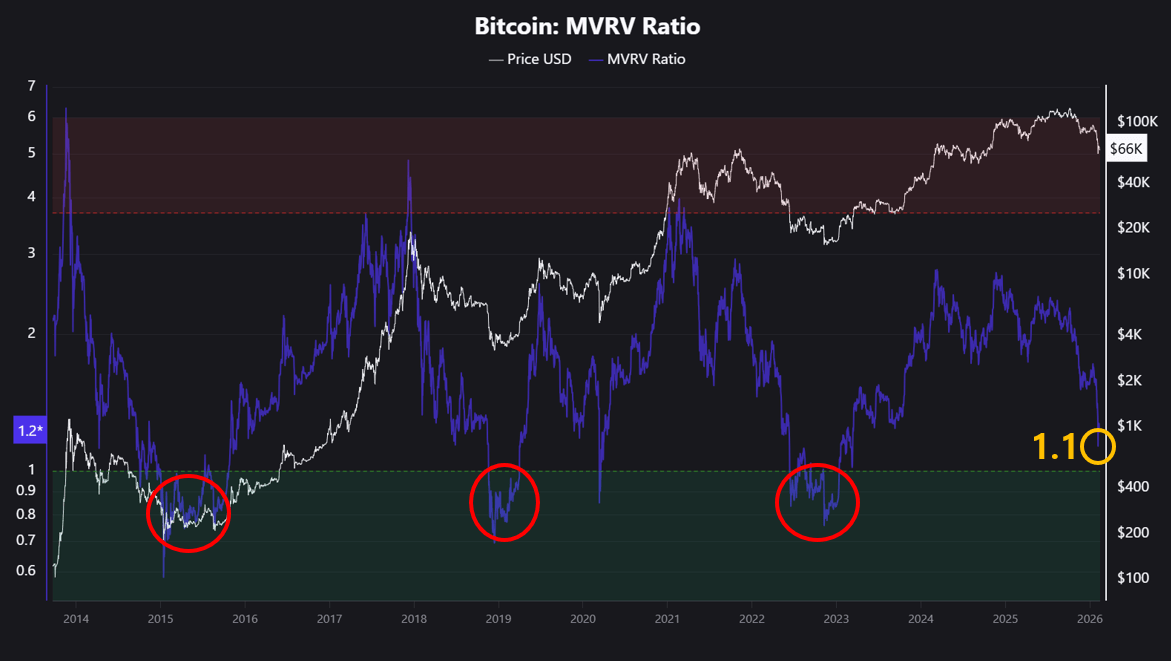
Bitcoin MVRV Ratio | Source: CryptoQuant

At the same time, analysts emphasize an important structural distinction from previous cycles. Unlike earlier bull markets, Bitcoin did not surge deep into a clearly overheated valuation zone before the recent correction began. This implies the current drawdown may not follow the same capitulation dynamics seen in prior bear market bottoms, complicating direct historical comparisons.

From a strategic standpoint, the analysis suggests that periods of market weakness often provide the most effective window for long-term positioning. For assets with a persistent upward macro trajectory, preparation during downturns tends to improve risk-adjusted outcomes. However, this does not eliminate near-term volatility risks, particularly while macro liquidity conditions remain uncertain and sentiment continues to shift.

Bitcoin Struggles Below Key Averages As Bearish Momentum Persists

Bitcoin price action continues to show persistent weakness, with the chart illustrating a clear sequence of lower highs and lower lows since the late-2025 peak near the $120K–$125K region. The recent breakdown below the $70K level reinforces the bearish structure, particularly as price remains well below the 50-week and 100-week moving averages, both of which are now sloping downward. This alignment typically reflects sustained distribution rather than a temporary correction.
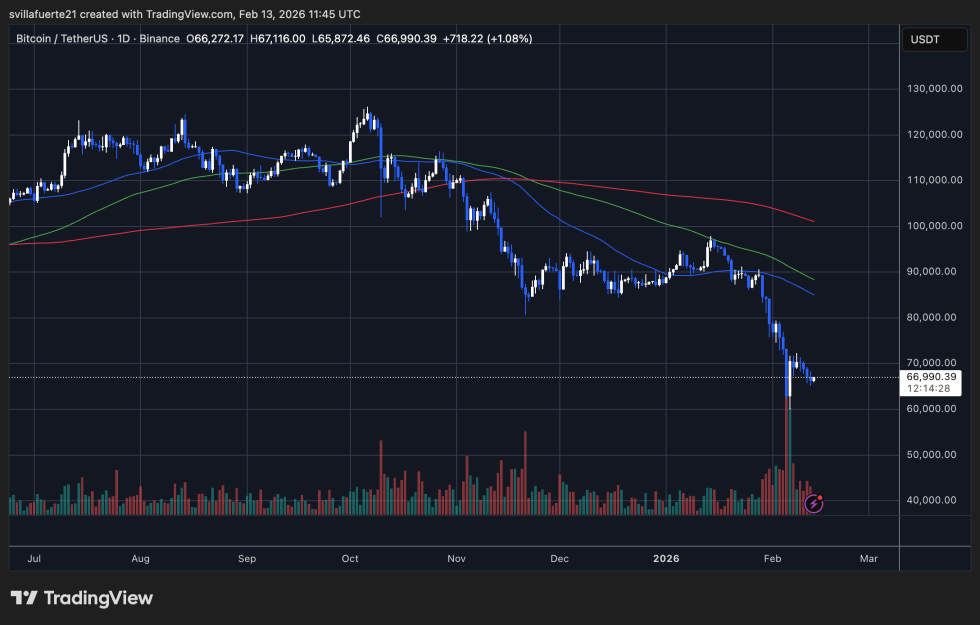
BTC testing critical price level | Source: BTCUSDT chart on TradingView

The sharp selloff into the mid-$60K area was accompanied by a noticeable spike in trading volume, suggesting forced liquidations or aggressive spot selling rather than routine profit-taking. While price has attempted minor stabilization around the $65K–$68K range, the lack of strong rebound momentum indicates buyers remain cautious. Historically, such muted recoveries after high-volume declines often signal ongoing market uncertainty rather than immediate reversal.

From a structural standpoint, the next critical technical focus lies near the $60K psychological level, which could act as interim support if selling pressure continues. Conversely, any sustained recovery would first require reclaiming the $70K zone and stabilizing above key moving averages. Until that occurs, the broader trend remains defensive, with volatility likely to persist as the market searches for a clearer equilibrium.

Featured image from ChatGPT, chart from TradingView.com 

Editorial Process for bitcoinist is centered on delivering thoroughly researched, accurate, and unbiased content. We uphold strict sourcing standards, and each page undergoes diligent review by our team of top technology experts and seasoned editors. This process ensures the integrity, relevance, and value of our content for our readers.

Sebastian Villafuerte

Follow

Sebastian's journey into the world of crypto began four years ago, driven by a fascination with the potential of blockchain technology to revolutionize financial systems. His initial exploration focused on understanding the intricacies of various crypto projects, particularly those focused on building innovative financial solutions. Through countless hours of research and learning, Sebastian developed a deep understanding of the underlying technologies, market dynamics, and potential applications of cryptocurrencies. As his knowledge grew, Sebastian felt compelled to share his insights with others. He began actively contributing to online discussions on platforms like X and LinkedIn, focusing on fintech and crypto-related content. His goal was to expose valuable trends and insights to a wider audience, fostering a deeper understanding of the rapidly evolving crypto landscape. Sebastian's contributions quickly gained recognition, and he became a trusted voice in the online crypto community. To further enhance his expertise, Sebastian pursued a UC Berkeley Fintech: Frameworks, Applications, and Strategies certification. This rigorous program equipped him with valuable skills and knowledge regarding Financial Technology, bridging the gap between traditional finance (TradFi) and decentralized finance (DeFi). The certification deepened his understanding of the broader financial landscape and its intersection with blockchain technology. Sebastian's passion for finance and writing is evident in his work. He enjoys delving into financial research, analyzing market trends, and exploring the latest developments in the crypto space. In his spare time, Sebastian can often be found immersed in charts, studying 10-K forms, or engaging in thought-provoking discussions about the future of finance. Sebastian's journey as a crypto analyst and investor has been marked by a relentless pursuit of knowledge and a dedication to sharing his insights. His ability to navigate the complex world of crypto, combined with his passion for financial research and communication, makes him a valuable asset to the industry. As the crypto landscape continues to evolve, Sebastian remains at the forefront, providing valuable insights and contributing to the growth of this revolutionary technology.

Full Profile

Related Posts

Brazil Revives Strategic Bitcoin Reserve Plan Targeting Purchase Of Up To 1 Million BTC

Bitcoin Stares Down the $55,000 Floor: The Last Bastion Before On-Chain Capitulation

This Key Bitcoin Metric Signals That The Downside May Persist A Bit Longer

¿Por qué BTC es tan volátil y qué tiene que ver con su tecnología?

Bitcoin Developers Kick Off Quantum-Safety Track With BIP-360

Bitcoin Selloff Drew Spot Volume, But Demand Lacked Follow-Through: Glassnode

Связанные с этим вопросы

QWhat is the current MVRV ratio for Bitcoin and what does it indicate about market valuation?

AThe Market Value to Realized Value (MVRV) ratio is currently near 1.1. This proximity to the threshold of 1 suggests Bitcoin may be entering a potential undervaluation zone, as readings below 1 historically signal that Bitcoin is trading below its aggregate cost basis.

QHow does the current Bitcoin price action differ from previous cycle corrections according to the analysis?

AUnlike previous bull markets, Bitcoin did not surge deep into a clearly overheated valuation zone before the correction began. This structural distinction means the current drawdown may not follow the same capitulation dynamics seen in prior bear market bottoms, complicating historical comparisons.

QWhat are the key technical levels to watch for Bitcoin's price recovery according to the chart analysis?

AThe $60K psychological level is critical as interim support if selling continues. For sustained recovery, Bitcoin would need to reclaim the $70K zone and stabilize above key moving averages, particularly the downward-sloping 50-week and 100-week moving averages.

QWhat does the volume spike during the selloff to mid-$60K suggest about market dynamics?

AThe sharp selloff into the mid-$60K area was accompanied by a noticeable spike in trading volume, suggesting forced liquidations or aggressive spot selling rather than routine profit-taking, indicating significant market stress.

QWhat strategic opportunity does the analysis suggest during this market phase?

AThe analysis suggests that periods of market weakness often provide the most effective window for long-term positioning. For assets with a persistent upward macro trajectory like Bitcoin, preparation during downturns tends to improve risk-adjusted outcomes despite near-term volatility risks.

Похожее

Former Bankless Member Lucas: Why I Still Bullish on Ethereum

Former Bankless member Lucas explains why he remains bullish on Ethereum despite widespread pessimism. He acknowledges ETH's poor price performance over the past five years compared to Bitcoin and traditional markets, but draws parallels to historical multi-year consolidations seen in tech giants like Amazon and NVIDIA before major breakouts. Fundamentally, Ethereum is stronger than ever: record-high daily transactions (2.27 million in May 2026), significantly lower average gas fees ($0.27), over 400 million total addresses, and more than 32% of ETH staked, securing the network. Lucas's core thesis remains unchanged: all valuable assets will eventually be tokenized, Ethereum will become the primary settlement layer for these assets, and ETH will capture the resulting value. This transition is already underway. Stablecoins, the first proven tokenized real-world asset (RWA), have a $300+ billion market cap, with 54% settled on Ethereum. The broader RWA sector has surpassed $30 billion, with over 53% deployed on Ethereum. He compares the current RWA adoption phase to early DeFi in 2019-20, suggesting immense growth potential. Key catalysts like the potential passage of the U.S. CLARITY Act in 2026 could accelerate institutional adoption. While other blockchains will share the market, Lucas argues that traditional finance prioritizes Ethereum's security, stability, and established ecosystem for trillion-dollar asset tokenization. He concludes that as global assets migrate on-chain, the market will reprice ETH accordingly.

foresightnews_api3 мин. назад

Former Bankless Member Lucas: Why I Still Bullish on Ethereum

foresightnews_api3 мин. назад

Trump's 'Bitcoin Retirement Plan' Hits Roadblock: Democrats Claim It Endangers American Workers' Pensions?

Democratic Senators Bernie Sanders (I-VT) and Elizabeth Warren (D-MA), along with Rep. Bobby Scott (D-VA), are urging the Labor Department to repeal a proposed rule that would open U.S. retirement savings accounts, like 401(k) plans, to investments in Bitcoin and other cryptocurrencies. In a letter to Acting Labor Secretary Keith Sonderling, they argue the rule would endanger workers' financial futures and contradicts long-standing legal precedents under the Employee Retirement Income Security Act (ERISA). The rule, stemming from a Trump executive order, would shift the legal standard for plan fiduciaries. Instead of requiring them to prove they conducted due diligence on volatile assets, it would presume prudence if they followed a specified process. The lawmakers warn this exposes the $14.2 trillion in 401(k) savings to highly volatile and less-regulated assets, citing FINRA warnings on crypto's risks and FBI data on massive crypto scam losses. The letter also alleges a conflict of interest, noting that President Trump's adult children manage the family's crypto business, which has raised billions. They claim the rule could allow the Trump family to profit at the expense of workers and retirees. Consumer advocates echo concerns that it could turn retirement savings into a lifeline for a risky industry. The Trump administration defends the rule as expanding worker choice, with officials stating it ends the department "picking winners and losers" and requires fiduciaries to follow a prudent process.

foresightnews_api6 мин. назад

Trump's 'Bitcoin Retirement Plan' Hits Roadblock: Democrats Claim It Endangers American Workers' Pensions?

foresightnews_api6 мин. назад

Rules Change Mid-Game, Polymarket’s Billion-Dollar Bitcoin Prediction Market Mired in Settlement Controversy

A nearly $150 million prediction market contract on Polymarket is in turmoil after the platform refused to settle in favor of traders who correctly predicted that MicroStrategy (now Strategy) would sell Bitcoin. The core dispute revolves around a sale of 32 BTC, which occurred between May 26-31 but was officially disclosed in an SEC 8-K filing on June 1. The original contract stated it would resolve to "Yes" if Strategy sold any Bitcoin before May 31, 11:59 PM ET, using public disclosures and on-chain data as proof. After the filing on June 1, traders who saw the disclosure rushed to buy "Yes" contracts, believing it was conclusive evidence. However, Polymarket's operators later added a rule that the disclosure itself must occur by the deadline, not just the transaction, invalidating the filing as proof. This retroactive rule change has sparked accusations of market manipulation, leaving traders like "willo2," who invested $527,000, facing total losses. The controversy highlights a deeper structural flaw in Polymarket's decentralized settlement system, which relies on UMA's optimistic oracle. Disputed resolutions are ultimately decided by a vote among UMA token holders, a mechanism critics say is vulnerable to manipulation by large holders ("whales") who can vote in their own financial interest rather than on objective facts. Data suggests a high concentration of voting power and significant overlap between voters and Polymarket traders. The dispute emerges as prediction markets like Polymarket and Kalshi are experiencing massive growth and seeking mainstream financial legitimacy, having recently secured regulatory approval from the U.S. CFTC. However, the incident underscores the unresolved tension between decentralized, token-vote-based settlement and the need for transparent, rules-based outcomes in high-stakes financial contracts.

foresightnews_api10 мин. назад

Rules Change Mid-Game, Polymarket’s Billion-Dollar Bitcoin Prediction Market Mired in Settlement Controversy

foresightnews_api10 мин. назад

Ethereum Foundation Researcher: Quantum Day Is Approaching, Plans to Complete Quantum-Resistant Migration by 2029

Ethereum Foundation researcher Justin Drake discusses the implications of a recent quantum computing breakthrough by Google’s quantum AI team, which demonstrated a 10x efficiency improvement in Shor’s algorithm against the secp256k1 elliptic curve used in Bitcoin and Ethereum. Notably, Google kept key algorithmic details confidential, using zero-knowledge proofs to verify the result without disclosure—a first in academia. Shortly after, the core optimization was independently reproduced, and an open-source competition (ecdsa.fail) emerged, further improving the algorithm by 8.4%. Meanwhile, startup Oratomic published research suggesting that neutral-atom quantum architectures could break secp256k1 with only 10,000 physical qubits, accelerating the timeline for "Q-Day"—the day quantum computers can break widely used cryptography. Drake estimates a 50% probability of Q-Day by 2032 and a 10% chance by 2030, contrasting with the U.S. government’s more conservative 2035 forecast. He warns against panic but stresses timely migration to post-quantum cryptography. Ethereum plans to complete its migration by 2029, covering consensus, data, and execution layers with hash-based systems. The Foundation is also developing leanVM, a formally verifiable zkVM, and has launched two $1 million initiatives to advance SNARK-friendly cryptography.

foresightnews_api10 мин. назад

Ethereum Foundation Researcher: Quantum Day Is Approaching, Plans to Complete Quantum-Resistant Migration by 2029

foresightnews_api10 мин. назад

Торговля

Спот
Фьючерсы

Популярные статьи

Как купить S

Добро пожаловать на HTX.com! Мы сделали приобретение Sonic (S) простым и удобным. Следуйте нашему пошаговому руководству и отправляйтесь в свое крипто-путешествие.Шаг 1: Создайте аккаунт на HTXИспользуйте свой адрес электронной почты или номер телефона, чтобы зарегистрироваться и бесплатно создать аккаунт на HTX. Пройдите удобную регистрацию и откройте для себя весь функционал.Создать аккаунтШаг 2: Перейдите в Купить криптовалюту и выберите свой способ оплатыКредитная/Дебетовая Карта: Используйте свою карту Visa или Mastercard для мгновенной покупки Sonic (S).Баланс: Используйте средства с баланса вашего аккаунта HTX для простой торговли.Третьи Лица: Мы добавили популярные способы оплаты, такие как Google Pay и Apple Pay, для повышения удобства.P2P: Торгуйте напрямую с другими пользователями на HTX.Внебиржевая Торговля (OTC): Мы предлагаем индивидуальные услуги и конкурентоспособные обменные курсы для трейдеров.Шаг 3: Хранение Sonic (S)После приобретения вами Sonic (S) храните их в своем аккаунте на HTX. В качестве альтернативы вы можете отправить их куда-либо с помощью перевода в блокчейне или использовать для торговли с другими криптовалютами.Шаг 4: Торговля Sonic (S)С легкостью торгуйте Sonic (S) на спотовом рынке HTX. Просто зайдите в свой аккаунт, выберите торговую пару, совершайте сделки и следите за ними в режиме реального времени. Мы предлагаем удобный интерфейс как для начинающих, так и для опытных трейдеров.

1.4k просмотров всегоОпубликовано 2025.01.15Обновлено 2026.06.02

Как купить S

Sonic: Обновления под руководством Андре Кронье – новая звезда Layer-1 на фоне спада рынка

Он решает проблемы масштабируемости, совместимости между блокчейнами и стимулов для разработчиков с помощью технологических инноваций.

2.3k просмотров всегоОпубликовано 2025.04.09Обновлено 2025.04.09

Sonic: Обновления под руководством Андре Кронье – новая звезда Layer-1 на фоне спада рынка

HTX Learn: Пройдите обучение по "Sonic" и разделите 1000 USDT

HTX Learn — ваш проводник в мир перспективных проектов, и мы запускаем специальное мероприятие "Учитесь и Зарабатывайте", посвящённое этим проектам. Наше новое направление .

1.8k просмотров всегоОпубликовано 2025.04.10Обновлено 2025.04.10

HTX Learn: Пройдите обучение по "Sonic" и разделите 1000 USDT

Обсуждения

Добро пожаловать в Сообщество HTX. Здесь вы сможете быть в курсе последних новостей о развитии платформы и получить доступ к профессиональной аналитической информации о рынке. Мнения пользователей о цене на S (S) представлены ниже.

活动图片















