This summer, countless South Korean retail investors experienced for the first time in such a concrete way:
The distance between a bull market and bankruptcy might be just one trading day.
On July 13, SK Hynix plunged more than 15%, marking its largest single-day drop in 20 years, dragging almost the entire South Korean market down with it.
Hundreds of thousands of leveraged retail investors were liquidated overnight.
Social media temporarily buzzed with news of someone allegedly planning to jump from a building due to unbearable stock losses.
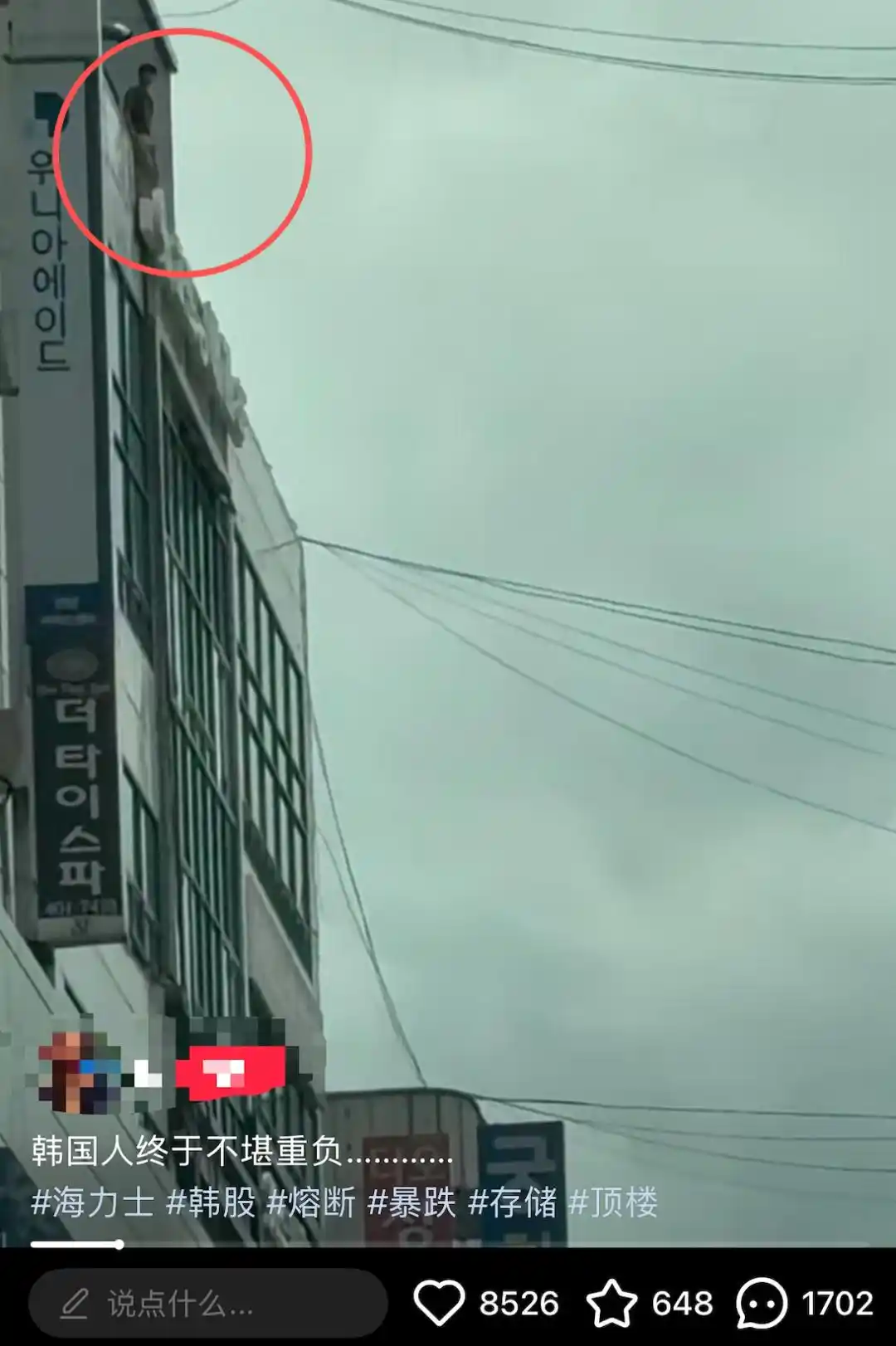
The comments section was unusually free of skepticism; everyone believed in an instant that this young man standing there intended to end his life, and the reason seemed to be none other than stocks.
That's simply because the South Korean stock market has really plummeted into numbness.
Since hitting an all-time high at the end of June, the KOSPI index has corrected by about 25% in just three weeks, officially entering a technical bear market. SK Hynix, the 'leading dragon' of the AI bull market, saw its stock price fall over 40% from its peak, while another giant, Samsung Electronics, wasn't far behind, losing nearly 30% of its market value.
Just a month ago, South Koreans were still immersed in the optimistic mood of 'the best summer ever.'
With semiconductor exports booming, pension account balances rising, and young people borrowing money to enter the market, it seemed as if simply grabbing hold of SK Hynix and Samsung Electronics was enough to catch the fastest wealth train of the AI era.
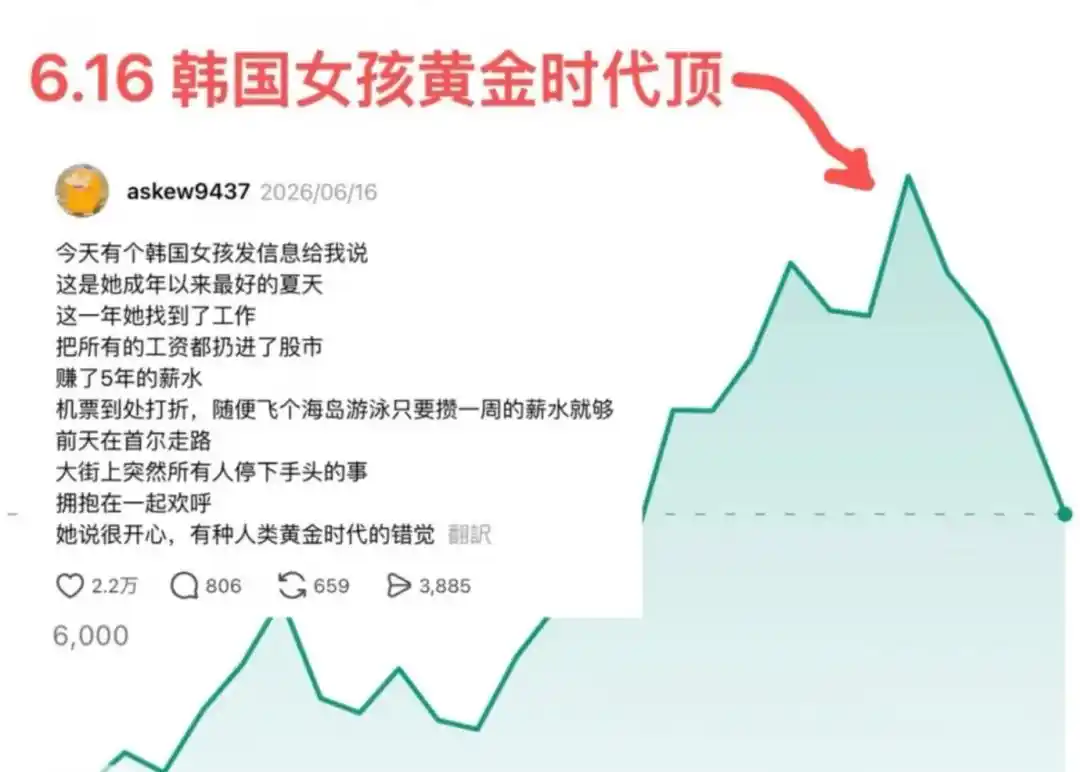
Just as the world thought South Korea's best summer had ended, and South Koreans everywhere lamented that their pension and house-buying money was gone for good, another reversal occurred:
On July 15, the South Korean stock market opened and immediately experienced a massive retaliatory rebound.
The KOSPI surged over 7% during the session, SK Hynix jumped about 13%, Samsung Electronics rose about 8%, and Hanmi Semiconductor climbed about 25%. In just two days, the index saw an amplitude of nearly 16 percentage points, with SK Hynix swinging from a 15% crash to a 13% surge.
One day panicking about being margin-called, the next regretting not buying the dip. This is the most realistic situation for South Korean retail investors:
A nation all-in, oscillating wildly between immense wealth and total ruin.
Circuit breakers on opening, daily rollercoaster rides.
The Best Summer for South Koreans, Yet 73% of Retail Investors Are Losing Money?
The catalyst for this decline was SK Hynix, the current star of the South Korean stock market.
After a sleepless night, countless retail investors flocked to the social media account of SK Group Chairman Chey Tae-won to comment:
"I'm still a minor, I want a refund."
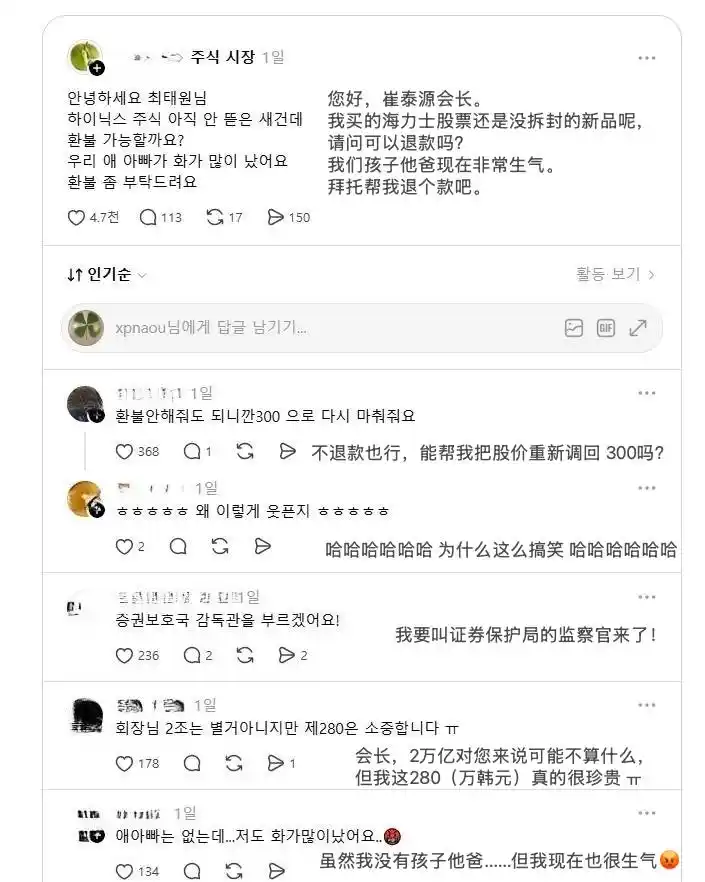
Investors without a 'daddy' also clamored for refunds:
"Wrong item shipped, I ordered red, why did you send green?"
"The government should step in! Stocks should have a 7-day no-reason return policy."
"Dammit, who hacked my account?!"

For South Koreans, stock trading is indeed no different from online shopping.
This country of just 50 million people boasts 14.5 million retail investors, with the number of opened securities accounts exceeding 100 million nationwide.
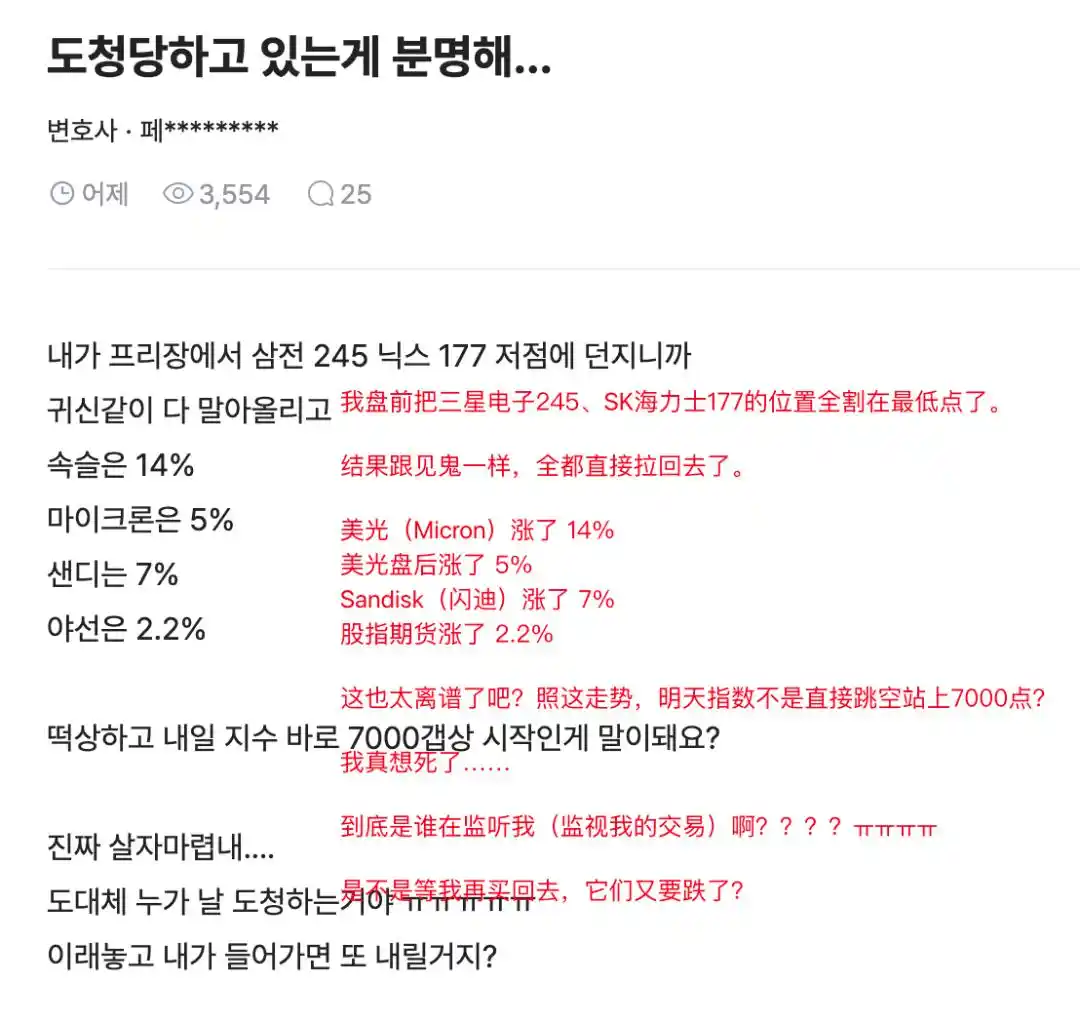
While the stock market may be unfortunate, literature benefits. The turbulent South Korean stock market is mass-producing its own versions of 'Big Brother.'
Some believe they are being monitored by big data or trapped by malicious schemes:
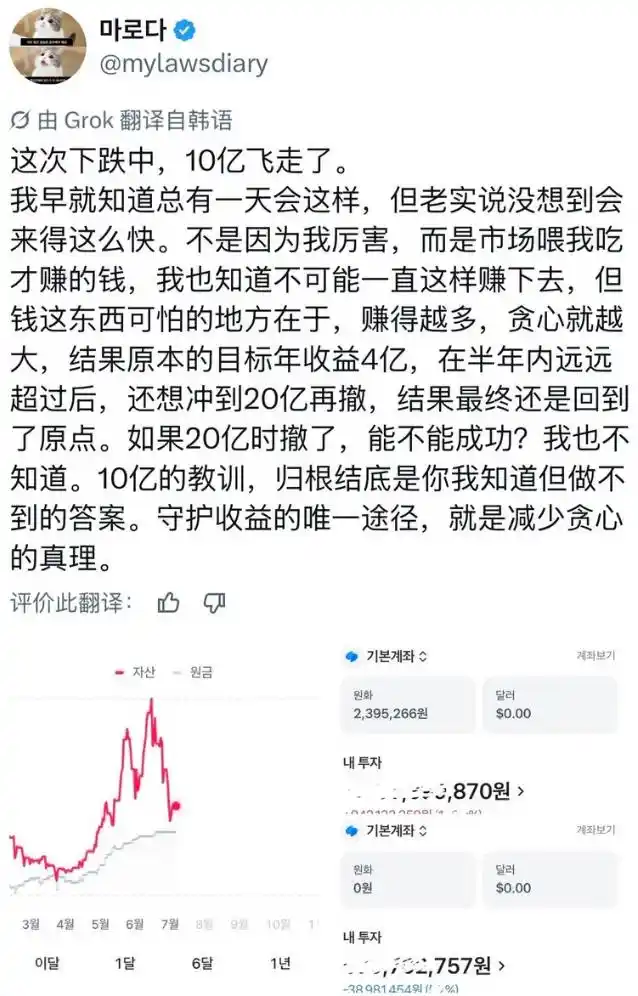
Some, after great pain and deep reflection, enter a state of post-crash clarity:
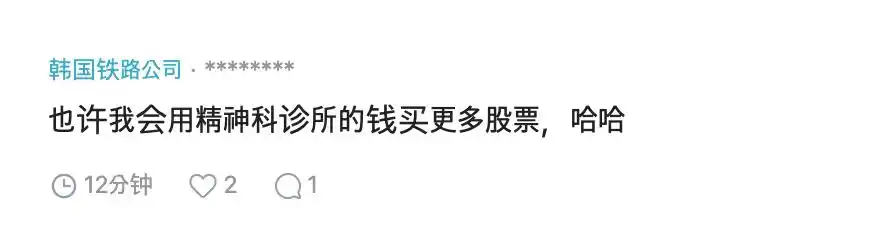
Some are so tortured by the stock market they consider seeing a psychologist:
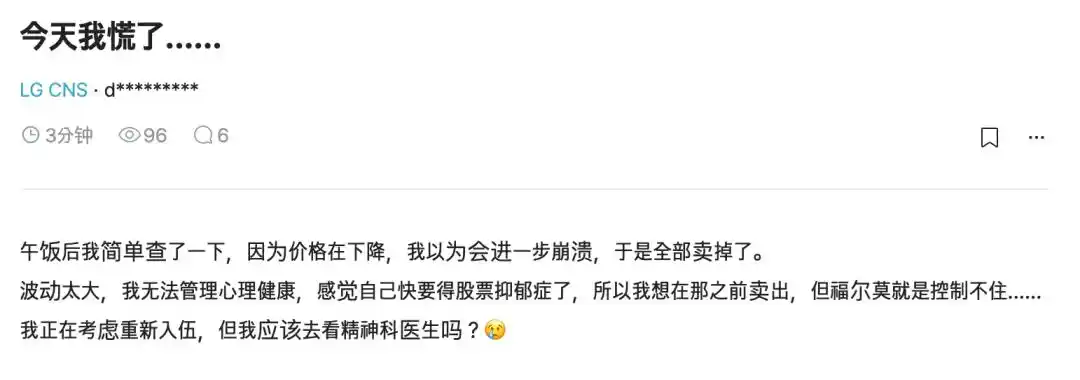
Netizens in the comments warmly encourage them: Use the therapy money to buy more stock instead.
A retail investor posted on a forum: "Was it all just a dream?"
The screenshot showed the investor floating a daily loss of 2.104 billion won (approximately over 10 million RMB), with a loss rate of 42.04%.
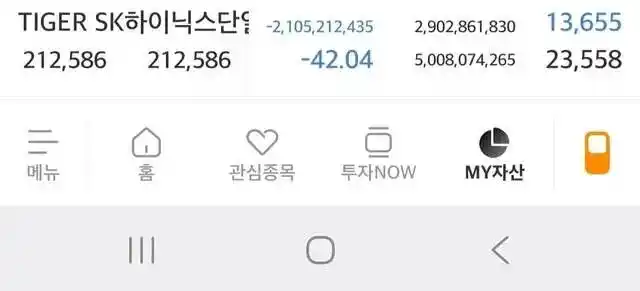
The reason for such an exaggerated drop was that he had frantically bought over 200,000 shares of a double-leveraged Hynix ETF, with principal investment reaching 5 billion won (approximately 22.7 million RMB).
Due to Hynix's crash, the speed of losing money was also supercharged.
The low pressure in the stock market even triggered a real-world violent incident.
According to Korean media reports, on July 13, a man in his 20s in Busan, who suffered huge losses after following stock recommendations from a YouTuber, tracked down the YouTuber with a knife and stabbed him.
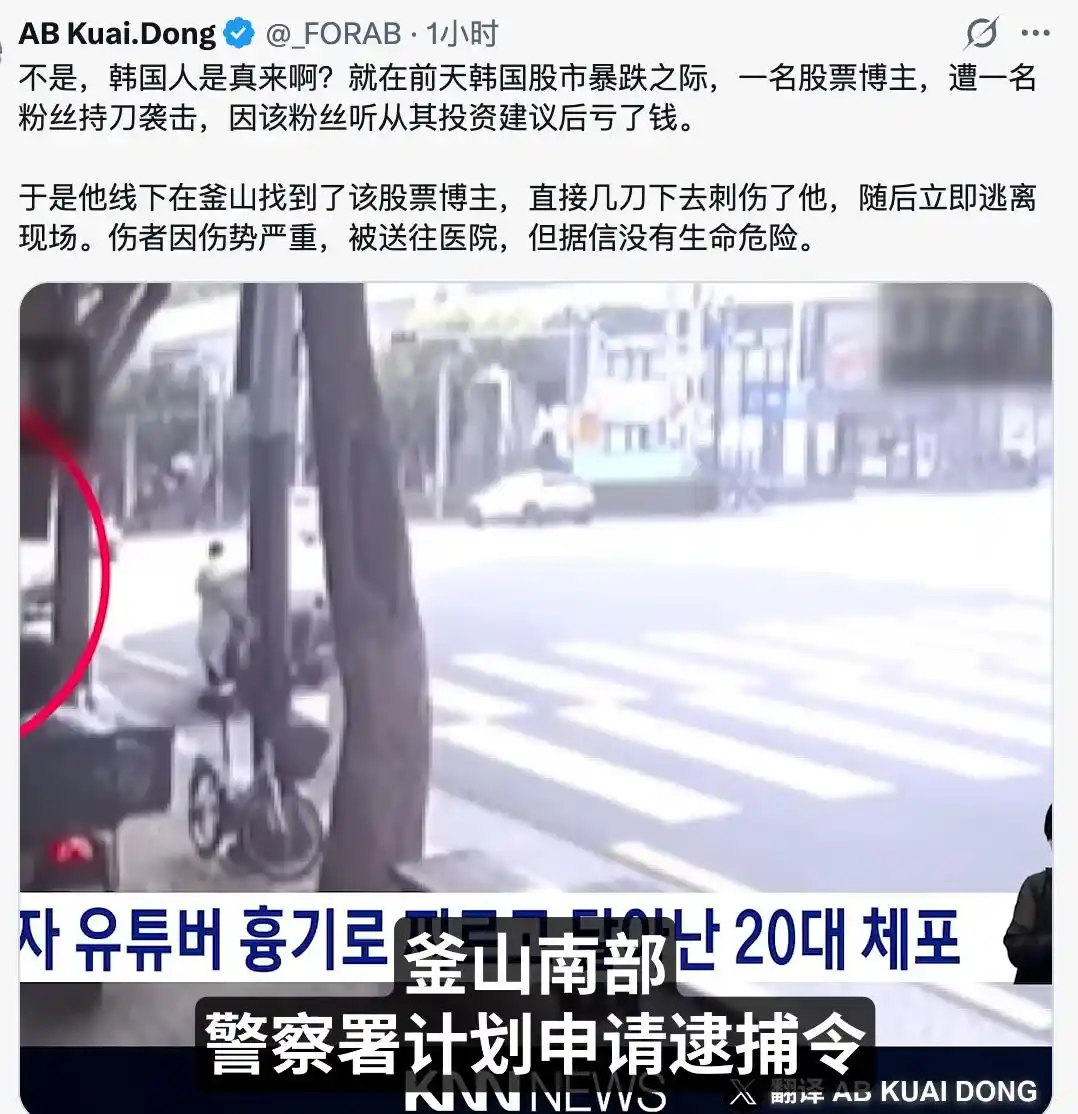
Police investigation suggested the motive was revenge for the failed investment.
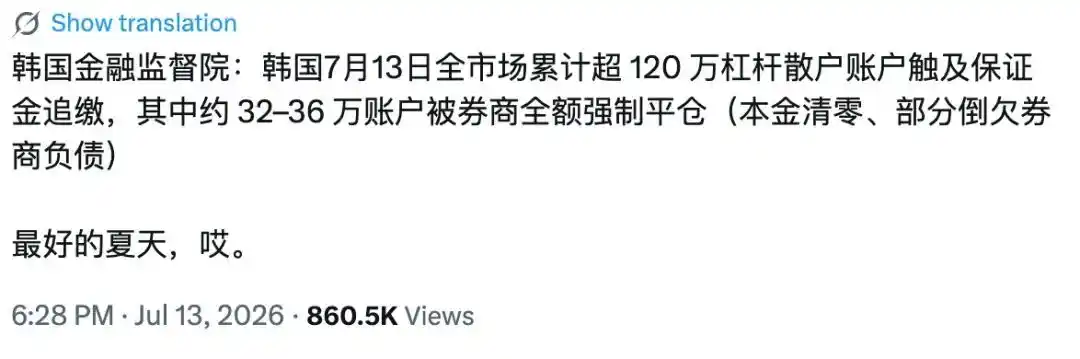
On that same day alone, over 1.2 million leveraged retail investor accounts in South Korea triggered margin calls, with about 300,000 accounts forcibly liquidated by brokers.
What drove South Koreans to go all-in without regard was the Korean stock market's rampant surge over the past half-year.
At the beginning of the year, the KOSPI was hovering around 4500 points, then it skyrocketed almost non-stop: breaking 5000 points by late January, 6000 points by late February, 7000 points in May, and briefly touching 9000 points in June...
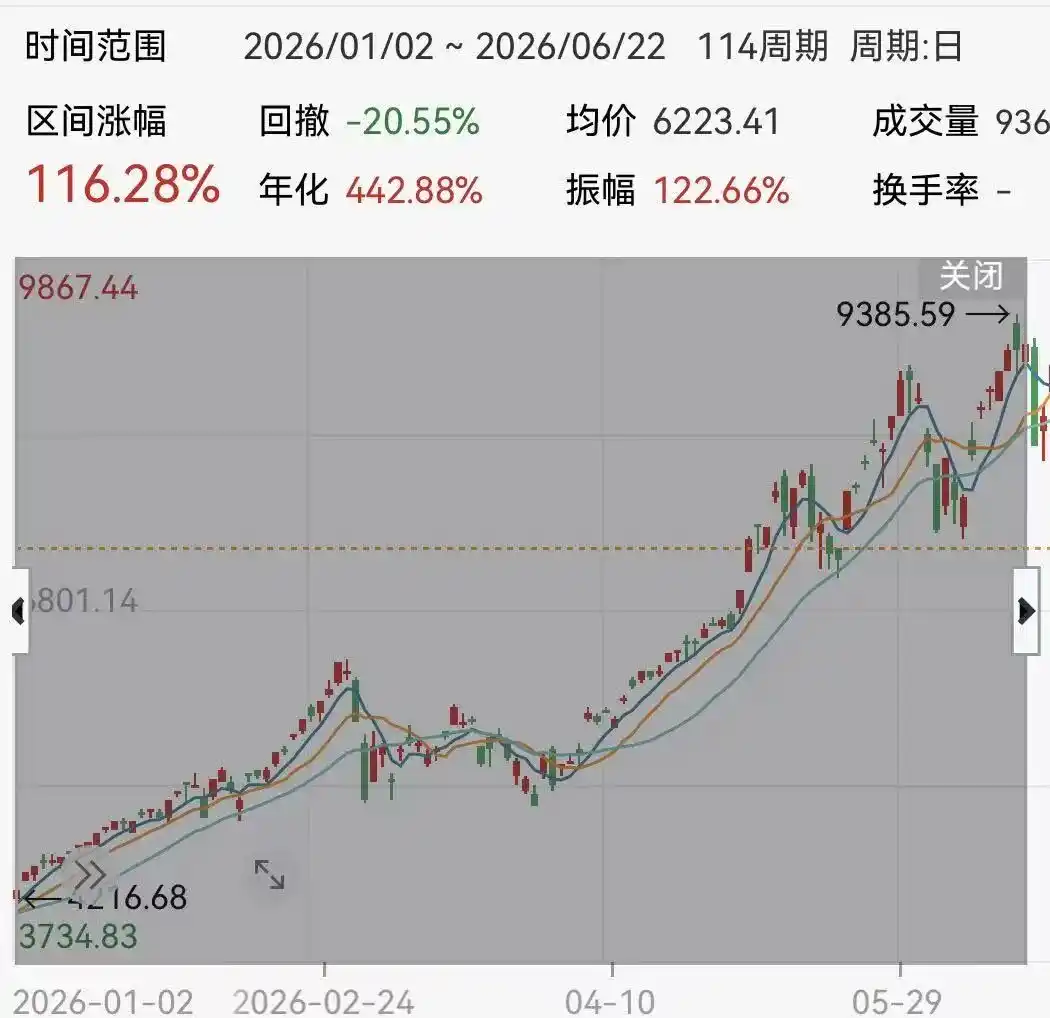
In half a year, the cumulative increase was 100%, with Samsung Electronics up 170% and Hynix's rise an astonishing 300%.
No technical analysis, fundamental research, or understanding of candlestick charts was needed. Just blindly buy semiconductors, then wait to count the money.
This was the gold-digging experience for many South Korean retail investors in the first half of the year.
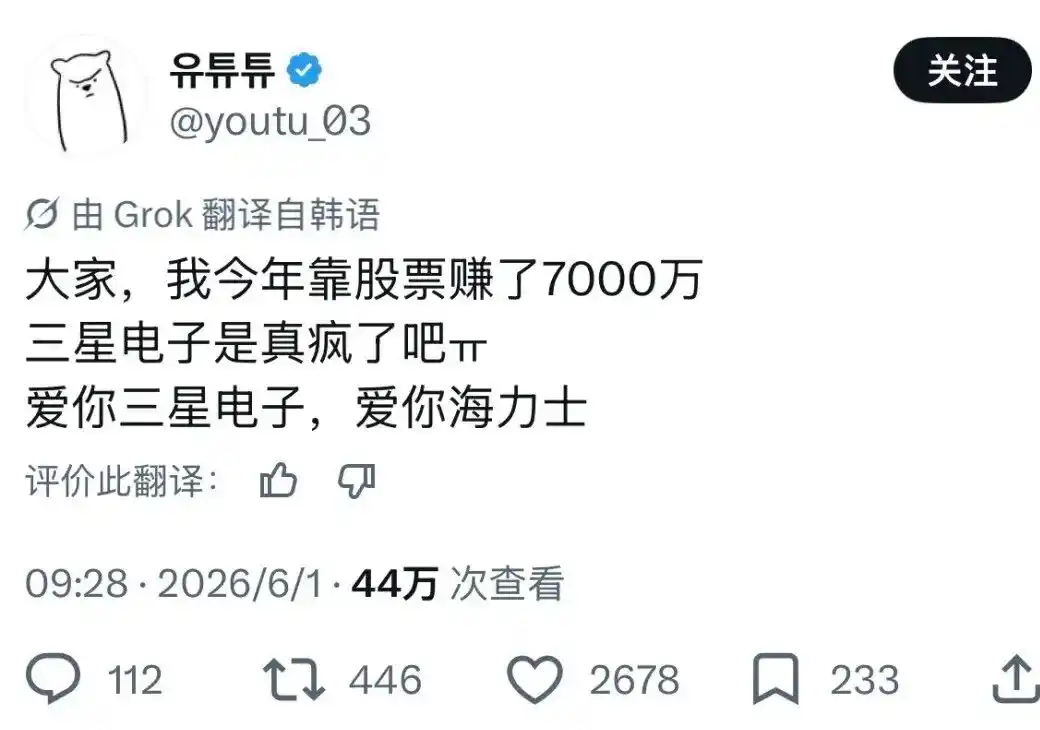
Seeing the stock market showering money like this, middle-aged people began withdrawing their deposits from banks and shifting to the stock market.
In January 2026 alone, the demand deposits at South Korea's five major commercial banks decreased by 30.75 trillion won. In April, during the accelerated bull phase, nearly 19 trillion won flowed out in just two weeks.
Most of this money went to the stock market.
A quick scroll through Korean forums reveals posts full of civil servants using wedding home down payments to buy Hynix, and retired employees withdrawing pensions to go all-in on Samsung.
Young people with little savings, meanwhile, are frantically going all-in with leverage.
In May 2026, South Korea's margin loan balance exceeded 60 trillion won, hitting a record high; double-leveraged ETFs were snapped up as soon as they were listed.
Stock markets were discussed in cafes, at family gatherings, and even the topic of conversation in nursing homes remained the stock market.
However, the actual situation wasn't as rosy as the index suggested. Even in the blazing-hot market, a large number of retail investors still failed to make money.
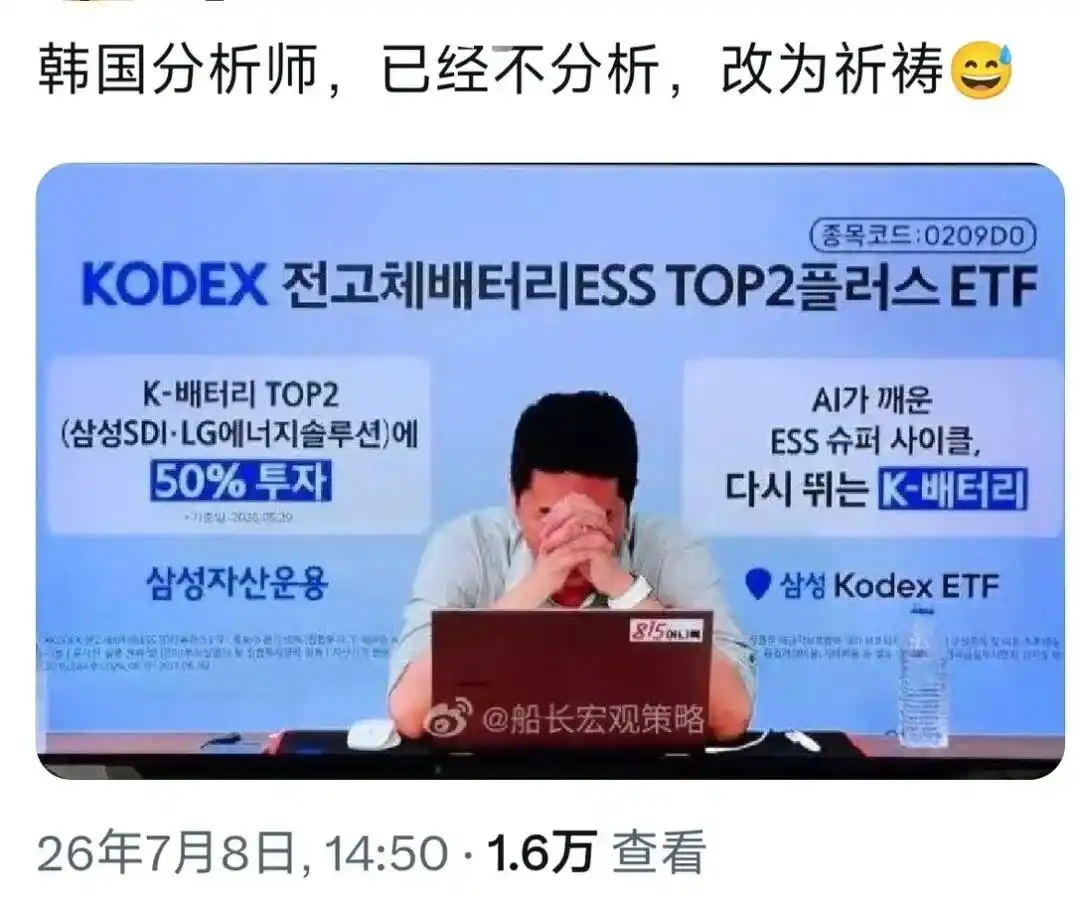
Korean newspaper *Maeil Business Newspaper* conducted an interesting analysis, examining the 50 most-bought Korean stocks by individual investors at a major brokerage in the first half of this year. The result showed:
73.45% of investors were losing money.
Even more staggering, among these 50 popular stocks, for 25 of them, the proportion of losing investors exceeded 80%. In other words, in these most-favored stocks, 8 out of every 10 buyers were trapped at high prices.
Losing money in a bull market is the common fate of retail investors worldwide.
Retail investors also have another trait: they fail to keep up with the pace on the way up, but lead the charge on the way down.
By the end of June, margin loan balances in the South Korean stock market had already reached a historical peak.
These margin loans were also heavily concentrated in a few AI leaders like Samsung Electronics and SK Hynix. At the same time, the trading volume of single-stock leveraged ETFs kept setting new records.

The entire market increasingly resembled a tower built with leverage blocks. On the way up, it moved faster than others, but once the direction reversed, all that leverage turned into counterforce.
Thus, we witnessed the scene at the beginning.
Will South Koreans stop? Probably not.
Looking back at the decades-long history of South Korea's capital market, you'll find that almost every decade or so, it plays out a nearly identical script:
In the 1980s, people believed the 'Miracle on the Han River' would never end;
Around 2000, people believed the internet would reshape everything;
During the 2020 pandemic, 'Donghak Ants' (Korean retail investor groups) shouted that retail could beat foreign capital;
Today, the protagonists are AI and memory chips.
Each time, there's a grand enough narrative of the times, each time accompanied by nationwide account openings, surging margin loans, wealth legends, and the optimistic sentiment that 'this time is different.'
But the ending each time seems to be the same.
The South Korean Stock Market: Why Does It Feel Like Riding a Roller Coaster Every Day?
Trading stocks in South Korea feels like riding a roller coaster every single day.
This involves the market's ferocity, but even more so, the frenzy of retail investors.
As is well known, today's KOSPI index resembles an ETF tracking the AI memory cycle. In 2024, the semiconductor sector already accounted for 26% of the total market capitalization of the South Korean stock market. By mid-2026, Samsung Electronics and SK Hynix alone constituted half of the KOSPI's total market cap.
In other words, the fortune of a nation's stock market is thus tied to the fate of these two memory giants.

This means a piece of fake news or a market rumor ('small essay') can easily send tens of millions of Korean investors either to heaven or hell within a single trading day.
This extreme volatility is particularly staggering when quantified:
From June 8 to July 13, during the brief five-week period of 'Memory Mania', the South Korean KOSPI triggered a market-wide circuit breaker 5 times.
Adding in the war-related shock in March, the South Korean stock market in 2026 has already halted trading 7 times —
exceeding the total number of circuit breakers over the previous two decades combined.
Yet, faced with such a volatile, high-stakes capital market, South Korean retail investors remain 'enthusiastic.'
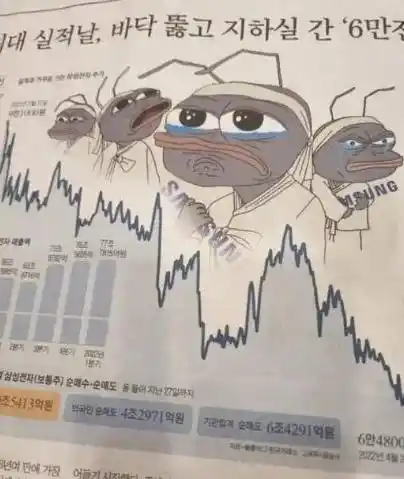
After all, as stated a few years ago in a report by the Korea Capital Market Institute:
A large portion of South Korean retail investors are essentially standard 'lottery-type' investors.
They are keen on chasing hot themes, enter the market primarily for speculation, and only turn to 'value investing' after getting stuck.
Relevant research estimates that post-2020, the annual turnover rate for individual Korean investors exceeds 1600%. For an account with an average holding value of 100,000 won, according to the study's calculation method, the annual turnover can reach about 1.6 million won.
This is equivalent to completely turning over the entire portfolio 16 times a year.
Put romantically, it's 'the bigger the waves, the more valuable the fish.' Put more abstractly, it's probably:
"Going all-in is a kind of wisdom."

And it is precisely these aggressive traders who happen to operate in a market that makes leveraging exceptionally easy.
Korean brokerages are exceptionally 'considerate' when it comes to borrowing to invest. A glance at their website descriptions reveals what feels like: easy qualification checks, mobile operation, borrow and repay anytime, ultra-low interest rates, daily interest settlement, no need for offline processing, no need for cumbersome documentation.
With just a few taps on the screen, Korean citizens can 'use a small amount of capital to purchase a large number of stocks, thereby obtaining higher returns when profitable.'
High-risk leveraging is thus packaged by Korean brokerages as something as commonplace as 'buy now, pay later'—frighteningly friendly.
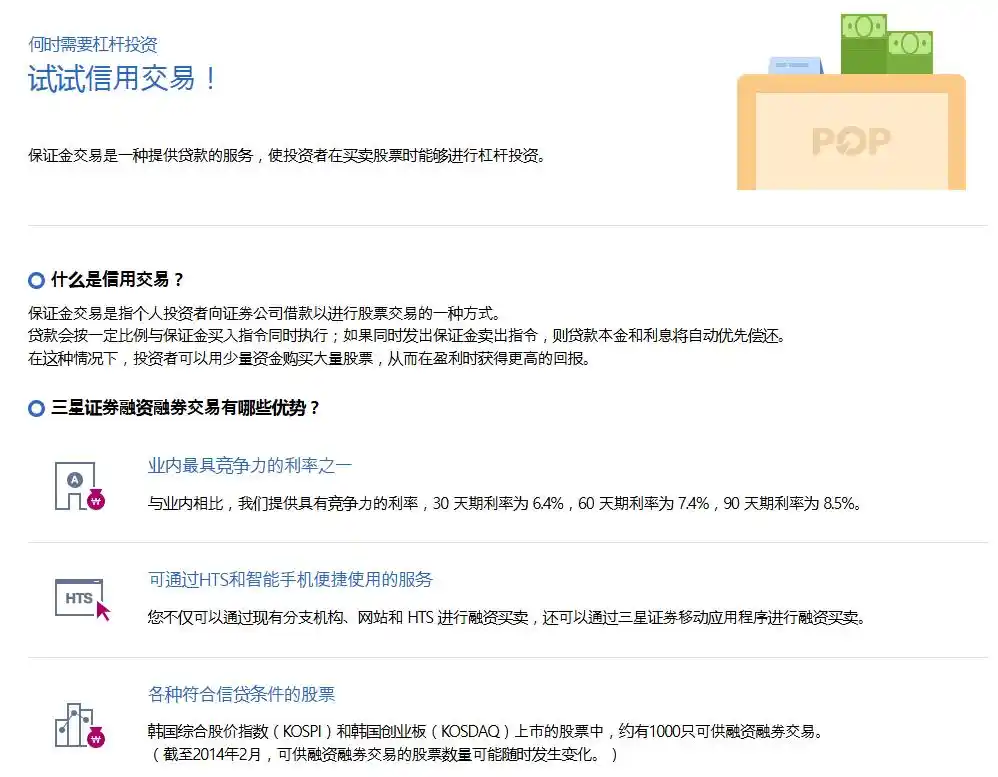
By late 2024, the Financial Supervisory Service stepped in, requiring brokerages like Toss to rectify such wording. But the capital market never lacks for new tricks:
A series of ETFs with names like 'Samsung/Hynix + X-times leverage' were developed, presented as benign 'just funds with higher volatility,' becoming the hot favorites eagerly snapped up by today's traders.
Now, even the act of borrowing itself is packaged into a product; you just need to click buy or sell.
To borrow the words of Lee In-cheol (이인철), director of the Chamjoeun Economic Research Institute, these ETFs can be described as:
"Directly targeting the retail investor's mentality for rapid wealth accumulation."

After all, almost everyone comes to this market to make quick money. Even Korean traders themselves express on social media:
"Investing, as they call it, is just a game of hitting it big and getting out fast."
So, looking at the Korean stock market today, from a peninsula wealth-creation myth to a man-eating monster that doesn't spit out the bones, the déjà vu feeling is strong:
In May 2022, the Luna cryptocurrency saga saw its value evaporate overnight, bankrupting hundreds of thousands of Koreans who had bet their life savings and loans on it.
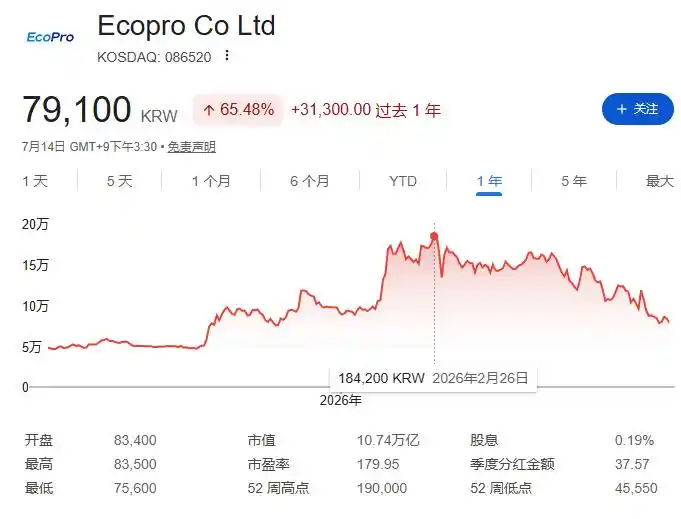
In April 2023, the narrative around EcoPro in the stock market—'Believe in Korean batteries,' 'Sniping Wall Street'—once again saw a flood of Korean speculators take on heavy leverage, rushing in at high prices, smoothly getting deeply trapped.
Among the 87,000 clients holding EcoPro through NH Investment & Securities:
93.54% of investors were in a loss position, with an average loss rate of 29.91%.
So why does the 'turn a bicycle into a motorcycle' narrative, despite often ending in a mess, remain so enduringly popular in South Korea?
There are, of course, reasons like solidified class structures, blocked upward mobility, and the younger generation's all-or-nothing gamble for a future because they can't see one otherwise...
But looking at the traders in today's market, you'll find speculation is truly 'all-ages':
There are middle school second-year students saying a third of their classmates are immersed in the stock market, and also investors over 70 in cryptocurrencies whose numbers have nearly tripled in three years.
Everyone wants to make money fast. People at different life stages are experiencing the same anxiety: the fear of missing the boat if they don't get on board soon enough.
So, what drives the Korean public's eager pursuit of market fluctuations might be more complex than just the phrase 'otherwise you can't climb up.'

Setting aside those K-lines and indicators and looking at the nation's meteoric rise, you realize that from the Han River Miracle to today's AI memory chips, over the past half-century-plus, South Korea itself has barely experienced what one might call a 'slow bull market of the era.'
To borrow scholar Jang Kyung-sup's concept of 'compressed modernity':
South Koreans have, in just a few decades, experienced development that took Western countries generations.
South Korea's economy is highly dependent on exports, which also determines that each round of its prosperity is often concentratedly manufactured by a few industries creating massive wealth effects in a short period.
From shipbuilding, oil refining, automobiles, to Seoul real estate, Gumi's mobile phone manufacturing, Paju's display panels, and today's semiconductors, the 'winds' keep shifting, and wealth migrates rapidly between different cities, companies, and groups of people.
But the more intense the industry红利, the shorter-lived it tends to be.
On this land, wealth is rarely accumulated through long, stable processes. More often, it comes from an export cycle, a hot stock, a skyrocketing property, or a company suddenly catching the global industry wave.
Thus, tens of millions constantly try to leap into the next wave: buying property, trading stocks, chasing hot industries, betting personal destinies on the rise and fall of economic cycles.
When the market rises, people feel like they're living in the best of times.
When the wind shifts, wealth, jobs, and confidence can all plummet simultaneously.
Everyone seems to be sitting on a roller coaster driven by industry cycles, swinging violently between surges and crashes.
This article is from the WeChat public account "Phoenix Weekly" (ID: phoenixweekly), authors: Wang Dong, Case, editor: Octopus.