The 2.4 Million Ethereum Anchor: How Binance’s Illiquid Supply Is Absorbing ETH’s February Volatility

bitcoinistОпубликовано 2026-02-28Обновлено 2026-02-28

Введение

Ethereum is experiencing volatility near the critical $2,000 level, acting as a psychological battleground rather than firm support. Analysis of Binance’s ETH reserves reveals 3.57 million ETH, with 2.40 million classified as illiquid (less likely to be sold) and 1.16 million as liquid (readily tradable). This illiquid majority suggests a structurally balanced market with reduced immediate sell pressure, as holders appear to be maintaining longer-term strategies rather than preparing for distribution. While this equilibrium may help absorb volatility and moderate downside risk, a shift toward higher liquid supply could increase potential selling pressure if market sentiment deteriorates.

Ethereum is navigating a period of heightened volatility and uncertainty as it hovers around the critical $2,000 threshold. While recent price action suggests temporary stabilization after weeks of selling pressure, conviction remains limited. The $2,000 level is functioning less as confirmed support and more as a psychological battleground where short-term positioning, liquidity conditions, and sentiment are colliding.

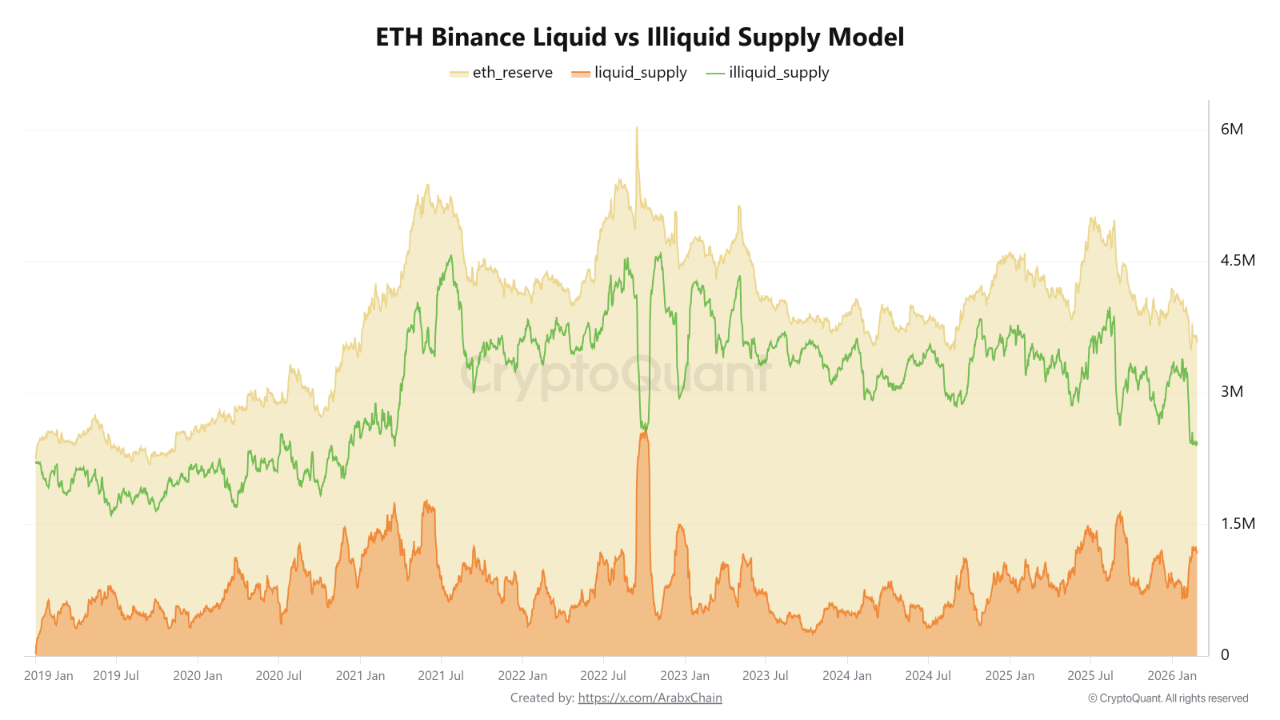
A recent analysis from Arab Chain offers additional structural insight through the ETH Binance Liquid vs. Illiquid Supply Model. This framework separates Ethereum held on Binance into liquid supply — coins readily available for trading — and illiquid supply, which is comparatively less likely to move in the short term. As of February, Binance’s total ETH reserves stand at approximately 3.57 million ETH. Of this amount, around 1.16 million ETH is classified as liquid supply, while 2.40 million ETH is categorized as illiquid.

This distribution matters. A relatively smaller liquid component can limit immediate sell-side pressure, but it does not eliminate risk if sentiment deteriorates. Conversely, a larger illiquid base may reflect longer holding behavior or strategic positioning rather than imminent distribution.

At a moment when price hovers near a key technical pivot, the composition of exchange reserves becomes a meaningful variable in assessing Ethereum’s next structural move.

Liquid vs. Illiquid Supply Signals A Fragile Equilibrium

The current reserve composition on Binance suggests Ethereum is operating within a structurally balanced environment rather than an immediate distribution phase. With illiquid supply accounting for the majority of the 3.57 million ETH held on the platform, a substantial portion of coins appears relatively dormant. Illiquid balances are typically associated with longer holding horizons or reduced trading frequency, which tends to dampen immediate sell-side pressure.

ETH Binance Liquid vs Illiquid Supply Model | Source: CryptoQuant

This matters at a time when ETH is hovering near $2,000. A dominant illiquid share implies that most holders are not actively positioning for a rapid exit. In previous cycles, sharp increases in liquid supply often preceded volatility spikes, as coins became readily available for market execution. That dynamic is not yet evident at scale.

By contrast, liquid supply historically expands during speculative phases, when traders rotate capital aggressively or prepare for directional exposure. The absence of a pronounced expansion suggests that, for now, speculative intensity remains contained.

The relatively stable gap between liquid and illiquid supply indicates equilibrium between holding behavior and active trading. However, this balance is conditional. A meaningful shift toward higher liquid supply would increase the probability of renewed volatility. Conversely, sustained illiquid dominance could help absorb price shocks and moderate downside acceleration.

Связанные с этим вопросы

QWhat is the current total amount of Ethereum reserves held on Binance, and how is it divided between liquid and illiquid supply?

AAs of February, Binance's total ETH reserves stand at approximately 3.57 million ETH. Of this amount, around 1.16 million ETH is classified as liquid supply, while 2.40 million ETH is categorized as illiquid.

QAccording to the article, what is the significance of the $2,000 price level for Ethereum?

AThe $2,000 level is functioning less as confirmed support and more as a psychological battleground where short-term positioning, liquidity conditions, and sentiment are colliding.

QWhat does a dominant illiquid supply on an exchange like Binance imply about holder behavior?

AA dominant illiquid share implies that most holders are not actively positioning for a rapid exit. Illiquid balances are typically associated with longer holding horizons or reduced trading frequency, which tends to dampen immediate sell-side pressure.

QWhat historical pattern is observed when there is a sharp increase in liquid supply on an exchange?

AIn previous cycles, sharp increases in liquid supply often preceded volatility spikes, as coins became readily available for market execution.

QWhat is the overall structural state of Ethereum on Binance as suggested by the reserve composition?

AThe current reserve composition suggests Ethereum is operating within a structurally balanced environment rather than an immediate distribution phase, indicated by the relatively stable gap between liquid and illiquid supply.

Похожее

What's the Connection Between Pinduoduo's Huang Zheng and Blockchain?

This text explores the unexpected connection between Pinduoduo founder Colin Huang and blockchain, as suggested in his article *Turning Capitalism Upside Down*. Huang argues Pinduoduo's core business is about managing "uncertainty." He posits that wealth flows to the rich because they absorb life's uncertainties (e.g., illness, job loss) that devastate the poor, who pay a premium for certainty through insurance or stable prices. Pinduoduo's model attempts a "reverse insurance": by aggregating consumer demand via group-buying and flash sales, it creates a large, predictable order for manufacturers. This certainty allows factories to remove risk premiums, passing savings back as lower prices, thus partially reversing the wealth flow. The key obstacle, Huang notes, is that an individual's buying intent is an unreliable promise. He then asks if blockchain is the natural solution for this "reverse insurance." The text elaborates that blockchain, through smart contracts with binding deposits, could transform casual intent into a costly-to-break, enforceable commitment. This replaces interpersonal trust with coded rules, making promises credible, pricable, and resistant to fraud. Finally, the author draws a parallel to Bitcoin, framing two paths to creating certainty: the "Pinduoduo path" of aggregating decentralized will into scale, and the "Bitcoin path" of locking rules into immutable code. Both sacrifice something—personal freedom or system flexibility—to manufacture trust and predictability.

链捕手15 мин. назад

What's the Connection Between Pinduoduo's Huang Zheng and Blockchain?

链捕手15 мин. назад

The Storage Magnate Who Conquered a Trillion-Dollar Kingdom, Yet Ultimately Could Not Become the Richest

**Summary:** "The Memory Magnate Who Built a Trillion-Dollar Empire, Yet Never Became the Richest" explores the journey of Zhu Yiming, founder of GigaDevice (603986) and co-founder of the soon-to-IPO ChangXin Memory Technologies (CXMT). The article positions GigaDevice, a fabless chip designer now valued at ~¥340 billion, as a prequel to the massive IDM (Integrated Device Manufacturer) venture, CXMT. Starting in 2005 with minimal capital, Zhu strategically "picked up the pieces" by focusing on niche markets like NOR Flash and microcontrollers (MCUs), areas major players were exiting. This allowed GigaDevice to grow into a diversified semiconductor company, maintaining robust profitability even during industry downturns by controlling costs. However, the piece argues that in the highly cyclical and capital-intensive memory chip industry, the fabless model has limits. True resilience and scale require the ability for "counter-cyclical expansion" – investing heavily during downturns – a tactic only possible for IDMs like Samsung or SK Hynix. This insight led Zhu to partner with the Hefei city government in 2016 to establish CXMT, an IDM focused on DRAM. Zhu's symbolic moves, like forfeiting salary and diluting his equity, were crucial in securing the massive state and bank funding needed. CXMT's equipment base is now valued even higher than that of BYD's vast auto manufacturing empire. Despite the potential for CXMT to reach a market cap of ¥1-2 trillion upon its IPO, Zhu's indirect stake in both companies is estimated below 3%, placing his personal wealth far below that of China's top billionaires. The article concludes that his strategic vision built a trillion-yuan memory landscape, but the capital structure necessary to achieve it precluded a personal fortune of similar scale.

marsbit22 мин. назад

The Storage Magnate Who Conquered a Trillion-Dollar Kingdom, Yet Ultimately Could Not Become the Richest

marsbit22 мин. назад

XRP Ledger Daily Fees Drop Below $400 As Network Activity Question Returns

The XRP Ledger is drawing attention as daily network fees have fallen below $400. While low fees align with XRPL's design for affordable transactions and are often seen as a strength, the metric can also serve as an indicator of network demand and paid transaction volume. This data point of around $3,100 in weekly fee burn highlights the stark contrast with higher-fee chains like Ethereum and Bitcoin. The development fuels an ongoing debate. Proponents view low fees as a sign of efficiency and accessibility, while critics may question if the network is generating sufficient high-value activity relative to its market cap and payments-focused narrative. The article cautions against overstating the finding, noting a single low-fee day does not signify network failure. It instead adds context to discussions about XRPL's usage, especially alongside Ripple's broader initiatives in stablecoins (RLUSD), AI payments, and enterprise infrastructure. The report recommends monitoring for a fee rebound, checking transaction counts for a fuller picture, and confirming the trend via native explorers like Bithomp. It frames the story within a larger market shift where on-chain data, protocol updates, and infrastructure developments are becoming crucial alongside price action. The editorial stance is to present the verified data, explain its significance for assessing network activity, and avoid hype, positioning it as part of the daily crypto conversation.

bitcoinist4 ч. назад

XRP Ledger Daily Fees Drop Below $400 As Network Activity Question Returns

bitcoinist4 ч. назад

Торговля

Спот
Фьючерсы

Популярные статьи

Как купить S

Добро пожаловать на HTX.com! Мы сделали приобретение Sonic (S) простым и удобным. Следуйте нашему пошаговому руководству и отправляйтесь в свое крипто-путешествие.Шаг 1: Создайте аккаунт на HTXИспользуйте свой адрес электронной почты или номер телефона, чтобы зарегистрироваться и бесплатно создать аккаунт на HTX. Пройдите удобную регистрацию и откройте для себя весь функционал.Создать аккаунтШаг 2: Перейдите в Купить криптовалюту и выберите свой способ оплатыКредитная/Дебетовая Карта: Используйте свою карту Visa или Mastercard для мгновенной покупки Sonic (S).Баланс: Используйте средства с баланса вашего аккаунта HTX для простой торговли.Третьи Лица: Мы добавили популярные способы оплаты, такие как Google Pay и Apple Pay, для повышения удобства.P2P: Торгуйте напрямую с другими пользователями на HTX.Внебиржевая Торговля (OTC): Мы предлагаем индивидуальные услуги и конкурентоспособные обменные курсы для трейдеров.Шаг 3: Хранение Sonic (S)После приобретения вами Sonic (S) храните их в своем аккаунте на HTX. В качестве альтернативы вы можете отправить их куда-либо с помощью перевода в блокчейне или использовать для торговли с другими криптовалютами.Шаг 4: Торговля Sonic (S)С легкостью торгуйте Sonic (S) на спотовом рынке HTX. Просто зайдите в свой аккаунт, выберите торговую пару, совершайте сделки и следите за ними в режиме реального времени. Мы предлагаем удобный интерфейс как для начинающих, так и для опытных трейдеров.

1.5k просмотров всегоОпубликовано 2025.01.15Обновлено 2026.06.02

Как купить S

Sonic: Обновления под руководством Андре Кронье – новая звезда Layer-1 на фоне спада рынка

Он решает проблемы масштабируемости, совместимости между блокчейнами и стимулов для разработчиков с помощью технологических инноваций.

2.3k просмотров всегоОпубликовано 2025.04.09Обновлено 2025.04.09

Sonic: Обновления под руководством Андре Кронье – новая звезда Layer-1 на фоне спада рынка

HTX Learn: Пройдите обучение по "Sonic" и разделите 1000 USDT

HTX Learn — ваш проводник в мир перспективных проектов, и мы запускаем специальное мероприятие "Учитесь и Зарабатывайте", посвящённое этим проектам. Наше новое направление .

1.8k просмотров всегоОпубликовано 2025.04.10Обновлено 2025.04.10

HTX Learn: Пройдите обучение по "Sonic" и разделите 1000 USDT

Обсуждения

Добро пожаловать в Сообщество HTX. Здесь вы сможете быть в курсе последних новостей о развитии платформы и получить доступ к профессиональной аналитической информации о рынке. Мнения пользователей о цене на S (S) представлены ниже.

活动图片