Technical Wave Patterns Turn Bullish for Ethereum as Price Reaction Intensifies Before Fed Decision

bitcoinistОпубликовано 2025-12-11Обновлено 2025-12-11

Введение

Ethereum (ETH) is showing bullish technical signals, breaking above key resistance near $3,300 as market sentiment strengthens ahead of the Federal Reserve's expected 25-basis-point rate cut. The ETH/BTC ratio has improved, and spot Ethereum ETFs saw significant inflows. Institutional interest is growing, highlighted by BlackRock's filing for an Ethereum Staking Trust ETF. Supply is tightening as exchange reserves hit multi-year lows. Technical analysis suggests a potential move toward $3,600, with some analysts targeting $4,200–$4,300 if the bullish trend continues. The Fed's decision remains a critical factor for momentum.

Ethereum (ETH) is under a pivotal week as traders weigh a mix of macroeconomic expectations, institutional developments, and strengthening technical signals.

Related Reading: Midnight Goes Live As Cardano Founder Targets A $10 Billion Ecosystem

With the Federal Reserve set to deliver its next rate decision, market participants are watching how Ethereum’s recent momentum interacts with a broader risk-on environment.

The second largest cap cryptocurrency has already staged a notable rebound, breaking key resistance levels and drawing renewed interest from both retail and institutional investors.

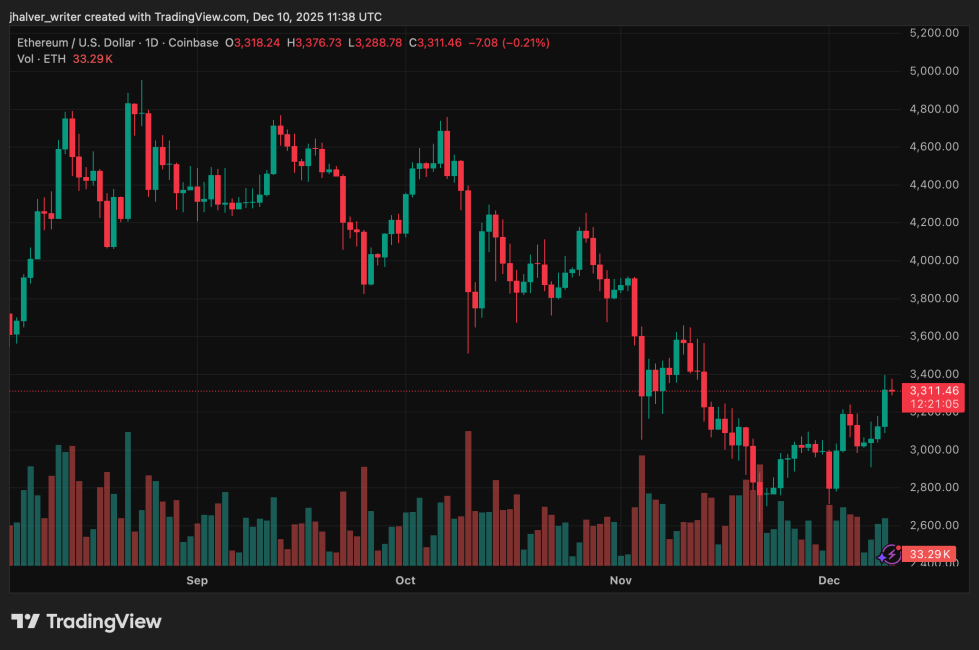
ETH's price sees some gains on low timeframes as recorded on the daily chart. Source: ETHUSD on Tradingview

Fed Expectations Drive Ethereum Position Repricing

Ethereum surged past $3,300 and briefly approached $3,400 after recording a 6% jump over the past 24 hours.

The rally comes as traders price in a high probability, close to 90%, that the Federal Reserve will announce a 25-basis-point rate cut. Lower interest rates tend to improve liquidity conditions, a factor that has historically supported digital assets.

Bitcoin’s recovery above $94,000 added further confidence to the market, though Ethereum outperformed on a relative basis. The ETH/BTC ratio reached its strongest point since late October, indicating a shift of capital from Bitcoin to Ethereum.

Spot Ethereum ETFs also saw $177.7 million in inflows on December 9, surpassing Bitcoin’s inflows on the same day.

Institutional Moves Add to Bullish Sentiment

One major catalyst behind this shift has been BlackRock’s filing for the iShares Ethereum Staking Trust ETF. The fund would offer exposure not only to ETH’s price but also to staking rewards, expanding access to yield-bearing strategies.

Analysts note that such products could increase liquidity inflows into Ethereum, especially as institutional portfolios diversify beyond Bitcoin. This filing arrives at a time when the amount of ETH held on centralized exchanges has fallen to its lowest level since 2015, roughly 8.7% of the total supply.

Large buyers, including Bitmine Immersion, have accumulated billions of dollars’ worth of ETH in recent months. Combined, these developments indicate a tightening of supply conditions.

Technical Breakouts Reinforce the Trend

Chart analysts highlight that Ethereum has broken above a downward trendline that previously capped rallies for nearly two months.

Momentum indicators, including MACD and RSI, show increasing buyer strength despite approaching overbought territory. Ethereum’s break above the $3,300 zone has shifted focus toward the next resistance level at $3,500, with wave-pattern analysis suggesting potential upside toward $3,600.

Related Reading: Bitwise Rolls Out New ETF For Broad Crypto Exposure, Including BTC, XRP, And ADA

Analysts such as Captain Faibik argue that a confirmed breakout could support a rally of up to 30%, targeting the $4,200–$4,300 region if bullish conditions persist. However, the Fed’s upcoming decision remains a key variable in determining whether momentum continues or cools.

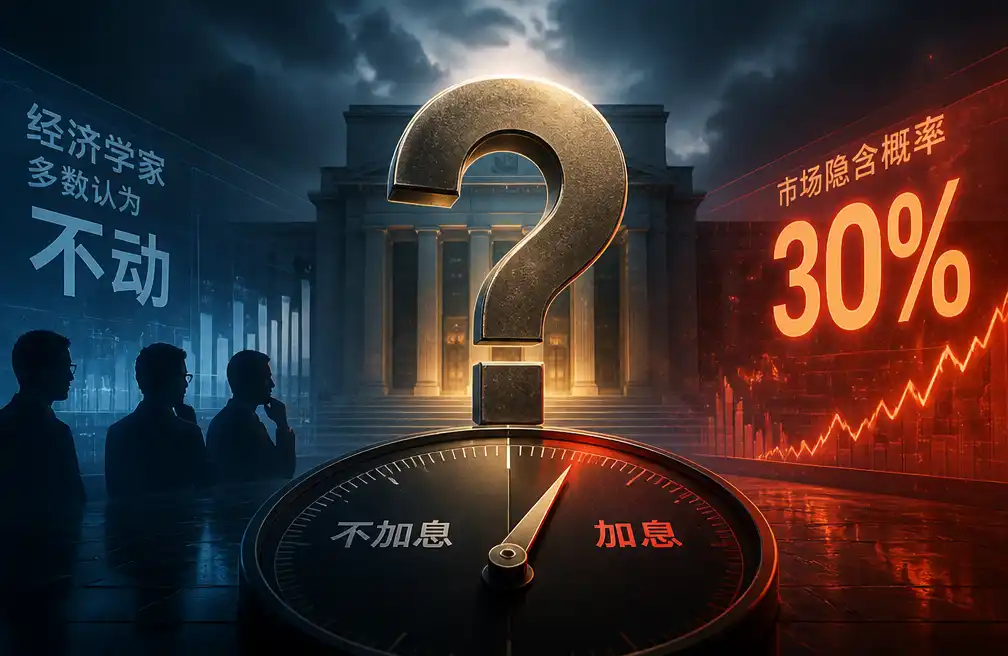
Cover image from ChatGPT, ETHUSD chart from Tradingview

Похожее

Different Choices After the Plunge: Institutions Buy the Dip, Traders Shift to US Stocks

Title: Diverging Strategies After the Crash: Institutions Buying the Dip, Traders Shifting to US Stocks Following a sharp decline where Bitcoin briefly fell below $60,000 on June 6th, market sentiment remains "extreme fear" despite a partial recovery. This has led to varied responses from major market participants. Several institutional figures and analysts present a cautiously optimistic long-term view for Bitcoin. Glassnode's co-founder identifies $46k-$54k as a probable key bottom range based on historical on-chain models, while a Standard Chartered executive suggests the bottom is nearly formed. Strive's CEO points to Bitcoin touching its 200-week moving average as a historically reliable buy signal. Analysts highlight metrics like MVRV ratio and the "Power Law" model indicating Bitcoin is in an extremely undervalued zone. Conversely, some traders are exiting the crypto space. One trader cited a more attractive risk/reward profile and deeper research opportunities in US stocks, particularly with AI-related equities outperforming and capital rotating away from crypto. This shift is partly attributed to perceived ongoing risks, including those related to Strategy's Bitcoin sales. Market prediction data suggests a high probability (72%) of Bitcoin falling below $55,000, but lower odds for a deeper crash below $35k-$40k. The overall picture is one of division: institutions and long-term analysts see a accumulating opportunity, while some active traders are seeking alpha elsewhere amidst the volatility and shifting capital flows.

marsbit40 мин. назад

Different Choices After the Plunge: Institutions Buy the Dip, Traders Shift to US Stocks

marsbit40 мин. назад

Tech Stocks in the Midst of Deleveraging: Rather Than Rushing to Buy the Dip, Wait for the Macro Environment to Stabilize First

"Technology Stocks in Deleveraging Phase: Wait for Macro Stability Before Buying the Dip" The current sell-off in tech/AI stocks is primarily driven by macro headwinds, not a breakdown in AI fundamentals. After a parabolic rise, the market faced a perfect storm: an overcrowded trade, a massive SpaceX IPO draining liquidity, pre-CPI/PPI/FOMC hedging, and strong jobs data renewing "higher-for-longer" rate fears. This triggered a concentrated deleveraging in hot tech names. Key historical context: Unlike the December 2023 sell-off focused on AI capex returns, the current correction centers on the "denominator" – rising concerns over rates, inflation, the Fed, geopolitics, and liquidity. Leading memory stocks like Micron have seen ~20% pullbacks, significant but not yet at panic levels seen in March. The intense selling wave may be largely over, but a quick V-shaped recovery is unlikely. The market will likely churn in high volatility, awaiting clarity. The immediate catalyst needed for a sustainable reversal is a "stop-bleeding" signal from macro conditions. This doesn't require a major positive shock (like the April Iran ceasefire), but simply a halt to further deterioration: CPI not surprising hotter, Treasury yields stabilizing, the Fed not turning more hawkish, and post-SpaceX IPO liquidity easing. Once macro pressure plateaus, the intact AI investment thesis – centered on persistent compute/memory shortages and accelerating commercialization – can quickly regain market focus. The strategy is clear: prioritize monitoring macro stabilization over rushing to bottom-fish individual AI stories. Patience is key.

marsbit47 мин. назад

Tech Stocks in the Midst of Deleveraging: Rather Than Rushing to Buy the Dip, Wait for the Macro Environment to Stabilize First

marsbit47 мин. назад

South Korean Stocks Plunge, Global Funds Liquidate: Has the Semiconductor Fundamentals Really Changed?

South Korean stocks experienced their sharpest decline of the year, with the KOSPI index plunging nearly 9% on Monday, triggering a market circuit breaker. Leading semiconductor firms Samsung Electronics and SK Hynix were heavily sold off, raising questions about whether the AI-driven bull market has reached an inflection point. This sell-off was largely triggered by a significant drop in the U.S. semiconductor sector late last week. Concurrently, NVIDIA CEO Jensen Huang visited Seoul over the weekend, meeting with top executives from SK Group, Samsung, LG, and NAVER. He announced a new multi-year partnership with SK Hynix to co-develop next-generation memory products for AI data centers. Huang emphasized that AI infrastructure build-out remains in its early stages, creating a stark contrast between market panic and ongoing, strengthened industry collaboration. The article argues that South Korea has become one of the most sensitive markets for global AI-related capital flows, functioning like a large AI memory ETF due to the heavy weighting of its chipmakers. The current market turmoil reflects a shift in investor focus: from simply betting on overall AI growth to scrutinizing which companies will actually capture the profits from that growth. This "profit pool reassessment" phase is causing high volatility based on supply chain news and earnings guidance. Ultimately, the direction of the Korean market will be determined by external factors—NVIDIA's orders, HBM supply-demand dynamics, and capital expenditures from cloud service providers—rather than domestic conditions. The disconnect between sharp price corrections and continued strong signals from the industry core leaves the market at a crossroads, awaiting clearer data on the durability of AI infrastructure demand.

marsbit1 ч. назад

South Korean Stocks Plunge, Global Funds Liquidate: Has the Semiconductor Fundamentals Really Changed?

marsbit1 ч. назад

Trump in Talks with AI Companies Over Profit Sharing, A Narrative Pressure of Industrial Revolution Scale Begins

In recent AI market discussions, a new dimension beyond growth and profits has emerged: the question of how the immense wealth potentially generated by AI should be shared with the wider public. Triggered by reports of White House officials discussing "voluntary equity transfers" with top AI firms, similar to models like Alaska's Permanent Fund, the conversation focuses on public wealth funds. OpenAI's own whitepaper proposes such funds, allowing households without direct tech stock ownership to benefit from AI gains. More radical proposals, like Bernie Sanders' call for high public equity stakes and board seats, represent an extreme end of the spectrum. Currently, these are early-stage policy probes, not enacted laws. OpenAI's initiative is seen as an attempt to secure "social license" for its future expansion, mitigating risks of public backlash, stricter regulation, or anti-trust actions as AI's economic impact grows. The core market implication is the introduction of a "policy discount" to AI valuations, particularly for private model companies like OpenAI, Anthropic, and xAI. Investors must now consider not just future earnings but also what portion might be allocated to public mechanisms. The impact varies greatly based on the mechanism. A small, voluntary transfer of non-voting economic rights (e.g., 5%) acts as a quantifiable long-term cost. Government acquisition of economic rights via warrants tied to support differs from direct equity with governance power. The most disruptive scenario would be forced high-percentage public ownership affecting control and innovation incentives. Key signals to watch include whether other AI companies follow suit, if the White House formalizes proposals, related disclosures in future IPO documents, and any market price reactions. For now, this represents a shift from pricing pure AI growth to pricing its potential distribution. A manageable, voluntary economic share is akin to an insurance cost for societal acceptance, while a forced shift toward control and governance would fundamentally alter valuation logic.

marsbit1 ч. назад

Trump in Talks with AI Companies Over Profit Sharing, A Narrative Pressure of Industrial Revolution Scale Begins

marsbit1 ч. назад

From Record Highs to a Two-Week Low: Why Did AI Concept Stocks Suddenly Pull Back?

From Record Highs to Two-Week Lows: Why Did AI Stocks Suddenly Pull Back? U.S. stock indices, led by the tech-heavy Nasdaq 100, fell sharply to two-week lows. This marked a reversal from earlier in the week when AI infrastructure and semiconductor stocks had propelled major indices to record highs. Investors are rotating out of these previously high-flying tech sectors into other areas. The sell-off was driven by profit-taking and concerns that the AI rally had become overextended, exacerbated by chipmaker Broadcom's sales outlook falling short of lofty market expectations. The decline accelerated following a stronger-than-expected U.S. May nonfarm payrolls report, which showed 172,000 jobs added versus an estimated 88,000. This data sparked a jump in bond yields, with the 10-year Treasury yield rising to 4.553%, as it reinforced market speculation that the Federal Reserve's next move could be a rate hike rather than a cut. Globally, equities also declined, with European and Asian markets falling. Within the U.S. market, chip and AI-related stocks like Super Micro Computer and Arm Holdings led the losses, dropping over 7%. Cryptocurrency-linked stocks and mining shares also fell sharply amid drops in Bitcoin and commodity prices. While the overall Q1 earnings season remained solid, with 83% of S&P 500 companies beating estimates, the weakness was concentrated in tech. Excluding the tech sector, Q1 earnings growth was around 3%, the weakest in two years.

marsbit1 ч. назад

From Record Highs to a Two-Week Low: Why Did AI Concept Stocks Suddenly Pull Back?

marsbit1 ч. назад

Торговля

Спот
Фьючерсы

Популярные статьи

Manyu: восходящая мем-звезда на Ethereum, готовая открыть новую эру культуры Shiba

Manyu - это мемтокен на Ethereum, который приносит децентрализованную культурную и развлекательную ценность через вирусное влияние в соцсетях и вовлечённость сообщества.

1.9k просмотров всегоОпубликовано 2025.11.27Обновлено 2025.11.27

Manyu: восходящая мем-звезда на Ethereum, готовая открыть новую эру культуры Shiba

Неделя обучения по популярным токенам 14: Glamsterdam — самое ожидаемое обновление Ethereum в 2026 году

Ordinals/Runes по-прежнему стимулируют доходы от комиссий за блоки и активность разработчиков, рассматриваются как отправная точка «нативной эмиссии активов» в сети.

1.5k просмотров всегоОпубликовано 2026.04.29Обновлено 2026.04.29

Неделя обучения по популярным токенам 14: Glamsterdam — самое ожидаемое обновление Ethereum в 2026 году

Обсуждения

Добро пожаловать в Сообщество HTX. Здесь вы сможете быть в курсе последних новостей о развитии платформы и получить доступ к профессиональной аналитической информации о рынке. Мнения пользователей о цене на ETH (ETH) представлены ниже.

活动图片