# Сопутствующие статьи по теме IPO

Новостной центр HTX предлагает последние статьи и углубленный анализ по "IPO", охватывающие рыночные тренды, новости проектов, развитие технологий и политику регулирования в криптоиндустрии.

How the $900 Billion Anthropic Was Built?

Anthropic, the AI startup behind Claude, is reportedly in early talks to raise at least $30 billion in new funding, targeting a valuation exceeding $900 billion. This would propel it past OpenAI's recent $852 billion valuation. The funding round is expected to close by late May 2026. The company's valuation surge is driven by extraordinary revenue growth, reportedly reaching an annualized $30 billion by March 2026 from $1 billion in December 2024. However, OpenAI questions this figure, suggesting a net revenue closer to $22 billion after cloud platform fees. Despite high revenue, Anthropic's gross margin is reportedly around 40%, and it is not yet profitable, with breakeven projected for 2028. A significant portion of the new capital would fund massive, pre-committed computing infrastructure with partners like Amazon, Google, and Microsoft. This highlights a new AI financing model where high valuations fuel compute spending, which in turn requires even higher future valuations to sustain. Notably, many early-stage investors are reportedly sitting out this round. Bankers privately estimate a potential IPO valuation between $400-500 billion, creating a rare scenario where the final private funding round valuation ($900B+) could far exceed the expected public market debut. Anthropic is targeting an IPO between October 2026 and the first half of 2027. Its public listing is poised to be a critical test for the entire AI sector's valuation logic, potentially validating or challenging the high-stakes "valuation-compute-valuation" cycle that has defined private market investments.

链捕手05/13 02:42

How the $900 Billion Anthropic Was Built?

链捕手05/13 02:42

Splashing Out 27 Billion Yuan, OpenAI Establishes New Company to Accelerate AI Deployment

On May 11th, OpenAI announced the formation of a new company, "OpenAI Deployment Company," with an initial investment of over $4 billion (approximately 27.2 billion RMB). This venture aims to help businesses build and deploy AI solutions. OpenAI is also acquiring the AI consulting firm Toromo to rapidly scale the deployment company's capabilities. This new entity, majority-owned by OpenAI, brings together 19 investment, consulting, and system integration partners, led by TPG with co-lead founding partners including Advent International, Bain Capital, and Brookfield. OpenAI's Chief Revenue Officer, Denise Dresser, stated that while AI is becoming increasingly capable, the current challenge lies in integrating these systems into core business infrastructure and workflows. The deployment company is designed to bridge this gap and translate AI capabilities into operational impact. This move comes as OpenAI emphasizes the next competitive phase will depend on the efficiency of deploying AI in real business scenarios. The company reports over 1 million businesses already use its products and APIs. OpenAI is significantly increasing its investments in computing power, with co-founder Greg Brockman stating the company expects to spend $50 billion on compute this year, a dramatic increase from $3 million in 2017. The announcement follows OpenAI's recent completion of a record $122 billion funding round in late March, led by Amazon, Nvidia, and SoftBank, valuing the company at $852 billion post-money. Major strategic investors committed $110 billion as a base for this round. Concurrently, OpenAI is advancing its core model development. It has shifted focus from its Sora video generator to developing advanced robotics and AI models that interact with the physical world. It has also begun allowing select users access to a new model specialized in identifying software vulnerabilities and is reportedly preparing to launch an enhanced image generation model in the coming weeks. According to reports citing founder Sam Altman, OpenAI is considering an IPO as early as 2027, with a potential valuation around $1 trillion.

marsbit05/12 11:40

Splashing Out 27 Billion Yuan, OpenAI Establishes New Company to Accelerate AI Deployment

marsbit05/12 11:40

Cerebras IPO: A $48.8 Billion Valuation—Is the 'Nvidia Challenger' a Bubble or a New King?

Cerebras Systems, positioning itself as an NVIDIA challenger, is going public with a $48.8 billion valuation despite several underlying paradoxes revealed in its S-1 filing. While 2025 revenue grew 76% to $510M and GAAP net income was $237.8M, this profitability relies heavily on a one-time, non-cash accounting gain. Adjusting for this, the company's non-GAAP net loss actually widened to $75.7M. Furthermore, customer concentration remains extreme: 86% of 2025 revenue came from two Abu Dhabi-based entities, MBZUAI (62%) and G42 (24%). Its landmark deal with OpenAI, valued at over $20 billion, creates a complex, nested relationship where OpenAI is simultaneously a major customer, lender, warrant holder, and strategic partner with exclusivity clauses. Cerebras's technical edge in latency-sensitive AI inference is real, with its wafer-scale chip outperforming competitors in benchmarks. However, this advantage is confined to a specific niche, not the broader AI training market dominated by NVIDIA's CUDA ecosystem. With a 95x price-to-sales ratio, the valuation demands flawless execution of the OpenAI contract and massive future revenue growth. Key long-term risks include intense competition from giants like NVIDIA and AMD, a dual-class share structure granting insiders near-total voting control, and ongoing geopolitical uncertainties regarding export controls. The IPO is a pivotal capital markets event for AI infrastructure. As an investment, it represents a high-risk, high-reward bet on the "inference-first" narrative and Cerebras's ability to dominate its specialized segment, underpinned by a valuation that highlights the current fervor in the sector.

marsbit05/12 09:05

Cerebras IPO: A $48.8 Billion Valuation—Is the 'Nvidia Challenger' a Bubble or a New King?

marsbit05/12 09:05

600 People, $66 Billion: The First Major Cash-Out in the Era of Large Models

The first systematic "big cash-out" of the AI era occurred in October 2025, when over 600 current and former OpenAI employees sold a total of $6.6 billion in shares via a secondary market. Approximately 75 individuals maxed out a $30 million per-person sale limit, while around 525 others cashed out an average of $8.3 million each. This event, exceeding the scale of any 2024 US IPO, functioned as a "shadow IPO." It marked a radical departure from the traditional Silicon Valley path of waiting for a public listing, instead allowing employees to convert equity to cash after just two years of tenure—a direct retention tool in a fiercely competitive talent market where rivals like Meta have offered packages worth hundreds of millions. This massive liquidity event presents a dual-edged sword for OpenAI. While it helps retain talent, it also risks triggering a brain drain as newly wealthy employees may depart. Furthermore, it creates a dilemma for those who sold: they forfeited potential future gains as the company's valuation soared from $400 billion to $852 billion within months. In stark contrast, employees at rival Anthropic demonstrated greater reluctance to sell during their own secondary offering. The financial narratives of the two labs also diverge sharply. OpenAI, while achieving over $20 billion in annualized revenue by 2025, faces massive projected losses (up to $14 billion in 2026), a long path to cash flow positivity, and significant revenue-sharing payments to Microsoft. Anthropic reports rapid revenue growth, improving gross margins, and a faster path to profitability. OpenAI's trajectory is thus balanced precariously between skyrocketing valuation based on funding narratives and the pressures of sustained financial losses post-cash-out. The event underscores that the AI race has evolved into a capital and human experiment, where immense wealth crystallizes the complex calculations of greed, fear, and ambition within the industry.

marsbit05/12 07:46

600 People, $66 Billion: The First Major Cash-Out in the Era of Large Models

marsbit05/12 07:46

OpenAI's Largest Internal Wealth Creation: 600 People Cash Out a Total of $6.6 Billion, 75 Take Home the Maximum $30 Million Each

A Wall Street Journal report reveals OpenAI's unprecedented pre-IPO wealth creation. In a single employee stock sale last October, over 600 current and former employees sold shares, collectively cashing out approximately $6.6 billion. Due to high investor demand, the company tripled the individual sale cap to $30 million, with about 75 employees selling the maximum amount. This event represents the largest such transaction in tech industry history for a private company. OpenAI's valuation was $500 billion for this tender offer. Employees with over two years of tenure were eligible, allowing many post-ChatGPT hires their first liquidity event. The company's stock has reportedly grown over 100-fold in seven years. Following a restructuring, employees collectively hold about 26% of OpenAI. The scale of executive wealth is also staggering. In court testimony related to Elon Musk's lawsuit, President and co-founder Greg Brockman confirmed his OpenAI stake is worth around $30 billion. Analysis indicates about 165 current and former employees hold a combined ~$164.9 billion in equity, averaging nearly $1 billion per person in paper wealth. OpenAI's per-employee stock-based compensation is estimated to be 34 times the average of major tech firms before their IPOs. OpenAI continues its rapid ascent, closing a $122 billion funding round at an $852 billion valuation in March. With monthly revenue hitting $2 billion, over 900 million weekly ChatGPT users, and plans for a potential trillion-dollar IPO in late 2026, this wealth-creation engine shows no signs of stopping.

链捕手05/11 10:32

OpenAI's Largest Internal Wealth Creation: 600 People Cash Out a Total of $6.6 Billion, 75 Take Home the Maximum $30 Million Each

链捕手05/11 10:32

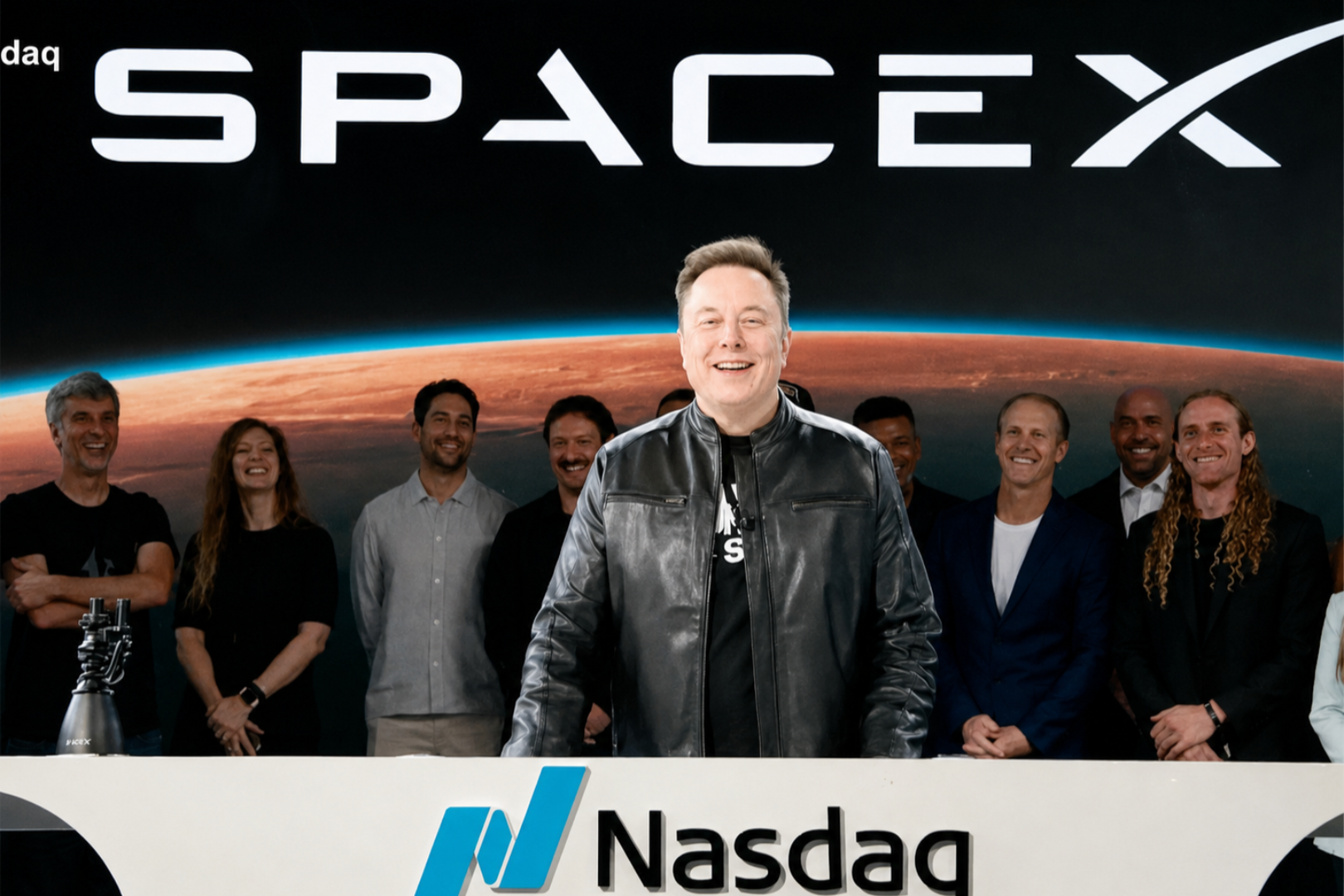
The Largest IPO in History Is Approaching, Surpassing SpaceX, 28 Years of AI Self-Iteration, Countdown to Intelligence Explosion

"Anthropic Nears Trillion-Dollar IPO, Fueled by Explosive Growth and 2028 'Intelligence Explosion' Warning Anthropic is considering a deal valuing the AI company near $1 trillion, potentially leading to one of the largest IPOs ever and surpassing SpaceX. Its revenue has skyrocketed, with Annual Recurring Revenue (ARR) reaching $45 billion in May 2026—a 500% increase in just five months. This vertical growth curve is attributed to its key products, Claude Code and Cowork, dominating AI coding and enterprise collaboration. Beyond commercial success, co-founder Jack Clark issued a pivotal warning in an interview: there is a greater than 50% chance that by the end of 2028, AI systems will achieve recursive self-improvement—the ability to autonomously build a 'better version' of themselves, initiating an 'intelligence explosion.' This prophecy underpins the company's astronomical valuation, as the market prices in the potential for transformative and disruptive AI. Further signaling its ambition, Anthropic formed a $1.5 billion joint venture with Goldman Sachs and Blackstone, aiming to disrupt traditional consulting firms like McKinsey by deploying Claude AI for complex strategic work. This move tests AI's capacity to replace high-level cognitive labor, a precursor to its predicted autonomous evolution. The narrative presents a dual future: unprecedented economic opportunity alongside significant risks like economic restructuring and security threats. Anthropic's meteoric rise and Clark's 2028 prediction frame the coming years as a countdown to a potential technological singularity."

marsbit05/11 07:08

The Largest IPO in History Is Approaching, Surpassing SpaceX, 28 Years of AI Self-Iteration, Countdown to Intelligence Explosion

marsbit05/11 07:08

The Night Before the AI Model Shakeout

China's large language model (LLM) industry is entering a critical consolidation phase. In a concentrated wave of funding in May 2026, leading players Kimi, StepFun, and DeepSeek reportedly secured over $70 billion combined, signaling a dramatic capital rush towards the few remaining independent contenders. This frenzy masks an impending shakeout. The core dynamic has shifted from a pure technology race to a battle for survival and strategic positioning. LLM capabilities are rapidly commoditized; gaps between top models are narrowing. Consequently, investment logic has pivoted from betting on future potential to prioritizing cash flow, user access, and ecosystem integration. The economic model poses a fundamental challenge: while user growth previously meant profits, in the AI era, it drives soaring inference costs. Startups, lacking the cross-subsidy ability of tech giants like ByteDance or Tencent, face immense pressure to achieve financial sustainability. DeepSeek's open-source, high-performance, low-cost strategy has further compressed industry profit margins. Facing this reality, the top players are scrambling to lock in their status before the window closes. StepFun is accelerating its港股 IPO, embedding itself in hardware supply chains. Kimi is aggressively showcasing revenue growth (ARR doubling to $2 billion in a month) to prove viability. DeepSeek, with new state-backed investment, is solidifying its role as a strategic national asset. The parallel to China's previous AI "Four Dragons" is stark. The industry is witnessing extreme capital concentration at the top, while mid-tier companies face a funding winter. The narrative has evolved from "who can build the best model" to "who can survive." For independent LLM companies, securing a public listing or a definitive strategic identity is no longer about expansion—it's about securing the very right to exist in the impending era of industry clearance.

marsbit05/10 02:05

The Night Before the AI Model Shakeout

marsbit05/10 02:05

Dissolving xAI, Musk Wants to Rebuild an AI Company Using Rocket-Building Methods

Elon Musk is making an unprecedented move by dissolving his AI startup, xAI, and folding it into his aerospace company, SpaceX, ahead of a planned public offering. This aims to package SpaceX's lucrative rocket and Starlink business with the high-cost, high-growth potential of AI. However, xAI's flagship model, Grok, has struggled to gain significant commercial or enterprise traction compared to leaders like OpenAI's ChatGPT or Anthropic's Claude. Internal turmoil led to the departure of much of xAI's founding AI talent. Musk has responded by installing SpaceX engineers as managers to transform xAI from a research lab into a high-efficiency "AI factory," focusing on infrastructure like its Colossus supercomputing cluster. Musk's vision positions the combined "SpaceXAI" as a future AI infrastructure company, addressing bottlenecks in computing power, energy, and data centers. He even proposes futuristic concepts like space-based AI data centers. To validate this story, SpaceXAI has begun sharing compute resources with former rival Anthropic. Financially, the merger appears to be a move to secure funding for xAI's massive losses by leveraging SpaceX's stable cash flow. While the combined entity targets a $1.25 trillion valuation, the market has yet to price in significant synergy. The strategic choice of SpaceX over Tesla, despite Tesla's closer ties to physical AI applications like robots and cars, is seen as Musk securing maximum control. Ultimately, Musk is betting that his proven methodology—centralized control, vertical integration, and aggressive engineering timelines—will succeed in the AI arena. But this time, he faces competitors like OpenAI and Google who are equally fast, well-funded, and determined. The merger is less about a guaranteed victory and more about ensuring Musk remains a key player at the table, regardless of the final outcome.

marsbit05/09 01:40

Dissolving xAI, Musk Wants to Rebuild an AI Company Using Rocket-Building Methods

marsbit05/09 01:40

活动图片