Survey of 81,000 Claude Users: 20% of Respondents Worry About Unemployment

marsbitОпубликовано 2026-05-10Обновлено 2026-05-10

Введение

Survey of 81,000 Claude Users: 20% Fear Job Loss A report by Anthropic surveying 81,000 Claude users reveals the complex impact of AI on work. Key findings show that 20% of respondents worry about AI-induced job loss, with anxiety strongest among early-career professionals and those in roles with high "observed exposure" to AI tasks, like software engineering. While most users report significant productivity gains—averaging 5.1 on a 7-point scale—the benefits are uneven. High-income professionals and, notably, some lower-income workers experience the largest boosts. The primary gains come from expanding work scope (48%)—enabling new tasks—and increasing speed (40%). Paradoxically, those who benefit most from AI, especially when it drastically speeds up work, express the greatest anxiety about their job security. Most users feel the productivity gains accrue to themselves, though 10% believe the benefits are captured by employers or clients. The report concludes that AI is demonstrably empowering users by unlocking new capabilities, but this does not alleviate the pervasive economic anxiety, particularly among those who best understand AI's potential. The study acknowledges limitations, including its sample of active Claude users, but highlights that the concerns of over 80,000 individuals are a significant signal.

Author: TinTinLand

Why are those who benefit the most from AI also the ones most worried about losing their jobs?

On April 22, Anthropic released a survey report covering 81,000 real Claude users—"What 81,000 people told us about the economics of AI"—attempting to uncover the real situations and mindsets of ordinary people under the wave of AI.

The core findings mentioned in the report are as follows:

  • The deeper AI involvement in a profession, the stronger the workers' anxiety about unemployment, especially among newcomers to the field;

  • Productivity improvements are most significant among the highest and lowest income groups. And most of these improvements are not about "doing things faster," but about "doing things that were previously impossible";

  • Those who achieve the highest efficiency gains through AI instead feel the deepest anxiety about their career prospects.

TinTinLand has conducted an in-depth translation of the full text, taking you through the analysis of this latest survey on AI, the economy, and survival.

🤔 Who is Worried About Unemployment?

One-fifth Express Concern

"Like every white-collar worker today, I worry almost all the time that my job will be replaced by AI." — A software engineer

Among the respondents, about one-fifth explicitly expressed concern about economic unemployment.

One software developer said, "AI at this stage is likely to replace entry-level positions." Others lamented that their job content is being eroded by automation.

A market researcher stated: "There's no doubt that AI has enhanced my capabilities. But in the future, it might replace my job."

In some positions, the arrival of AI has even made work more difficult. A software developer observed: "Since AI emerged, project managers have been assigning us increasingly difficult tasks and bugs."

Data Validation

In this report, we used Claude to infer the attributes and sentiments of respondents from their answers. For example, many respondents incidentally mentioned their occupation or provided details about their work life, allowing us to infer their occupational category. Similarly, we quantified "unemployment concern" by having Claude identify and interpret respondents' direct statements about "their own position facing the risk of AI replacement."

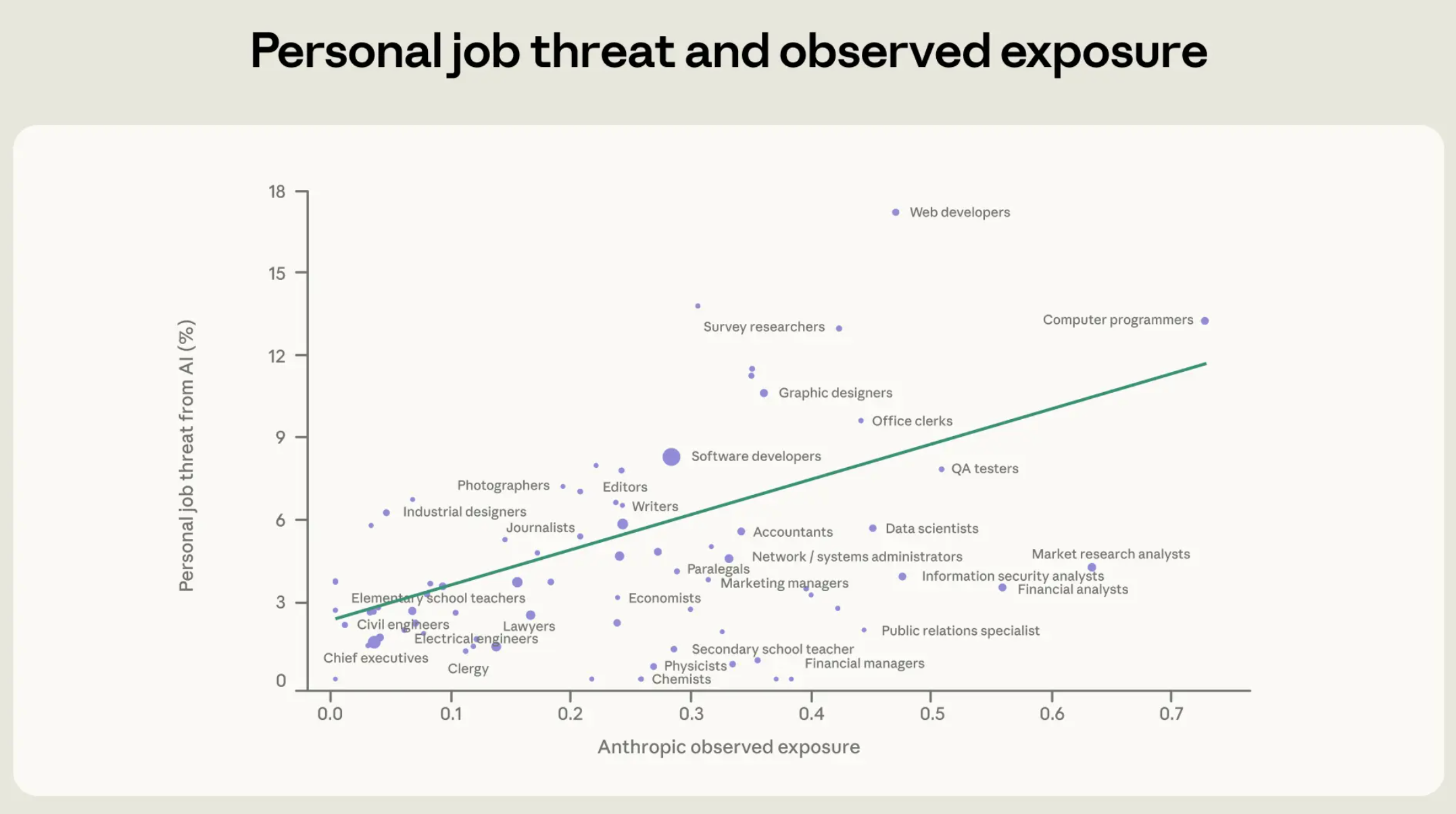
The study found that respondents' subjective perception of AI threat is highly correlated with the "observed exposure" of their occupation. Exposure refers to the proportion of tasks actually undertaken by AI in that profession.

For example, elementary school teachers' concern about being replaced is significantly lower than that of software engineers, which aligns perfectly with the reality of programming tasks dominating Claude's usage.

As shown in Figure 1, the vertical axis represents the percentage of respondents in a given occupation who believe AI is already replacing their positions or is likely to do so in the near future; the horizontal axis represents "observed exposure."

For every 10-percentage-point increase in exposure, the perceived job threat rises by 1.3 percentage points. Those in the top 25% of exposure express concern three times more frequently than those in the bottom 25%.

Figure 1: Job Threat from AI vs. Observed Exposure

Younger People Are More Anxious

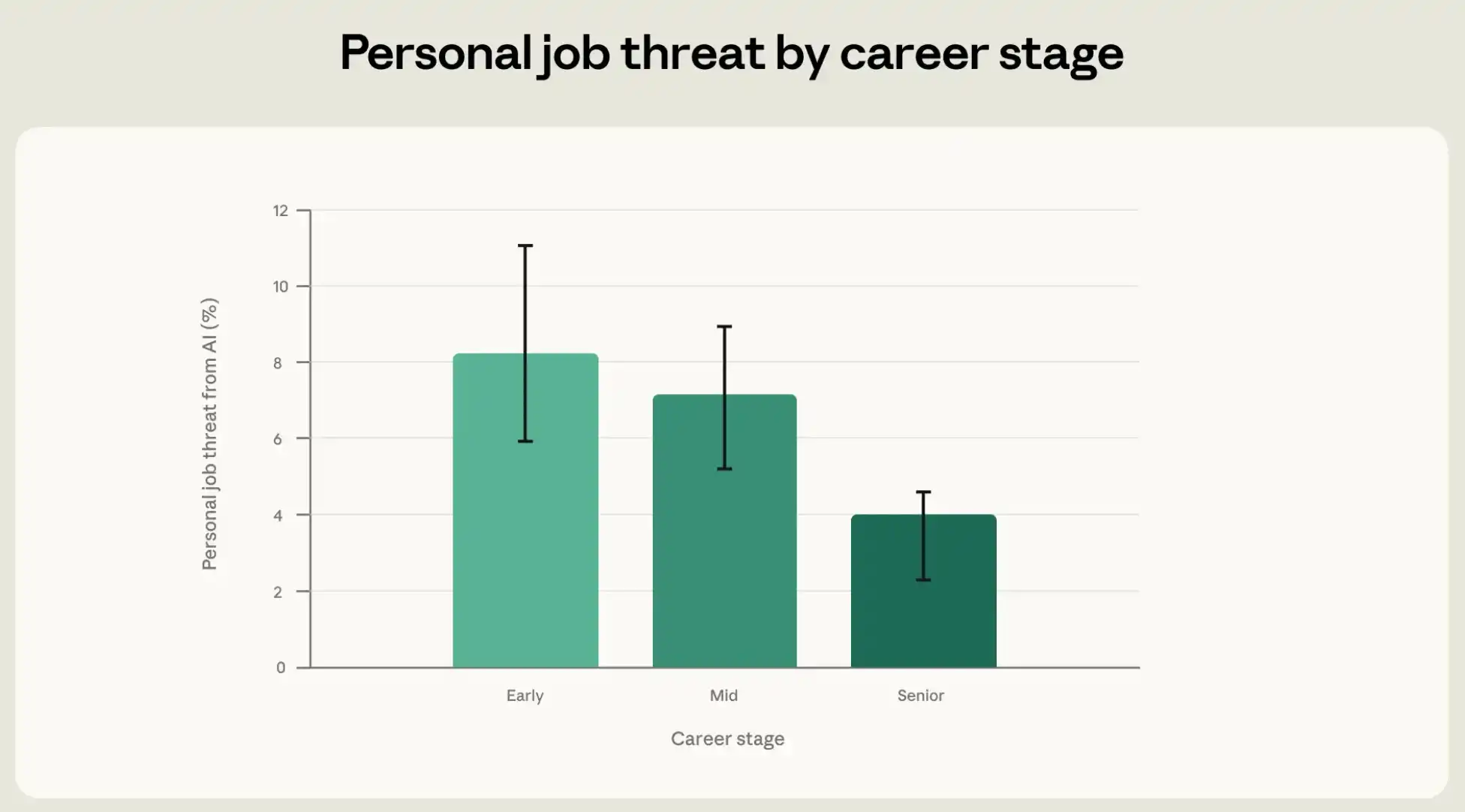
Career stage is a key variable influencing anxiety. In previous research, we have already observed signs of a slowdown in hiring for new graduates and early-career professionals in the US.

In this survey, we also found: Early-career professionals are far more panicked about unemployment than their senior counterparts.

Figure 2: Unemployment Concern by Career Stage

Who is Benefiting from AI?

Most People Feel a Productivity Boost

We used Claude to score the degree of self-reported productivity improvement among respondents on a scale from 1 to 7: 1 represents "decreased efficiency," 2 represents "no change," and each subsequent level represents greater improvement.

  • A typical 7-point response: "Building a website used to take months, now it's done in 4 or 5 days";

  • A 5-point response: "Something that might have taken four hours can now be done in half an hour";

  • A 2-point response: "AI helped me fix a piece of code, but it took several tries to get the desired result."

The final average score was 5.1, meaning "significantly more efficient."

Of course, these respondents are active Claude users who were willing to take the survey, so they are more likely than the average user to perceive productivity gains. About 3% reported negative or neutral impacts, and another 42% did not explicitly mention productivity changes.

High Earners Benefit the Most

This result shows some divergence along income lines.

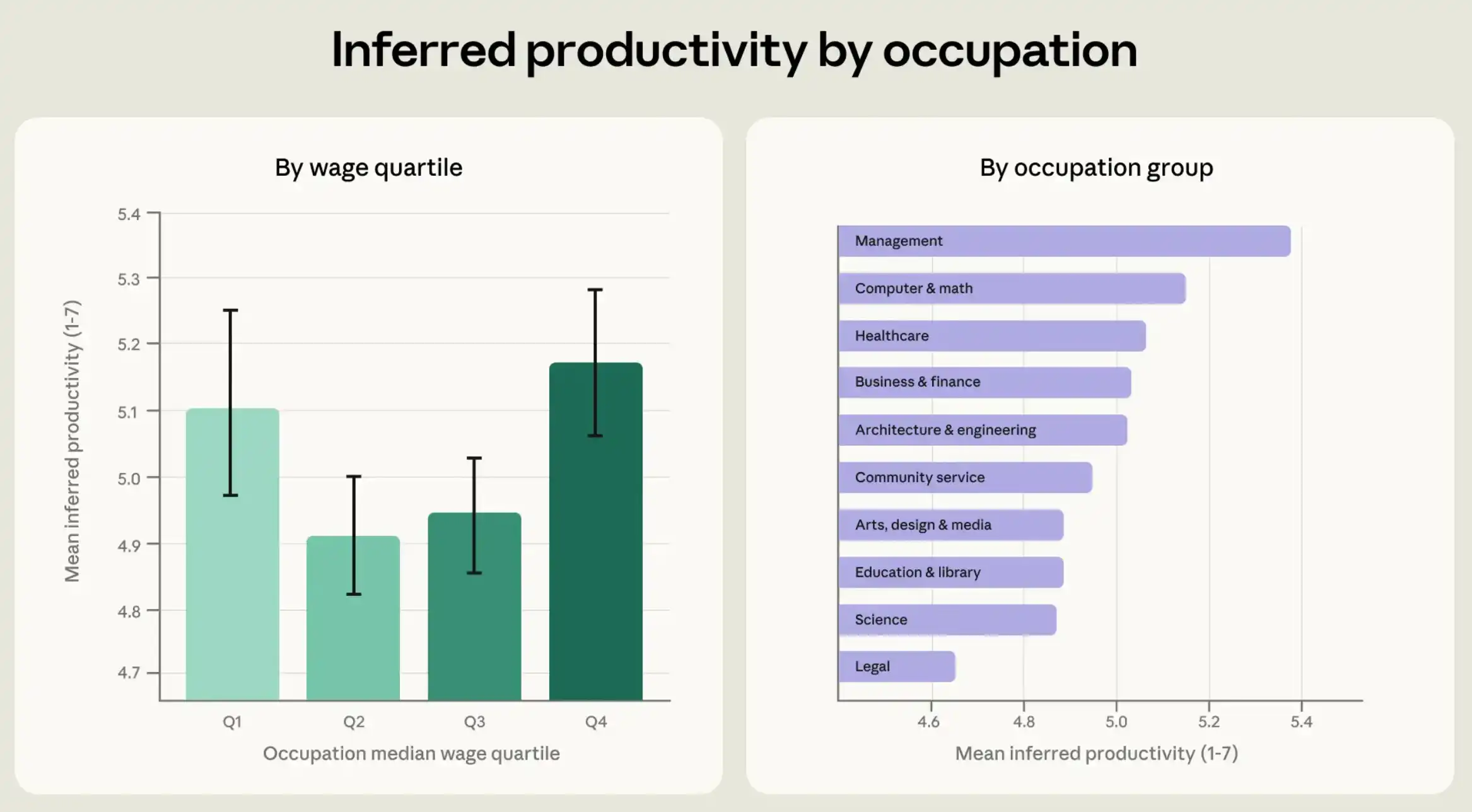
The left side of Figure 3 shows that high-paying professions (like software developers) gained the largest productivity boosts. This trend holds even when excluding computer and math-related occupations.

For tasks requiring higher education levels, Claude tends to shorten the time needed to complete them more substantially (compared to not using AI).

But one detail is worth noting: The benefit for low-wage positions is also not insignificant. A customer service representative uses AI to quickly generate responses, saving a lot of time; a delivery person is using Claude to start an e-commerce business; a gardener is developing a music app. AI is opening doors for less educated, lower-income people that were previously inaccessible.

Figure 3: Productivity Improvement by Occupation (Inferred)

We break down this result more finely on the right side of Figure 3.

Management occupations rank highest; these respondents are mostly entrepreneurs using Claude to start businesses. Next are computer and math occupations, including software developers. The two groups with the most modest productivity improvements are research and legal professionals.

Some lawyers expressed concern about AI's ability to accurately follow complex instructions: "I've given very specific rules, including content placement, how to interpret legal documents, the operations I want it to perform... but it goes off track every time."

Where Do the Gains Flow?

As AI diffuses through the economic system, a key question is: Where do these gains ultimately flow—to the workers themselves, managers, consumers, or companies?

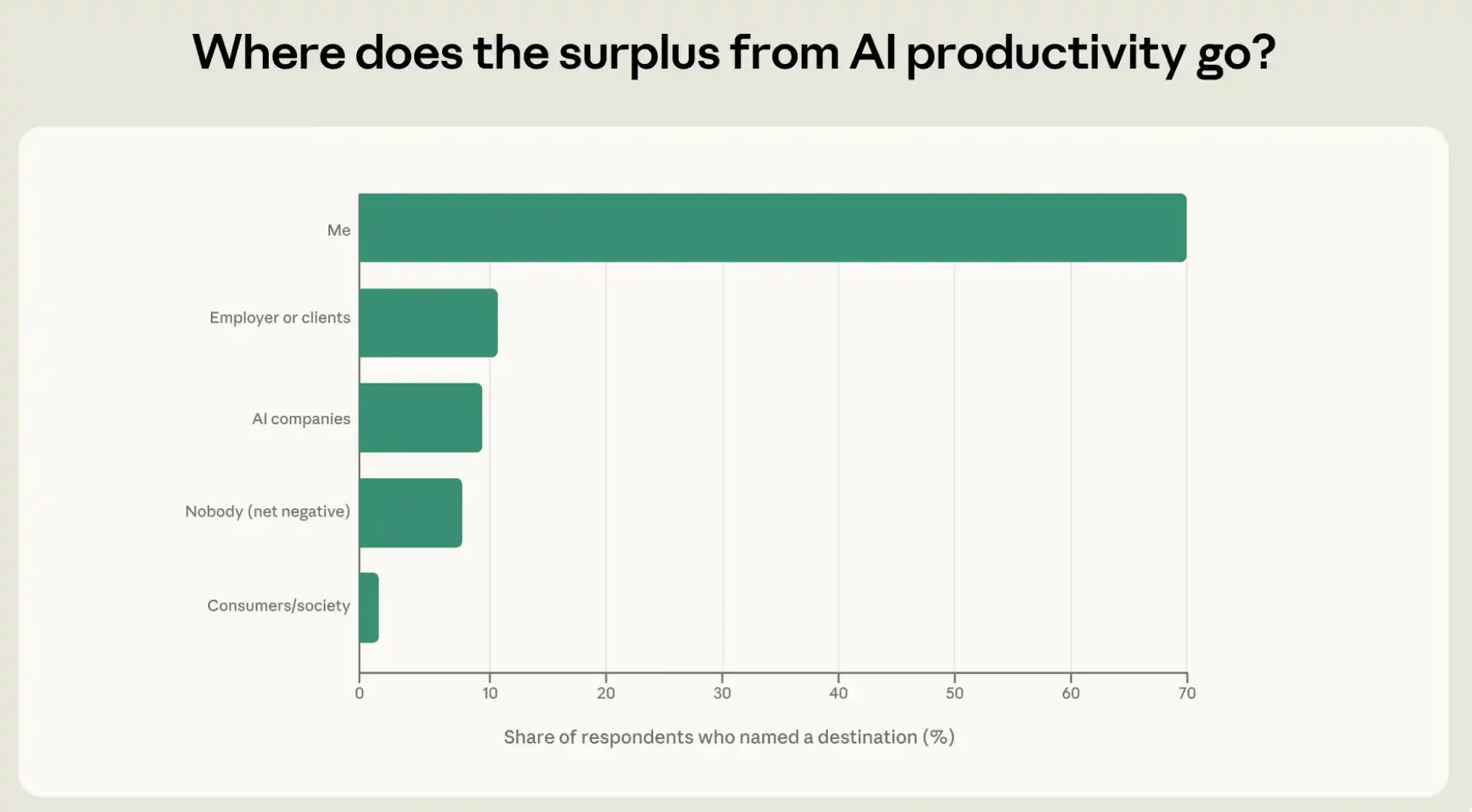
Overall, most people believe the benefits go to themselves: tasks are completed faster, they can do more things, and they gain more discretionary time.

However, 10% of respondents still felt this dividend was "harvested" by employers or clients: needing to deliver more output in the same amount of time. A small fraction also mentioned that AI companies would benefit.

This difference also relates to career stage: only 60% of early-career professionals believe they are beneficiaries of the AI dividend, compared to 80% among senior professionals.

Figure 4: Where Does the AI Productivity Dividend Flow?

Where is Efficiency Improvement Manifested?

"I'm Doing Things I Couldn't Do Before"

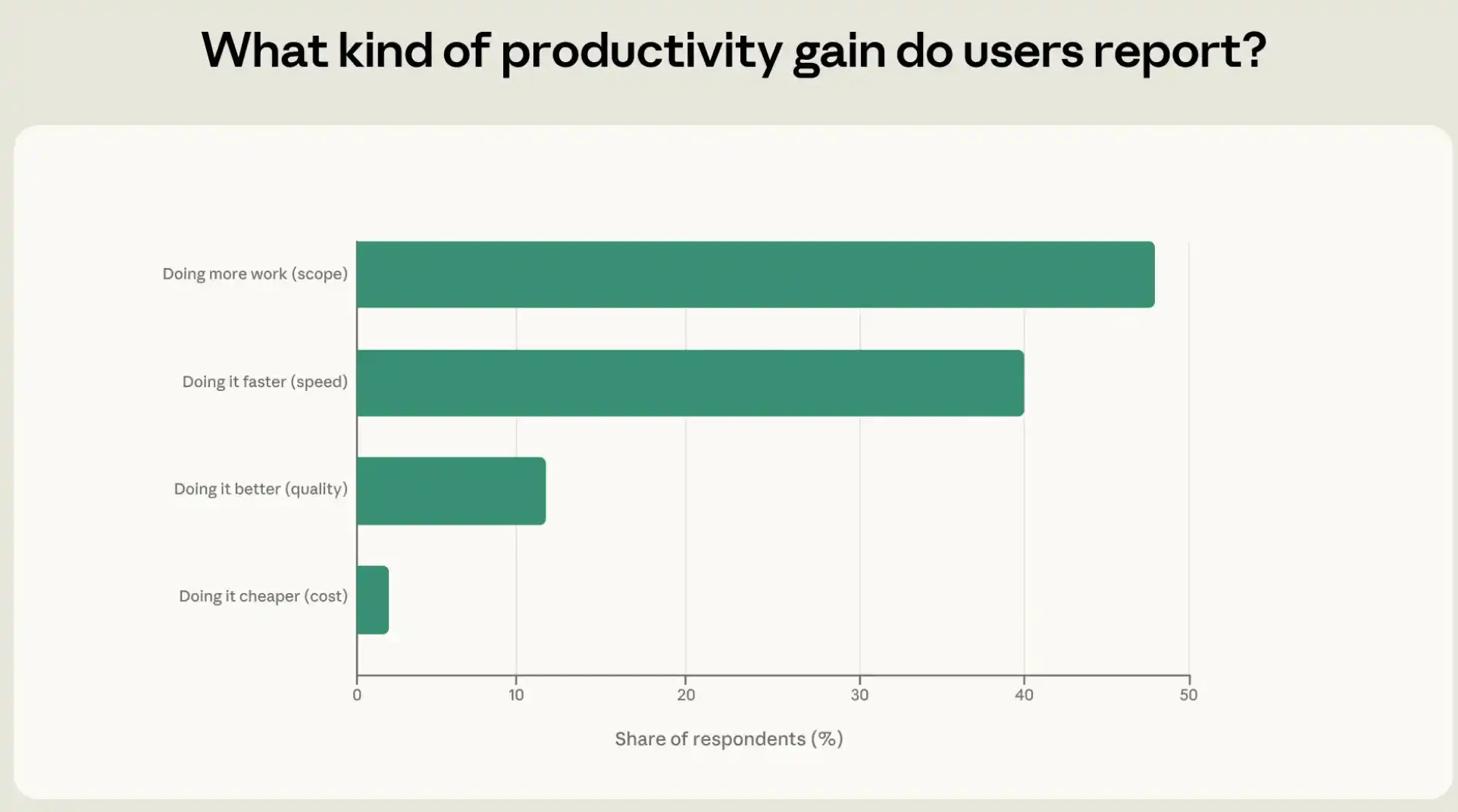
Respondents shared in which aspects they felt productivity improvements. We break this down into four dimensions: work scope, speed, quality, and cost.

Analysis found that among all respondents who explicitly mentioned productivity changes, the most common improvement came from "expansion of work scope," accounting for 48%; while 40% emphasized speed improvements.

For example, many using AI for programming said: "I wasn't a technical person before, but now I can do full-stack development." This falls under scope expansion—AI unlocked new capabilities for them.

Others achieved speed-ups on existing tasks, like an accountant who said: "I built a tool that can complete financing tasks in 15 minutes that used to take 2 hours."

Quality improvements often manifest in more comprehensive and detailed checks on code, contracts, and various documents. A small portion of respondents also mentioned AI's low-cost advantage.

Figure 5: Types of Productivity Improvements Reported by Users

The Faster the Speed, The Greater the Fear of Unemployment

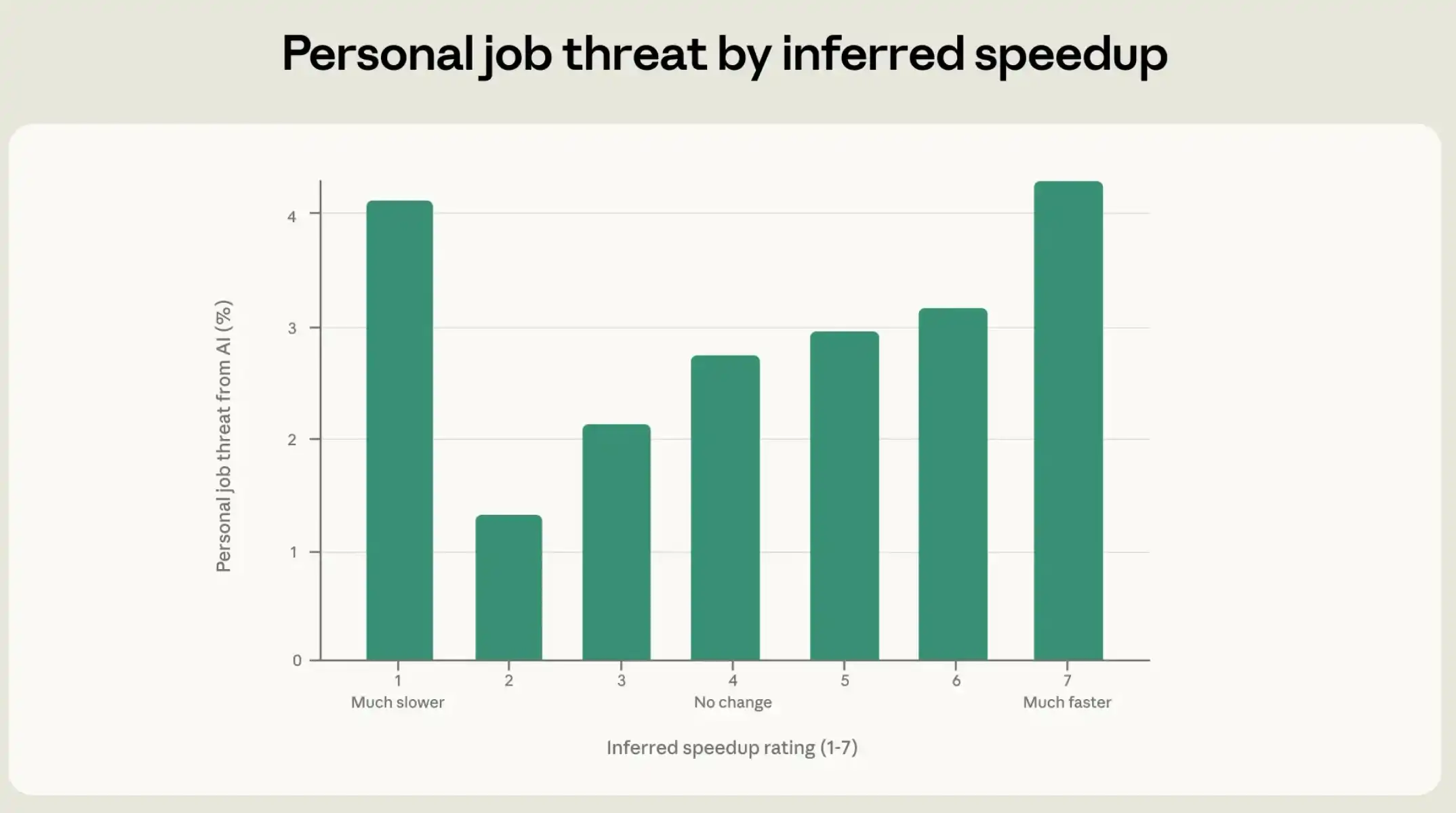
The study found a U-shaped relationship between AI's improvement in work speed and perceived job threat (see Figure 6).

  • Low-Speed Group (Slower): Mainly creative workers (e.g., writers, artists) who feel AI's rigidity limits creative flow, yet worry that the flood of low-quality AI content will squeeze their living space.

  • High-Speed Group (Extreme Speed Boost): When task completion time shrinks from hours to minutes, users develop a strong sense of insecurity—if work becomes so easy, what is the long-term value of "my" existence?

Figure 6: Relationship Between Job Threat from AI and Speed Change

Conclusion: What Can We Read From This?

People's Perceptions Highly Align with Data

Data shows that people's perceptions are consistent with actual usage data: the more tasks Claude can undertake, the more people worry about AI's impact.

Additionally, higher economic anxiety among early-career populations aligns with existing research findings.

AI is Empowering, But Anxiety is Also Real

Meanwhile, the survey also presents the other side of the coin: AI is genuinely expanding people's capabilities.

Although high-income earners are most positive about productivity gains from AI, low-wage positions and those with lower education levels also report significant efficiency improvements. Most respondents believe Claude enhances their capabilities by expanding work scope or increasing execution speed.

But this does not dissolve the anxiety. Those who benefit the most are often also the most uneasy—because they understand better than anyone else what AI can do.

Limitations and Outlook

It must be noted that our analysis has some important limitations:

Respondents are all active Claude users, making them more likely to perceive personal benefits from AI; information like occupation and career stage is inferred from open-ended responses, with some margin of error; also, the survey uses open-ended questions, so results depend on what respondents "happened to voluntarily mention."

Nevertheless, the economic anxiety mentioned by 80,508 Claude users in the report is itself a signal that cannot be ignored.

Связанные с этим вопросы

QWhat is the main finding of the Anthropic survey regarding AI and job security?

AThe main finding is that about 20% of the 81,000 surveyed Claude users expressed concern about economic displacement due to AI. The anxiety is strongest among professionals in fields where AI is most actively used, particularly those early in their careers.

QWhich professional groups reported the greatest productivity gains from using AI according to the report?

AThe report found that high-income professionals, such as software developers and managers, reported the greatest productivity gains. However, low-income and low-education individuals also reported significant benefits, as AI enabled them to perform tasks previously out of reach.

QHow did the 'speed of task completion' relate to users' perception of job threat?

AThe relationship was U-shaped. Users who reported a very high speed increase (e.g., tasks reduced from hours to minutes) felt the strongest job insecurity. Some creative professionals who felt AI slowed their workflow also expressed anxiety about being displaced by lower-quality AI content.

QWhat was the most common way in which users experienced productivity improvements from AI?

AThe most common form of productivity improvement was an expansion of 'work scope' (48% of respondents who mentioned changes), meaning AI allowed them to do things they couldn't do before. Speed improvements were the second most common (40%).

QWho do most users believe benefits from the productivity gains provided by AI tools like Claude?

AMost users believe the primary benefits accrue to themselves, through faster task completion, expanded capabilities, and more free time. However, 10% feel the gains are captured by their employers or clients, who expect more output in the same time.

Похожее

Bloomberg Uncovered: How Do China's Wealthy Circumvent the Annual $50,000 Limit to Transfer Assets?

**Summary: How Wealthy Chinese Circumvent $50,000 Annual Foreign Exchange Limits** Despite China's strict capital controls, including an annual $50,000 per person foreign exchange quota, an estimated $150 billion in funds still leaves the country annually via various gray and underground channels. This report outlines the evolution of China's "capital wall" and the methods used to bypass it. **The Evolving Capital Controls:** * **Foundation (1994):** The system of "current account convertibility with strict capital account controls" was established. * **Quota Set (2007):** The $50,000 individual annual forex purchase limit was formalized. * **Crackdown Begins (2015-2017):** Following market volatility, enforcement tightened. Banks were required to scrutinize transactions, and channels like using UnionPay cards for Hong Kong insurance premiums or buying overseas property were blocked. * **Digital & Legal Upgrades (2024-2026):** Enhanced algorithms now flag suspicious patterns (e.g., "smurfing"). The Common Reporting Standard (CRS) provides Chinese tax authorities with data on citizens' offshore accounts. Unlicensed cross-border brokers have been targeted. **Five Primary Methods for Moving Capital:** 1. **Underground Banking / "Hawala" (Duiqiao):** The largest-scale method. No money crosses borders. Clients pay RMB to a domestic account; an overseas associate deposits equivalent foreign currency into the client's offshore account. Risks include high fees, account freezes, and legal penalties. 2. **"Smurfing" or "Ant Moving":** Using multiple individuals' $50,000 quotas to pool funds for one offshore recipient. Increasingly detected by anti-money laundering algorithms. 3. **Trade Invoice Manipulation:** Businesses over-invoice imports or under-invoice exports via offshore shell companies, creating a pretext to transfer excess funds abroad under the guise of trade. 4. **Channel Migration:** After a crackdown on internet brokers, funds flow toward more compliant but costly channels like major banks' cross-border wealth management services or Qualified Domestic Institutional Investor (QDII) quotas. 5. **Structural Arrangements:** High-net-worth individuals use complex, high-cost legal structures involving offshore trusts, insurance, and investment migration programs to transfer asset ownership. **Regulatory Response: Focusing on People, Not Just Money** The current strategy extends oversight from enterprises to **individual residents**. Tools like CRS allow retroactive visibility into offshore assets. Cryptocurrencies, once seen as a potential loophole, are now actively monitored and prosecuted as an illegal channel. The underlying driver remains: with significant wealth concentrated among millions of affluent households seeking diversification amid domestic economic shifts, the incentive to move assets offshore persists despite regulatory barriers.

marsbit5 мин. назад

Bloomberg Uncovered: How Do China's Wealthy Circumvent the Annual $50,000 Limit to Transfer Assets?

marsbit5 мин. назад

Ethereum's Ballmer Moment: As Everyone Is Bearish, the Circulating Supply Is Disappearing

"Ethereum's Ballmer Moment: Circulation Shrinks Amid Bearish Sentiment" Amid widespread bearish sentiment, with prominent figures like Bankless founder David Hoffman selling ETH and young developers flocking to Solana, some argue Ethereum is entering its "Ballmer era"—akin to Microsoft's perceived stagnation under Steve Ballmer. While surface-level criticisms about slow protocol development, cautious leadership, and competitive pressure are valid, underlying fundamentals tell a different story. Approximately 30% of ETH is staked, major holders like BitMine are accumulating, and spot ETFs continue to absorb supply. Regulatory clarity, including the SEC/CFTC's March ruling on staking rewards and the potential passage of the CLARITY Act, is transforming crypto from a regulatory threat into a legitimized framework. This institutionalization, alongside a shrinking circulating supply (with net issuance around 0.23% annually), creates significant buy-side pressure independent of fee-based value capture. The broader crypto total addressable market is expanding through regulated stablecoins, tokenized assets, and institutional adoption. While public chains face competition from permissioned alternatives, the winning model appears to be permissioned assets settling on public chains like Ethereum and Solana. The author advocates a non-maximalist, barbell strategy: holding ETH for its institutional role and supply squeeze, SOL for consumer/throughput trends, BTC as a macro hedge, and a basket of next-gen L1s. Key bullish drivers for ETH include rapid circulation shrinkage, potential Q2 staked ETF approvals, regulatory tailwinds solidifying its role as a default settlement layer, and the optionality of an eventual "Satya moment" leadership shift. Despite bearish consensus, the current setup—where crypto is "not hot" and regulatory groundwork is being laid—presents a compelling investment opportunity. The crypto cycle's focus may have shifted to AI, but blockchain infrastructure is gaining a legal and institutional foothold precisely while attention is elsewhere.

marsbit6 мин. назад

Ethereum's Ballmer Moment: As Everyone Is Bearish, the Circulating Supply Is Disappearing

marsbit6 мин. назад

Claude Code Introduces Dynamic Workflows: Enabling AI to Form Teams and Collaborate

Claude Code introduces dynamic workflows, enabling AI to coordinate teams of specialized agents for complex tasks. This transforms Claude from a code assistant into a programmable workbench. Workflows address key limitations of single-agent systems: agentic laziness (premature task completion), self-preferential bias (favoring own outputs), and goal drift (losing sight of original objectives). The system allows Claude to dynamically create execution frameworks using JavaScript. It can split tasks, dispatch parallel agents for isolated work (e.g., in separate worktrees), implement adversarial validation, run tournaments, and synthesize results. This multi-agent approach is valuable for tasks requiring deep research, factual verification, code migration, root cause analysis, large-scale triage, and qualitative sorting. Key patterns include: classify-and-route, fan-out-and-synthesize, adversarial verification, generate-and-filter, tournaments, and loop-until-done. While token usage is higher, workflows excel where tasks resemble programming—needing problem decomposition, isolated context, hypothesis testing, and handling many details. They extend Claude Code's utility beyond technical work to areas like business plan review, resume screening, and naming brainstorm. The feature is not a universal solution but points to a future where AI tool competitiveness depends on organizing reliable, reusable, and auditable execution flows for complex goals.

marsbit47 мин. назад

Claude Code Introduces Dynamic Workflows: Enabling AI to Form Teams and Collaborate

marsbit47 мин. назад

Hyperliquid, Wall Street's 24/7 Trading Convenience Store

Hyperliquid: The 24/7 Trading "Convenience Store" for Wall Street Hyperliquid, a decentralized cryptocurrency exchange, has become a go-to platform for Wall Street traders seeking to trade around the clock, especially during traditional market closures. Founded by Jeff Yan, a former quantitative trader, after the FTX collapse, the platform emphasizes user self-custody of assets. It offers a wide range of perpetual contracts—leveraged derivatives with no expiry—on assets from Bitcoin and crude oil to the S&P 500 and even pre-IPO companies like SpaceX. A notable example involves a hedge fund trader who capitalized on geopolitical news over a weekend, securing a 243% return on oil derivatives before markets reopened. The platform, run by just 11 employees, generated approximately $800 million in revenue last year, and its native token HYPE has seen significant growth. Its rise highlights the merging of traditional finance and crypto. While U.S. users are currently restricted, recent CFTC rule changes could open access. The platform is known for its transparency, having processed $10 billion in liquidations during a market crash while competitors faltered. Regulators warn of the high risks and complexity of perpetual contracts for retail investors. Key to its appeal is a strong community culture, direct engagement with founders, and a simple interface. Despite rules against VPN use, it attracts global users with its permissionless approach. Hyperliquid plans to expand into prediction markets and options, aiming to eventually host all financial activity.

marsbit47 мин. назад

Hyperliquid, Wall Street's 24/7 Trading Convenience Store

marsbit47 мин. назад

Торговля

Спот
Фьючерсы

Популярные статьи

Неделя обучения по популярным токенам (2): 2026 может стать годом приложений реального времени, сектор AI продолжает оставаться в тренде

2025 год — год институциональных инвесторов, в будущем он будет доминировать в приложениях реального времени.

1.8k просмотров всегоОпубликовано 2025.12.16Обновлено 2025.12.16

Неделя обучения по популярным токенам (2): 2026 может стать годом приложений реального времени, сектор AI продолжает оставаться в тренде

Обсуждения

Добро пожаловать в Сообщество HTX. Здесь вы сможете быть в курсе последних новостей о развитии платформы и получить доступ к профессиональной аналитической информации о рынке. Мнения пользователей о цене на AI (AI) представлены ниже.

活动图片