Strategy Takes a Hard Line Against MSCI: The Ultimate Defense of DAT

深潮Опубликовано 2025-12-11Обновлено 2025-12-11

Введение

In a significant industry clash, digital asset treasury company Strategy has issued a forceful 12-page public letter to MSCI opposing its proposal to exclude companies with over 50% digital asset holdings from its global investable market indices. Strategy argues the move is discriminatory, misleading, and threatens billions in capital flow, potentially causing up to $2.8 billion in passive outflows from its stock alone. The company defends its business model, asserting that digital asset treasuries (DATs) are operational companies—not passive funds—with active strategies like issuing digital debt instruments to fund Bitcoin acquisitions and generate shareholder returns. It compares its role to historic infrastructure builders like Standard Oil and AT&T, emphasizing Bitcoin’s transformative potential in finance. Strategy highlights four key objections: the proposal is arbitrarily discriminatory against digital assets; it violates index providers' neutrality principles; it is impractical due to Bitcoin's volatility and accounting disparities; and it contradicts the U.S. government’s pro-digital asset strategy. The firm demands MSCI withdraw the proposal or extend consultations. Backed by industry advocates and data showing over 200 public companies hold more than 5% of Bitcoin’s supply, Strategy urges MSCI to let markets—not biased rules—determine the value of digital asset companies. The decision, expected by January 2026, could redefine the role of crypto-native firms in ...

Author: KarenZ, Foresight News

The博弈 concerning the development of the Digital Asset Treasury (DAT) industry continues to intensify.

In October, global index provider MSCI put forward a proposal to exclude companies with digital asset holdings accounting for 50% or more of their total assets from its Global Investable Market Indexes. This move directly threatens the market position of companies like Strategy, representative of digital asset treasury companies, and could potentially redirect capital flows for the entire DAT sector.

According to statistics from Bitcoin for Corporations, 39 companies risk exclusion from the MSCI Global Investable Market Indexes. J.P. Morgan analysts previously warned that the exclusion of Strategy alone could lead to nearly $2.8 billion in passive fund outflows. If other index providers follow suit with similar rules, outflows could reach as high as $8.8 billion.
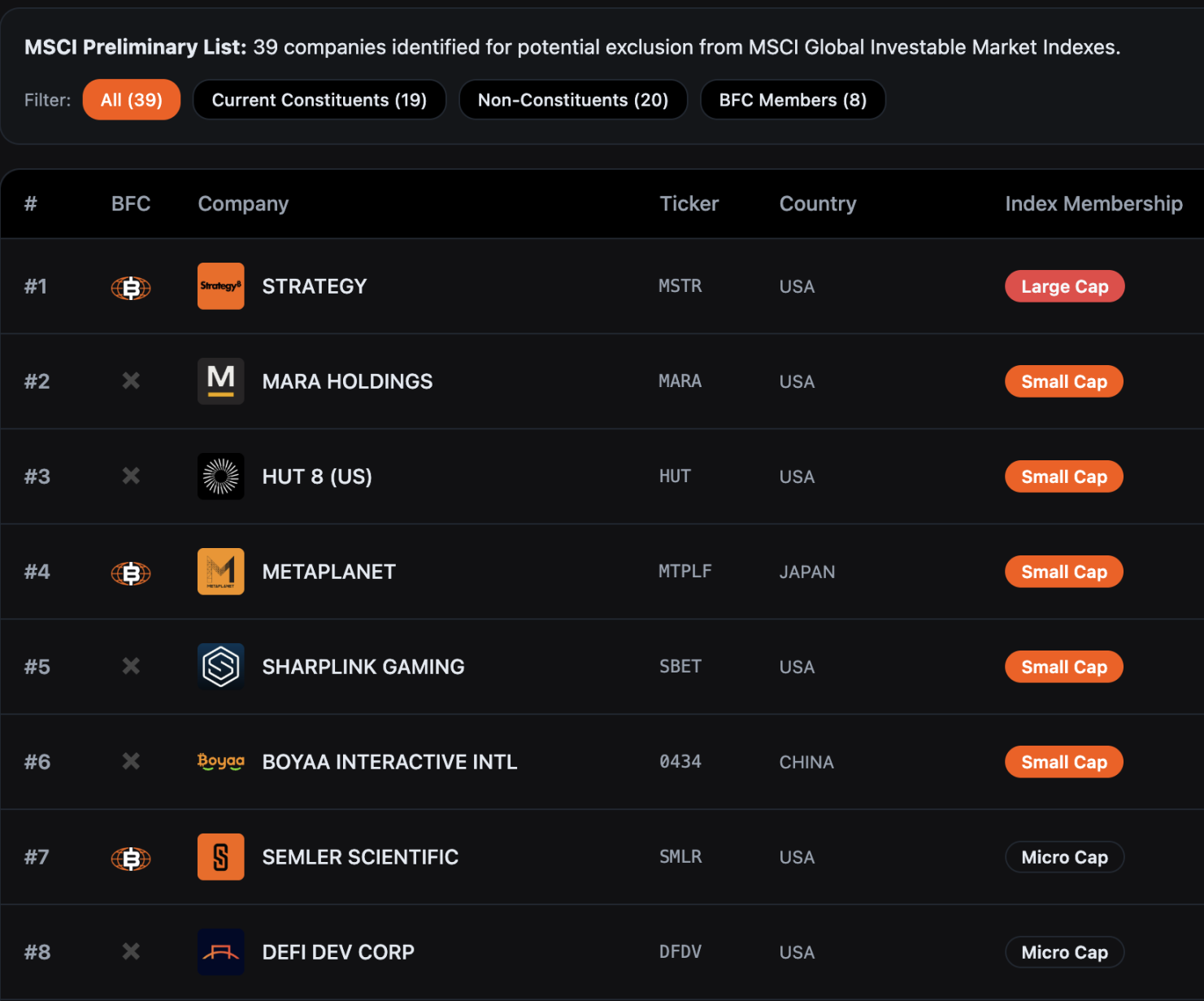
The consultation period for this MSCI proposal is currently open until December 31, 2025, with a final conclusion expected by January 15, 2026. Any adjustments would be formally implemented during the February 2026 index review.

Faced with this urgent situation, Strategy submitted a strongly worded 12-page public letter to the MSCI Equity Index Committee on December 10th. Signed jointly by Executive Chairman and Founder Michael Saylor and President & CEO Phong Le, the letter clearly expressed firm opposition to the proposal. It stated unequivocally: "This proposal is seriously misleading and will have far-reaching destructive consequences for the interests of global investors and the development of the digital asset industry. We strongly urge MSCI to completely withdraw this plan."

Strategy's Four Core Arguments

Digital Assets Are a Revolutionary Foundational Technology Reshaping the Financial System

Strategy believes MSCI's proposal underestimates the strategic value of Bitcoin and other digital assets. Since Satoshi Nakamoto introduced Bitcoin 16 years ago, this digital asset has gradually grown into a key component of the global economy, with a current total market value of approximately $1.85 trillion.

In Strategy's view, digital assets are far more than simple financial instruments; they represent a fundamental technological innovation capable of reshaping the global financial system — companies investing in Bitcoin-related infrastructure are building a new financial ecosystem, much like leading companies that deeply invested in single emerging technologies throughout history.

Just as Standard Oil focused on oil well extraction in the 19th century and AT&T全力 built telephone networks in the 20th century, these companies laid a solid foundation for subsequent economic transformations through前瞻性 investment in core infrastructure, ultimately becoming industry benchmarks. Strategy argues that companies focusing on digital assets today are following this path of "technology pioneers" and should not be simply dismissed by traditional index rules.

DATs Are Operating Companies, Not Passive Funds

This is the core of Strategy's argument — Digital Asset Treasury companies (DATs) are operating companies with complete business models, not merely investment funds passively holding Bitcoin. Although Strategy currently holds over 600,000 Bitcoin, its core value does not rely solely on Bitcoin's price fluctuations. Instead, it creates sustainable returns for shareholders by designing and offering unique "digital credit" instruments.

Specifically, Strategy issues "digital credit" instruments including various types of preferred stock with fixed dividend rates, floating dividend rates, different priority levels, and credit protection terms. It uses the funds raised from selling these instruments to acquire more Bitcoin. As long as the long-term investment return on Bitcoin exceeds Strategy's USD-denominated financing costs, it can generate stable returns for shareholders and clients. Strategy emphasizes that this model of "active operation + asset appreciation" is fundamentally different from the passive management logic of traditional investment funds or ETFs and should be regarded as a normal operating company.

Furthermore, Strategy questions in the letter: Why can oil giants, Real Estate Investment Trusts (REITs), timber companies, etc., concentrate holdings in a single asset class without being classified as investment funds and excluded from indexes? Imposing special restrictions only on digital asset companies clearly violates the principle of industry equity.

The 50% Digital Asset Threshold is Arbitrary, Discriminatory, and Impractical

Strategy points out that MSCI's proposal employs discriminatory standards. Many large companies in traditional industries also hold a highly concentrated single asset class in their portfolios, including oil and gas companies, REITs, timber companies, and power infrastructure firms. Yet, MSCI has set special exclusion criteria only for digital asset companies, constituting obvious unfair treatment.

From an implementation feasibility perspective, the proposal also has serious issues. Due to the high volatility of digital asset prices, the same company could frequently enter and exit MSCI indexes within days due to changes in asset value, causing market chaos. Additionally, differences between accounting standards (the treatment of digital assets differs under US GAAP and international IFRS standards) will lead to differential treatment for companies with the same business model based on their jurisdiction of incorporation.

Violates Index Neutrality Principle, Introduces Policy Bias

Strategy argues that MSCI's proposal is essentially a value judgment on a certain asset class, violating the fundamental principle that index providers should remain neutral. MSCI claims to markets and regulators that its indexes provide "exhaustive" coverage, aiming to reflect the "evolution of the underlying equity market," and should not "make judgments about the goodness or appropriateness of any market, company, strategy, or investment."

By selectively excluding digital asset companies, MSCI is effectively making a policy judgment on behalf of the market, which is precisely what index providers should avoid.

Contradicts US Digital Asset Strategy

Strategy specifically emphasizes that this proposal conflicts with the strategic goals of the Trump administration to advance US leadership in digital assets. The Trump administration signed an executive order in its first week to promote growth in digital financial technology and established a strategic Bitcoin reserve, aiming to make the US the global leader in digital assets.

However, if MSCI's proposal is implemented, it would directly prevent long-term US capital, such as pension funds and 401(k) plans, from investing in digital asset companies, leading to tens of billions of dollars flowing out of the sector. This would not only hinder the development of US digital asset innovation companies but could also weaken US competitiveness in this strategic field, running counter to the government's stated policy direction.

Citing analyst estimates, Strategy states that it alone could face up to $2.8 billion in passive stock liquidation due to MSCI's proposal. This harms not only Strategy itself but will also have a chilling effect on the entire digital asset ecosystem. For example, it might force Bitcoin mining companies to sell assets prematurely to adjust their asset structure, thereby distorting the normal supply and demand dynamics of the digital asset market.

Strategy's Ultimate Demands

Strategy puts forward two main demands in its public letter:

First, it hopes MSCI will completely withdraw the exclusion proposal, allowing the market to test the value of Digital Asset Treasury companies (DATs) through free competition, enabling indexes to neutrally and faithfully reflect the development trends of next-generation financial technology.

Second, if MSCI still insists on "special treatment" for digital asset companies, it must expand the scope of industry consultation, extend the consultation period, and provide more substantial logical support to explain the rationality of the rules.

Strategy Is Not Fighting Alone

Strategy is not fighting alone. According to data from BitcoinTreasuries.NET, as of December 11th, 208 publicly listed companies globally hold over 1.07 million Bitcoin, exceeding 5% of Bitcoin's total supply, currently worth approximately $100 billion.
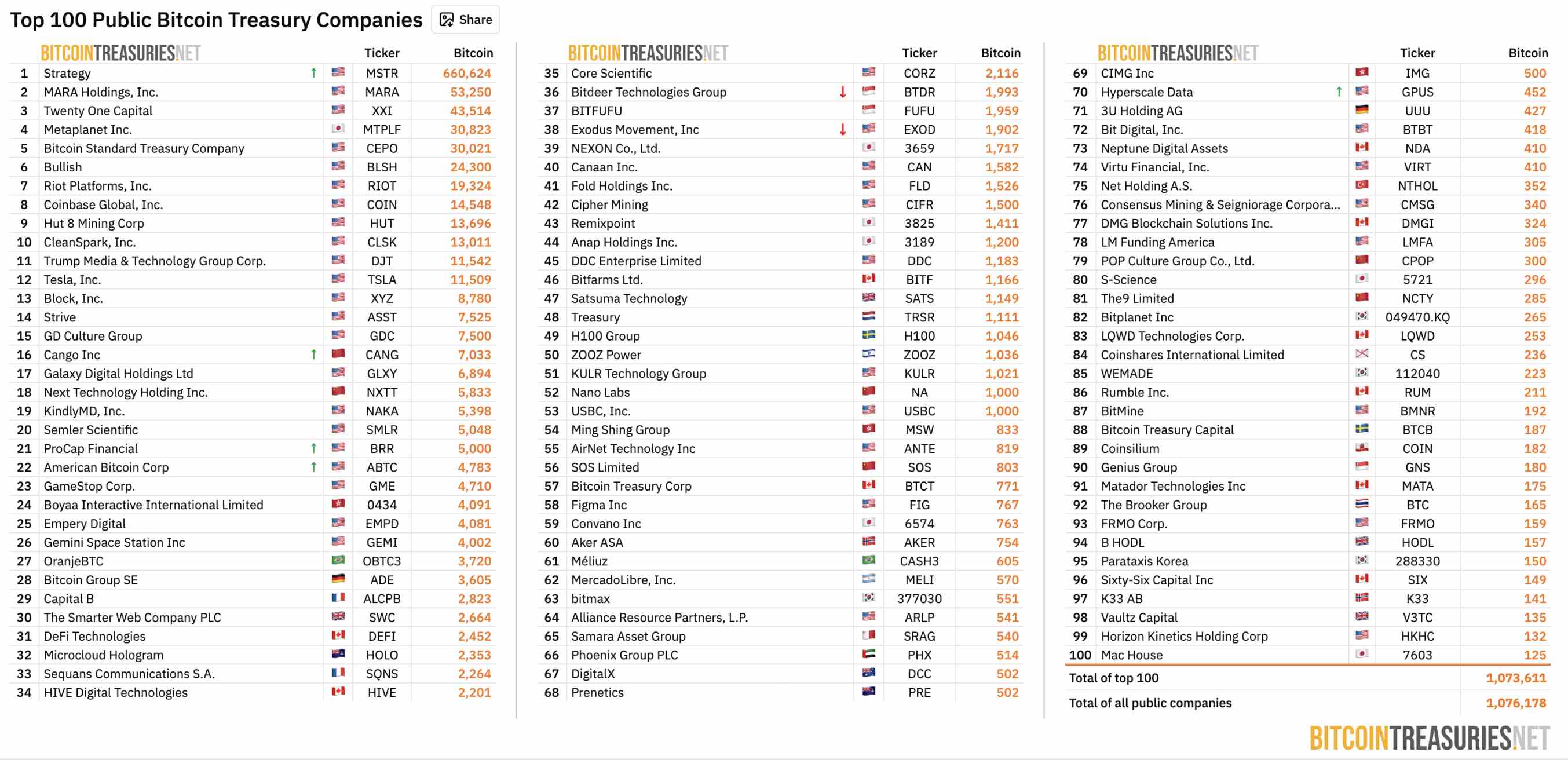
Source: BitcoinTreasuries.NET

These digital asset treasury companies have become important bridge for institutional adoption of cryptocurrency, providing compliant indirect exposure for traditional financial institutions like pension funds and endowments.

Previously, Strive, a Bitcoin-holding public company, suggested that MSCI should leave the "choice" regarding digital asset companies to the market. A simple and direct solution would be to create "ex-Digital Asset Treasury" versions of existing indexes, such as the MSCI USA ex Digital Asset Treasuries Index and the MSCI ACWI ex Digital Asset Treasuries Index. A transparent screening mechanism would allow investors to choose their tracking benchmark independently, preserving index integrity while meeting the needs of different investors.

Additionally, the industry organization Bitcoin for Corporations has initiated a joint petition calling on MSCI to withdraw the digital asset proposal. It advocates that classification should be based on a company's actual business model, financial performance, and operational characteristics, rather than simply drawing a line based on asset percentage. According to the organization's website, 309 companies or investors have currently signed the joint letter. Signatories, besides Strategy, include executives from industry-known firms like Strive, BitGo, Redwood Digital Group, 21MIL, Btc inc, DeFi Development Corp, as well as numerous individual developers and investors.

Summary

The standoff between Strategy and MSCI is essentially a fundamental debate about "how emerging financial innovations integrate into the traditional system." Digital Asset Treasury companies (DATs), as "cross-border" entities between traditional finance and the cryptocurrency world, are neither pure technology companies nor simple investment funds, but represent a new business model built upon digital assets.

MSCI's proposal attempts to use a "50% asset threshold" to classify these complex entities as "investment funds" and exclude them from indexes; Strategy insists that this simplified treatment is a serious misunderstanding of their business essence and a departure from the principle of index neutrality. As the January 15, 2026 decision date approaches, the outcome of this博弈 will not only determine the index "eligibility" of several Bitcoin-holding public companies but will also delineate a critical "survival boundary" for the future position of the digital asset industry within the global traditional financial system.


Трендовые криптовалюты

Связанные с этим вопросы

QWhat is the core argument that Strategy uses to defend its classification as an operational company rather than a passive fund?

AStrategy argues that it is an operational company with a complete business model, not a passive investment fund. Its core value is not derived from Bitcoin's price fluctuations but from creating sustainable returns for shareholders through its unique 'digital credit' instruments, such as preferred shares with fixed or floating dividend rates, which it sells to raise capital for acquiring more Bitcoin. This active operational model is fundamentally different from the passive management of ETFs or funds.

QWhat potential financial impact does Strategy claim the MSCI proposal could have on it and the broader digital asset market?

AStrategy, citing analyst estimates, claims that its exclusion from the MSCI index alone could trigger nearly $2.8 billion in passive fund outflows. If other index providers adopt similar rules, the outflows could reach as high as $8.8 billion. This would not only harm Strategy but also create a chilling effect on the entire digital asset ecosystem, potentially forcing companies like Bitcoin miners to sell assets prematurely and distorting market supply and demand.

QHow does Strategy's public letter justify the strategic value of Bitcoin and digital assets?

AStrategy's letter argues that Bitcoin and digital assets represent a revolutionary foundational technology reshaping the financial system, not merely financial instruments. It compares companies investing in Bitcoin infrastructure to historical pioneers like Standard Oil and AT&T, which made foundational investments in oil and telephone networks. These companies laid the groundwork for economic transformation and became industry benchmarks, a path Strategy believes digital asset companies are now following.

QWhat alternative solution does the industry group Bitcoin for Corporations suggest to MSCI's proposal?

AThe industry group Bitcoin for Corporations, along with companies like Strive, suggests that MSCI should create new versions of its existing indices that explicitly exclude Digital Asset Treasury companies, such as 'MSCI USA ex Digital Asset Treasuries' and 'MSCI ACWI ex Digital Asset Treasuries'. This would give investors the transparent choice of which benchmark to follow, preserving the integrity of the main indices while catering to different investor preferences.

QWhat is Strategy's ultimate request to MSCI regarding the proposed rule change?

AStrategy's primary request is for MSCI to completely withdraw the proposal to exclude companies based on their digital asset holdings. It argues the market should freely compete to validate the value of Digital Asset Treasury companies (DATs) and that the index should neutrally reflect the evolution of next-generation fintech. If MSCI insists on special treatment for these companies, Strategy demands a broader industry consultation, an extended consultation period, and a more robust logical justification for the rule.

Похожее

Стратегия превратилась в настоящего подлеца, продав 3588 BTC с убытком в 55 миллионов долларов

**Strategy (бывшая MicroStrategy) понесла убытки в 55 миллионов долларов США при продаже 3588 BTC, впервые за шесть лет институционализируя продажи.** Компания продала криптовалюту по средней цене около 60 200 долларов, что ниже её заявленной средней цены приобретения в 75 476 долларов. Вырученные средства направлены на выплату дивидендов по привилегированным акциям и пополнение долларовых резервов. Несмотря на то, что Strategy остаётся крупнейшей публичной компанией-держателем биткойнов (843 775 BTC), эта продажа знаменует отход от прежней доктрины «никогда не продавать». Ранее в 2026 году компания представила новую структуру капитала, разрешающую продажу биткойнов на сумму до 12,5 миллиардов долларов для управления обязательствами. Аналитики отмечают, что хотя продажа составляет лишь 0,4% от общего запаса, она подрывает ключевую часть инвестиционного нарратива компании — образ «машины, которая только покупает и никогда не продаёт». Премия к стоимости чистых активов (NAV) акций MSTR, основанная на этом обещании, теперь находится под вопросом. Компания сталкивается с противоречием: обязательства по дивидендам по привилегированным акциям, выпущенным для покупки биткойнов, теперь вынуждают её продавать криптовалюту с убытком.

Foresight News59 мин. назад

Стратегия превратилась в настоящего подлеца, продав 3588 BTC с убытком в 55 миллионов долларов

Foresight News59 мин. назад

Может ли стабильная монета Ethereum с ликвидностью в 150 млрд долларов помочь быкам ETH вернуть контроль?

Согласно последним данным, Ethereum лидирует в финансовой инфраструктуре для цифровых долларов и токенизированных активов, имея более 150 миллиардов долларов ликвидности стейблкоинов в своей сети. Это отражает реальную экономическую активность, а не спекулятивную. На момент публикации цена ETH составляла $1 748,47, показав рост на 11% за предыдущую неделю. При этом ETF на Ethereum фиксировали отток средств, однако в начале июля был зафиксирован приток, сигнализирующий о возобновлении интереса. Аналитики отмечают диапазон $1 750–$1 800 как ключевой уровень сопротивления, где продавцы традиционно останавливают дальнейший рост. Удержание цены выше этой зоны при высоком объеме торгов может свидетельствовать о поглощении продавцов покупателями. Некоторые эксперты также указывают на формирование фигуры «двойное дно» на графике ETH, что часто рассматривается как бычий сигнал. Один из аналитиков прогнозирует рост до ~$8 500 к середине 2027 года благодаря развитию стейблкоинов и токенизации реальных активов (RWA) в сети. Дополнительным позитивным фактором является запуск долгосрочного плана развития Lean Ethereum, направленного на полное перепроектирование базового протокола сети в течение следующих 3-4 лет. Взаимодействие растущей полезности сети и притока капитала может способствовать дальнейшему росту цены.

ambcrypto1 ч. назад

Может ли стабильная монета Ethereum с ликвидностью в 150 млрд долларов помочь быкам ETH вернуть контроль?

ambcrypto1 ч. назад

Рост TVL токенизированного фонда JPMorgan на 250% за месяц: институциональные деньги выбирают Ethereum в качестве базового уровня по умолчанию

Крупные финансовые учреждения, такие как JPMorgan Chase, активно наращивают свое присутствие на блокчейне Ethereum, несмотря на падение цены ETH. За месяц объем средств под управлением (TVL) в токенизированном денежном фонде JPMorgan (JLTXX), работающем исключительно в сети Ethereum, вырос примерно на 250%, достигнув почти $7 млрд. Фонд инвестирует в консервативные активы, такие как краткосрочные казначейские облигации США, и часть его средств используется в качестве резервов для стейблкоинов, соответствующих новому регулированию США. Параллельно компания BitMine Immersion Technologies, связанная с Томом Ли, за неделю приобрела ETH на сумму около $73 млн, увеличив свои общие запасы примерно до 4.8% от текущего объема обращения Ethereum. Акцент делается на долгосрочную роль Ethereum в качестве базового инфраструктурного слоя для регулируемых финансовых продуктов и резервов стейблкоинов, а не на краткосрочные спекуляции на цене. Хотя институциональное внедрение растет, это не обязательно является сигналом к немедленному росту рыночной цены ETH, которая продолжает демонстрировать слабость.

marsbit1 ч. назад

Рост TVL токенизированного фонда JPMorgan на 250% за месяц: институциональные деньги выбирают Ethereum в качестве базового уровня по умолчанию

marsbit1 ч. назад

Биткоин начал самостоятельное движение: сейчас это отскок или разворот?

Биткоин демонстрирует самостоятельный рост, вернувшись к отметке в 60 000 долларов после падения до 57 742 долларов. Этот отскок был спровоцирован сочетанием макроэкономических факторов и структурных изменений на рынке. Заявления председателя ФРС Кевина Уоша, смягчившие опасения по поводу инфляции, и слабые данные по занятости в США снизили ожидания дальнейшего ужесточения денежно-кредитной политики, что поддержало рискованные активы. Рост был усилен вынужденным закрытием коротких позиций (шорт-сквиз), что привело к ликвидации на сотни миллионов долларов и ускорило движение цены вверх. Вслед за биткоином выросли Ethereum и Solana, а индекс "сезона альткойнов" достиг максимума за три месяца, что указывает на возвращение аппетита к риску. Однако ряд сигналов говорит о сохраняющейся осторожности. Прем

marsbit1 ч. назад

Биткоин начал самостоятельное движение: сейчас это отскок или разворот?

marsbit1 ч. назад

Диалог с One Reed Capital, SoundAI Technology, Ling Universe и Zhongbo Jili: Возможности и вызовы на рынке AI-аппаратного обеспечения

28 июня 2026 года в Пекине прошел форум «Новые возможности аппаратного обеспечения ИИ: начинается борьба за точку интерактивного взаимодействия», организованный IT Juzi. На мероприятии были представлены данные и мнения экспертов из IT Juzi, Yiwei Capital, SoundAI, Ling Universe и Zhongbo Juli. **Основные тенденции рынка:** * **Высокая активность:** С 2023 года на рынке появилось 431 новая компания, 75.9% из которых уже привлекли финансирование. * **Лидеры по финансированию:** Наибольшие инвестиции привлекают проекты в области робототехники (воплощенный ИИ). Умные кольца, очки ИИ и носимые устройства демонстрируют быстрый рост. * **География:** Шэньчжэнь является главным хабом (22% компаний), формируется дуополия Пекин-Шэньчжэнь. * **Инновации:** Компании фокусируются на микромодернизации существующих категорий продуктов для конкретных сценариев использования. **Ключевые выводы участников:** * **Проблема внедрения:** Предприниматели сталкиваются с трудностью поиска подходящего массового продукта для своих ИИ-технологий («молоток ищет гвоздь»). Успех зависит от баланса технологий, спроса, себестоимости и инкрементных инноваций. * **Будущее взаимодействия:** Текущие голосовые интерфейсы все еще требуют wake-слов. Будущее — за активным, бесшовным взаимодействием на основе сенсоров и физического ИИ, но технологии еще незрелы. * **Конкуренция и стратегия:** Крупные игроки доминируют в экосистемах, но у стартапов есть шанс в узких вертикалях. Им следует выбирать четкие сценарии, работать с конкретной аудиторией и использовать данные для итераций продукта. * **Создание барьеров:** Барьеры формируются не только в «железе», но и в программном обеспечении, алгоритмах взаимодействия и данных. Командам нужен опыт как в ИИ-моделях, так и в аппаратной части (выбор компонентов, себестоимость). * **Коммерциализация:** Критически важно найти работающую бизнес-модель. Модель «железо без наценки, доход по подписке» возможна, но требует жесткого контроля расходов на производство и инференс моделей. Продукт должен быть принят рынком и генерировать устойчивый денежный поток. * **Советы инвесторам:** При оценке проектов следует фокусироваться на проверке реального применения технологии в конкретном сценарии, способности команды реализовать продукт и построить устойчивый коммерческий цикл. * **Главный ключ к успеху:** Победит тот, кто выберет перспективное направление и создаст совершенный цикл от технологии и продукта до успешной коммерциализации, обеспечив долгосрочный рост.

marsbit1 ч. назад

Диалог с One Reed Capital, SoundAI Technology, Ling Universe и Zhongbo Jili: Возможности и вызовы на рынке AI-аппаратного обеспечения

marsbit1 ч. назад

Торговля

Спот

Популярные статьи

Что такое подарки от HTX

Подарки — это эксклюзивная функция обмена вознаграждениями, предоставляемая HTX соответствующим условиям пользователям.

854 просмотров всегоОпубликовано 2026.06.24Обновлено 2026.06.24

Что такое подарки от HTX

Что такое NES

I. Введение в проектNesa является крупнейшей децентрализованной платформой и экосистемой ИИ, поддерживаемой первым уровнем ИИ с приоритетом конфиденциальности. Ее собственная технология зашифрованного вывода поддерживает широкий спектр рабочих нагрузок и обслуживает клиентов из списка Fortune 500 в таких отраслях, как розничная торговля, здравоохранение и ИТ.II. Информация о токенеНазвание токена: NES (Nesa)III. Связанные ссылкиВебсайт: https://nesa.ai/Эксплореры: https://bscscan.com/address/0x3131f6B80C26936aB03F7d9D29Eb4Ddf36AC3FB5Твиттер: https://x.com/nesaorgПримечание: Введение в проект основано на материалах, опубликованных или предоставленных официальной командой проекта, и предназначено только для справки и не является инвестиционным советом. HTX не несет ответственности за любые прямые или косвенные убытки, возникшие в результате.

122 просмотров всегоОпубликовано 2026.06.24Обновлено 2026.06.24

Что такое NES

Как купить NES

Добро пожаловать на HTX.com! Мы сделали приобретение Nesa (NES) простым и удобным. Следуйте нашему пошаговому руководству и отправляйтесь в свое крипто-путешествие.Шаг 1: Создайте аккаунт на HTXИспользуйте свой адрес электронной почты или номер телефона, чтобы зарегистрироваться и бесплатно создать аккаунт на HTX. Пройдите удобную регистрацию и откройте для себя весь функционал.Создать аккаунтШаг 2: Перейдите в Купить криптовалюту и выберите свой способ оплатыКредитная/Дебетовая Карта: Используйте свою карту Visa или Mastercard для мгновенной покупки Nesa (NES).Баланс: Используйте средства с баланса вашего аккаунта HTX для простой торговли.Третьи Лица: Мы добавили популярные способы оплаты, такие как Google Pay и Apple Pay, для повышения удобства.P2P: Торгуйте напрямую с другими пользователями на HTX.Внебиржевая Торговля (OTC): Мы предлагаем индивидуальные услуги и конкурентоспособные обменные курсы для трейдеров.Шаг 3: Хранение Nesa (NES)После приобретения вами Nesa (NES) храните их в своем аккаунте на HTX. В качестве альтернативы вы можете отправить их куда-либо с помощью перевода в блокчейне или использовать для торговли с другими криптовалютами.Шаг 4: Торговля Nesa (NES)С легкостью торгуйте Nesa (NES) на спотовом рынке HTX. Просто зайдите в свой аккаунт, выберите торговую пару, совершайте сделки и следите за ними в режиме реального времени. Мы предлагаем удобный интерфейс как для начинающих, так и для опытных трейдеров.

78 просмотров всегоОпубликовано 2026.06.24Обновлено 2026.06.24

Как купить NES

Обсуждения

Добро пожаловать в Сообщество HTX. Здесь вы сможете быть в курсе последних новостей о развитии платформы и получить доступ к профессиональной аналитической информации о рынке. Мнения пользователей о цене на A (A) представлены ниже.

活动图片