South Korean Lawmakers Propose Bill To Abolish 22% Upcoming Crypto Tax

bitcoinistОпубликовано 2026-03-20Обновлено 2026-03-20

Введение

South Korea's opposition People Power Party (PPP) has proposed a bill to abolish the upcoming 20% income tax (up to 22% with local taxes) on crypto assets, scheduled to take effect in 2027. The party argues that classifying crypto as a commodity, similar to recent US regulatory guidance, makes its taxation under the current system inappropriate and could lead to double taxation. They also raised concerns about fairness, consistency, and administrative challenges. The ruling Democratic Party of Korea (DPK), which had previously supported the tax with a higher deduction limit, has agreed to review the amendment but noted it had not been previously discussed and that their stance had been to proceed with the existing policy.

South Korea’s opposition party has proposed a bill to abolish the upcoming income tax on crypto assets, citing US regulators’ guidance on asset classification, concerns about double taxation, and inconsistencies with the current tax system.

SK Lawmakers Push To Repeal Crypto Taxation

On Thursday, local news outlet Digital Asset reported that South Korea’s People Power Party (PPP) proposed a bill to amend the long-delayed Income Tax Act, which is scheduled to take effect next year.

According to the report, PPP’s floor leader, Song Eun-seok, introduced the legislation on March 19, seeking to abolish the taxation of crypto assets. If approved, the amendment would remove all provisions governing the taxation of digital assets in the current Income Tax Act.

Under the current digital assets law, crypto assets will be subject to a 20% income tax rate, up to 22% including local taxes, starting January 1, 2027, with a deduction limit of 2.5 million won.

Originally, the government proposed implementing a 20% tax on crypto gains by January 2022. However, the rule change has been postponed three times, including a two-year delay to the January 1, 2025, implementation date in December 2024.

As the report noted, the People Power Party and the Democratic Party of Korea (DPK) clashed over the latest two-year delay, with the PPP and the government supporting the postponement. In contrast, the DPK advocated raising the tax deduction limit to 50 million won rather than postponing crypto taxation, ultimately agreeing to postpone it until 2027.

The proposed amendment mentioned recent joint guidance by the US Securities and Exchange Commission (SEC) and the Commodities Futures Trading Commission (CFTC). This guidance classified most digital assets as commodities rather than securities, which reportedly raised concerns in South Korea that “treating them under the same tax system as securities is inappropriate.”

“Since digital assets are already classified as commodities in Korea and subject to the value-added tax system, imposing an additional income tax on them would create issues of double taxation,” the report added, citing the bill.

The amendment contends that imposing a separate income tax on digital assets raises concerns regarding the fairness and consistency of the tax system, considering that the financial investment income tax has been abolished to promote capital market development and protect investors.

If income tax is imposed in the future, significant practical and administrative difficulties are expected, such as determining the acquisition cost for non-resident foreigners, which would limit the effectiveness of the system.

DPK To Review Tax Amendment Despite Long-Standing Policy

In response to the People Power Party’s push to abolish the 20% crypto taxes, the Democratic Party of Korea has affirmed that it will review the recently introduced amendment.

DPK’s Senior Deputy Floor Leader for Policy, Kim Han-kyu, acknowledged PPP’s concerns about tax equity between stocks and crypto assets and the consistency of the Korean tax system.

“I am aware that there are calls to strike a balance between the stock market and the digital asset market in terms of taxation,” he told reporters after a general meeting of lawmakers on Thursday.

Kim also revealed the South Korean ruling party had not considered a proposal or any measures to abolish the upcoming crypto taxation, as it had “not yet reached a level where it is being seriously discussed or where there is a consensus within the party.”

The PPP’s bill was not previously discussed between the ruling and opposition parties in advance, he stated, but affirmed that DPK lawmakers will discuss the bill in the Finance and Economy Committee now that it has been introduced.

Nonetheless, he noted that the party’s stance had previously been to proceed with the existing bill, previously advocating a higher deduction limit instead, which could signal the proposed amendment risks limited support from the DPK.

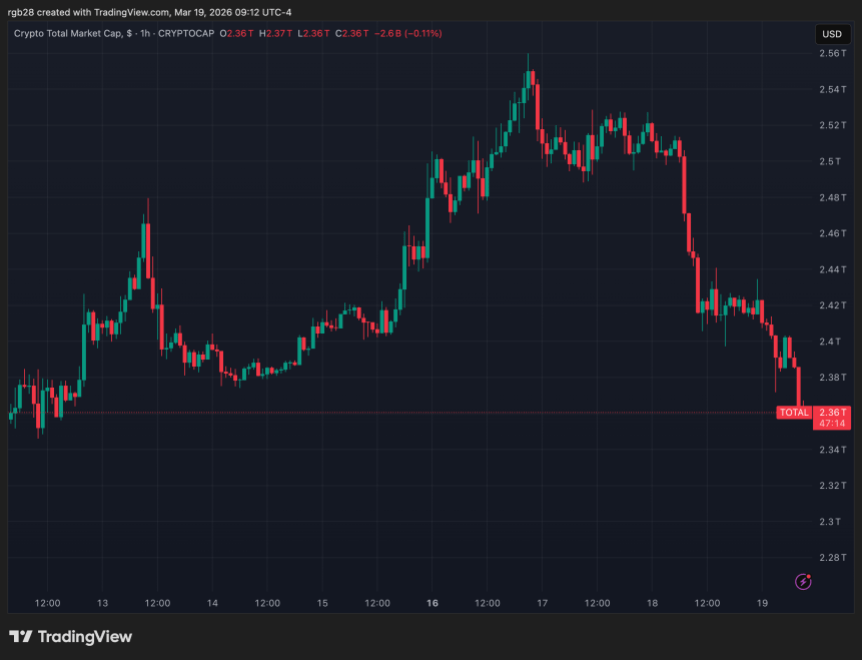
The total crypto market capitalization is at $2.36 trillion in the one-week chart. Source: TOTAL on TradingView

Связанные с этим вопросы

QWhat is the main purpose of the bill proposed by South Korea's People Power Party (PPP)?

AThe main purpose of the bill is to abolish the upcoming 20% income tax on crypto assets by removing all provisions governing their taxation in the current Income Tax Act.

QWhat are the key reasons cited by the PPP for proposing to abolish the crypto tax?

AThe key reasons include the US regulators' guidance classifying most digital assets as commodities (not securities), concerns about double taxation since crypto is already subject to value-added tax, and inconsistencies with the current tax system which abolished the financial investment income tax to promote capital markets.

QWhen was the current 20% crypto income tax (up to 22% with local taxes) originally scheduled to take effect, and what is its new implementation date?

AThe tax was originally proposed to take effect in January 2022 but has been postponed multiple times. Its current scheduled implementation date is January 1, 2027.

QHow did the Democratic Party of Korea (DPK) initially differ from the PPP regarding the crypto tax?

AThe DPK initially advocated for raising the tax deduction limit to 50 million won instead of postponing the tax, but they ultimately agreed to the postponement until 2027. Their long-standing policy has been to proceed with the tax.

QWhat was the response of the Democratic Party of Korea (DPK) to the PPP's newly proposed amendment?

AThe DPK affirmed that it will review the amendment in the Finance and Economy Committee. However, a senior DPK official noted that the party had not seriously discussed abolishing the tax and that its previous stance was to proceed with the existing bill, indicating limited support for the PPP's proposal.

Похожее

U.S. Stock Market Trend: Nasdaq Plunges 3.5% Intraday Before a Remarkable Recovery, All Eyes on CPI Tomorrow

"US Stock Market Trends: Nasdaq Plunges 3.5% Before Dramatic Recovery, Eyes on Tomorrow's CPI" On Tuesday, US markets experienced a wild swing. The Nasdaq initially surged nearly 0.7% before plummeting to a 3.5% intraday loss following a post by Donald Trump on Truth Social. He stated that Iran had shot down a US Apache helicopter in the Strait of Hormuz and that the US "must...respond." The index, however, staged a remarkable recovery in the final two hours, closing down only 0.97%, as subsequent remarks from Trump and Vice President Vance suggested a potential Iran deal within days. The S&P 500 fell 0.26%, while the Dow Jones gained 0.17%, supported by its non-tech components. This incident marked the first loss of a US military asset since tensions with Iran escalated in late February. Despite the event, crude oil prices fell sharply (WTI -3.93%) due to expectations of a near-term deal, OPEC+ plans to increase output, and fears that strong jobs data could lead to Fed rate hikes. Market attention is now laser-focused on the May CPI data release Wednesday morning. This report is seen as critical evidence for whether hot job growth is fueling inflation and will heavily influence expectations for the Federal Reserve's upcoming meeting. A hotter-than-expected reading could trigger further sell-offs, particularly in tech, while a cooler print could spark a significant rebound. The article notes a clear sector rotation, with money flowing out of tech (Nasdaq down over 5% in a week) into defensive sectors like healthcare and consumer staples. Other assets like gold and Bitcoin also remain under pressure. The overarching sentiment is one of "war fatigue," with markets desperately awaiting concrete results from the prolonged Iran negotiations rather than reacting to each new headline.

marsbit14 мин. назад

U.S. Stock Market Trend: Nasdaq Plunges 3.5% Intraday Before a Remarkable Recovery, All Eyes on CPI Tomorrow

marsbit14 мин. назад

Second Only to GPUs and Memory: MLCCs Are Becoming the Next Billion-Dollar Windfall for AI Computing Power

After GPU and memory, MLCC (Multi-Layer Ceramic Capacitors) is emerging as the next critical component in AI compute, potentially a multi-billion-dollar market. The article highlights a significant, industry-wide price increase for MLCCs, driven not by inventory cycles but by a fundamental, structural demand surge from AI and automotive sectors. AI servers require exponentially more MLCCs than traditional servers—from 2,000 to over 350,000 units per high-end AI rack—primarily to stabilize power for increasingly powerful, low-voltage GPUs. A key AI server's MLCC cost can reach thousands of dollars, making it the third-largest cost component after GPUs and memory. This demand is compounded by the automotive shift to EVs and advanced ADAS. Supply, however, struggles to keep up. Manufacturing high-end MLCCs involves extreme precision and faces six major barriers: proprietary technology, long customer certification cycles (12-18 months for AI), high capital intensity, patent thickets, specialized talent, and massive scale. Industry capacity grows at only ~10% annually, creating a persistent supply-demand gap projected to last until 2030. Three companies dominate this high-end market. **Murata** (40% global share) is the stable leader. **Samsung Electro-Mechanics** offers the highest growth elasticity with aggressive expansion. **Taiyo Yuden** is the purest MLCC play. While their current P/E ratios appear high, they are expected to compress rapidly as earnings surge, powered by significant pricing power and operational leverage. Key risks include a potential slowdown in AI capex, high valuations, competition from Chinese manufacturers in lower tiers, yen appreciation, and consumer electronics weakness. The article concludes that MLCCs are transforming from a commoditized component into a strategic, capacity-constrained asset essential for the AI-powered future.

marsbit44 мин. назад

Second Only to GPUs and Memory: MLCCs Are Becoming the Next Billion-Dollar Windfall for AI Computing Power

marsbit44 мин. назад

The First to Bring an AI OS to 1.4 Billion People Might Actually Be WeChat?

WeChat has introduced a significant AI update, allowing mini-program developers to integrate their services with WeChat AI. Developers can choose an "automatic mode," where WeChat AI autonomously analyzes and operates mini-programs without additional coding, or a "development mode" for creating customized skills. This move effectively transforms WeChat's vast ecosystem—including millions of mini-programs, WeChat Pay, and official accounts—into an execution layer for AI. The technical documentation reveals that WeChat's approach aligns with industry standards like MCP (Model Context Protocol) and incorporates practical lessons from AI-agent development. Key design principles include a clear "attention weight" system for API calls and a "fact + action" response structure to ensure reliable operations. Unlike Apple's Siri, which struggles with third-party app integration, WeChat's centralized control over mini-program code provides a "God's-eye view," enabling seamless AI orchestration across services. This development revives the concept of "WeChat OS," where the app could function as a natural-language-operated platform for daily tasks—from booking flights to ordering food—all within a chat interface. While challenges remain in areas like payment security and user trust, WeChat's existing service network and massive user base position it uniquely to advance AI agents from conversation to actionable assistance, potentially making complex tasks feel effortless for its 1.432 billion monthly active users.

marsbit1 ч. назад

The First to Bring an AI OS to 1.4 Billion People Might Actually Be WeChat?

marsbit1 ч. назад

Торговля

Спот
Фьючерсы

Популярные статьи

Как купить S

Добро пожаловать на HTX.com! Мы сделали приобретение Sonic (S) простым и удобным. Следуйте нашему пошаговому руководству и отправляйтесь в свое крипто-путешествие.Шаг 1: Создайте аккаунт на HTXИспользуйте свой адрес электронной почты или номер телефона, чтобы зарегистрироваться и бесплатно создать аккаунт на HTX. Пройдите удобную регистрацию и откройте для себя весь функционал.Создать аккаунтШаг 2: Перейдите в Купить криптовалюту и выберите свой способ оплатыКредитная/Дебетовая Карта: Используйте свою карту Visa или Mastercard для мгновенной покупки Sonic (S).Баланс: Используйте средства с баланса вашего аккаунта HTX для простой торговли.Третьи Лица: Мы добавили популярные способы оплаты, такие как Google Pay и Apple Pay, для повышения удобства.P2P: Торгуйте напрямую с другими пользователями на HTX.Внебиржевая Торговля (OTC): Мы предлагаем индивидуальные услуги и конкурентоспособные обменные курсы для трейдеров.Шаг 3: Хранение Sonic (S)После приобретения вами Sonic (S) храните их в своем аккаунте на HTX. В качестве альтернативы вы можете отправить их куда-либо с помощью перевода в блокчейне или использовать для торговли с другими криптовалютами.Шаг 4: Торговля Sonic (S)С легкостью торгуйте Sonic (S) на спотовом рынке HTX. Просто зайдите в свой аккаунт, выберите торговую пару, совершайте сделки и следите за ними в режиме реального времени. Мы предлагаем удобный интерфейс как для начинающих, так и для опытных трейдеров.

1.4k просмотров всегоОпубликовано 2025.01.15Обновлено 2026.06.02

Как купить S

Sonic: Обновления под руководством Андре Кронье – новая звезда Layer-1 на фоне спада рынка

Он решает проблемы масштабируемости, совместимости между блокчейнами и стимулов для разработчиков с помощью технологических инноваций.

2.3k просмотров всегоОпубликовано 2025.04.09Обновлено 2025.04.09

Sonic: Обновления под руководством Андре Кронье – новая звезда Layer-1 на фоне спада рынка

HTX Learn: Пройдите обучение по "Sonic" и разделите 1000 USDT

HTX Learn — ваш проводник в мир перспективных проектов, и мы запускаем специальное мероприятие "Учитесь и Зарабатывайте", посвящённое этим проектам. Наше новое направление .

1.8k просмотров всегоОпубликовано 2025.04.10Обновлено 2025.04.10

HTX Learn: Пройдите обучение по "Sonic" и разделите 1000 USDT

Обсуждения

Добро пожаловать в Сообщество HTX. Здесь вы сможете быть в курсе последних новостей о развитии платформы и получить доступ к профессиональной аналитической информации о рынке. Мнения пользователей о цене на S (S) представлены ниже.

活动图片