Solana under ‘industrial scale’ DDoS attack: Co-founder says it’s ‘bullish’

cointelegraphОпубликовано 2025-12-16Обновлено 2025-12-16

Введение

Solana has been hit by a large-scale distributed denial-of-service (DDoS) attack, with traffic reportedly peaking near six terabits per second (Tbps), as stated by co-founder Anatoly Yakovenko and others in the ecosystem. Yakovenko described the attack as "bullish," suggesting that the attacker spent as much as the chain generates in revenue. Despite the massive scale, the network reportedly showed no significant signs of stress, such as latency or delays. This is not the first time Solana has faced such issues; the network has a history of downtimes, including several in 2022 due to bugs and transaction overloads. However, downtime incidents have decreased in recent years. In comparison, Bitcoin has maintained over 99.99% uptime, with only two major downtime events since 2009. The article highlights Solana’s ongoing challenges with stability despite improvements, contrasting its performance with Bitcoin’s reliability.

Solana co-founder Anatoly Yakovenko and several accounts tied to the network’s ecosystem said this week that Solana has been hit by a large distributed denial-of-service attack, with some posts citing traffic that peaked near six terabits per second (Tbps).

Yakovenko wrote in a Dec. 9 X post that Solana was under a six Tbps distributed denial-of-service (DDoS) attack. Earlier today, Solana Labs co-founder and president Raj Gokal suggested the attack was still ongoing. Cointelegraph was unable to independently verify the attack or its scale.

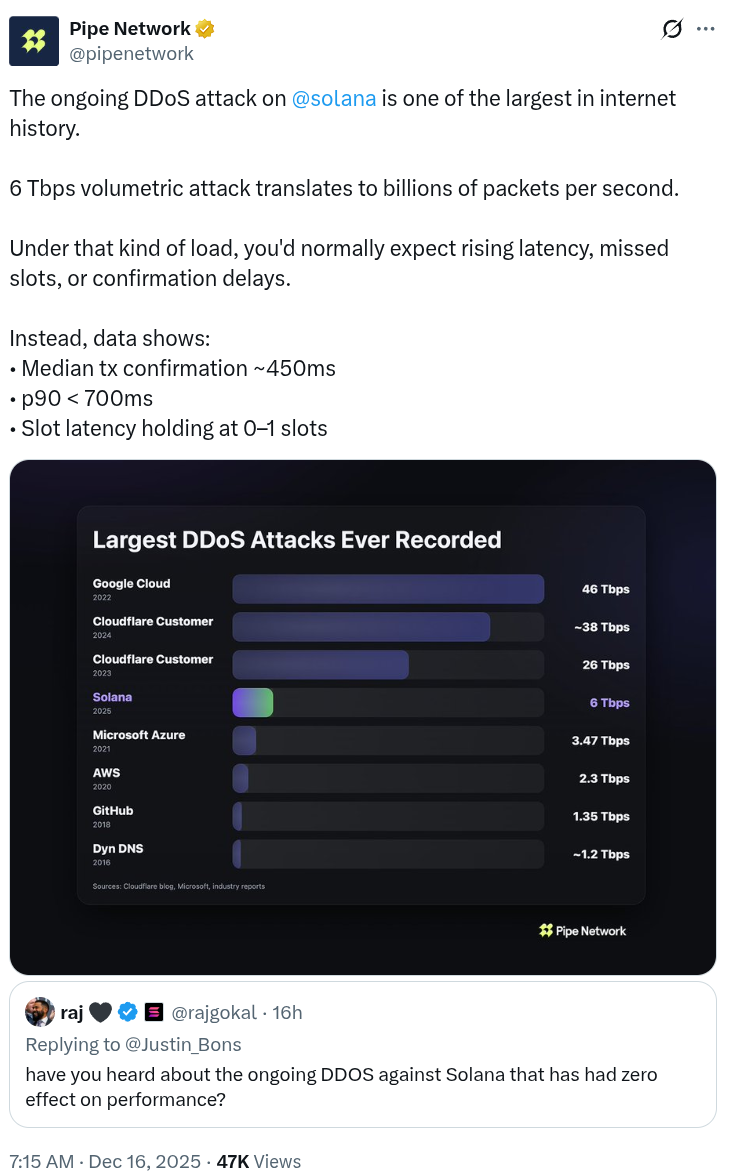
On Monday, the CEO of Solana-based decentralized physical infrastructure network (DePIN) project Pipe Network, David Rhodus, pointed out that the shared metric puts the attack at an “industrial-scale.” In a Monday update, Pipe Petwork also claims that the attack is “one of the largest in internet history” since six Tbps “translates to billions of packets per second.”

A “bullish” attack, co-founder says

A DDoS attack involves many devices flooding a target with traffic to overwhelm it and knock it offline or slow it down. A chart shared by Pipe Network suggests that Solana has faced the fourth-largest DDoS attack ever reported. Still, in 2025 alone, Cloudflare reported a 29.7 Tbps attack, KrebsOnSecurity reported a 6.3 Tbps attack, and Gcore disclosed a six Tbps attack, with none appearing on Pipe Network’s chart.

Yakovenko wrote in a Dec. 9 post that the attack is bullish, also suggesting that “someone is spending as much as the chain makes in revenue to send it.” Similarly, Pipe Network highlights that “under that kind of load, you’d normally expect rising latency, missed slots, or confirmation delays” while the network is not showing any significant signs of stress.

Source: Pipe Network

Solana Labs had not answered Cointelegraph’s request for comment by publication.

Related: Coinbase fixes Solana transaction backlog after 48-hour delay

Solana outage history and fixes

Solana has a history of multiple downtimes, some of which are tied to DDoS-like causes. In December 2020, a block propagation bug halted the network operation. Back in September 2021, Solana’s mainnet saw a 17-hour downtime as Grape Protocol’s launch of its onchain initial DEX offering (IDO) on the crowdfunding platform Raydium AcceleRaytor overwhelmed the network, much like a DDoS would.

In 2022, Solana saw three downtime instances. First, it experienced seven hours of downtime due to transaction spam from bot accounts, then the network saw four and a half hours of downtime due to a bug that caused a consensus failure. Again in 2022, Solana experienced 8.5 hours of downtime due to a bug in the fork choice rules, resulting in consensus failure.

This is where the network stability seemed to pick up slightly. Cointelegraph was able to locate only one instance of downtime in 2023, when, in late February, a fault in Solana’s deduplication logic led to almost 19 hours of downtime. In 2024, the network again saw only one downtime instance when it went down for nearly five hours due to a bug causing an infinite recompile loop.

Related: Solana users hit by delays after Trump memecoins debut

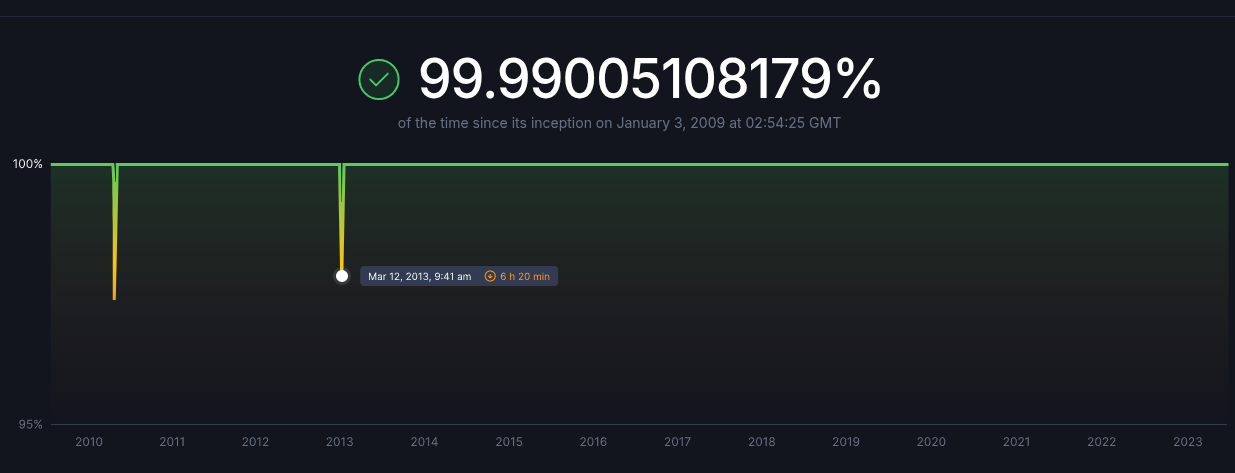
Despite the clear downtrend, this is a lot of downtime for blockchain standards. Bitcoin (BTC), the world’s first blockchain, currently has an uptime of over 99.99%, with the last downtime incident taking place in 2013.

Bitcoin has seen only two downtime incidents since its first block was mined in January 2009. The first one took place in August 2010, when a value-overflow bug was exploited, briefly creating nearly 184.47 billion BTC until a patch reversed the issue. The second one happened in March 2013, when a bug split the network between Bitcoin Core 0.7 and 0.8. The 2013 event did not create new Bitcoin.

Bitcoin uptime chart. Source: BitBo

Похожее

Google TPU Shipments Revised Up by 50%

Recent industry research indicates a significant upward revision in the shipments of Google's TPU (Tensor Processing Unit) chips. Previous expectations for 2027 were set at around 10 million units, but new estimates now point to 15 million units, a 50% increase. This substantial boost directly translates to higher demand across the entire supporting supply chain. Google's TPU clusters utilize a standardized all-optical interconnect architecture. Consequently, key hardware components are deeply integrated and scaled in fixed ratios with the chips. The 15 million TPU target will drive corresponding demand increases for NPO optical engines (roughly a 1:1 match), 1.6T optical modules, OCS optical switches, high-end server power supplies, fiber optics & MPO connectors, and liquid cooling solutions. Among these, liquid cooling is highlighted as the sector experiencing the most significant transformation and offering the most stable potential for excess returns. As next-generation TPU chips reach power levels where traditional air cooling is insufficient, liquid cooling becomes essential. 2026 is forecasted as the first year of substantial adoption for Google's liquid cooling solutions. This shift, coupled with delivery and capacity bottlenecks faced by incumbent overseas manufacturers, is creating a prime window for domestic Chinese suppliers to enter and secure Google's core supply chain. The market size for Google-specific liquid cooling is projected to potentially triple from a baseline of hundreds of billions to around 300 billion units by 2028. The logic for the fiber optic sector is also being rewritten. Once considered a cyclical commodity tied to telecom operator procurement, fiber is now a strategic and scarce resource for AI Data Centers (AIDC). A severe supply-demand imbalance, driven by the long lead time for preform production (18-24 months) and surging demand from cloud giants, is supporting strong performance. Chinese fiber manufacturers are well-positioned to capture a significant share of global AIDC demand, with exports potentially reaching 200-300 million core kilometers in 2026. Overall, the investment focus within the AI computing industry is shifting from pure "chip performance speculation" towards the more certain incremental growth in computing infrastructure and its supporting ecosystem. The upward revision in Google TPU shipments, along with the potential for further doubling by 2028, is seen as solidifying performance visibility for the entire supporting supply chain over the next two years.

marsbit15 мин. назад

Google TPU Shipments Revised Up by 50%

marsbit15 мин. назад

What Wall Street Really Wants After the Crypto Story Recedes

The tide of speculative crypto narratives has receded, revealing Wall Street's true objective: building a controlled, yield-generating, and compliant financial pipeline on distributed ledgers. They are migrating core functions onto blockchains, not for decentralization, but for efficiency and new revenue streams. Key developments include BlackRock's BUIDL fund, a tokenized treasury fund acting as a foundational reserve asset, and the rise of Securitize, which is going public and partnering with the NYSE to build a 24/7 digital securities trading and settlement system. This signals a major shift of securities clearing to blockchain technology. To make volatile assets like Bitcoin palatable for institutional investors, firms like BlackRock and Goldman Sachs are creating "covered call" ETFs (e.g., BITA). These products systematically sell options on Bitcoin holdings, transforming price volatility into stable monthly income, effectively repackaging crypto as a yield-bearing asset. Stablecoins are being positioned not as speculative tools but as efficient payment rails. Companies like Stripe and Mastercard are integrating them for instant, low-cost merchant settlements and cross-border card payments, respectively. Critically, new legislation like the GENIUS Act shapes them as non-interest-bearing, heavily regulated extensions of the US dollar system. In summary, Wall Street is quietly constructing a parallel, blockchain-based financial infrastructure featuring tokenized traditional assets, structured crypto yields, and programmable dollar pipelines—all under its control and fully integrated with existing regulatory and credit frameworks.

marsbit32 мин. назад

What Wall Street Really Wants After the Crypto Story Recedes

marsbit32 мин. назад

Tying Itself to SpaceX: Cursor's $60 Billion Rise

This article recounts the rapid rise of AI-powered coding startup Cursor and its 25-year-old MIT graduate CEO, Michael Truell. Launched in 2023, Cursor achieved explosive growth, reaching over 10 billion USD in revenue by late 2025. However, its journey highlights a central dilemma for AI application companies: dependence on foundational model providers. Cursor initially relied heavily on Anthropic's models but faced an existential threat when Anthropic launched its own competing coding tool, Claude Code. In response, Cursor declared an internal emergency in early 2026 and accelerated development of its own model, Composer. To secure the immense computing power needed, Truell struck a pivotal deal with Elon Musk's SpaceX in April 2026. The collaboration grants Cursor access to SpaceX's supercomputing resources for Composer, while SpaceX's Grok model benefits from Cursor's programming data. The agreement includes a potential 600 billion USD acquisition of Cursor by SpaceX later in the year, though a substantial termination fee is in place if the deal falls through. The story explores Cursor's intense, sometimes controversial hiring practices involving lengthy unpaid "work trials," its complex partnership-turned-rivalry with Anthropic, and its high-stakes gamble to ensure independence through the SpaceX alliance. The core question remains: will Cursor evolve into a defining, independent "generational" software company, or become a key piece in a tech giant's AI arsenal?

marsbit37 мин. назад

Tying Itself to SpaceX: Cursor's $60 Billion Rise

marsbit37 мин. назад

Warsh's Debut: Will the FED Chair Who Knows Crypto Best Bring Surprises or Shocks to the Market?

Kevin Warsh, the new Federal Reserve Chairman, prepares for his inaugural press conference amidst a challenging macroeconomic landscape: resurgent inflation, a bond market sell-off, and political pressure from President Trump for rate cuts. Uniquely, Warsh holds indirect investments in over 20 crypto and Web3 entities (e.g., Solana, dYdX), making him the first Fed Chair with disclosed crypto exposure. His stance may combine a hawkish, inflation-focused monetary policy with a crypto-friendly regulatory philosophy that shifts from Powell’s “same risk, same rule” approach toward a framework acknowledging blockchain’s productivity value. Warsh’s leadership could impact crypto markets across three dimensions: a paradigm shift in regulation (potentially accelerating pro-innovation legislation and stable币 rules), a re-pricing of risk premiums based on clearer communication and his view of AI as a structural disinflationary force, and a long-term reallocation of global institutional capital driven by increased legitimacy. Two potential scenarios for the press conference are outlined. A “positive surprise” would involve a dovish-leaning tone on rates coupled with signals of regulatory openness, potentially boosting crypto asset valuations. Conversely, a “negative shock” would see a more hawkish-than-expected stance on inflation and rates, triggering a broad risk-asset selloff that crypto markets would not escape. While ethics rules required Warsh to divest his crypto holdings upon confirmation, his deep understanding of the technology may fundamentally lower policy uncertainty and build a more receptive long-term foundation for digital assets’ integration into the mainstream financial system.

marsbit11 ч. назад

Warsh's Debut: Will the FED Chair Who Knows Crypto Best Bring Surprises or Shocks to the Market?

marsbit11 ч. назад

Торговля

Спот
Фьючерсы

Популярные статьи

Как купить S

Добро пожаловать на HTX.com! Мы сделали приобретение Sonic (S) простым и удобным. Следуйте нашему пошаговому руководству и отправляйтесь в свое крипто-путешествие.Шаг 1: Создайте аккаунт на HTXИспользуйте свой адрес электронной почты или номер телефона, чтобы зарегистрироваться и бесплатно создать аккаунт на HTX. Пройдите удобную регистрацию и откройте для себя весь функционал.Создать аккаунтШаг 2: Перейдите в Купить криптовалюту и выберите свой способ оплатыКредитная/Дебетовая Карта: Используйте свою карту Visa или Mastercard для мгновенной покупки Sonic (S).Баланс: Используйте средства с баланса вашего аккаунта HTX для простой торговли.Третьи Лица: Мы добавили популярные способы оплаты, такие как Google Pay и Apple Pay, для повышения удобства.P2P: Торгуйте напрямую с другими пользователями на HTX.Внебиржевая Торговля (OTC): Мы предлагаем индивидуальные услуги и конкурентоспособные обменные курсы для трейдеров.Шаг 3: Хранение Sonic (S)После приобретения вами Sonic (S) храните их в своем аккаунте на HTX. В качестве альтернативы вы можете отправить их куда-либо с помощью перевода в блокчейне или использовать для торговли с другими криптовалютами.Шаг 4: Торговля Sonic (S)С легкостью торгуйте Sonic (S) на спотовом рынке HTX. Просто зайдите в свой аккаунт, выберите торговую пару, совершайте сделки и следите за ними в режиме реального времени. Мы предлагаем удобный интерфейс как для начинающих, так и для опытных трейдеров.

1.5k просмотров всегоОпубликовано 2025.01.15Обновлено 2026.06.02

Как купить S

Sonic: Обновления под руководством Андре Кронье – новая звезда Layer-1 на фоне спада рынка

Он решает проблемы масштабируемости, совместимости между блокчейнами и стимулов для разработчиков с помощью технологических инноваций.

2.3k просмотров всегоОпубликовано 2025.04.09Обновлено 2025.04.09

Sonic: Обновления под руководством Андре Кронье – новая звезда Layer-1 на фоне спада рынка

HTX Learn: Пройдите обучение по "Sonic" и разделите 1000 USDT

HTX Learn — ваш проводник в мир перспективных проектов, и мы запускаем специальное мероприятие "Учитесь и Зарабатывайте", посвящённое этим проектам. Наше новое направление .

1.8k просмотров всегоОпубликовано 2025.04.10Обновлено 2025.04.10

HTX Learn: Пройдите обучение по "Sonic" и разделите 1000 USDT

Обсуждения

Добро пожаловать в Сообщество HTX. Здесь вы сможете быть в курсе последних новостей о развитии платформы и получить доступ к профессиональной аналитической информации о рынке. Мнения пользователей о цене на S (S) представлены ниже.

活动图片