Rules Change Mid-Game, Polymarket’s Billion-Dollar Bitcoin Prediction Market Mired in Settlement Controversy

foresightnews_apiОпубликовано 2026-06-05Обновлено 2026-06-05

Введение

A nearly $150 million prediction market contract on Polymarket is in turmoil after the platform refused to settle in favor of traders who correctly predicted that MicroStrategy (now Strategy) would sell Bitcoin. The core dispute revolves around a sale of 32 BTC, which occurred between May 26-31 but was officially disclosed in an SEC 8-K filing on June 1. The original contract stated it would resolve to "Yes" if Strategy sold any Bitcoin before May 31, 11:59 PM ET, using public disclosures and on-chain data as proof. After the filing on June 1, traders who saw the disclosure rushed to buy "Yes" contracts, believing it was conclusive evidence. However, Polymarket's operators later added a rule that the disclosure itself must occur by the deadline, not just the transaction, invalidating the filing as proof. This retroactive rule change has sparked accusations of market manipulation, leaving traders like "willo2," who invested $527,000, facing total losses. The controversy highlights a deeper structural flaw in Polymarket's decentralized settlement system, which relies on UMA's optimistic oracle. Disputed resolutions are ultimately decided by a vote among UMA token holders, a mechanism critics say is vulnerable to manipulation by large holders ("whales") who can vote in their own financial interest rather than on objective facts. Data suggests a high concentration of voting power and significant overlap between voters and Polymarket traders. The dispute emerges as prediction m...


By: Oluwapelumi Adejumo

Compiled by: Saoirse, Foresight News


A nearly $150 million prediction market contract is in chaos: the Polymarket platform is refusing to pay out winnings to traders who accurately predicted that Strategy would sell a portion of its Bitcoin. The core dispute centers on a mismatch between the actual transaction time and the official disclosure time, exposing fundamental systemic flaws in how decentralized prediction markets handle the settlement of large-scale contracts. Traders are now locked in a tug-of-war over a fine-print rule, facing the risk of having their expected millions in profits wiped out.


Strategy (formerly MicroStrategy), an asset management firm holding nearly $60 billion in Bitcoin, filed a regulatory 8-K form on June 1, confirming it sold 32 Bitcoins between May 26 and May 31, with a market value of approximately $2.5 million. For participants in Polymarket's "Will Strategy sell Bitcoin before May 31?" contract, this regulatory disclosure was supposed to be irrefutable proof for the "Yes" bet. However, the current disputed ruling heavily favors the "No" camp.


After the contract deadline, Polymarket's operators added a new rule: since the official disclosure of this sale landed on June 1, exceeding the deadline, the transaction would not be considered valid evidence for the contract. This last-minute rule change has sparked numerous accusations of market manipulation. At a critical juncture where the prediction market sector is striving for compliance with traditional finance, its decentralized, lottery-like settlement mechanisms are facing intense industry scrutiny.


Complete Timeline of the Disputed Contract


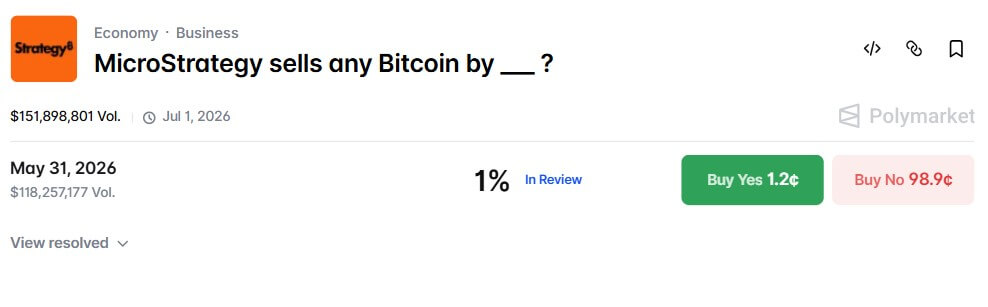
The controversy stems from the contract's original terms: the contract would be settled as "Yes" if Strategy sold any amount of Bitcoin before 11:59 PM ET on May 31. The rules explicitly stated that official company disclosure documents and on-chain data were the two primary sources for adjudication.


Polymarket contract regarding the disputed Bitcoin sale by Strategy (Source: Polymarket)


When Strategy submitted the mandatory disclosure document on June 1, trading for this contract remained open. Several traders, spotting the disclosure and perceiving an arbitrage opportunity, rushed to enter the market: user 'willo2' invested $527,000 to go all-in on "Yes," while the market odds still implied an 80% probability of a "No" outcome. This trader initially expected to secure a 20% arbitrage profit. However, as large buy orders flooded in, Polymarket retroactively added the rule, deeming the disclosure date invalid because it was past the deadline. As a result, this user lost their entire principal.


Willo posted on X platform in protest: "This limit was never written in the contract rules, it makes no logical sense, and Polymarket itself hasn't followed this standard before. If the disclosure had to be made by May 31, trading should have been halted directly at that time, but the market continued to operate normally afterward."


Industry analysts collectively criticized the platform's contradictory operations. Jeff Dorman, Chief Investment Officer of Arca, pointed out a fatal flaw: if the contract strictly required May 31 midnight as the final cutoff, the platform should have closed trading at that exact time. Allowing users to open positions on June 1 while later retroactively demanding the disclosure date align with the deadline is tantamount to setting a trap for traders who followed the contract's written rules. Jonatan Pallesen, a data researcher specializing in decentralized projects, stated bluntly:


The platform's failure to explicitly state hidden conventions upfront and its post-hoc addition of rules constitutes implicit fraud; institutional players familiar with the platform's unwritten rules can exploit these gaps to harvest ordinary retail traders, who default to expecting payouts based on factual transactions but end up suffering losses.


UMA Oracle Reveals Underlying Structural Flaws


The Strategy wager dispute has evolved from a single contract conflict into a collective interrogation of Polymarket's entire settlement system. Unlike traditional exchanges that rely on centralized clearinghouses and legal departments to execute derivatives settlements, Polymarket outsources the fact-finding entirely to the UMA (Universal Market Access) optimistic oracle. UMA's operating logic is: token holders determine disputed outcomes through on-chain voting; a trader can initiate a dispute by posting a $750 bond. If the disagreement persists unresolved, the final verdict is determined by a vote among UMA token holders weighted by their token holdings, based on stake proportion rather than objective fact-checking.


Many industry insiders warn that this system is highly susceptible to manipulation by whales. Prominent crypto analyst Eric Conner noted that token voting mechanisms inherently suffer from design flaws: large holders (whales) can exploit ambiguous rules to protect their own positions, disregarding objective facts to overturn settlement results and avoid significant losses.


Data from a Wall Street Journal investigation corroborates these concerns: in the vast majority of disputed orders on Polymarket, the top ten wallets hold over half the voting power; approximately 60% of active UMA voting accounts are linked to Polymarket trading addresses, and in one-fifth of dispute cases, voters themselves have a direct financial stake in the outcome. In the first five months of 2026, disputed orders on Polymarket exceeded 1,150, surpassing the platform's total for the entire previous year; constrained by its decentralized architecture, the platform's official team has no authority to overturn the final rulings issued by UMA's token vote.


Rapid Industry Expansion vs. The Reality of Decentralized Mechanisms


This billion-dollar dispute coincides with a critical window for the large-scale adoption of prediction markets. Over the past two years, Polymarket and Kalshi have worked vigorously to shed the "unregulated crypto casino" label and deeply integrate with the traditional financial ecosystem. DeFiLlama data shows that in May 2026, the combined trading volume of the two platforms exceeded $10 billion, a tenfold year-on-year surge; the platforms have successively secured data and content partnerships with the New York Stock Exchange, Dow Jones, Associated Press, and Fox News.


The regulatory landscape for the industry has fluctuated: in 2022, the U.S. Commodity Futures Trading Commission (CFTC) ordered Polymarket to cease U.S. operations and relocate overseas; Kalshi also engaged in prolonged litigation with the CFTC over the compliance of event contracts until winning a federal court case in late 2024. Following the 2024 U.S. election, regulatory winds shifted. Polymarket secured a U.S. federal derivatives license, with the CFTC explicitly stating that event contracts fall under commodity derivatives and are within its regulatory purview. CFTC Chairman Michael S. Selig stated: "Event contracts can help entities and individuals hedge against event risks and optimize portfolio exposure, while also conveying market expectations about events. The product attributes fall within the CFTC's regulatory responsibilities."


Even with compliance licenses, the settlement logic of decentralized prediction markets remains experimental. Traditional secondary markets rely on strong regulation and ample liquidity to anchor prices to real fundamentals; whereas in token-vote-based prediction markets, the definition of "factual truth" is always determined by voting games. Until adjudication mechanisms are perfected, traders in the rapidly expanding prediction market sector will remain subject to unwritten rules and on-chain voting juries that exist beyond the black-and-white text of contracts.

Связанные с этим вопросы

QWhat was the core issue that led to the settlement dispute on Polymarket's $150 million Bitcoin prediction contract?

AThe core issue was a mismatch between the actual transaction time and the official disclosure time, coupled with a rule change by Polymarket after the contract deadline. The platform ruled that MicroStrategy's sale of 32 BTC did not count for settlement because the official SEC 8-K filing disclosing the sale occurred on June 1st, after the contract's cutoff of May 31st at 23:59 ET, even though the sales themselves happened between May 26-31.

QHow did the user 'willo2' allegedly lose their investment in the disputed Polymarket contract?

AUser 'willo2' invested $527,000 to buy 'Yes' shares after MicroStrategy's 8-K filing was published on June 1st, believing the confirmed sale guaranteed a payout. However, Polymarket later applied a new rule stating the disclosure had to occur by the May 31st deadline to be valid. Since the filing was on June 1st, the 'No' outcome was favored, causing 'willo2' to lose their entire principal.

QWhat is the role of UMA's optimistic oracle in Polymarket's dispute resolution process, and what criticism has it faced?

AUMA's optimistic oracle is used to settle disputes on Polymarket. Its process involves token holders voting on-chain to determine the outcome. It has been criticized for a structural defect where large token holders (whales) can manipulate votes to favor their own positions, ignoring objective facts. Data shows the top 10 wallets hold over half the voting power, and many voters have direct ties to Polymarket addresses.

QWhat recent regulatory developments were mentioned regarding prediction markets like Polymarket and Kalshi?

AThe article mentions that after a 2024 court victory for Kalshi and a shifting regulatory landscape post-2024 elections, Polymarket secured a federal derivatives license in the U.S. The CFTC chairman stated that event contracts fall under the agency's jurisdiction as commodity derivatives, helping entities hedge risk and convey market expectations.

QAccording to the article, what fundamental tension exists in decentralized prediction markets as they scale?

AThe fundamental tension is between the industry's rapid growth and the experimental nature of its decentralized settlement logic. While traditional markets rely on strong regulation and liquidity to anchor prices to fundamentals, in token-voting prediction markets, the 'truth' or settlement outcome is ultimately determined by voting博弈 (game theory and博弈), leaving traders subject to unwritten rules and on-chain voting juries.

Похожее

Торговля

Спот
Фьючерсы

Популярные статьи

Тест по Bitcoin Биткоина

HTX Learn: Изучите Bitcoin halving и Заработаете Токены USDT

3.1k просмотров всегоОпубликовано 2024.04.16Обновлено 2024.04.16

Тест по Bitcoin  Биткоина

Что такое $BITCOIN

ЦИФРОВОЕ ЗОЛОТО ($BITCOIN): Комплексный анализ Введение в ЦИФРОВОЕ ЗОЛОТО ($BITCOIN) ЦИФРОВОЕ ЗОЛОТО ($BITCOIN) — это проект на основе блокчейна, работающий в сети Solana, который стремится объединить характеристики традиционных драгоценных металлов с инновациями децентрализованных технологий. Хотя он носит имя Биткойн, часто называемого “цифровым золотом” из-за его восприятия как средства хранения ценности, ЦИФРОВОЕ ЗОЛОТО является отдельным токеном, предназначенным для создания уникальной экосистемы в ландшафте Web3. Его цель — позиционировать себя как жизнеспособный альтернативный цифровой актив, хотя детали его применения и функциональности все еще развиваются. Что такое ЦИФРОВОЕ ЗОЛОТО ($BITCOIN)? ЦИФРОВОЕ ЗОЛОТО ($BITCOIN) — это токен криптовалюты, специально разработанный для использования в блокчейне Solana. В отличие от Биткойна, который выполняет широко признанную роль хранения ценности, этот токен, похоже, сосредоточен на более широких приложениях и характеристиках. Примечательные аспекты включают: Инфраструктура блокчейна: Токен построен на блокчейне Solana, известном своей способностью обрабатывать высокоскоростные и недорогие транзакции. Динамика предложения: ЦИФРОВОЕ ЗОЛОТО имеет максимальное предложение, ограниченное 100 квадриллионами токенов (100P $BITCOIN), хотя детали о его обращающемся предложении в настоящее время не раскрыты. Утилита: Хотя точные функциональные возможности не описаны, есть указания на то, что токен может быть использован для различных приложений, потенциально связанных с децентрализованными приложениями (dApps) или стратегиями токенизации активов. Кто создатель ЦИФРОВОГО ЗОЛОТА ($BITCOIN)? На данный момент личность создателей и команды разработчиков, стоящих за ЦИФРОВЫМ ЗОЛОТОМ ($BITCOIN), остается неизвестной. Эта ситуация типична для многих инновационных проектов в области блокчейна, особенно тех, которые связаны с децентрализованными финансами и феноменом мем-криптовалют. Хотя такая анонимность может способствовать культуре, ориентированной на сообщество, она усиливает опасения по поводу управления и ответственности. Кто инвесторы ЦИФРОВОГО ЗОЛОТА ($BITCOIN)? Доступная информация указывает на то, что у ЦИФРОВОГО ЗОЛОТА ($BITCOIN) нет известных институциональных спонсоров или значительных венчурных капиталовложений. Проект, похоже, функционирует по модели пирингового взаимодействия, сосредоточенной на поддержке и принятии сообществом, а не на традиционных путях финансирования. Его активность и ликвидность в основном сосредоточены на децентрализованных биржах (DEX), таких как PumpSwap, а не на устоявшихся централизованных торговых платформах, что еще больше подчеркивает его подход, ориентированный на grassroots. Как работает ЦИФРОВОЕ ЗОЛОТО ($BITCOIN) Операционные механизмы ЦИФРОВОГО ЗОЛОТА ($BITCOIN) можно подробно описать на основе его дизайна блокчейна и характеристик сети: Механизм консенсуса: Используя уникальный механизм доказательства истории (PoH) Solana в сочетании с моделью доказательства доли (PoS), проект обеспечивает эффективную валидацию транзакций, что способствует высокой производительности сети. Токеномика: Хотя конкретные дефляционные механизмы не были подробно описаны, большое максимальное предложение токенов подразумевает, что оно может быть предназначено для микротранзакций или нишевых случаев использования, которые еще предстоит определить. Интероперабельность: Существует потенциал для интеграции с более широкой экосистемой Solana, включая различные платформы децентрализованных финансов (DeFi). Однако детали относительно конкретных интеграций остаются неуточненными. Хронология ключевых событий Вот хронология, которая подчеркивает значимые вехи, касающиеся ЦИФРОВОГО ЗОЛОТА ($BITCOIN): 2023: Первоначальное развертывание токена происходит в блокчейне Solana, отмеченное его адресом контракта. 2024: ЦИФРОВОЕ ЗОЛОТО приобретает видимость, когда оно становится доступным для торговли на децентрализованных биржах, таких как PumpSwap, позволяя пользователям обменивать его на SOL. 2025: Проект наблюдает спорадическую торговую активность и потенциальный интерес к инициативам, возглавляемым сообществом, хотя на данный момент не зафиксировано никаких значительных партнерств или технических достижений. Критический анализ Сильные стороны Масштабируемость: Основная инфраструктура Solana поддерживает высокие объемы транзакций, что может повысить полезность $BITCOIN в различных сценариях транзакций. Доступность: Потенциально низкая цена торговли за токен может привлечь розничных инвесторов, способствуя более широкому участию благодаря возможностям дробного владения. Риски Отсутствие прозрачности: Отсутствие публично известных спонсоров, разработчиков или процесса аудита может вызвать скептицизм относительно устойчивости и надежности проекта. Волатильность рынка: Торговая активность сильно зависит от спекулятивного поведения, что может привести к значительной волатильности цен и неопределенности для инвесторов. Заключение ЦИФРОВОЕ ЗОЛОТО ($BITCOIN) является интригующим, но неоднозначным проектом в быстро развивающейся экосистеме Solana. Хотя он пытается использовать нарратив “цифрового золота”, его отход от установленной роли Биткойна как средства хранения ценности подчеркивает необходимость более четкого различения его предполагаемой утилиты и структуры управления. Будущее принятие и усвоение, вероятно, будут зависеть от решения текущей непрозрачности и более четкого определения его операционных и экономических стратегий. Примечание: Этот отчет охватывает синтезированную информацию, доступную на октябрь 2023 года, и с тех пор могут произойти события.

99 просмотров всегоОпубликовано 2025.05.13Обновлено 2025.05.13

Что такое $BITCOIN

Fractal Bitcoin: масштабирование Биткоина с помощью рекурсивной системы

Fractal Bitcoin — масштабное Layer-1-решнение, созданное на базе кода Биткоина, позволяющего достигать бесконечного масштабирования с помощью рекурсивного подхода.

2.3k просмотров всегоОпубликовано 2025.06.30Обновлено 2025.06.30

Fractal Bitcoin: масштабирование Биткоина с помощью рекурсивной системы

Обсуждения

Добро пожаловать в Сообщество HTX. Здесь вы сможете быть в курсе последних новостей о развитии платформы и получить доступ к профессиональной аналитической информации о рынке. Мнения пользователей о цене на BTC (BTC) представлены ниже.

活动图片