Ripple CTO Explains How The XRP Ledger ‘Will Take Over The World’

bitcoinistОпубликовано 2025-12-24Обновлено 2025-12-24

Введение

Ripple CTO David Schwartz emphasized that sustained usage, real value movement, and institutional-grade infrastructure are key to the XRP Ledger's global adoption. He highlighted metrics like over 4 billion transactions processed, consistent 4-5 second settlement, and minimal fees. Schwartz stressed the importance of deep liquidity and real-world asset tokenization, noting involvement from major institutions like Guggenheim and Franklin Templeton. He distinguished between mere token issuance and active on-chain financial activity, asserting that practical financial products—not retail speculation—will drive mainstream adoption. At the time of reporting, XRP was trading at $1.88.

On a Token Relations webinar for the XRP ecosystem on Dec. 20, Ripple CTO David Schwartz was asked the sort of question that usually produces a tidy dashboard answer, what on-chain metrics actually matter, what’s “real” economic activity, and what trends are showing up across the ledger (and, yes, the ETF chatter in the background). He went straight to the point: usage that sticks, value that moves, and the boring-but-decisive plumbing that financial institutions actually care about will “take over the world.”

How Ripple Wants To Make The XRPL Mainstream

“I definitely focus on metrics that show sustained usage and real value moving through the network,” Schwartz said. “Transaction activity is probably the clearest signal. The XRP ledger has now processed more than four billion transactions with pretty consistent settlement in about four to five seconds at a fairly predictable fee.”

That’s the pitch in one breath: scale, predictable finality, and fees so low you don’t have to pretend they’re a feature.“You know, a transaction on the XRP ledger costs a tiny fraction of a penny,” the Ripple CTO added. “It’s not trying to extract value from people’s transactions. That’s trying to enable people to do what they need to do.”

Then he pivoted to liquidity, the kind of line XRP holders love to hear, but framed as infrastructure rather than tribal scoreboard-watching. “Liquidity is another huge factor,” Schwartz said. “XRP is a top five digital asset by market capitalization and has been for I think 10 years now, about 109 billion dollars deep global liquidity for real financial activity. That depth matters.”

The bigger point he kept coming back to was momentum in actual network use, not just “we issued a token and it sat there.”

“The XRP ledger itself is now one of the top 10 blockchains for real world activity this year with a rate of increase that’s just absolutely astonishing from a use case that was you know almost unthinkable just a year ago,” he said. “We now have institutional issuers like Guggenheim, Ondo [Finance], Aberdeen [Standard Investments], Franklin [Templeton].”

And then the part that’s meant to separate “RWA theater” from RWAs that matter: “And it’s not just issuance, you know, it wouldn’t be super exciting if they were just sort of issuing an asset on chain that just sort of sat on chain,” the Ripple CTO said. “What’s interesting is that these assets are actually moving and settling on chain. So the financial activity is getting the benefit.”

That little distinction is where a lot of tokenization narratives either hold up or collapse. Anybody can “issue” a thing on a ledger. The harder bit is getting it to behave like financial infrastructure, moving, settling, plugging into workflows that aren’t built for crypto vibes.

Schwartz also threw a bit of cold water on the current retail mix. XRPL has users who love the tech (and users who love leverage), but he was pretty blunt that this isn’t the endgame.

But obviously that’s not how we’re going to take over the world. We’re going to take over the world with solid financial products that solve real world use cases. And we are actually starting to see that now enabled by things like stablecoins and tokenized real world assets that let us handle these use cases like payments and like reasonable investments, tokenized money, market funds and treasuries,” he said. “

And retail might follow the institutions, not the other way around. The Ripple CTO pointed to “more than 500,000 new wallets” created, framing it as early evidence that institutional rails can drag everyday users in behind them.

At press time, XRP traded at $1.88.
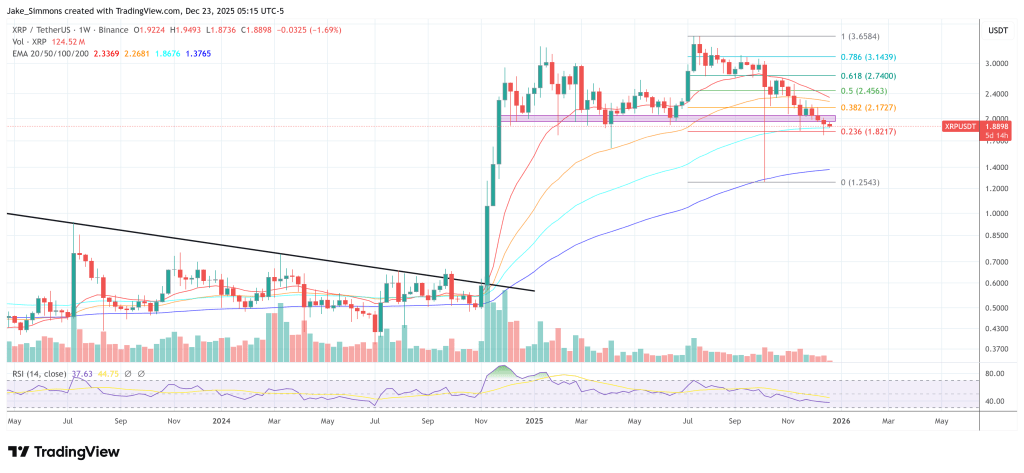
XRP falls below key support, 1-week chart | Source: XRPUSDT on TradingView.com

Связанные с этим вопросы

QWhat are the three key metrics that Ripple CTO David Schwartz believes will help the XRP Ledger 'take over the world'?

AThe three key metrics are sustained usage, real value moving through the network, and the 'boring-but-decisive plumbing' (reliable infrastructure) that financial institutions care about.

QAccording to Schwartz, what is the current transaction fee and settlement time on the XRP Ledger?

AA transaction costs a tiny fraction of a penny and settles in about four to five seconds.

QWhat distinction does Schwartz make to separate real 'tokenization' from mere issuance?

AHe states that it's not exciting to just issue an asset on-chain; what matters is that the assets are actually moving, settling, and being used for financial activity, thereby getting the full benefit of the infrastructure.

QHow does Schwartz describe the current growth and ranking of the XRP Ledger in terms of real-world activity?

AHe said the XRP Ledger is now one of the top 10 blockchains for real-world activity this year, with a rate of increase that is 'absolutely astonishing' from a use case that was almost unthinkable a year ago.

QWhat does Schwartz suggest is the primary driver for mass adoption of the XRP Ledger, and what evidence does he cite?

AHe suggests that solid financial products solving real-world use cases, enabled by institutional adoption (like stablecoins and tokenized assets), will be the primary driver. He cites the creation of more than 500,000 new wallets as early evidence that institutional rails can attract everyday users.

Похожее

Gensyn AI: Don't Let AI Repeat the Mistakes of the Internet

In recent months, the rapid growth of the AI industry has attracted significant talent from the crypto sector. A persistent question among researchers intersecting both fields is whether blockchain can become a foundational part of AI infrastructure. While many previous AI and Crypto projects focused on application layers (like AI Agents, on-chain reasoning, data markets, and compute rentals), few achieved viable commercial models. Gensyn differentiates itself by targeting the most critical and expensive layer of AI: model training. Gensyn aims to organize globally distributed GPU resources into an open AI training network. Developers can submit training tasks, nodes provide computational power, and the network verifies results while distributing incentives. The core issue addressed is not decentralization for its own sake, but the increasing centralization of compute power among tech giants. In the era of large models, access to GPUs (like the H100) has become a decisive bottleneck, dictating the pace of AI development. Major AI companies are heavily dependent on large cloud providers for compute resources. Gensyn's approach is significant for several reasons: 1) It operates at the core infrastructure layer (model training), the most resource-intensive and technically demanding part of the AI value chain. 2) It proposes a more open, collaborative model for compute, potentially increasing resource utilization by dynamically pooling idle GPUs, similar to early cloud computing logic. 3) Its technical moat lies in solving complex challenges like verifying training results, ensuring node honesty, and maintaining reliability in a distributed environment—making it more of a deep-tech infrastructure company. 4) It targets a validated, high-growth market with genuine demand, rather than pursuing blockchain integration without purpose. Ultimately, the boundaries between Crypto and AI are blurring. AI requires global resource coordination, incentive mechanisms, and collaborative systems—areas where crypto-native solutions excel. Gensyn represents a step toward making advanced training capabilities more accessible and collaborative, moving beyond a niche controlled by a few giants. If successful, it could evolve into a fundamental piece of AI infrastructure, where the most enduring value in the AI era is often created.

marsbit5 ч. назад

Gensyn AI: Don't Let AI Repeat the Mistakes of the Internet

marsbit5 ч. назад

Why is China's AI Developing So Fast? The Answer Lies Inside the Labs

A US researcher's visit to China's top AI labs reveals distinct cultural and organizational factors driving China's rapid AI development. While talent, data, and compute are similar to the West, Chinese labs excel through a pragmatic, execution-focused culture: less emphasis on individual stardom and conceptual debate, and more on teamwork, engineering optimization, and mastering the full tech stack. A key advantage is the integration of young students and researchers who approach model-building with fresh perspectives and low ego, prioritizing collective progress over personal credit. This contrasts with the US culture of self-promotion and "star scientist" narratives. Chinese labs also exhibit a strong "build, don't buy" mentality, preferring to develop core capabilities—like data pipelines and environments—in-house rather than relying on external services. The ecosystem feels more collaborative than tribal, with mutual respect among labs. While government support exists, its scale is unclear, and technical decisions appear driven by labs, not state mandates. Chinese companies across sectors, from platforms to consumer tech, are building their own foundational models to control their tech destiny, reflecting a broader cultural drive for technological sovereignty. Demand for AI is emerging, with spending patterns potentially mirroring cloud infrastructure more than traditional SaaS. Despite challenges like a less mature data industry and GPU shortages, Chinese labs are propelled by vast talent, rapid iteration, and deep integration with the open-source community. The competition is evolving beyond a pure model race into a contest of organizational execution, developer ecosystems, and industrial pragmatism.

marsbit6 ч. назад

Why is China's AI Developing So Fast? The Answer Lies Inside the Labs

marsbit6 ч. назад

3 Years, 5 Times: The Rebirth of a Century-Old Glass Factory

Corning, a 175-year-old glass company, is experiencing a dramatic revival as a key player in AI infrastructure, driven by surging demand for high-performance optical fiber in data centers. AI data centers require vastly more fiber than traditional ones—5 to 10 times as much per rack—to handle high-speed data transmission between GPUs. This structural demand shift, coupled with supply constraints from the lengthy expansion cycle for fiber preforms, has created a significant supply-demand gap. Nvidia has invested in Corning, along with Lumentum and Coherent, in a $4.5 billion total commitment to secure the optical supply chain for AI. Corning's competitive edge lies in its expertise in producing ultra-low-loss, high-density, and bend-resistant specialty fiber, which is critical for 800G+ and future 1.6T data rates. Its deep involvement in co-packaged optics (CPO) with partners like Nvidia further solidifies its position. While not the largest fiber manufacturer globally, Corning's revenue from enterprise/data center clients now exceeds 40% of its optical communications sales, and it has secured multi-year supply agreements with major hyperscalers including Meta and Nvidia. Financially, Corning's optical communications revenue has surged, doubling from $1.3 billion in 2023 to over $3 billion in 2025. Its stock price has risen nearly 6-fold since late 2023. Key future catalysts include the rollout of Nvidia's CPO products and the scale of undisclosed customer agreements. However, risks include high current valuations and potential disruption from next-generation technologies like hollow-core fiber. The company's long-term bet on light over electricity, maintained even through the telecom bubble crash, is now being validated by the AI boom.

marsbit7 ч. назад

3 Years, 5 Times: The Rebirth of a Century-Old Glass Factory

marsbit7 ч. назад

Торговля

Спот
Фьючерсы

Популярные статьи

Что такое XRP 2.0

XRP 2.0: Новая грань в мире криптовалют Введение в XRP 2.0 В постоянно развивающейся сфере криптовалют появляются новые проекты, стремящиеся к вниманию и внедрению. Один из таких многообещающих проектов - это XRP 2.0, новая криптовалюта, созданная для использования передовых технологий блокчейна и надежных методов шифрования. Хотя название вызывает ассоциации с XRP от Ripple, важно отметить, что XRP 2.0 функционирует независимо, сосредоточив внимание на повышении безопасности сделок, конфиденциальности и масштабируемости. Поскольку цифровая финансовая среда все больше принимает децентрализованные решения, XRP 2.0 намерена внести значимый вклад в web3 и общее расширение криптопроектов. Что такое XRP 2.0? XRP 2.0 в своей основе - это проект криптовалюты, цель которого - создать безопасную и децентрализованную экосистему цифровой валюты. Его базовая технология интегрирует сложные принципы блокчейна с современными методами шифрования. Основная цель XRP 2.0 - утвердиться как надежная и эффективная платформа, позволяющая быстро осуществлять транзакции с приоритетом на улучшенную защиту конфиденциальности для своих пользователей. Проект рекламируется как решение многих недостатков, с которыми сталкиваются существующие криптовалюты, предлагая систему, способную обрабатывать более высокий объем транзакций с улучшенной скоростью и конфиденциальностью. Эта универсальность позиционирует XRP 2.0 как значимого конкурента на рынке, переполненном различными цифровыми валютами. Кто создатель XRP 2.0? Идентичность создателя XRP 2.0 была обозначена как «Уилбур». Однако исчерпывающие данные о Уилбуре или связанном с ним проекте остаются неясными. Анонимность многих создателей криптовалют не является редким явлением в этой отрасли и часто применяется для сохранения определенной степени конфиденциальности и безопасности. Кто инвесторы XRP 2.0? <pна данный момент конкретная информация о инвестиционных фондах или организациях, поддерживающих xrp 2.0, не доступна публично. в секторе криптовалют поддержка репутабельными инвесторами может существенно повлиять на кредитоспособность и успех проекта, однако прозрачность в отношении финансовых спонсоров 2.0 еще была установлена. Как работает XRP 2.0? XRP 2.0 выделяется использованием сочетания технологий блокчейна и продвинутых алгоритмов шифрования, что обеспечивает безопасные и децентрализованные транзакции. Его инновационная структура включает уникальные функции, разработанные для повышения вовлеченности пользователей и расширения функциональности за пределами традиционных транзакций с криптовалютами. Среди этих функций XRP 2.0 интегрирует возможности с искусственным интеллектом, такие как текст в изображение и текст в речь. Эти дополнения разработаны для улучшения интерактивной работы пользователей, способствуя более широкому применению в различных секторах. Соединяя технологические достижения с дизайном, ориентированным на пользователя, XRP 2.0 стремится привлечь внимание разнообразных индивидуумов и предприятий, стремящихся интегрировать решения с криптовалютой в свои бизнес-процессы. Хронология XRP 2.0 Для понимания XRP 2.0 необходимо рассмотреть ключевые события, которые определили его путь до сих пор: 23 июля 2023 года: XRP 2.0 представлен как новый проект криптовалюты, стремящийся революционизировать возможности безопасных и децентрализованных транзакций в области блокчейна. 8 сентября 2023 года: Запуск другого проекта, XRP20, который представляет собой токен ERC-20 на блокчейне Ethereum и не имеет отношения к XRP 2.0. 13 ноября 2023 года: XRP Ledger подвергается значительному обновлению с выпуском программного обеспечения серверов rippled версии 2.0.0. Важно отметить, что это развитие не связано с проектом криптовалюты XRP 2.0. Ключевые моменты о XRP 2.0 Чтобы выделить суть XRP 2.0, возникают несколько критически важных факторов: Уникальные особенности: Включение таких функций, как основанные на ИИ текст в изображение и текст в речь, дополнительно разнообразит потенциальные приложения XRP 2.0. Технология блокчейна: Структура использует современные механизмы блокчейна и протоколы шифрования, обеспечивая безопасную и децентрализованную среду для транзакций. Масштабируемость и конфиденциальность: XRP 2.0 придает приоритет повышенным мерам защиты конфиденциальности в процессах транзакций и масштабируемости, необходимой для привлечения растущей базы пользователей. Нет связи с Ripple: Важно отметить, что, несмотря на свое название, XRP 2.0 не имеет никаких отношений или сотрудничества с XRP от Ripple, что отличает его операционные рамки и цели в экосистеме криптовалют. Заключение XRP 2.0 представляет собой амбициозное начинание в сфере криптовалют, стремясь предложить сочетание безопасности, конфиденциальности и эффективности в цифровых транзакциях. Интегрируя сложные технологии и удобные функции, проект стремится расширить горизонты того, что может достичь криптовалюта в современной цифровой экономике. Хотя анонимность его создателя и отсутствие раскрытых инвесторов могут вызвать вопросы у некоторых, акцент XRP 2.0 на передовых функциональных возможностях и децентрализации увеличивает его привлекательность на фоне все более переполненного крипто-рынка. Поскольку мир криптовалют продолжает развиваться, XRP 2.0 может еще стать ключевым игроком в расширении безопасных и масштабируемых блокчейн-решений.

198 просмотров всегоОпубликовано 2024.04.05Обновлено 2024.12.03

Что такое XRP 2.0

Неделя обучения по популярным токенам 13: запуск основной сети HIP-4 ожидается в середине 2026 года на фоне смещения фокуса рынка к масштабируемому внедрению ключевых криптоактивов, включая XRP

HIP-4 представит децентрализованные рынки прогнозов без разрешений, бинарные (исходные) контракты и опционы 0DTE.

1.1k просмотров всегоОпубликовано 2026.04.22Обновлено 2026.04.22

Неделя обучения по популярным токенам 13: запуск основной сети HIP-4 ожидается в середине 2026 года на фоне смещения фокуса рынка к масштабируемому внедрению ключевых криптоактивов, включая XRP

Обсуждения

Добро пожаловать в Сообщество HTX. Здесь вы сможете быть в курсе последних новостей о развитии платформы и получить доступ к профессиональной аналитической информации о рынке. Мнения пользователей о цене на XRP (XRP) представлены ниже.

活动图片